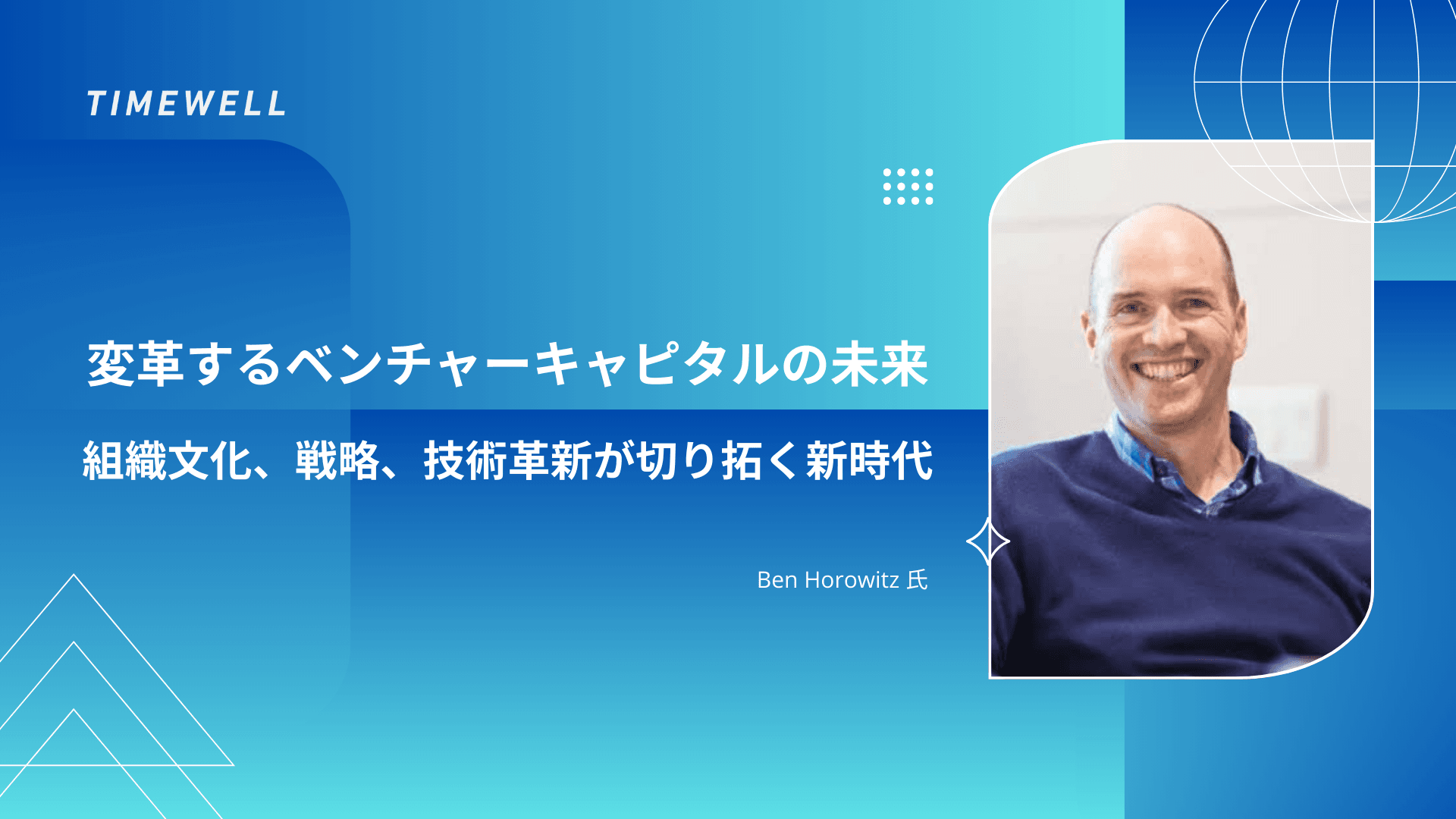
The world of venture capital goes far beyond simply providing capital
The world of venture capital goes far beyond simply providing capital — it is evolving in step with the times through corporate culture, leadership, and investment strategies with an eye on the market.
In recent years, there has been lively discussion in the industry about the wide gap between companies that "run for 10 years" and those that "run for 30 years" — rooted not just in investor acumen, but in organizational flexibility and the inheritance of culture.
On the a16z podcast, Ben Horowitz — American businessman, investor, blogger, and technology entrepreneur, co-founder of venture capital firm a16z alongside Marc Andreessen — shared in detail the secrets of companies that continue to grow across generations, and how to adapt to a shifting market environment while taking on next-generation technology: his strategies and ways of thinking.
This article, drawing on the discussion from the a16z podcast, comprehensively introduces management philosophy, organizational reform, and investment strategies for new technologies through rich episodes — covering content that serves as a hint not just for investors, but for entrepreneurs and all those who aspire to be the leaders of the future.
By understanding the challenges facing modern venture capital and their solutions, as well as the new trends in the tech industry and the background of strategic investment in AI, crypto, and web3, readers will gain insight into "how a balance has been maintained in a world where success and failure are separated by a hair's breadth." Investment decisions that look beyond capital management, passion for founder support, and flexible responses to changing regulations and markets — all of these fused together enable companies not just to win quickly in the short term, but to achieve sustainable growth into the future.
The Secret to Multi-Generational Success — The Evolution of Culture, Leadership, and Investment Strategy Taking On the Age of Transformation — The Future That New Technology, Regulation, and Global Strategy Open The VC Challenge of Building the Future — The Future of Technological Innovation and Market Strategy Conclusion
Taking on AI-driven work? You do not have to do it alone
WARP is a hands-on program for people who want to build with AI themselves, from training through implementation support.
The Secret to Multi-Generational Success — The Evolution of Culture, Leadership, and Investment Strategy
A question many investors grapple with is: "Why do some companies achieve success in a short period, while others continue to grow over decades?" The answer lies not simply in whether excellent investors are present, but in the corporate culture and the process by which leadership transitions smoothly — the key is hidden there.
For example, Sequoia Capital — a storied firm — has smoothly transferred leadership from founder Donald T. "Don" Valentine to successors like Michael Moritz, Doug Leone, and Jim Goetz, incorporating new ideas and strategies while maintaining the original culture. They do not simply inherit knowledge and experience — they treasure the culture, values, and vision for the future of the organization as a whole, and point the way forward for the next generation. It is precisely this fusion of tradition and innovation that enables companies to grow across generations.
Ben Horowitz, on the other hand, points out that "simply having a few excellent investors, without accompanying corporate culture, makes generational transition difficult." For example, even with an excellent investment track record in the early phases, if corporate culture is thin and the organization as a whole cannot make management decisions as one, there is a risk of being limited to success over a short period like ten years — obstructing further development. This way of thinking can be said to place great importance on a very human perspective: not just numbers and performance, but how to maintain and transform leadership, and how to pass on the founding spirit to the next generation.
Furthermore, in recent years a "product first" approach has been attracting attention in the investment industry. Sequoia Capital put forward the thinking that investors do not simply exist as a fund — rather, the products and services provided are the core, followed by the team. This achieves major support for invested entrepreneurs — not limited to capital provision, but in product growth and market launch, and in the cultivation of corporate culture as well. This approach is distinct from the "investor-led" model deployed by traditional investor groups, enabling more practical and flexible support for corporate growth.
New approaches to internal organizational governance are also cited as important points for companies taking on transformation. Traditional partnership organizational structures placed importance on equal economic share and control — but one VC adopted centralized control while sharing economic stakes, realizing rapid organizational decision-making and flexible organizational restructuring. This model has proven an effective means of continuously reorganizing into the optimal structure as the company grows from 50 to 500 people — rather than maintaining the status quo. The ability to rapidly and accurately restructure the organization in response to a changing market environment and the advancement of technology is an indispensable element for long-term corporate success.
Recruiting talented partners is also a key to VC success. Rather than the conventional recruiting strategy that only pursues high salaries and conditions, the people who are truly necessary to win in the fierce competition of the industry are those who empathize with the company's mission, are not afraid of challenge, and have the resolve to "overcome difficulties together." If the management team and partners have built a relationship of mutual trust and support no matter how difficult the situation, they can demonstrate strong resistance to market fluctuations and external influences as well. Moreover, these principles are not merely stated as ideals — they are embodied in practice by proven firms like Sequoia Capital and Andreessen Horowitz, underpinning their success.
Against this backdrop, companies that continue to grow across generations are seeking the optimal balance in every dimension — not just investment strategy, but management philosophy, the internal structure of the organization, and even the way the baton is passed to the next generation. Passion for the mission centered on entrepreneur support, and the talent development and organizational restructuring to realize it, directly connect to the company's survival and growth as a result. The fact that these efforts shape the modern VC industry offers great suggestions for the future business environment as well. How the fusion of new management models and traditional values opens the future — and how to actually realize that — will be greatly influenced by the future movements of companies.
Taking On the Age of Transformation — The Future That New Technology, Regulation, and Global Strategy Open
The present is an era of rapid advancement in technological innovation and intense volatility in regulatory and market environments. Venture capital is being forced, in this uncertain environment, to transform its investment strategies and business models beyond conventional constraints.
Traditional venture capital tended to focus on quantitative analysis based on investment judgment. But the recent market is large enough that it cannot be measured by fund scale or investment volume alone — diverse technological innovations are influencing the market. If you consider that the market size itself is not fixed, the potential arises beyond the conventional fixed idea of "15 companies growing to $10 billion" — new markets with the possibility of 150 companies or more are being born. In step with these market trends, investment funds are increasingly required to increase both the number of portfolio companies and the scale of capital. In this environment, a wide variation in the strategies adopted by each firm emerges — with strategy differences becoming visible in areas like how capital is used and the timing of investment.
Market expansion means not just an increase in the number of cases a single investment fund must handle, but the need for specialized expertise and networks by sector — with the boundary between the conventional "generalist type" and "specialist type" tending to become increasingly clear.
In this context, one VC cites the following important points:
- Setting up platforms by sector and concentrating investment in target markets through dedicated investment teams
- Supporting corporate growth from a long-term perspective that foresees the environment 10 years ahead, unswayed by macro-economic fluctuations
- Building a mechanism that continues to flexibly restructure the organization itself in line with the evolution of invested companies' technology and products
These measures function not as something to be buffeted by mere short-term market waves, but as guidelines for targeting genuinely long-term growth. Furthermore, investment in new technological fields like AI, crypto (cryptocurrency), and web3 has the potential to fundamentally transform the conventional investment framework. AI is expected to introduce the new concept of non-deterministic computation and bring groundbreaking solutions to problems that were previously difficult to solve. Crypto and web3, meanwhile, are creating decentralized ecosystems through the building of new networks and dialogue with regulators. These fields are deeply intertwined not just with technological evolution, but with global regulation and policy — making them extremely attractive as investment destinations, while also carrying risks.
With respect to crypto in particular, the casino-like aspect and opposition from some regulatory authorities as negative elements cannot be ignored. In reality, some cases demand the development of regulation and performance improvement — challenges that invested companies face. AI, on the other hand, has an extremely wide scope of application, and as the technology is beginning to mature, investors are successively finding new business opportunities as well. As a result, collaboration with technology-savvy specialists and researchers — not just "excellent investors" — is becoming important, making the urgency of rebuilding the VC's internal structure and network acute.
From a global perspective, America has distinguished itself as the center of technological innovation and entrepreneurial spirit — but there are also observations that its advantage is now wavering. In particular, cases where overseas companies are leading in certain areas due to regulatory impact can be seen, and cross-border collaboration is becoming increasingly indispensable for VCs to achieve sustainable growth regardless of location. In this situation, not just invested companies but investors themselves need to constantly be aware of global market trends while flexibly changing strategy. With rapid response to economic conditions and market needs being demanded, VC players must build a structure to support innovative products without wavering in their own investment philosophy.
Furthermore, the VC's posture is rooted not merely in profit pursuit, but in a high sense of mission to create value for entrepreneurs and for society as a whole. A posture of not being biased toward economic indicators and investment returns, but continuing to provide long-term and sincere support as a partner to help entrepreneurs realize their dreams — this brings a sense of reassurance and trust to many investors and entrepreneurs. This is precisely what allows a VC to be not just a capital supplier, but a truly central presence that leads the entire tech industry and builds an innovative future.
The VC Challenge of Building the Future — The Future of Technological Innovation and Market Strategy
The current market environment is filled with unprecedented volatility and uncertainty. With political backgrounds, regulatory changes, and the pace of technological innovation accelerating rapidly, the investment industry is being forced to seek management strategies under a harsh environment. In contrast to the optimistic era of the past, today's VCs must sometimes face difficult political discussions and regulatory constraints while still making investment judgments with a long-term view of the future.
For example, in today's dark economic environment, sudden changes in legal regulations in specific technology fields have been seen to seriously impact corporate growth. One VC player, regarding the crypto field, has warned of challenges like "casino-like aspects" and "immature performance" — and that opacity in domestic and international regulation threatens to have a negative impact on the market as a whole. This reality suggests that investors and entrepreneurs need to build foundations for realizing sustainable long-term growth, rather than simply pursuing short-term returns.
Technological evolution and market strategy fluctuations also frequently run counter to conventional investor common sense. There was a time when a method of pursuing a small number of success stories in a short period, based on strict investment criteria, worked. But today, new waves of the era continuously arrive — the rapid penetration of AI in the market, the realistic application potential of Web3's decentralized technology. Industry pioneers emphasize the importance of approaching these transformations not just with caution, but with "smart boldness." Rather than being swayed by external factors like macro-economic conditions and regulatory environments, the approach adopted is to always push technological innovation to the front lines — making investment judgments from a long-term perspective, looking toward an exit strategy for 2033 and beyond.
From the VC's perspective, macro-economic uncertainty is treated as an event that is not easily predictable. Accurately predicting the economic situation several years or ten years ahead is impossible — and therefore a long-term perspective of "investing on the premise of an exit strategy looking ten years ahead" is emphasized. For example, Ben Horowitz speaks of looking ahead to how the companies he currently invests in will be evaluated by society in 2033 — maintaining a posture not swayed by short-term market movements. This way of thinking is distinct from conventional hedge funds and investors conducting short-term market analysis — becoming a new paradigm that prioritizes the intrinsic value of companies.
The way of providing support to entrepreneurs and invested companies has also changed — going beyond the rigid conventional methodology of "focusing only on winners," to a commitment to riding alongside them even in failure. Ben Horowitz emphasizes: "Because I myself have experienced crises firsthand, when a company is in difficulty, the presence of someone to talk with is necessary" — placing the relationship of trust with portfolio companies above everything. Such partnerships not only become a strong support base for companies to make a comeback in difficult times, but can also be said to be an indispensable element for protecting the VC's own brand and competitive advantage.
Furthermore, in recent years the venture capital industry has been entering a major turning point in terms of internal controls and governance as well. The conventional equal share and decision-making process had faced the challenge of obstructing flexible leadership transition as the organization grew. However, one advanced VC has introduced centralized control, building a mechanism that improves organizational efficiency while realizing rapid structural reform when necessary. This eliminates unnecessary politics within the organization and builds a structure that focuses purely on improving corporate value and realizing innovation.
Currently, general views on the tech industry are often colored by politics — with negative assessments and excessive criticism flying, the original possibilities and convenience that technology holds tend to be overlooked. Ben Horowitz, comparing the transformation brought by the web movement and innovative social networks of the past with the changes in the tech industry now demanded through regulation and political response, deliberately takes the position of an optimist. In reality, without technological progress, confronting the extremely serious social problems of modern pandemic response and climate change would not have been possible. Therefore, directly facing the harsh realities of the present while thinking about how to fuse technology and policy for the future — and lead to sustainable growth — has become an unavoidable theme for modern VCs.
In the market going forward, VCs need not just to provide capital through investment, but to build management models that evolve alongside technological innovation and build structures that can respond flexibly to global regulation and economic conditions. How to maintain resilience — elasticity and recovery — in difficult situations, and how to reconfirm the relationship of trust with companies and partners while advancing — this is precisely the most difficult yet most meaningful challenge that future VCs must take on.
Conclusion
In this article, we explained in detail how modern venture capital is responding to the changes of the times — reconstructing corporate culture, leadership, and investment strategy — through specific cases and strategies. Companies that succeed across generations have continued to realize challenges in technological innovation and new markets under leadership adapted to the times while inheriting tradition — cases that offer great guidance for the future economic society. The posture of not being swayed by short-term market fluctuations and taking a long-term approach to entrepreneur support and technological development can be said to be the best strategy for ensuring future success.
Furthermore, the transformation brought by new technologies like AI and Web3 contains the potential to generate innovative value beyond existing frameworks — and the entire industry will evolve along with it. To ride the waves of technological innovation, VCs need to incorporate multi-asset strategies and a global perspective, building structures that can flexibly respond to regulatory and political challenges.
In this way, the venture capital industry is constantly using both corporate culture and technology strategy to pioneer the future in order to overcome "change." For entrepreneurs, investors, and everyone who aspires to the tech industry, the cases and thinking introduced here will serve as guidance toward the future. Facing challenge and innovation — and sometimes the harsh realities — while continuing to believe in the possibilities of the future is what brings true growth to the entire industry.
Going forward, we hope this serves as a hint for building a sustainable future together — continuing to pay attention to the movements of venture capital that drives technological innovation and market transformation.
Reference: https://www.youtube.com/watch?v=njfAB-oyNfY
TIMEWELL's AI Consulting
TIMEWELL is a professional team supporting business transformation in the AI agent era.
Services Offered
- AI Agent Implementation Support: Business automation leveraging GPT-5.2, Claude Opus 4.5, and Gemini 3
- GEO Strategy Consulting: Content marketing strategy for the AI search era
- DX Advancement & New Business Development: Business model transformation through AI
In 2026, AI is shifting from "something you use" to "something you work with." Shall we think through your company's AI strategy together?