In today's turbulent era, those who challenge without fear of change
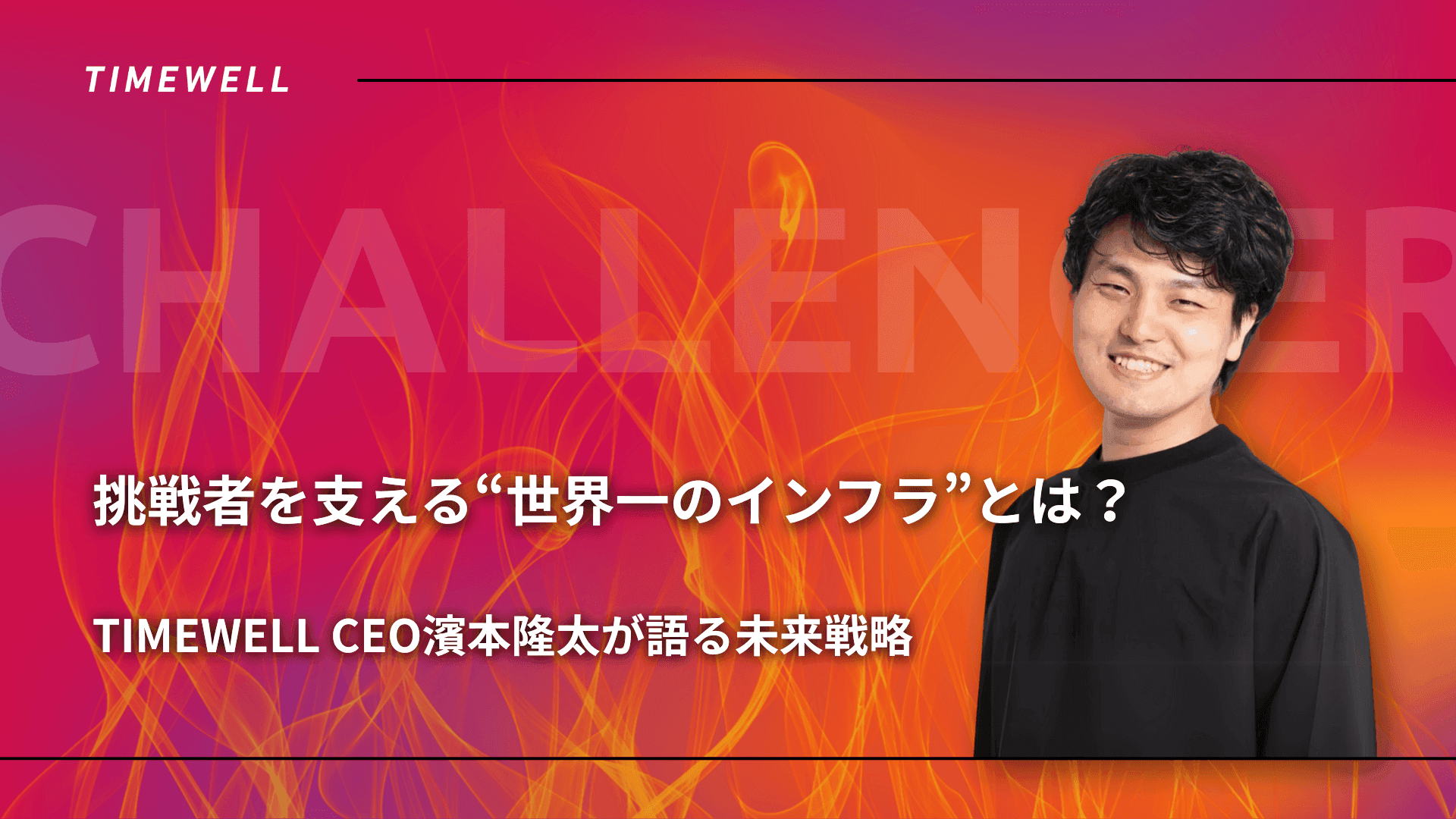
In today's turbulent era, the people and companies who challenge without fear of change have become a powerful driving force that opens the future. Ryuta Hamamoto, co-founder and CEO of TIMEWELL, is working to build an "infrastructure" that supports challengers, drawing on his own experiences and beliefs. Hamamoto pours his passion into a wide range of fields — traditional crafts, AI, education — and continues taking on new challenges every day to realize his dreams and vision. His goal is to build a support system that encourages challengers and create the "world's number one challenge infrastructure." The passionate conviction running through this entire article is this: that young people, executives, and students alike should be provided with an environment in which they can keep challenging without fear — and feel the future that spreads beyond.
Hamamoto also wears the hat of a university instructor, working to put AI education into practice on an individual level and provide new support services through super agents. His activities, through numerous events and projects, have already been pushing the backs of many challengers. This article gets close to the vision of challenge support that Hamamoto draws, the full picture of his concrete initiatives, and the origin of his own "challenger's spirit" that underlies it all — delivering empathy and courage to readers.
Aiming to Be World Number One — Ryuta Hamamoto's Vision and Origins From AI Education to Global Talent Development — The New Shape of Challenge Support That TIMEWELL Creates The Power That "I'm Cheering for You" Generates — Ryuta Hamamoto's Journey and a Message to Challengers Making Challenge a Culture — The Future Standard That TIMEWELL Points Toward
Taking on AI-driven work? You do not have to do it alone
WARP is a hands-on program for people who want to build with AI themselves, from training through implementation support.
Aiming to Be World Number One — Ryuta Hamamoto's Vision and Origins
The spirit embedded in TIMEWELL's vision goes far beyond a mere corporate goal. Ryuta Hamamoto, having overcome the fears and conflicts he felt since childhood, holds the dream of building an "infrastructure" that supports many challengers. The vision he describes is not about simply providing powerful systems and tools — it is about creating an environment that walks alongside individuals and companies in their challenge journey and pushes them forward. Concretely, this includes tools and training programs as products, and the sharing of know-how put into practice in business settings and education.
Looking back on his career, Hamamoto speaks of how the support he received from many seniors and mentors in the past became the nourishment for him to provide it himself next. Being able to keep challenging was because many people made him feel that they were "cheering for him" — and he burns with passion to be in that position himself. The "world's number one challenge infrastructure" that Hamamoto holds up is precisely the realization of a system in which when challengers speak of their dreams, they are not laughed at — where people support each other and grow together.
Hamamoto also holds the position of university instructor, witnessing the evolution of AI education firsthand. In that role as well, he is searching for the new possibilities that AI-powered education offers.
From his experience as a backpacker traveling overseas in his 20s, Hamamoto encountered diverse cultures and the spirit of challenge. Having been exposed to the vibrant challengers of Southeast Asia, he emphasizes the importance of a challenging mindset — contrasting it with the conservative tendencies of Japanese society and traditional organizations. In a Japan where speaking about dreams invites ridicule and a defensive tendency is visible, his words — that cultivating a culture that supports challengers is an urgent task — are precisely the message needed in this era.
Hamamoto himself has overcome the anxiety and fear of standing on the field of challenge. As a young child, even a 15-centimeter step felt frightening, and he cried his eyes out at swimming school — he shares this episode as a major turning point in his own growth. Such episodes will resonate from the heart with the many people who feel anxiety and uncertainty about new challenges. He reflects that, having overcome the fear of that time, he has since expanded his own limits — supported by a swimming coach, respected seniors, and mentors.
This vision is being brought to reality based on a concrete action plan rather than mere fantasy. For example, the "super agent" product in recent development is a system that supports challengers through voice and text, automatically handling many tasks. This makes it easier for challengers to break down tasks and build execution plans, while also significantly improving day-to-day business efficiency. What Hamamoto emphasizes is not simply providing tools — it is creating "the moment when a challenger's eyes change." For that reason, he also has high hopes for promoting the building of a community in which challengers believe in their own possibilities and support each other.
In this way, Hamamoto's dreams and vision go beyond mere technological innovation — they ignite the very hearts of the people who challenge. The future he envisions is a world in which the environment is in place for everyone to believe in their own power, take new steps without fear of failure — a force that allows all people to notice their own possibilities and advance toward their dreams.
From AI Education to Global Talent Development — The New Shape of Challenge Support That TIMEWELL Creates
The activities that TIMEWELL pursues are composed of multifaceted initiatives for supporting challenge. Ryuta Hamamoto — playing the dual roles of entrepreneur and university instructor — pours effort into a wide range of projects: supporting the growth of local small and medium-sized enterprises, innovating AI education, and cultivating entrepreneurs who can compete globally. These initiatives materialize into concrete and practical support to help challengers overcome the various walls they face.
First, regarding challenger support through the hosting of events and seminars — Hamamoto states that he has a track record of nearly 2,000 events. These events are not just about providing information — they are precious opportunities for participants to meet and stimulate each other. Many participants have taken concrete first steps in challenge after an event, growing while sharing ideas with each other. These initiatives go beyond mere networking — they are positioned as practical programs for promoting talent development and business growth.
Hamamoto has also systematized know-how for application development using generative AI through his WARP program — building an environment in which even beginners can complete services and products in a short time. This program is arguably Japan's first systematic offering of its kind, and over 150 challengers have already begun to see its results. Going forward, plans are advancing to dramatically increase the number of challengers — with targets of 200, then 300.
TIMEWELL also focuses on AI utilization within companies, deploying programs that allow management and leaders to leverage AI to improve operational efficiency and maximize potential. Concretely, a mechanism has been built to teach correct AI usage and practical skills through in-company training and certification courses, supporting efforts toward operational efficiency improvements. This is expected to lead advanced technologies and methods — previously limited to large corporations — to spread to small and medium-sized enterprises as well.
Among TIMEWELL's initiatives, what is most treasured is "drawing out human potential." Hamamoto firmly believes that the latent capabilities of challengers are the driving force that enriches society. To that end, he emphasizes the following elements.
- Building a support system that maximally liberates each challenger's individual power
(This support system is the core of the challenge infrastructure that TIMEWELL provides.)
Furthermore, TIMEWELL does not stop at merely providing tools and programs — it also puts energy into forming support networks so that challengers can take independent action toward their own goals. For example, consulting that supports new initiatives within companies, and support projects for traditional regional companies to introduce the latest technology — practical work in the field is carried out daily. Through collaboration with universities, real-world case studies and practical instruction are also provided to students and young executives, so they can take on challenges from a global perspective appropriate to the era.
TIMEWELL also recognizes the importance of incorporating a global perspective. Hamamoto speaks of how behind the global market success of Japanese companies like Sony, Honda, and Toyota lies a challenge that looked to the world. Against this, he says that the urgent task is to cultivate entrepreneurs (global entrepreneurs) who challenge globally from the start rather than staying confined to the domestic market — creating a venue for challengers to compete and sharpen each other through collaboration with Musashino University's Faculty of Entrepreneurship and similar institutions. These initiatives are not just measures for the domestic market — they aim to cultivate management and technological capability that can compete worldwide, and are expected to eventually become a source of Japan-born innovation.
Among TIMEWELL's products, significant effort is also being put into super agent development. This system is designed as a groundbreaking mechanism that supports challengers' operations — from automatic task breakdown to efficient information dissemination to individual follow-up. It is firmly believed that as many small and medium-sized enterprises and new projects adopt this tool, operations that were previously labor-intensive will be dramatically streamlined and lead to real results. The super agent is inspired by advanced technology attracting attention in Silicon Valley — and as Japan's first systematized service, it has already brought good news to the market. The provision of these products is the very embodiment of the "challenge infrastructure" that TIMEWELL aims for — a powerful weapon that allows challengers to freely tackle new ideas and projects and lead them to success.
Furthermore, TIMEWELL puts energy into support for regional enterprises and up-and-coming startups — building a practical and flexible support model distinct from the conventional approach targeted at large corporations. Projects are being promoted to cultivate a culture of challenge across the entire regional community, working together with universities and public institutions as a gateway for companies that preserve tradition to adopt the latest technology, and as a means to improve corporate management efficiency. That should function as an "infrastructure" for companies and individuals to realize new ideas without fearing challenge, activating society as a whole.
In this way, the challenge support initiatives that TIMEWELL is working to realize are heading toward building an ecosystem for drawing out each participant's power and growing together. These practical projects have produced many success stories as effective support measures for challengers to overcome the various hurdles they face. Overall, Hamamoto feels it is his mission to leverage his rich experience and broad perspective to deliver unstinting support to future challengers. His efforts are not just about pursuing technological innovation — they are about igniting the hearts of those who challenge and creating the moment when their eyes change. That is what is becoming the most valuable culture in modern society.
The Power That "I'm Cheering for You" Generates — Ryuta Hamamoto's Journey and a Message to Challengers
The future of challenge that Ryuta Hamamoto draws is deeply rooted in his own experiences from childhood and the trajectory of overcoming numerous trials. Drawing on experiences from childhood, he has honed through many challenges the posture of "action comes first, thinking follows."
Hamamoto turned the fears and anxieties of childhood into nourishment for his own growth — experienced countless failures and successes — and ultimately acquired the spirit of "challenging new things without fear." He says that even when he cried during swimming practice as a child, he was greatly encouraged by a trusted coach's words — "I'm cheering for you" — or by the warm relationships with parents, seniors, and friends that became a major factor in overcoming his fear.
As he grew as an entrepreneur, Hamamoto has spared no support for overcoming fear and failure in corporate management either, always sending warm cheers to colleagues, employees, and partners. What he aims for is the experience of each person surpassing their own limits and sharing the moment when their eyes change. Creating an environment in which companies and individuals influence and grow from each other in the midst of challenge is, for him, the most important mission — and at the same time, its origin.
Hamamoto also provides practical approaches for breaking free from fear and anxiety through his own practice. He emphasizes the importance of taking that first step, encouraging many challengers to have the posture of "trying to take action first." Within that, the reality of individual challengers discovering their own possibilities and successively taking on new challenges without fear of failure is at the core of the programs he supports. The diverse initiatives — AI education at universities, corporate training programs, and global entrepreneur development projects — are all directly connected to the realization of this philosophy: "action calls thinking and expands possibilities."
Among the episodes Hamamoto shares are not just childhood experiences, but many warm stories — exchanges with his father and friends at a camping club, talks about management shared around a bonfire at night as an entrepreneur. These episodes are not merely personal success stories — they speak to the importance of supporting each other, lifelong passion for challenge, and the spirit of empathy and solidarity for opening the future. Hamamoto speaks powerfully of continuing to create environments that allow challengers to maximize their latent potential — drawing on his own experience — and that passion has become a major message to the next generation of entrepreneurs and leaders.
Furthermore, he faces frankly the conventional challenges and the conservative tendencies of society as well within this challenge support work. Feeling acutely the current state of affairs — a culture where speaking about dreams invites ridicule, a tendency to put down those who challenge, and as a result a low absolute number of challengers — he shows the resolve to turn even such negative evaluations and criticism into nourishment for future reform. Hamamoto's message becomes not just warm energy for all those who challenge, going beyond mere technological innovation and management theory — and his activities will continue to have a major ripple effect on Japanese society and the wider world going forward.
Making Challenge a Culture — The Future Standard That TIMEWELL Points Toward
Ryuta Hamamoto of TIMEWELL — against the backdrop of his own rich experience and the trajectory of overcoming numerous trials — is developing initiatives in education, corporate support, and with a global perspective, to create the "world's number one challenge infrastructure." The concrete programs for supporting challengers — the WARP generative AI application development program, AI utilization training for managers, global entrepreneur development projects — these are all designed so that challengers can experience the moment when their own "eyes change." Drawing on childhood experiences, he holds the conviction that "action comes first, thinking follows" — and based on that experience, works thoroughly to establish a support system for challenging new things without fear of failure.
Hamamoto also speaks frankly about the negative sides — the tendency to be laughed at for speaking of dreams, the negative evaluations that challengers face — and argues that the power of warm encouragement to overcome these is above all else important. The words "I'm cheering for you" that he advocates are not pressure — they are a magical existence that gives challengers energy and confidence. And that practice is becoming a new standard of challenger support in modern society, resonating widely with many.
Overall, Ryuta Hamamoto's vision is to build a solid infrastructure for challengers to believe in their own possibilities and move forward without fear. His initiatives — from educational settings to corporate management and even on the international stage — are gathering wide support and expectation, and will be a major message toward the future of Japan and the world as a whole. Through this article, we hope readers will also re-recognize the courage to challenge and the importance of the precious bond of supporting each other. The road of challenge is never smooth — but by walking together and cheering each other on, everyone can gain the power to soar toward the future.
Reference: https://www.youtube.com/watch?v=Or8lbMkD1e0
Streamline Event Management with AI | TIMEWELL Base
Are you struggling with managing large-scale events?
TIMEWELL Base is an AI-powered event management platform.
Track Record
- Adventure World: Managed Dream Day with 4,272 participants
- TechGALA 2026: Centrally managed 110 side events
Key Features
| Feature | Effect |
|---|---|
| AI Page Generation | Event page complete in 30 seconds |
| Low-cost payments | 4.8% fee (among the lowest in the industry) |
| Community features | 65% continue engaging after the event |
For more about streamlining event management, please feel free to reach out.