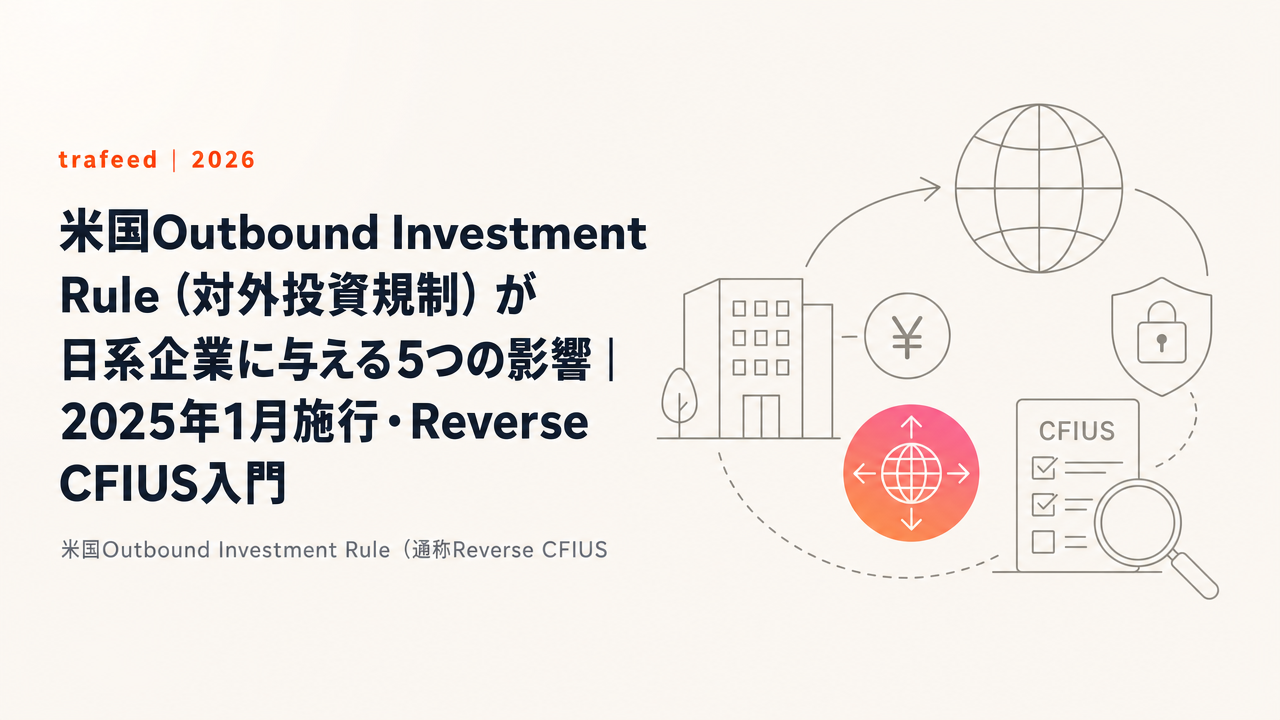
Hello, this is Ryuta Hamamoto from TIMEWELL. Corporate strategy and M&A teams keep asking the same question: “We don’t export to the U.S., but our U.S. subsidiary invested in a Chinese startup — is that regulated?” Many people mix this with export control. It is a different layer: the Outbound Investment Rule. I am writing for readers who already know FEFTA and the EAR, but have not lived with outbound investment controls. I walk the January 2025 effective date and the December 2025 COINS Act codification through five Japanese impact paths.
What you will learn
- Outbound Investment Rule (“Reverse CFIUS”) is a capital-flow regime, separate from export controls
- What is prohibited vs notifiable in semiconductors, quantum, and AI
- What AI compute thresholds (10^23 / 10^24 / 10^25 FLOPs) mean for frontier models
- Five patterns that catch Japanese groups
- Penalties (civil $377,700 / criminal up to 20 years) and enforcement mode from May 2025
- COINS Act (18 Dec 2025) expanding covered countries to China + five
Three terms first
| Term | Plain meaning |
|---|---|
| Outbound Investment Rule | Treasury’s outbound investment program — formally 31 CFR Part 850. Restricts U.S. persons’ investments into China/HK/Macau semiconductors, quantum, and AI via prohibition or notification. |
| Reverse CFIUS | Industry nickname: traditional CFIUS reviews foreign→U.S. investment; this regime reviews U.S.→foreign capital. Not a statutory term. |
| U.S. person | U.S. citizens and permanent residents, plus entities organized under U.S. law and their branches, and persons physically in the U.S. Japanese parents’ U.S. subsidiaries are U.S. persons. |
Point three is decisive. Even if Japan HQ is not a U.S. person, investments routed through a U.S. subsidiary are in scope.
Checkpoint: The rule stops U.S. capital from funding certain advanced technologies in countries of concern. Japan HQ alone may be out. U.S. subsidiaries, U.S. citizen officers, and U.S. VC routes still matter.
What is prohibited vs notifiable
Program summary
| Item | Content |
|---|---|
| Formal name | Provisions Pertaining to U.S. Investments in Certain National Security Technologies and Products in Countries of Concern (31 CFR Part 850) |
| Nicknames | Outbound Investment Security Program (OISP) / Reverse CFIUS |
| Authority | Treasury Office of Investment Security (OIS) |
| EO basis | Executive Order 14105 (9 Aug 2023) |
| Final rule | 28 Oct 2024 |
| Effective date | 2 January 2025 |
| Countries (initial rule) | PRC, Hong Kong, Macau |
| Technologies | Semiconductors/microelectronics; quantum information; AI |
| Mode | ① Prohibited ② Notifiable (within 30 days after completion) |
Export control vs outbound investment
| Point | Export control (EAR / FEFTA) | Outbound Investment Rule |
|---|---|---|
| Object | Cross-border transfer of goods, tech, software | Overseas transfer of U.S. capital |
| Entry point | ECCN / end user | Target industry (semicon, quantum, AI) + country |
| Typical owners | Export control, engineering, logistics | Strategy, M&A, CVC, finance |
| Who is hit | The shipper | The investor |
A perfect export-control program does not filter investments. If M&A, CVC, and LP approvals bypass export control, you already have a gap.
Three technology fields
1. Semiconductors / microelectronics
| Tier | Covered activity (summary) |
|---|---|
| Prohibited | Advanced equipment (e.g., EUV) development/manufacture; advanced IC design/manufacture/packaging; supercomputer design/manufacture |
| Notifiable | Other IC design/manufacture/packaging not in the prohibited tier |
2. Quantum information technology
| Tier | Covered activity |
|---|---|
| Prohibited only | Quantum computers and critical components; certain quantum sensing/platforms; quantum networks/communications |
| Notifiable | (none — quantum is prohibit-only where covered) |
3. AI — see next section.
Checkpoint: Prohibited means do not do it. Notifiable means complete the deal, then notify Treasury within 30 days. Quantum is prohibit-only where covered; semiconductors and AI are two-tier.
Replace siloed classification work with AI.
METI's FY2024 data shows 52% of foreign exchange law violations stem from classification errors. Download the TRAFEED product catalog covering features and rollout.
AI FLOPs thresholds (10^23 / 10^24 / 10^25)
Compute-based
| Threshold (training operations) | Tier | Image |
|---|---|---|
| Above 10^25 (general data) | Prohibited | Frontier-class large models |
| Above 10^24 (primarily biological sequence data) | Prohibited | Large bio/pharma AI |
| Above 10^23 | Notifiable | Large research models; practical LLMs can sit here |
10^23 is lower than many people expect. Mid-size AI shops routinely exceed it. “We’re not frontier” does not mean “not notifiable.”
End-use based (compute-independent)
Also prohibited when designed exclusively or intentionally for military, government intelligence, or mass surveillance. Certain cybersecurity-offensive, robotics-control, digital surveillance/behavioral analysis, facial recognition, and location-tracking end uses can be notifiable regardless of compute.
vs EU AI Act
EU AI Act “systemic risk” often references 10^25 FLOPs — close to OISP’s prohibit line. OISP’s notify line at 10^23 is broader.
What counts as a covered transaction
Broader than “buying shares”:
- Equity (including convertibles / warrants)
- Debt with equity-like features (governance or profit participation)
- Greenfield / brownfield investments for covered activities in countries of concern
- JVs with persons of countries of concern for covered activities (even if sited in a third country)
- LP investments where a U.S. person knows or should know the fund will invest in a covered foreign person
Geography alone does not save you. Who invests in whom is the test.
Quick decision flow
| Step | Question | If No |
|---|---|---|
| ① | Is the investor a U.S. person? | Generally out of OISP |
| ② | Does the target have PRC/HK/Macau base or control ties? | Generally out |
| ③ | Does the target engage in covered semicon/quantum/AI activity? | Generally out |
| ④ | Is the deal an excepted transaction (public equity, small LP, etc.)? | If yes, exception analysis |
All of ①–③ Yes and ④ No → formal prohibit/notify analysis. Legal review before concluding “No.”
Knowledge standard
Knowledge includes actual knowledge, awareness of a high probability, and reason to know. “We didn’t ask” fails without reasonable and diligent inquiry. DD records protect you.
Five patterns that catch Japanese companies
Pattern 1: Japan HQ → U.S. subsidiary → China investment
The cleanest hit. U.S. subsidiaries are U.S. persons. Controlled foreign entities under a U.S. subsidiary (for example, Singapore or Hong Kong holdcos investing into China) still require the U.S. person to take reasonable steps. Map group capital flows for U.S. origin points before the next board pack.
Pattern 2: Japanese LP into U.S. VC that invests in China AI
U.S. GP/managers are directly covered. Japanese LPs are not U.S. persons by default, but:
- A Japanese group’s U.S. subsidiary as LP is covered
- LP investments ≤ $2M or with certain binding contractual assurances may be excepted under the rule’s LP framework
- Side letters on OISP representations and opt-outs are becoming market standard
Pattern 3: U.S.–Japan JV for China business
If the U.S. partner is a U.S. person and the JV does covered activity, U.S. capital is a covered transaction. Japan side may not be directly regulated, but JV governance and funding redesign if the U.S. partner cannot continue.
Pattern 4: M&A where the target has China tech subsidiaries
When a Japanese group’s U.S. subsidiary is the buyer, DD must test whether the target is a covered foreign person, including revenue, profit, and expense contribution from China subs doing covered activity.
| DD item | Check |
|---|---|
| ① China sub/affiliate inventory | 100% subs, JVs, minority stakes, captive centers |
| ② Business per China site | Covered activity yes/no site-by-site |
| ③ China-sub share of group economics | Revenue/profit/expense vs rule thresholds |
| ④ Covered foreign person conclusion | On ②+③ |
| ⑤ Deal design if “yes” | Carve-out, restructure buyer entity, or walk away |
If China economics are not disclosed early, you miss sign timing. Switching the buyer from a U.S. subsidiary to a non-U.S. entity may need 2–4 weeks of legal lead time.
Pattern 5: U.S. citizen officers / decisions taken in the U.S.
“Directing” prohibitions can reach U.S. citizen officers who direct China investments even under a Japanese parent name, and can reach HQ directing a U.S. subsidiary into prohibited deals. Inventory U.S. citizen board history and investment-committee locations. I keep hearing the same surprise when groups discover an IC that meets in California twice a year.
Checkpoint: Five paths — U.S. sub, U.S. VC LP, U.S.–Japan JV, U.S.-buyer M&A, U.S. citizen officers or U.S. decisions. Cross-cut M&A, CVC, JV, and HR.
Penalties and enforcement
IEEPA §206 track:
| Type | Content |
|---|---|
| Civil | $377,700 (2025 inflation-adjusted) or 2× transaction value, whichever greater |
| Criminal (willful) | Up to $1M and 20 years per individual |
| Other | Treasury may nullify, void, or order divestment of prohibited transactions |
| Statute of limitations | 10 years under IEEPA |
Two times value is the scary number. A ¥10 billion prohibited investment implies theoretical ¥20 billion exposure.
Enforcement mode from May 2025
About six months after the final rule, Treasury began outreach resembling non-notified inquiries. The “rules on paper, soft in practice” phase is over.
Five practical steps (priority and effort)
| Step | Content | Priority | Effort | Owner |
|---|---|---|---|---|
| 1 | Inventory U.S. touchpoints | Highest | 1–2 weeks | Strategy / legal |
| 2 | Map China-bound investment pipeline | High | 1–2 months | Strategy / CVC / finance |
| 3 | Add OISP reps & covenants to M&A/investment docs | High | ~1 month legal | Legal / M&A |
| 4 | Document knowledge-standard DD | Medium | 1–2 months | Legal / export control |
| 5 | Self-disclosure playbook for suspected breaches | Medium | 2–3 weeks | Legal / executive |
Do Step 1 before Step 2, or scope thrash follows.
Step 1 — U.S. touchpoints
- U.S. subs/branches/rep offices?
- U.S. citizen/permanent-resident officers (including past)?
- Investment committees or boards held in the U.S.?
- LP positions in U.S. VCs?
- U.S. bank accounts / fund admins?
Any yes → OISP analysis needed.
Step 2 — China/HK/Macau investment map
- Last five years of equity, JV, M&A, LP
- Live pipeline
- For each: U.S. touchpoint + covered tech flags
Ownership-chain tools can cut months of manual work to days.
Step 3 — Contract architecture
- Reps that the target is not a covered foreign person
- Walk-away / buyback if status changes
- Notice duties on business-model shifts
- Audit and information rights
Retrofit is hard; fix new deals at term sheet.
Step 4 — Knowledge-standard DD procedure
Always document:
- Target business (semicon/quantum/AI flags)
- China subs/affiliates and economic share
- AI compute/end-use where relevant
- Military/government customer share
Records support a later “we inquired diligently” defense.
Step 5 — Self-disclosure playbook
- Immediate legal/executive path
- Outside counsel protocol
- Treasury self-disclosure criteria
- Legal hold of records
Self-disclosure can mitigate. Having a ready answer to “can we disclose if found?” is reputation insurance.
See group risk in seconds
If M&A, CVC, JV, and LP books have not been OISP-tested, try TRAFEED on ownership chains for targets, JV partners, and fund portfolios. It runs a 200M+ knowledge graph of papers, patents, researchers, corporations, and restricted lists, on AWS Tokyo Region.
FAQ
Q1. Is Japan HQ really out?
Formally, Japan HQ alone is not a U.S. person. Any of (1) U.S. subsidiaries, (2) U.S. citizen officers, (3) decisions in the U.S., (4) U.S. VC/fund LPs, (5) U.S. bank rails can pull you into analysis.
Q2. If export control does not apply, is OISP irrelevant?
No — different layer. Pure equity, JV formation, and LP capital often escape export control but sit at the center of OISP. Brief strategy/finance/CVC, not only export control.
Q3. How is this different from CFIUS?
CFIUS = foreign→U.S. (inbound). OISP = U.S.→China covered tech (outbound). Hence “Reverse CFIUS.”
Q4. Does notification make a deal free to close?
Notifiable deals can close; you must file within 30 days of completion. False or late filings are punishable. Prohibited deals cannot be cured by notification.
Q5. Does every Japanese company with a China sub become a covered foreign person?
No. Need covered activity in the China sub and substantial revenue/profit/expense contribution under rule thresholds. Not “China sub = automatic yes.”
Q6. Do pre-2 January 2025 investments retroact?
Generally no. Deals completed after the effective date are in. Follow-on capital calls and conversion rights can be new covered transactions.
Q7. After COINS Act (Dec 2025), which countries?
Statute signed 18 December 2025 expands covered countries to add Cuba, Iran, North Korea, Russia, and Maduro Venezuela alongside China/HK/Macau. New implementing rules are due by 13 March 2027; until then 31 CFR Part 850 continues. See also our COINS Act deep dive.
Q8. Will Japan create a mirror regime?
As of May 2026, no Japanese outbound investment control twin. G7 Hiroshima language noted outbound measures; domestic debate remains limited. Watch the space.
Latest developments as of July 2026
Japan still has no outbound twin. Inbound screening moved fast: amended FEFTA promulgated 5 June 2026; JFIC launched 29 June 2026 (MOF inbound FDI, June 2026). Direction is opposite OISP, but investment review as an economic-security tool is settling in Japan too. Japan–India semiconductor and critical-minerals cooperation also advanced (Japan–India Summit 2026). The weight of the five-path check only grows.
If you want to tighten export-control operations or classification efficiency, review the TRAFEED service catalog (PDF) or contact us.
Key takeaways
If you only remember the operating map:
- Outbound Investment Rule (Reverse CFIUS / 31 CFR Part 850) restricts U.S. capital into China, HK, and Macau semiconductors, quantum, and AI via prohibit or notify
- Effective 2 January 2025 for transactions completed on or after that date
- Japan HQ alone is not a U.S. person, but five paths bite: U.S. sub, U.S. VC LP, U.S.–Japan JV, U.S.-buyer M&A, U.S. citizen officers or U.S. decisions
- Penalties: civil $377,700 or 2× value; criminal up to $1M and 20 years. Enforcement mode from May 2025
- AI thresholds: 10^25 prohibit, 10^24 bio prohibit, 10^23 notify, plus end-use tests
- COINS Act (18 Dec 2025) moves the program toward permanence and broader countries
Related reading
- BIS Affiliates Rule (50% rule) complete guide
- Japan CFIUS proposal 2026
- MATCH Act and Japan impact
- Deemed export risk guide
If you need ownership-chain visibility
Entity List screening alone is not enough for outbound investment. You have to walk investment targets, JV partners, and LP fund portfolios for covered foreign person status, across M&A, CVC, strategy, and finance.
TRAFEED visualizes ownership chains, covered-tech activity signals, and China-sub economics in seconds, and tracks the COINS Act expansion path (China plus five countries). It runs on AWS Tokyo Region for sensitive data.
References
Primary (U.S. government)
- Treasury OISP portal
- Treasury OISP FAQ
- 31 CFR Part 850 (eCFR)
- Final rule PDF
- Penalty inflation notice (29 Jan 2025)
- CRS IF12629
Japan-side
- CISTEC Q&A-style note on Trump Administration China export/investment controls (22 Apr 2025)
- JETRO U.S. FDI reports
Law-firm analyses
- Davis Polk; Skadden (COINS Act); Cooley (May 2025 enforcement); Sidley; Clifford Chance; Latham & Watkins; Dechert (COINS expansion)

![ECCN Number List and Cheat Sheet [2026 Edition]: Categories 0-9 x Groups A-E, Frequent Numbers, and How They Map to Japan's Export Control Items](/images/columns/eccn-number-list-cheatsheet-2026/cover.en.png)