Enterprise AI Cost Optimization: A Deployment and Operations Strategy to Maximize ROI
"We adopted AI, but the impact never became visible, and only the monthly invoice keeps arriving." That is the single most common thing we hear from companies about six months after deployment. No one can tell who is using what or how much, it never takes root on the front line, and the folder of proofs of concept just keeps growing. In manufacturing, it is not unusual to still spend 30 minutes hunting for a drawing every time, and to prepare every quote entirely by hand.
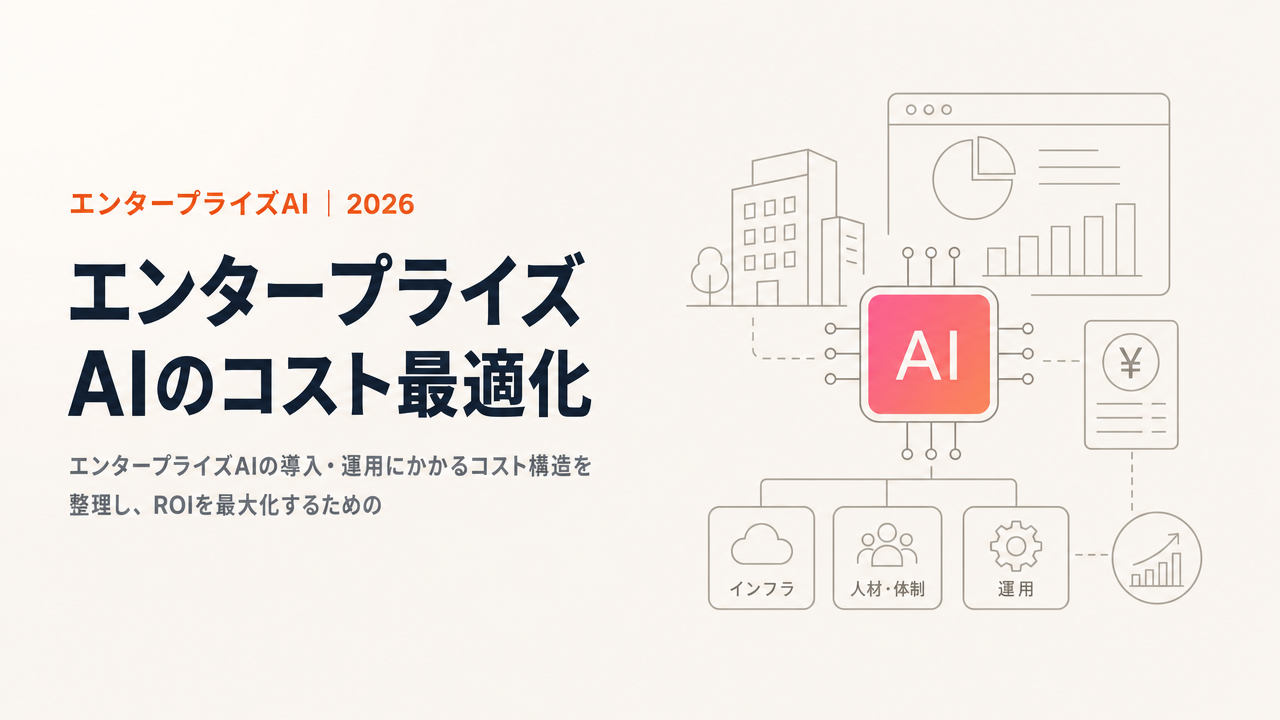
Costs pile up not because AI itself is expensive. In most cases, it is because teams start running before they have decided on the cost structure and on how to measure the return. This article organizes everything at once: the full picture of enterprise AI cost structure, how to measure ROI, the optimization strategies that cut waste, and the questions we hear most often. It is written so that, by the end, you walk away with a yardstick for your own investment decisions.
What you will learn here
Here is the overall picture first. In the order below, we assemble the material you need to decide.
| What you want to know | Where it is covered |
|---|---|
| Why so many AI investments fail to pay back | Why the payback fails |
| The breakdown of upfront and running costs | The full cost picture |
| Where costs are heading | Running costs keep falling |
| How to calculate and measure ROI | How to think about ROI |
| Concrete ways to cut waste | Six cost optimization strategies |
| The traps that catch people out | Common pitfalls |
With that in mind, hold on to just three facts about AI costs in 2026.
- Enterprise generative AI spending expanded to roughly USD 37 billion in 2025, more than triple the prior year. It is the fastest-scaling software category on record.
- The shift from "build" to "buy" is advancing: enterprise AI procurement moved from 53% purchase in 2024 to 76% purchase-based in 2025.
- Even so, about 95% of enterprise generative AI pilots deliver no measurable impact to the bottom line.
Spending is expanding rapidly, yet most of it is not paying back. That gap is exactly the starting point for any conversation about cost optimization.
Why so many AI investments fail to pay back
The MIT and NANDA study "State of AI in Business 2025" reported that about 95% of enterprise generative AI pilots deliver no measurable impact to profit and loss. Taken at face value, the number looks hopeless, but break down the causes and the moves become clear.
The first cause is not a shortfall in model performance. It is what the report calls the "learning gap" -- the problem of general-purpose tools not fitting a company's own work. An off-the-shelf general chatbot is versatile, but it does not know your pricing instincts, your design rules, or your past judgments. So it returns a clever-sounding answer in the moment, yet never rides the flow of the actual work. Roll that out horizontally without closing the gap, and the impact simply does not appear.
The second cause is misallocated budget. Many companies skew their AI budget toward sales and marketing while putting off back-office automation, which offers the highest ROI. Drafting quotes, reconciling documents, first-line responses to internal inquiries -- unglamorous, but areas where the time you save converts directly into money. Flashy use cases soak up the budget, and the reliably recoverable areas get missed. That is the classic profile of a company that cannot recoup its investment.
This is why AI should be designed as an "investment," not a "cost." Try to do it as cheaply as possible, and you end up with a low-impact deployment. Set the budget by working backward from the return you expect. That ordering alone sharply reduces the odds of landing on the 95% side.
The full cost picture of AI deployment
Enterprise AI costs swing widely by scale and use case. Even so, separating the components improves the accuracy of your estimates.
Upfront cost changes by an order of magnitude depending on build versus buy
Environment setup used to be the main character of upfront cost. That is no longer true. Because enterprise AI procurement has shifted rapidly from in-house development to buying, choosing a SaaS option erases most of the environment-build cost.
| Cost item | In-house (build) estimate | SaaS (buy) estimate |
|---|---|---|
| Requirements and design | JPY 1M - 5M | Tens of thousands to hundreds of thousands of yen (mostly initial setup) |
| Environment setup and development | JPY 3M - 30M | Largely unnecessary (included in the service) |
| Data preparation | JPY 0.5M - 5M | JPY 0.5M - 3M (depends on scale) |
| Training and education | JPY 0.5M - 2M | Tens of thousands to JPY 0.5M |
Building in-house lets you craft your own differentiation, but it eats time and money and tends to leave production far off. Off-the-shelf SaaS reaches production sooner and demonstrates impact faster. In practice, roughly 67% of deployments that reached production did so through purchase from a specialist vendor or a partnership, versus about 33% for in-house development -- nearly a twofold gap in success rate. Build in-house only the parts that directly drive your competitiveness, and buy the rest. Drawing that line is the first step in optimizing upfront cost.
The four elements of running cost
Monthly expenses should be understood in advance across four buckets.
- AI model API fees. Usage-based pricing is the norm; for SaaS, expect a few thousand to tens of thousands of yen per user per month.
- Infrastructure maintenance. Cloud means server usage fees; on-premises means maintenance costs.
- Data updates and maintenance. The effort of ingesting more internal documents and tuning as the work changes.
- Support and operations management. The human cost of handling inquiries and monitoring who is using how much.
The hidden costs that get overlooked
Look only at the figures on the invoice and you will misjudge. The labor to prepare data, the time it takes employees to learn how to use the tool, the effort of building an operating structure -- these rarely surface on paper, yet they carry weight that cannot be ignored in the total. Judge on "total cost," not on license fees. Miss this, and the budget balloons later.
Running costs keep falling
There is a premise that often goes overlooked in cost planning: the price of AI keeps dropping the longer you wait.
The venture capital firm a16z analyzed that the token price for delivering a given level of performance is falling at roughly 10x per year. The emblematic case: GPT-3-class processing that cost USD 60 per million tokens in 2021 had dropped to about USD 0.06 by 2024. Roughly a thousandfold in three years. Even GPT-4-class models have become about 62x cheaper since their debut.
This fact steers cost strategy toward one conclusion: do not lock in excess infrastructure upfront. Build a large in-house environment on today's prices, and by the time that investment pays back, the same processing will be available far more cheaply. That is precisely why it is smarter to choose a plan where you pay only for what you use, keeping yourself positioned to receive the benefit of falling prices.
There is a second implication: matching the model to the task. In enterprise API usage, different models are strong for different purposes. One survey found, for example, that a particular model holds a strikingly high share for coding use. There is no need to run every task on a single top-tier model. Simply matching a lightweight model or a stronger model to the difficulty of the task lowers cost while holding quality. Being able to switch among multiple AI models within one environment is becoming a precondition for cost optimization going forward.
How to think about ROI and measure it
If you are going to design AI as an investment, it is meaningless unless you can track the return in numbers. Measure ROI from two sides: "cost reduced" and "value newly created."
The calculation itself is simple.
ROI (%) = (annual impact - annual total cost) / annual total cost x 100
If, say, the annual impact is JPY 12M and the total cost is JPY 6M, ROI is 100%. The hard part is not the arithmetic; it is how you estimate the impact figure.
Measure quantitatively
The easiest thing to count is the reduction in work hours. Multiply the hours saved by the labor cost per hour and you get a monetary figure. This assumes you measured a baseline before deployment (current work hours or inquiry volumes); neglect it, and you cannot prove the impact internally even when it exists.
On the design and sales front lines of manufacturing, the sources of impact are clear. The time spent hunting for drawings, the time spent building a first-draft quote by hand, the time spent generating 3D data from 2D drawings -- all work that has relied on people, and all cases where AI lets you count the hours saved. For reference, one company reduced the time spent retrieving information from internal materials by 80% after adopting ZEROCK. Simply erasing the time spent searching visibly changes the productivity of each designer.
The same thinking applies across white-collar work in general. Panasonic Connect disclosed a reduction of roughly 186,000 work hours on an annualized basis through company-wide use of an internal AI assistant. However large the number, the root is the same formula: hours saved x unit cost.
Do not discard the qualitative
Some effects are hard to convert into money. Faster decisions, veterans' judgment retained within the organization, fewer missed opportunities. In manufacturing especially, the value of accumulating the design and estimating instincts inside a skilled worker's head as knowledge and sharing them across the organization is far from small. Do not discard these just because they resist quantification; keep one column for "qualitative" in your ROI assessment. That is what prevents the mistake of judging an investment on short-term savings alone.
Six cost optimization strategies
Building on all of the above, here are six concrete ways to actually cut cost.
1. Start small and build a track record. Rather than a company-wide rollout, begin with one department and one task. You keep initial investment low, and demonstrating concrete outcomes in the pilot makes it easier to win approval for additional investment.
2. Prioritize buying (SaaS). As noted, the production-reach rate is about 67% for purchase and partnership versus about 33% for building in-house. Before assembling a platform from scratch, verify the impact with an off-the-shelf service first. It is entirely sufficient to consider in-house development later, only for the parts where differentiation directly drives competitiveness.
3. Optimize usage volume. Match the model to the difficulty of the task.
| Task difficulty | Model to choose | Cost level |
|---|---|---|
| Simple (template generation, classification) | Lightweight model | Low |
| Moderate (summarization, internal Q&A) | Standard model | Medium |
| Complex (analysis, drafting strategy) | High-performance model | High |
4. Invest in data preparation early. AI answer quality is determined by the quality of the data you feed it. In an Informatica survey, 43% of data leaders in Japan cited "data reliability" as a barrier to production operation. Put preparation off, and low accuracy surfaces after deployment, with remediation cost riding in afterward. Investing in cleansing and structuring first works out cheaper in the end.
5. Build measurement in from day one. Measure the baseline before deployment and design a mechanism to track the change periodically afterward, starting on day one. If "the impact is invisible" persists, internal support drains away and the investment you made stalls.
6. Use public subsidies. The former IT Implementation Subsidy was renamed the Digital and AI Adoption Subsidy 2026 in 2026. The standard frame shows a subsidy rate of one-half to two-thirds and grants of JPY 50,000 to 4.5 million (roughly JPY 50,000 to under 1.5 million for one process or more, and JPY 1.5 million to 4.5 million for four processes or more). New frames, including one for multi-party collaboration, were also added. Because frames and conditions change each fiscal year, always check the official site for the latest requirements before applying.
Common pitfalls in cost management
Finally, here are the classic patterns that inflate spending.
Overlooking hidden costs happens again and again. Judging something cheap by its license fee alone, then starting to run without counting the labor for data preparation, training, and the operating structure. The most common regret is finding, on a total-cost basis, that it was expensive after all.
Over-customization also warrants caution. Cram in too many features from the start and both development cost and deployment time balloon. Start with standard functionality and add only the missing pieces later. That ordering is far cheaper and faster.
Vendor lock-in comes back as a future switching cost. Confirm before signing whether you can export your data and whether the API is standard. Securing an exit also works in your favor for continuing to receive the benefit of falling prices.
And the biggest trap is a skewed budget allocation. Flashy sales and marketing use cases soak up the budget, and the back-office automation you could reliably recoup gets missed. As MIT's findings suggest, place budget starting from the high-ROI areas. Holding to just this one point changes the recovery odds of the whole investment.
Frequently asked questions
Q. What is the typical upfront cost of enterprise AI? Building your own platform from scratch, from requirements definition through environment setup, runs from several million to tens of millions of yen. A SaaS option, by contrast, removes most of the environment-build cost. Procurement has shifted toward buying, reaching 76% purchase in 2025. The realistic approach is to start at a few thousand yen per month and expand as results become visible.
Q. What is the monthly cost of enterprise AI? Usage-based API fees scale with how much you use. For SaaS, expect a few thousand to tens of thousands of yen per user per month. For example, ZEROCK starts at JPY 1,000 (tax included) per month on the Light plan. Because the price of a given level of AI performance keeps falling year after year, a plan where you pay only for what you use ends up cheaper.
Q. When does AI deliver ROI? It depends on the target task and your measurement setup. Areas where saved time is easy to count, such as back-office routine work and information retrieval, start showing savings within a few months. Conversely, if you never measured a pre-deployment baseline, you cannot prove the impact even when it exists. Building measurement in from the start speeds payback.
Q. Is it better to build AI in-house or buy a SaaS product? For most companies, buying is the practical choice. In the MIT and NANDA study, the production-reach rate was about 67% for purchase and partnership versus about 33% for in-house development. Off-the-shelf services reach production faster and show impact sooner. Build in-house only where differentiation directly drives competitiveness, and buy the rest.
Q. Can public subsidies be used for AI adoption? Yes. The former IT Implementation Subsidy was renamed the Digital and AI Adoption Subsidy 2026 in 2026, with a standard frame showing a subsidy rate of one-half to two-thirds and grants of JPY 50,000 to 4.5 million. Because frames and conditions change each fiscal year, check the official site for the latest requirements before applying.
Getting started with cost optimization for manufacturing, with ZEROCK
The AI deployments that recoup their cost share one trait: they fit the work. Close the "learning gap" where general-purpose tools stumble, and start with areas where saved time is easy to count. Satisfy these two conditions and the investment tilts toward payback.
TIMEWELL's ZEROCK is an AI agent built for design and sales in manufacturing. Just upload a drawing, and it converts paper drawings and image PDFs into DXF data you can edit in CAD, generates a 3D STEP file from a 2D drawing, reads a drawing to build a first-draft quote, and supports cost calculation by building up material and processing costs. The more you teach it your past quoting history, the closer it gets to your own pricing instincts. Using hybrid search that includes GraphRAG, it quickly finds the one drawing you need from a large volume of internal drawings, and it can serve as a mechanism for passing on skills by retaining veterans' judgment as knowledge.
The cost design follows the principles laid out in this article. Pricing has four tiers starting at JPY 1,000 (tax included) per month on the Light plan, so you can move up as your usage grows. Drawing conversion and quoting start on the Team plan (JPY 10,000 per month, tax included, up to three people), and if you work with drawings and 3D every day, the Business plan (JPY 30,000 per month, tax included, up to five people) is the right fit. A 14-day free trial with no card required lets you test the impact on your own drawings. No large-scale infrastructure investment is required. Data is stored encrypted on domestic AWS servers, and the drawings and documents you input are never used to retrain an AI provider's models. This is exactly the setup for starting small, building a track record, and expanding as needed.
- To measure where you stand today, the AI Readiness Check confirms how prepared you are for deployment.
- For details on drawing AI features and pricing, see the ZEROCK service page.
- To discuss how far the impact would go on your own drawings and workflows, reach out via a ZEROCK consultation.
Summary
Cost optimization for enterprise AI comes down to a few rules.
- Grasp costs across both upfront and running dimensions, including hidden costs.
- Measure ROI from both "cost reduced" and "value newly created."
- Buy rather than build. Start small, buy SaaS, and optimize usage volume as the basic form.
- Invest in data preparation first. Answer quality is decided by the data you feed it.
- Build measurement in from day one, and keep yourself in a state where you can count the hours saved.
The price of AI keeps dropping the longer you wait. That is precisely why, rather than building big, you should pay only for what you need while starting with the work you can reliably recoup. That is how you avoid landing on the 95% side. Your next step is to write down one task where your company can count the hours saved. That is the starting line for cost optimization.
References (primary sources)
- Menlo Ventures -- 2025: The State of Generative AI in the Enterprise (enterprise AI spending, the procurement shift from build to buy)
- Fortune -- MIT report: 95% of enterprise generative AI pilots are failing (primary source: MIT NANDA "State of AI in Business 2025")
- a16z -- LLMflation: LLM inference cost is going down fast (falling token prices)
- SME Support Japan -- Digital and AI Adoption Subsidy 2026, standard frame (subsidy rate and grant amounts)
- Panasonic Connect -- disclosure on internal use of generative AI (work-hour reduction from internal AI assistant use)
This article was produced with the help of AI. A human verified the primary sources and edited the text before publication.
More Articles in This Category
What Is Enterprise AI? Differences from Consumer AI, Use Cases & Key Considerations (2026)
A clear guide to what enterprise AI is: how it differs from consumer AI, why agentic AI is the story of 2026, real-world use cases such as manufacturing, and the governance and cost factors that decide success.
RAG, Knowledge Graphs, and GraphRAG: How Internal Search Works and How to Choose
A clear guide to RAG (Retrieval-Augmented Generation), knowledge graphs, and GraphRAG, using manufacturing examples such as drawing search and quoting. Learn the limits of vector search, why GraphRAG excels at multi-hop questions, the agentic RAG of 2026, and permission control at deployment, so you can choose the right internal AI search.
Enterprise AI Security Guide: Data Leakage Risks of Generative AI and How to Prevent Them
A practical, end-to-end guide to the security challenges enterprises face when using generative AI at work. Covers generative-AI-specific risks such as shadow AI and prompt injection, the fundamentals of data residency and access control, and how to align with Japan's AI Business Operator Guidelines, with concrete measures to prevent data leakage.