Knowledge Management with AI: Turning Siloed Expertise and Skills Transfer into Organizational Assets
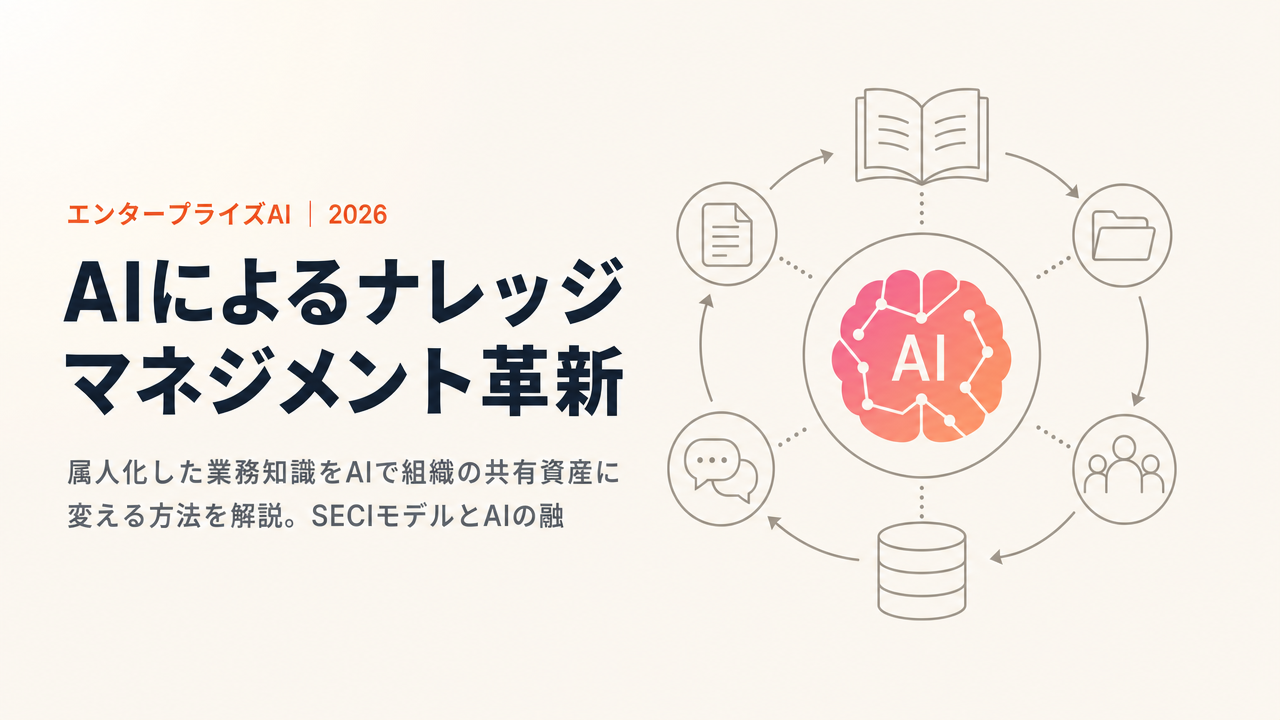
"Once that veteran retires, no one will be able to read the intent behind this drawing." It is a line you hear often on the manufacturing design floor. Why is this tolerance set to this value? What lesson from a past failure is baked into this machining sequence? The reasons behind the judgments are not written on the drawing; they live only inside one person's head. Sales is no different. A given customer's hot buttons and how past trouble was handled vanish from the organization the moment the account owner is reassigned.
This is what silos are, and as the veterans of the baby-boomer generation exit, it now weighs on every company as a management risk called skills transfer. Silos are not a "way of working" problem; they are the problem of company assets retiring alongside the individual. This article lays out, comprehensively and with manufacturing examples, both the mindset and the practical steps for turning siloed knowledge into an organizational asset with AI.
What This Article Covers
First, the terms and what AI can do. The details follow in the body.
| Term | Meaning | What AI can do |
|---|---|---|
| Tacit knowledge | Unverbalized knowledge based on experience and intuition | Supports verbalization through interview transcription and point structuring |
| Explicit knowledge | Documented, shareable knowledge such as manuals and drawings | Solves the "can't find it" problem with semantic search |
| SECI model | A framework for cycling tacit and explicit knowledge | Accelerates each process with AI |
| RAG | A mechanism where AI answers by searching internal documents | Answers internal questions with grounding |
| GraphRAG | A search-and-generation technique that also uses relationships between documents | Discovers cross-department knowledge connections |
The mechanics of the technology itself are covered in An Introduction to RAG and Knowledge Graphs. This article leans toward the practical side of adoption and operation.
What Is Knowledge Management
Knowledge management is the effort to bring the knowledge and experience held by individuals into a state where the whole organization can share and use it. It is not mere document management. The aim is to eliminate the situation where only a specific person can answer, so that anyone can reach the knowledge they need.
At its center sit two concepts: tacit knowledge and explicit knowledge. Tacit knowledge refers to knowledge the holder cannot clearly put into words, such as a veteran salesperson's sense of timing in negotiation, a seasoned engineer's instinct for diagnosing failures from sound or vibration, and the design intent embedded in a drawing. Explicit knowledge is knowledge expressed as documents or formulas that can be handed to others, such as manuals, regulation sets, drawings, and databases. The true nature of silos is that tacit knowledge valuable to the organization stays inside individuals, never converted into explicit knowledge.
Why Skills Transfer, Why Now
Behind this is what Japan calls the "2025 problem." The demographically large baby-boomer generation is leaving the active workforce, and the mass retirement of skilled workers has become reality. The number of people employed in manufacturing has been on a long-term downward trend, and as skills transfer to younger workers fails to keep pace, the danger of losing the knowledge that has supported the floor keeps growing. The detailed figures are laid out in the Ministry of Economy, Trade and Industry's White Paper on Manufacturing Industries, but the direction is clear. Left alone, the intent behind drawings, the feel for inspection, and the criteria for handling trouble all disappear with retirement.
That is exactly why knowledge management, so long put off with "we'll get to it someday," has become an urgent management issue that can no longer wait. The move is further accelerated by the fact that generative AI has entered the phase of business implementation, and simply bringing internal knowledge into a searchable state can now be achieved at a realistic cost.
The SECI Model: How Knowledge Takes Root in an Organization
The framework that explains how tacit and explicit knowledge circulate is the SECI model, proposed by Ikujiro Nonaka of Hitotsubashi University. Cycling through its four processes lets an individual's knowledge grow into the organization's knowledge. Applied to manufacturing scenes, it becomes easier to grasp.
| Step | Name | Description | Example in manufacturing |
|---|---|---|---|
| S | Socialization | Passing tacit knowledge from person to person through the body | Shadowing OJT with a veteran, on-site accompaniment |
| E | Externalization | Turning tacit knowledge into words or diagrams as explicit knowledge | Documenting work procedures, turning drawing intent into manuals |
| C | Combination | Combining explicit knowledge to create new knowledge | Integrating and analyzing design standards and past trouble records |
| I | Internalization | Making explicit knowledge one's own tacit knowledge through practice | Acquiring skills through training and hands-on work |
The step that clogs most easily in this cycle is externalization. Veterans say "I remember it with my body, so it's hard to explain," and younger workers say "I don't know what to ask." The height of this wall is the biggest reason skills transfer struggles to progress. As described later, AI greatly helps with this externalization and combination. The framework itself has not aged. Reading it as a structure for accelerating each process with AI is how to use it today.
Why Traditional Knowledge Management Failed
It is not uncommon to hear "we tried knowledge management but it did not stick." The causes mostly boil down to four patterns.
| Failure pattern | What happens | Countermeasure |
|---|---|---|
| Stored but not searchable | The information exists but can't be found, so people ask the veteran anyway | Set up search that finds things by meaning first |
| Documentation burden is too heavy | The floor can't finish writing on top of their real jobs, and updates stop | Let AI handle transcription and point summarization |
| Not updated, becomes obsolete | Old procedures linger and no one trusts them | Find gaps from usage logs and run improvement cycles |
| The floor doesn't use it | The tool is deployed but never takes hold | Create the reason to use it with success stories and evaluation |
Let us state the editorial position clearly here. Skills transfer is not something you begin only after a thick manual is complete. That order is backwards. First create a state where "the drawings and records you already have are searchable," and once the act of searching has taken hold, add the missing knowledge afterward. Put perfect documentation at the entrance, and the weight of the burden means the first step never happens and the plan stalls. Rather than storing, first being able to find. That is the knack for avoiding failure.
Three Ways AI Changes Knowledge Management
Generative AI has lowered the walls that traditional knowledge management faced to a height you can actually clear in practice. The effects break down mainly into three.
The first is supporting the conversion of tacit into explicit knowledge. Even knowledge long deemed hard to verbalize gets closer to explicit form if you transcribe interview audio from veterans with AI and structure the key points. You can also extract and accumulate knowledge from day-to-day exchanges. As long as you create the occasion for people to talk, AI takes on the heavy lifting of recording and organizing. That the cost of externalization comes down is, above all, the biggest change.
The second is solving the "can't find it" problem. Traditional keyword search would not reach the target document unless you knew the exact term. Semantic search using AI can return relevant documents even from a vague phrasing like "that thin-plate welding condition that caused trouble last year," reading the intent behind it. Go further with RAG (retrieval-augmented generation) and AI can return an answer directly, grounded in the documents it found.
The third is finding relationships between pieces of knowledge. A complaint-response record for one customer and a quality-improvement report from another department may actually be connected. Techniques that use a knowledge graph, such as GraphRAG, automatically surface these cross-department relationships. In SECI terms, AI underpins the "combination" step. We leave the technical mechanics to An Introduction to RAG and Knowledge Graphs; here it is enough to hold onto the practical effect. The broader premises of enterprise AI are covered in What Is Enterprise AI.
Manufacturing: The Front Line of Skills Transfer
Where knowledge management works most urgently is on the design and sales floors of manufacturing. Rather than abstractions, think of it grounded in concrete work.
Drawing search is the classic case. Floors where it takes half a day just to find a similar past drawing are not rare. With search that finds things by meaning, you can reach the relevant drawing by asking something like "a mass-production part from last year close to this shape." Building a draft quote from a drawing, or estimating cost based on a drawing, are also areas that used to rely on a veteran's experience. The feel for inspection and the criteria for handling trouble are treasure troves of tacit knowledge too. If you can accumulate judgments like "is this scratch within tolerance?" or "what is this abnormal noise a sign of?" as records and cases in explicit form, the time until a young worker can stand on their own will surely shrink.
One technical point here. As the volume of internal information grows, general vector search tends to drop sharply in accuracy. For manufacturers where drawings and technical documents pile up by the tens of thousands, that is fatal. TIMEWELL's ZEROCK adopts a hybrid search that combines keyword search, meaning-capturing semantic search, and GraphRAG that uses relationships between documents, so it is designed to hold accuracy even as information grows. The more drawing assets a company holds, the more this difference tells.
Four Steps to Implement AI-Powered Knowledge Management
There is an order to how you proceed. In each step, hold the "what to do" and the "pitfall" together.
Step 1 is identifying the target area. Trying to handle every operation at once makes the project diverge. Is silo risk high? Are there many inquiries? Does a new hire take a long time to ramp up? Narrow to one priority area by these three conditions. The pitfall is getting greedy and starting with a company-wide rollout. Starting small and building a success case ends up spreading faster.
Step 2 is organizing and ingesting existing documents. Turn the target area's drawings, manuals, FAQs, meeting minutes, and reports into a form AI can handle. Cleaning up duplicates and attaching metadata for when and what each document is raises search accuracy. The pitfall is trying to ingest only after organizing perfectly. Putting things in at 80 percent and fixing them while using is more realistic.
Step 3 is systematizing the collection of tacit knowledge. Build interviews with veterans, recording or video of work, and extraction from daily reports into everyday operations. The pitfall is ending it as a one-off event. Without a mechanism that keeps gathering, knowledge quickly ages.
Step 4 is the cycle of use and improvement. Once you release it, watch how it is used. Frequently searched terms that return no hits are a sign that knowledge is missing. Add the missing knowledge while watching how it gets used. The pitfall is treating release as the finish line. A knowledge base is something you grow.
Measuring Impact and Governance
If you can't explain return on investment, the effort won't last. The metrics can be simple. The time it takes to find information, the time until a new hire becomes independent, and how often the same question comes back to a veteran. Compare these three before and after adoption and the change becomes visible in numbers. Search time in particular is easy to measure and well-suited to explaining to management. For reference, ZEROCK cites a track record of cutting information search time by 80 percent at adopting companies.
Just as important is governance. Drawings and technical information are company assets themselves. Precisely because of that, you should decide the design of where you entrust them and who you show them to at the very start. Three things to confirm in practice: where data is stored, whether input information is used to retrain the AI, and whether viewing permissions can be controlled by department and role. In ZEROCK's case, data is stored encrypted on AWS servers in Japan and operated under an ISMS-compliant setup. The LLMs used are enterprise offerings such as Azure OpenAI and Vertex AI, so the drawings and documents you input are never used to retrain the AI provider's models. Viewing permissions can also be set finely by department and role. Do not bolt security on afterward; place it at the very start of the implementation design. Proceed with this left vague and the floor will not entrust their drawings with peace of mind.
Common Misconceptions and Mistakes
The stumbling points are mostly fixed.
The first is trying to build every manual before releasing. Aim for perfection and you will never release. The right answer is to create a searchable state first and add while using. The second is thinking that once built, it's done. Without a mechanism that keeps gathering knowledge, a knowledge base loses trust within half a year. The third is the assumption that once you install a tool, the floor will use it. People make it a habit only after they feel firsthand that "using it makes my job easier." Create a small success early, and tie the sharing and use of knowledge to the evaluation system. Eliminating silos takes shape only when mechanism and evaluation are in place together.
Frequently Asked Questions
Can tacit knowledge really be turned into explicit knowledge with AI? AI does not pull things out of a head on its own. The division of labor is that you create the occasion for veterans to talk, and let AI handle the transcription and point summarization. As the heavy lifting of verbalization eases, the externalization you had given up on becomes workable at a realistic cost.
Can small and mid-sized manufacturers adopt it too? Yes. The smaller the headcount and the higher the dependence on a single veteran, the greater the retirement risk and the higher the priority. Starting narrowed to one area is realistic.
Is data leakage a concern? It depends on the design. Encrypted storage on domestic servers, a mechanism that does not use input data for retraining, and viewing permissions by department and role. Confirm these three are guaranteed.
How do you measure impact? Search time, new-hire ramp-up period, and the number of repeated questions. Comparing these three before and after adoption is the practical approach.
Is the SECI model still valid? Yes. Reading it as a framework for accelerating each process with AI, mapping externalization to audio transcription and combination to GraphRAG, is how it is used today.
Making Knowledge Utilization a System
Knowledge management solves the challenges of silos and skills transfer with a mechanism, not with willpower or individual effort. TIMEWELL's ZEROCK, as an AI agent for manufacturing design and sales, supports drawing conversion, quoting, and cost estimation, plus drawing search through hybrid search and the skills-transfer support that turns a veteran's insight into knowledge. From "you can't know unless you ask someone" to "you can know by asking the AI." There is no hard sell intended. First, check whether it fits your own challenges with the three options below.
- If you want to know your company's AI readiness first, go to the AI Readiness Check. You will see where you stand in a few minutes.
- If you want a detailed look at the drawing-search and skills-transfer features, go to the ZEROCK service page. A 14-day free trial is available.
- If you want to try it with your own drawings and documents, go to a one-on-one consultation. A demo using your actual data is possible.
Summary
Finally, three iron rules from this article. For skills transfer, don't wait for the manuals; first create a "searchable state." For turning tacit into explicit knowledge, have AI take on the heavy lifting of verbalization while people focus on the occasions to talk. And eliminating silos does not end with installing a tool; it takes hold only when paired with the evaluation system. Before knowledge retires along with the individual, you want to move it over into an organizational asset. Begin that first step from a small, single area.
References (Primary Sources)
- Ministry of Economy, Trade and Industry, "White Paper on Manufacturing Industries (Monodzukuri White Paper)" (Primary source on skills transfer and the 2025 problem; refer to the latest edition at the time of writing)
- Ministry of Internal Affairs and Communications, "White Paper on Information and Communications" (Trends in enterprise adoption of generative AI; refer to the latest edition at the time of writing)
- Small and Medium Enterprise Agency, "White Paper on Small and Medium Enterprises" (Primary source on human resources, skills succession, and silos)
- Ikujiro Nonaka and Hirotaka Takeuchi, "The Knowledge-Creating Company" (Oxford University Press, 1995) (The original source of the SECI model)
- Microsoft Research, "GraphRAG: Unlocking LLM discovery on narrative private data" (Primary explainer on GraphRAG, 2024)
This article was produced with the help of AI. A human verified the primary sources and edited the text before publication.
More Articles in This Category
What Is Enterprise AI? Differences from Consumer AI, Use Cases & Key Considerations (2026)
A clear guide to what enterprise AI is: how it differs from consumer AI, why agentic AI is the story of 2026, real-world use cases such as manufacturing, and the governance and cost factors that decide success.
RAG, Knowledge Graphs, and GraphRAG: How Internal Search Works and How to Choose
A clear guide to RAG (Retrieval-Augmented Generation), knowledge graphs, and GraphRAG, using manufacturing examples such as drawing search and quoting. Learn the limits of vector search, why GraphRAG excels at multi-hop questions, the agentic RAG of 2026, and permission control at deployment, so you can choose the right internal AI search.
Enterprise AI Security Guide: Data Leakage Risks of Generative AI and How to Prevent Them
A practical, end-to-end guide to the security challenges enterprises face when using generative AI at work. Covers generative-AI-specific risks such as shadow AI and prompt injection, the fundamentals of data residency and access control, and how to align with Japan's AI Business Operator Guidelines, with concrete measures to prevent data leakage.