Hello, this is Ryuta Hamamoto from TIMEWELL.
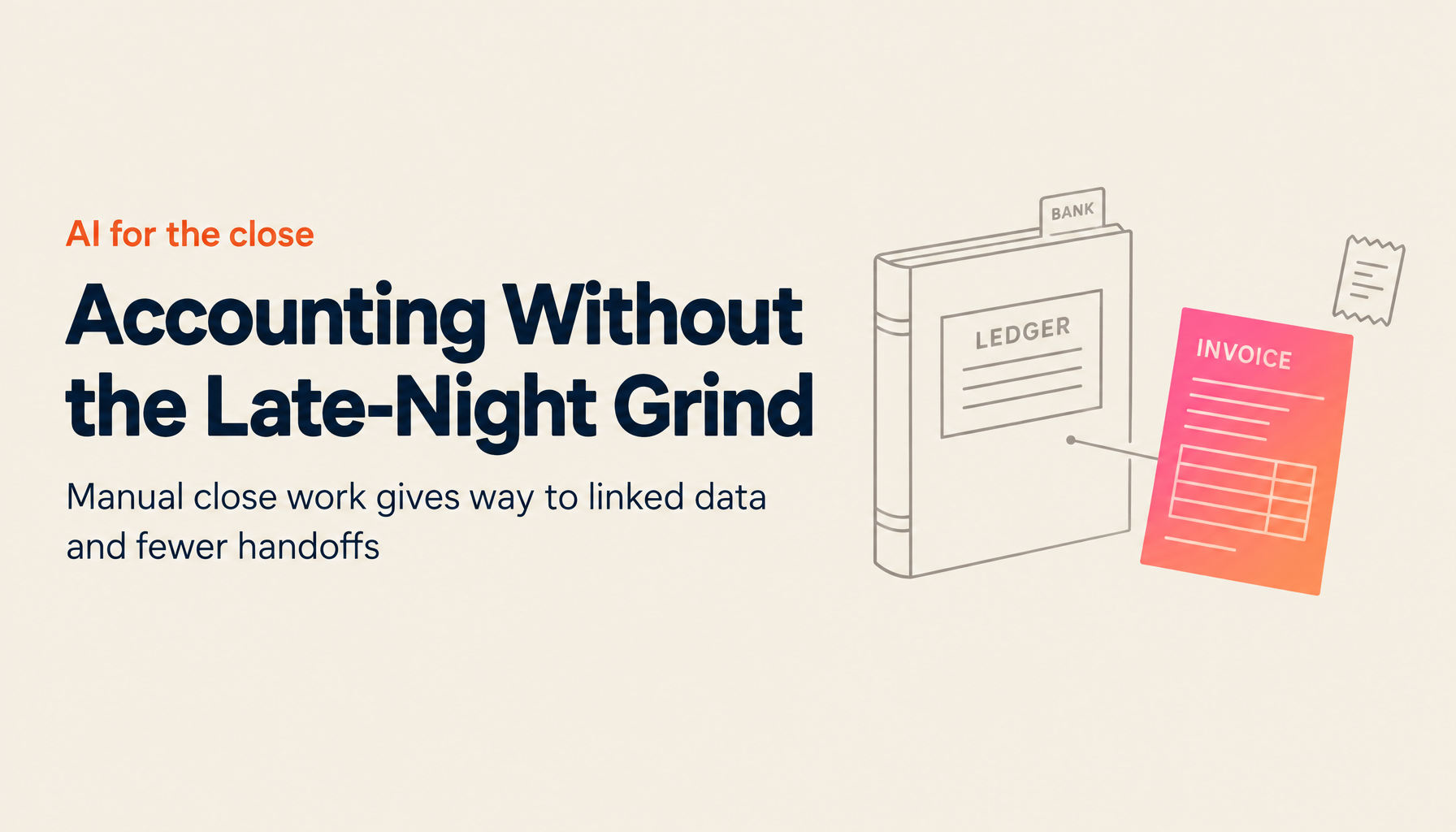
As month-end approaches, there are still plenty of offices where only the accounting desk stays lit. After sales and engineering have gone home, someone sits between a stack of invoices and copies of the bankbook, moving back and forth between a calculator, Excel and the accounting software. When the figures are off by a single yen, they trace the transactions one by one to find where the gap is. Just when they think it finally balances, a single receipt for an expense claim turns out to be missing. I suspect a lot of people in charge spend nights like that, month after month.
This article is written for those accounting staff, and for the people who run the back office. First I want to unpick, from its structure, where the weight of the close and voucher work comes from. Then, on the basis of primary sources from the National Tax Agency and the Digital Agency, I lay out what "AI-driven accounting," meaning automated journal entries and the reading and matching of vouchers, actually changes, and how. Because this is work that deals in numbers, I intend to write about both the effects and the risks without exaggerating either. If you want to check where your own company stands on AI use first, starting from the free AI literacy self-check will make the second half of this piece read more concretely.
At month-end, only the accounting desk stays lit
Let me start by laying out, concretely, the pain that repeats on the accounting floor. Without a sense of that, the AI discussion turns into a pipe dream.
The first is the monthly close. You total sales, purchases and expenses, and fix the month's profit and loss. This sequence of work concentrates into a few days from the start to the middle of the month. If submissions from each department are late, the accounting work is pushed back by that much, and the gap gets papered over with overtime. Because management cannot be given the figures until the close is done, only accounting is chased by the deadline. That structure is common to many companies.
The second is matching vouchers. A voucher is a document that proves a transaction actually happened: invoices, receipts, delivery notes, contracts and so on. You check each of these against the accounting data and the deposits and withdrawals on the bankbook. Is the amount right, is the date correct, does the counterparty's name match the ledger. When there are a few dozen, manual work still copes; when there are hundreds or thousands, that alone consumes a day. And when you find the one that does not match, that is where the hunt for the cause begins.
The third is keeping up with the rules. I will come to this in detail later, but two systems, the Electronic Books Preservation Act and the qualified invoice system, have placed a heavy load on accounting in recent years. Invoices received as data must be kept as data, and to deduct the consumption tax on purchases you check, one by one, whether each is a qualified invoice. Simply running the daily processing while observing the rules has piled up as new work in its own right.
And the fourth is the way it comes to depend on one person. The state where "only that person understands this process" arises easily in accounting. When a long-serving staff member has run everything on their own Excel files and their own procedures, the close stops the moment they take a day off. I have heard, more than once, the story of an owner who went pale after that person resigned with no handover materials left behind. It is work that deals in numbers, and yet how those numbers are made has become a black box. That is a management risk in itself.
Why can't accounting ever escape manual work?
It is a mistake to blame this pain on the staff not trying hard enough. There is a clear structural reason it cannot escape.
The biggest reason is that the information coming into accounting is, from the outset, in scattered shapes. From one counterparty a paper invoice arrives by post, from another a PDF arrives by email, and from yet another it is shared as a cloud link. Even for the same "invoice," the format and the order of the fields differ from company to company. A human can look at it and read off "this is the amount, this is the counterparty, this is the date," and that reading and transcribing is exactly what manual accounting work is. Because the information is not structured, a person has to step in and tidy it up. That is at the root.
The National Tax Agency itself shows this "chain of manual work" in a diagram. You file paper and PDF invoices by hand, save them with a scanner, send invoices you made on a PC as paper, look at those to make the ledger by hand, and submit by post or at a counter. At each step from when a transaction happens to when it reaches filing and payment, a human hand is inserted. Turned around, that means the room to cut manual work at each of those steps is correspondingly large.
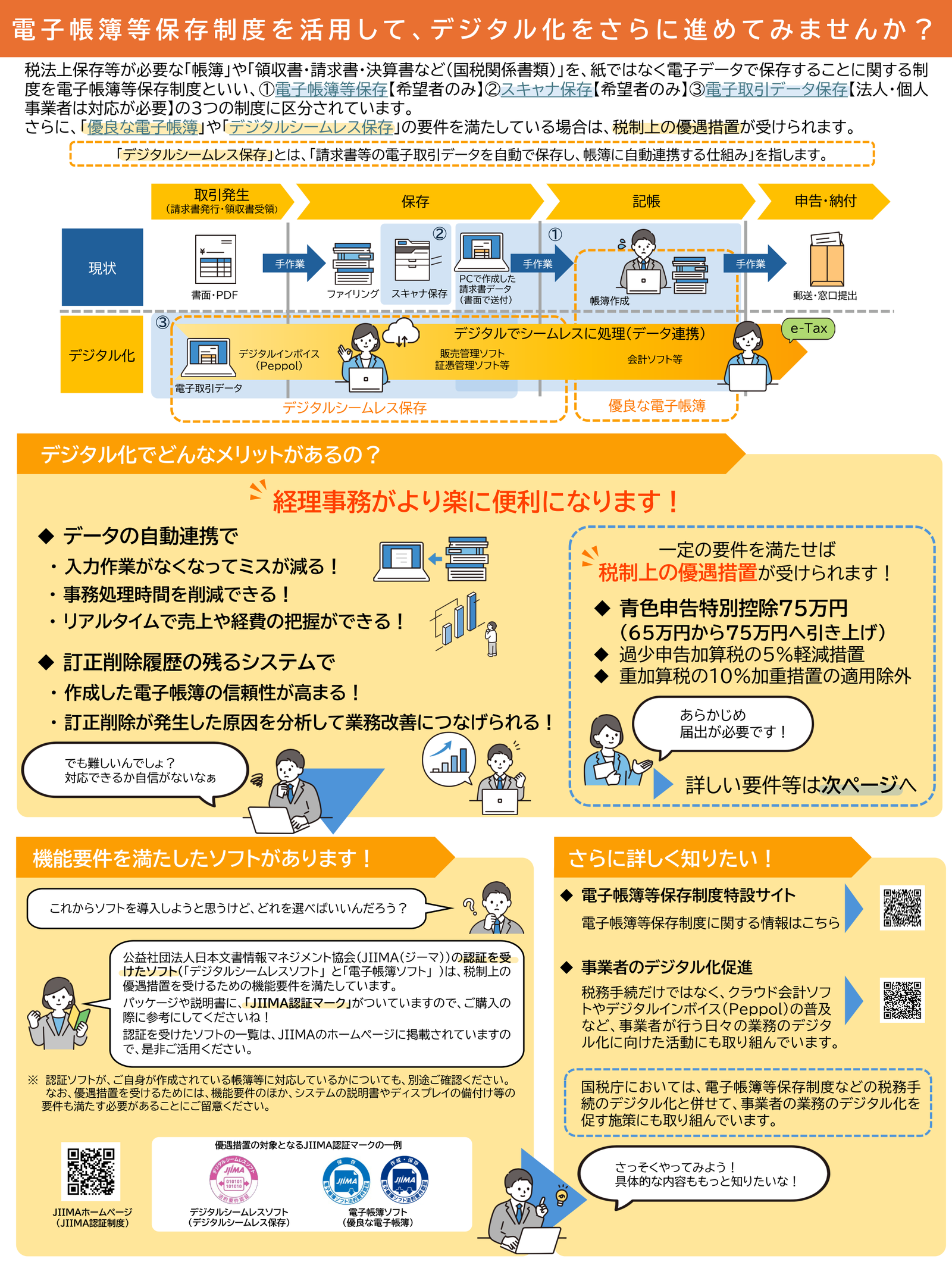
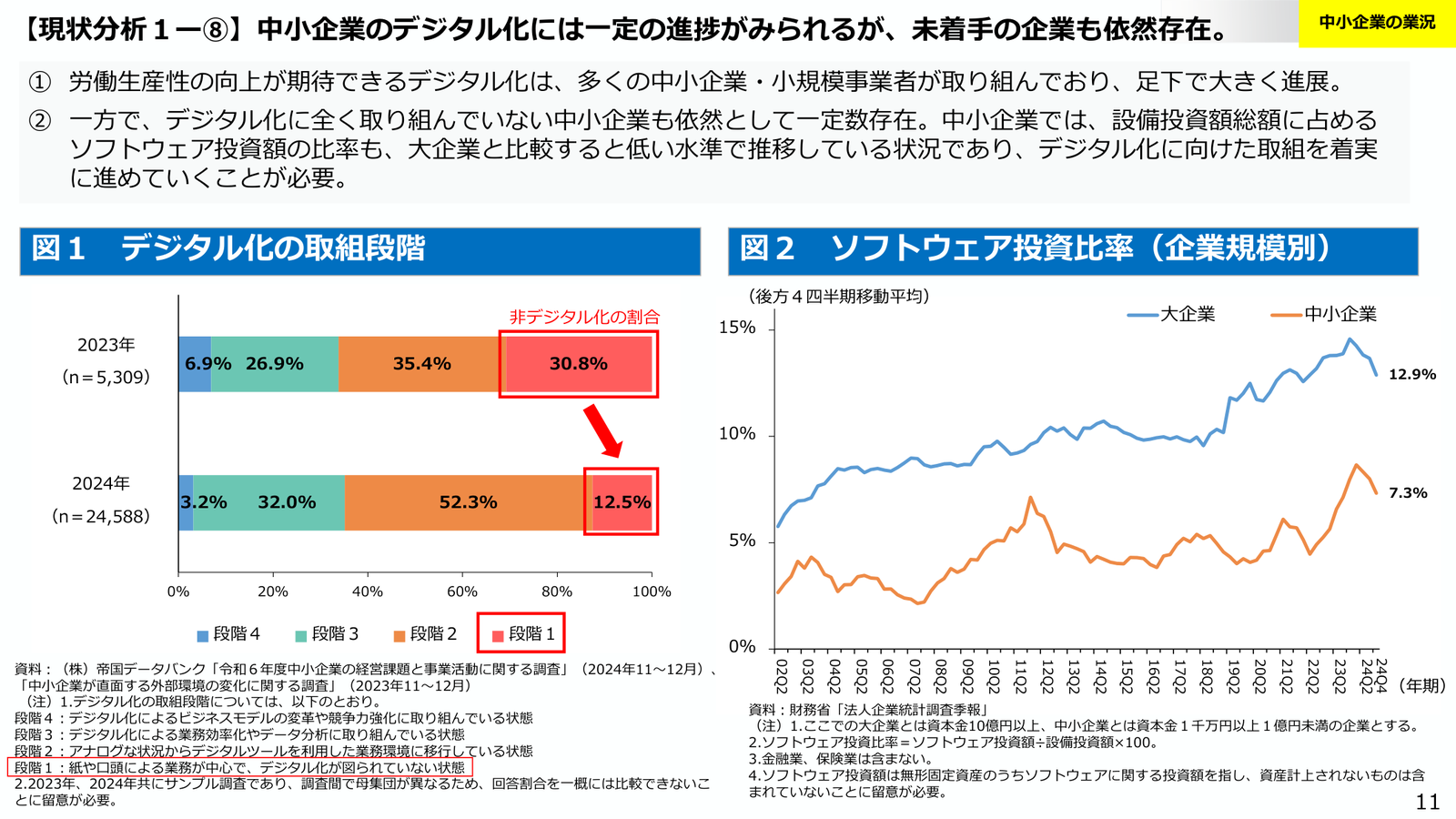
Source: National Tax Agency, "Why not use the electronic-books preservation system to take digitisation further?" (June 2026), p.1 The other reason is that investment tends to be put off. Because accounting is not a department that directly generates sales, the decision to invest in systems is easily deferred with "it runs without it." In fact, if you look at the share of capital investment that goes to software by company size, large firms spend 12.9% while SMEs stop at 7.3%1. The funds that can be turned toward digitising the back office differ by scale. As long as it is somehow kept running by hand, the need to invest is hard to convey to management. This vicious circle has preserved manual work.
Even so, things are moving. If you look at the stage of digitisation among SMEs, the share of companies centred on paper and word of mouth, with no digitisation, is on a downward trend. One caveat is needed here: because the mix of responding companies changes considerably from year to year, the white paper itself notes that simple year-on-year comparison calls for caution. Still, that more companies have advanced to the stage of working on operational efficiency and data analysis is a fact as a direction. How to change the back office, accounting included, is becoming an unavoidable theme for many companies.
Looking for AI training and consulting?
Learn about WARP training programs and consulting services in our materials.
AI-driven accounting means replacing the chain of manual work with data linkage
From here I move into the solution. The phrase "AI-driven accounting" sounds new, but what it does is simple: it replaces that "chain of manual work" with automatic data linkage and AI judgment. Broken down, it comes to about the following five things.
The first is automating journal entries. A journal entry is the basic accounting task of splitting each transaction into a "debit" and a "credit" and recording it in the ledger. Traditionally a person judged this and typed it in by hand, but AI has come to learn the patterns of past entries and to propose account items from the content of a transaction. Import the statements from a bank account or credit card, and candidate entries line up automatically. The person moves to the side of checking and approving them.
The second is OCR reading and matching of vouchers. OCR is a technology that reads the characters inside an image or PDF as data, and it stands for optical character recognition. Import an invoice or receipt by scanner or smartphone photo, and AI reads the amount, counterparty, date and registration number, and matches them against the accounting data and the deposits and withdrawals on the bankbook. The matching work I called "a day gone" earlier gets its groundwork done by the machine. The person only needs to look at the exceptions the machine has flagged as "not matching."
The third is anomaly detection. Compared with past data, the digits of an amount are clearly off, a large payment stands against an unusual counterparty, or the same invoice is booked twice. AI picks up these "not as usual" cases and prompts attention. It helps catch, at an early stage, the seeds of mistakes and fraud that slip past the human eye.
The fourth is automatic report generation. From the figures once closed, it compiles the monthly report and the cash-flow outlook automatically. You can aim at a state where the numbers management wants can be produced on the very day the close finishes.
And the fifth is the data linkage that ties all of this together. This is in fact the most important, and the part the state is backing as policy. Billing and settlement are carried out as data, that data is preserved without tampering, journal entries are recorded through data linkage too, and it links through to filing and payment. The National Tax Agency calls this end-to-end arrangement "a mechanism that links invoices and the like automatically into the ledgers," and states that because it does not go through manual input work, a reduction in clerical burden and an improvement in compliance can be expected2. If you grasp AI-driven accounting as AI reading and judgment placed on top of this foundation, its outline comes into focus.
Deciding which task to hand to AI first, the order of it, is where many people hesitate. What we work on with owners in an AI consulting service called WARP is exactly this call. Try to automate everything at once and it usually collapses. Where is the process with high volume and heavy manual work; conversely, where is it dangerous to leave things to AI. Because the answer differs by company, we start from designing that.
The rules themselves are pushing accounting toward digitisation
The digitisation of accounting is no longer merely a story of efficiency. The rules themselves are pushing accounting in the direction of processing by data. Accuracy is everything here, so let me sort out the two systems in order.
First, the Electronic Books Preservation Act. The National Tax Agency's system divides broadly into three categories. The first, "electronic books preservation," and the second, "scanner preservation," are optional systems that those who wish to may use; but the third, "electronic transaction data preservation," must be addressed by corporations and sole proprietors3. When order forms, contracts, receipts, invoices, estimates and the like are exchanged as data by email or cloud, that electronic transaction data is required to be kept in electronic form. Printing it on paper and filing it, and calling it done, will fall short of the requirements in some situations.
Next, the qualified invoice system. Its formal name is the qualified-invoice-based method, and it began on 1 October 20234. Because consumption tax has multiple rates, it is a mechanism that calculates from invoices, namely qualified invoices, that state the consumption-tax amount and so on, so that tax can be paid accurately. What bites for accounting here is the requirement for the purchase-tax credit. To subtract the consumption tax paid on purchases and expenses, keeping a qualified invoice is in principle required, and transactions without a qualified invoice cannot in principle be deducted. That is precisely why the work arises of checking, per transaction, whether an invoice received is a qualified invoice and whether the registration number is correct.
These two systems, while they have added to the accounting burden on one side, are also designed to reduce the burden when combined with digitisation. The connection point is the "system corresponding to a mechanism that links invoices and the like automatically into the ledgers," newly established in the FY2025 tax reform. The electronic transaction data of invoices and the like is saved automatically and linked automatically into the ledgers. Using this arrangement, called "digital seamless preservation," the National Tax Agency explains, input work disappears and mistakes fall, clerical processing time can be reduced, and sales and expenses can be grasped in real time2.
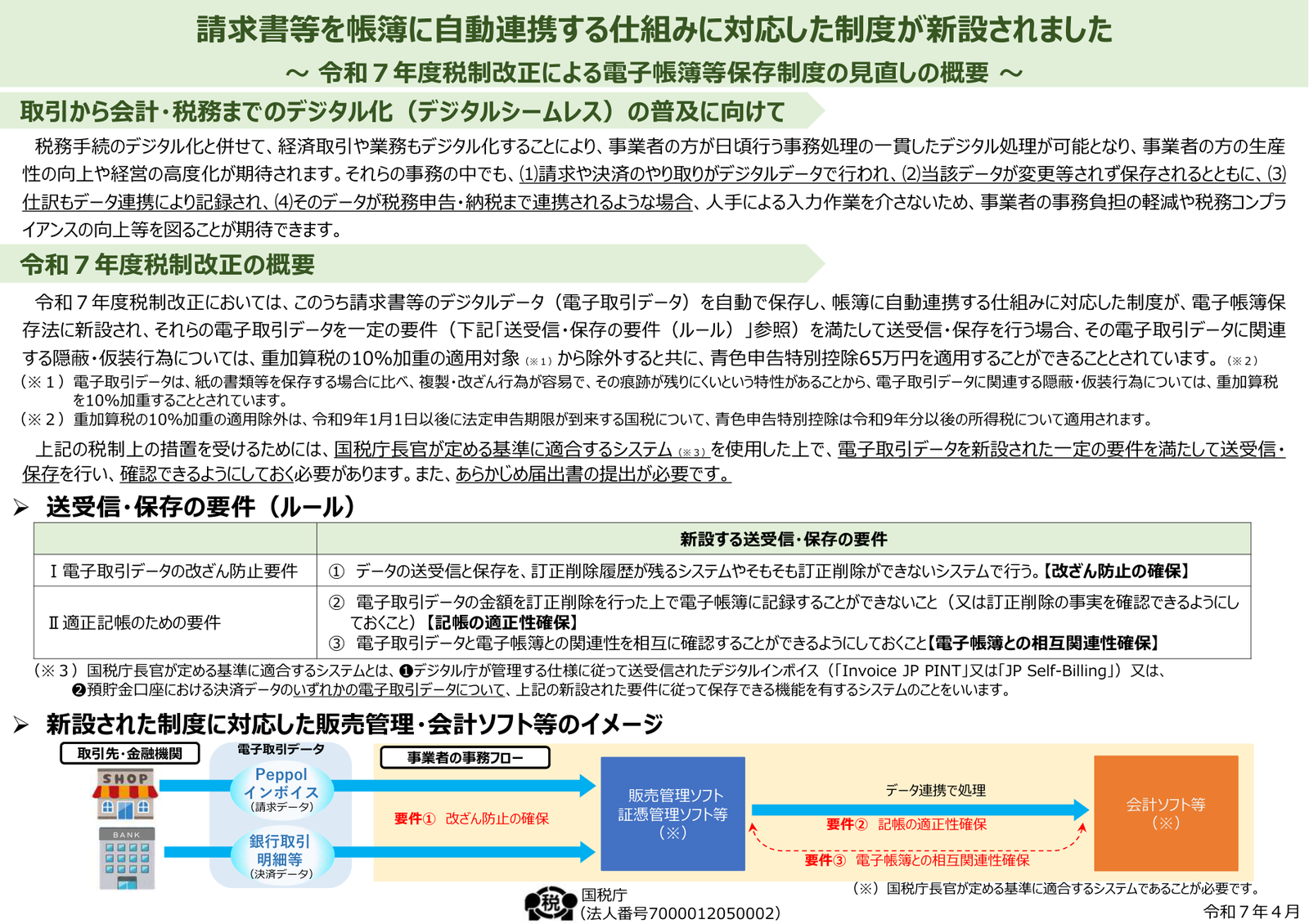
Source: National Tax Agency, "A system corresponding to a mechanism that links invoices and the like automatically into the ledgers has been newly established" (April 2025) As its foundation, what the state is building out is the digital invoice. A little sorting of terms is needed here. The Digital Agency's material explains invoices in three stages. A paper invoice is data that is, to begin with, neither standardised nor structured. An electronic invoice in PDF or CSV is electronic, but because the format differs by system, manual input often ends up being needed anyway. Against this, a digital invoice is standardised and structured data that can be processed automatically regardless of the system used5. The standard for this used worldwide is an international specification called "Peppol," adopted in more than 30 countries including Europe, Singapore and Australia. Japan too became the managing authority in September 2021 when the Digital Agency set the standard specification for Japan5. From the seller's system to the buyer's system, data flows directly without a person in between. This world is the groundwork for the ideal form of AI-driven accounting.
Drawing an honest line on how much efficiency you can expect
This is where, as an article that deals in numbers, I most want to be honest. I will not casually write a spirited figure like "accounting overtime falls by X hours." The reason is simple: an official government figure to back up that effect could not be found in this round of research.
What the National Tax Agency lists as benefits of digitisation are items such as "input work disappears and mistakes fall," "clerical processing time can be reduced" and "sales and expenses can be grasped in real time"2. Each matches what one actually feels, but all are qualitative expressions, and no hard figure like "X hours cut" or "X percent cut" is given. In other words, the state clearly states the direction of efficiency, but its quantity differs by company, and that is the accurate reading of the current situation.
On the other hand, there are areas with clear numbers. That is the tax merits. When the requirements are met, for superior electronic books the additional tax for under-declaration is reduced from 10% in principle to 5%. The blue-return special deduction is raised, for sole proprietors meeting the requirements, from 650,000 yen to 750,000 yen for income tax from the FY2027 return onward. Furthermore, if certain requirements such as digital seamless preservation are met, the heavier additional tax for concealment or disguise relating to electronic transaction data is excluded from application3. That said, all of these presuppose meeting the requirements or filing in advance, and they do not apply uniformly to every business. There are conditions on the timing of application too, so whether your own company is covered needs individual checking.
So how should you estimate your own efficiency gain? Here it is realistic to hold a way of estimating. For example, multiply the number of invoices you process monthly by the reading-and-matching time per item, and you get the total monthly time you spend on that process. Suppose you process 300 invoices a month at five minutes each by hand; that alone is 25 hours a month. Put OCR matching in so that a person only checks a portion of the exceptions, and the estimate stands that a substantial part of that time is freed up. It is no more than an estimate placed with your own real figures, but thinking this way, pulled toward your own workload, is far more useful than gazing at another company's showy reduction rate.
Source: 2025 White Paper on Small and Medium Enterprises, Overview (Akira Okada, Director of the Research Office, SME Agency; original data from Teikoku Databank survey and the Ministry of Finance Financial Statements Statistics of Corporations quarterly)
The security and audit-trail story, so you don't over-trust it
Once you decide to leave things to AI, the question that always comes up is "is it really all right?" For a department that deals in numbers, that is natural wariness, and it is healthy. Here too the rules clearly show the line to defend.
To preserve electronic transaction data, you must meet two requirements: "ensuring authenticity" and "ensuring visibility"6. Ensuring authenticity is a mechanism that guarantees the saved data has not been tampered with afterward, addressed by one of the following: applying a timestamp, saving in a system that retains the history of corrections and deletions (or in which correction and deletion cannot be done), or drawing up and operating internal rules to prevent tampering. Ensuring visibility is being able to find and check that data when needed, and it requires searchability by the three elements of date, amount and counterparty. Note that businesses whose sales in the base period are 50 million yen or less are exempt from the search requirement if they respond to a request to download.
What matters here is that these requirements do not stand against AI-driven accounting. Quite the opposite: use a system that retains the history of corrections and deletions, and it is left as an audit trail who corrected which figure and when. The reliability of the electronic books rises, and you can analyse the cause of corrections and deletions and connect that to operational improvement, the National Tax Agency states too2. The audit trail that was hard to keep in manual Excel becomes stronger by switching to a system. In the sense of resolving over-dependence on one person and the black box, this is a positive story too.
On the other side, the eye on tampering has sharpened. Because electronic transaction data has the property of being easier to copy and tamper with than paper, and leaving fewer traces, the additional tax for concealment or disguise relating to electronic transaction data is increased by 10% (applied to national taxes whose statutory filing deadline arrives on or after 1 January 2027)6. Meeting requirements such as digital seamless preservation excludes it from application, but in any case, the era of "it's data, so you can treat it lightly" is over.
On top of that, let me raise two points of caution on the operational side. One is not to take AI's judgment at face value. Both the entry proposal and the voucher reading are, in the end, candidates and groundwork. The responsibility for final approval rests with a person. Especially for large-amount transactions and first-time counterparties, you should keep a workflow in which a person checks. The other is that not every piece of accounting software automatically qualifies for the tax preferences. What the state assumes for digital seamless preservation is limited to standard-specification digital invoices, and to systems that can preserve settlement data from deposit accounts under certain requirements. Before adopting, you need to confirm whether the arrangement your company uses meets the requirements.
Where to put the first step
Reading this far, some of you will feel "that looks like a lot to do." That is exactly why I recommend placing the first step small.
The realistic order is this. First, identify the one process that eats the most time in your accounting. In many cases it is either reading and matching vouchers, or expense settlement. Next, replace just that one process with AI or a system. Rather than remaking the whole company at once, start where the effect is easy to see and the risk is small, and as you get a feel for it, widen to the next process. For keeping up with the rules too, if you steadily firm up from the mandatory part, electronic transaction data preservation, you can get things in order without panic.
You do not have to shoulder this order and the design of where and how to put AI within accounting alone. The same thinking runs to the back office beyond accounting. How to use AI in HR and labour is dug into in a piece organising AI use in HR, and how owners should face AI in a piece on AI use for executives. Read them together and you can draw a map of how to use AI across the whole company.
Where in your accounting to bring AI in first, and how to balance keeping up with the rules against efficiency. If your hand has stopped there, please talk to the WARP team. Specialists who have led DX and data strategy at major companies walk alongside you month by month, helping you bring AI down into the back office, accounting included. Neither an order nor merely installing a tool changes the shop floor. We design it together, right down to the point where the voucher processing of the one item in front of you actually gets easier.
To sum up
It ran long, so let me organise the key points.
- Accounting's pain concentrates into the monthly close, matching vouchers, keeping up with the Electronic Books Preservation Act and the qualified invoice system, and over-dependence on one person. This is not a lack of effort by the staff; it is a structural problem rooted in the fact that the information coming in is scattered and unstructured
- AI-driven accounting is an arrangement that replaces the chain of manual work with automated journal entries, OCR reading and matching of vouchers, anomaly detection, report generation, and the data linkage that ties them together. The state-advanced "mechanism that links invoices and the like automatically into the ledgers" is its foundation
- No official government figure showing the quantity of efficiency gain could be confirmed this time. Because the National Tax Agency's effects are all qualitative, estimating the reduction against your own workload is realistic. On the other hand, tax merits such as the blue-return special deduction and the reduction in the under-declaration additional tax do apply once the requirements are met
- Security and the audit trail are lined out by the Electronic Books Preservation Act's requirements to ensure authenticity and visibility. A mechanism that retains the history of corrections and deletions actually strengthens internal control. That said, do not take AI's judgment at face value; keep a workflow in which a person makes the final check
- Keep the first step small. Replace from the one process that eats the most time, and steadily firm up from the mandatory electronic transaction data preservation, which is the workable way to proceed
Accounting is the last line of defence for a company's numbers. Supporting that line with overtime and over-dependence on one person is close to its limit. Now that the rules are pushing digitisation, this is not a bad time to take a step toward remaking accounting. Start by writing out which of your own tasks are heavy.
References and primary sources
Footnotes
-
2025 White Paper on Small and Medium Enterprises and Small Enterprises, Overview (Akira Okada, Director of the Research Office, SME Agency; RIETI BBL material, May 2025). Figure "Software investment ratio (by company size)": large firms 12.9% / SMEs 7.3% (original data from the Ministry of Finance, "Financial Statements Statistics of Corporations, quarterly"); figure "Stage of digitisation." https://www.rieti.go.jp/jp/events/bbl/25051401_okada.pdf ↩
-
National Tax Agency, "A system corresponding to a mechanism that links invoices and the like automatically into the ledgers has been newly established: Overview of the revision of the electronic-books preservation system in the FY2025 tax reform" (April 2025), and National Tax Agency, "Why not use the electronic-books preservation system to take digitisation further?" (June 2026), p.1. https://www.nta.go.jp/law/joho-zeikaishaku/sonota/jirei/pdf/0025003-097_01.pdf / https://www.nta.go.jp/law/joho-zeikaishaku/sonota/jirei/tokusetsu/pdf/0026006-122.pdf ↩ ↩2 ↩3 ↩4
-
National Tax Agency, "Electronic books and electronic documents" (Electronic Books Preservation Act guide), and "Why not use the electronic-books preservation system to take digitisation further?" (June 2026), pp.1-2. The response categories for electronic transaction data preservation, the blue-return special deduction (650,000 yen to 750,000 yen, from the FY2027 return onward), the reduction of the under-declaration additional tax (10% to 5%), etc. https://www.nta.go.jp/law/joho-zeikaishaku/sonota/jirei/tokusetsu/02.htm ↩ ↩2
-
National Tax Agency, "About the qualified invoice system" (basics of the system and the requirement for the purchase-tax credit, began 1 October 2023). https://www.nta.go.jp/taxes/shiraberu/zeimokubetsu/shohi/keigenzeiritsu/invoice_about.htm ↩
-
Digital Agency, Material 4, "About the digital invoice (Peppol e-invoice)" (Digital and System Reform Council, 18 December 2023), pp.1-4. Peppol-adopting countries, the Japan Peppol Authority (September 2021), and the three stages of paper, electronic and digital. https://www.digital.go.jp/assets/contents/node/basic_page/field_ref_resources/fe4b257e-3cb3-48c4-8f11-3729bf98d43f/0bcb83ce/20231218_meeting_digital-system-reform_outline_04.pdf ↩ ↩2
-
National Tax Agency, "Why not use the electronic-books preservation system to take digitisation further?" (June 2026), p.2. The "ensuring authenticity" and "ensuring visibility" requirements for electronic transaction data preservation, the base-period sales of 50 million yen or less at which the search requirement becomes unnecessary, and the 10% heavier additional tax (on or after 1 January 2027). https://www.nta.go.jp/law/joho-zeikaishaku/sonota/jirei/tokusetsu/pdf/0026006-122.pdf ↩ ↩2