Hello, this is Ryuta Hamamoto from TIMEWELL.
If you work in HR, does this sound familiar? You put out a job posting and the applications do not come in as you hoped, and the candidate pool thins out. You finally get to the interview stage, but the bar for "good" differs from one interviewer to the next, and the same candidate can get a different verdict depending on who runs the interview. The person you did manage to hire lands in an onboarding where, before you know it, the actual way of doing things lives only in the head of one particular senior colleague, and when that person is busy the newcomer is left to drift. Then, six months later, a quiet resignation notice arrives.
Each of these looks like a small tear on its own, but pile them up and the HR function itself starts to wear down. In this article I want to unpick, from the structure up, why this pain arises, and to lay out "AI-driven HR," a way of using AI as an aid to move hiring, evaluation, development and placement from gut feel to a system, together with government primary data and the lines you have to hold. I explain the technical terms as they come up, so no one who is not familiar with AI gets left behind. If your first concern is where your own company stands, checking how far your HR team understands AI with our free AI literacy self-check will make the second half of this piece more concrete.
Has your hiring, evaluation and development all quietly become "only one person knows how"?
Let me start by drawing, a little more concretely, the pain that so many HR leaders carry at the same time. As you read, count how many of these ring true for you.
The first is too small a candidate pool. You post to a job board and no applications come. When they do, they do not match the requirements you are after. The HR team ends up forcing a choice from a thin pool, and mismatched hires become more likely. The volume of resume screening is not to be dismissed either. On a posting where applications pile in, just reading through each work history one by one can eat up a whole day.
The second is uneven evaluation. In interviews and in performance reviews alike, the bar shifts from one evaluator to the next. One interviewer weighs enthusiasm heavily; another weighs track record. The same person draws a different conclusion depending on the evaluator, and later you cannot explain "why did we pass that person." For the person being evaluated too, an evaluation with an invisible bar breeds distrust.
The third is onboarding and development that live only in one person's head. Onboarding is the word for the whole process of receiving someone who has joined, helping them settle into the organisation and become effective quickly. The steps and the knack of that reception sit only in the head of a particular senior or manager. There may be a manual, but it is not updated, and the real way of doing things is passed down by word of mouth. When the teacher changes, so does what is taught, and the newcomer's start comes down to luck.
And the fourth, as the result of all this, is attrition. The person joined, but the reception was thin, the evaluation did not convince them, and no path for growth was visible. When someone leaves, you start over from hiring. You are back at the first pain, the small candidate pool, and HR keeps turning the same wheel.
Why does HR work drift toward gut feel and one-person knowledge?
So why does this pain arise again and again? It is not a lack of effort by the people doing the work. There is a more structural reason.
At the very root sits the fact that the working population itself is shrinking. According to the Ministry of Internal Affairs and Communications' Information and Communications White Paper, Japan's working-age population, meaning the core generation aged 15 to 64, is projected to fall by 26.2%, from about 75.09 million in 2020 to about 55.40 million in 20501. The reason a candidate pool is hard to gather is, ahead of the skill or clumsiness of any individual posting, that the total number of people you can hire is thinning out in the first place.
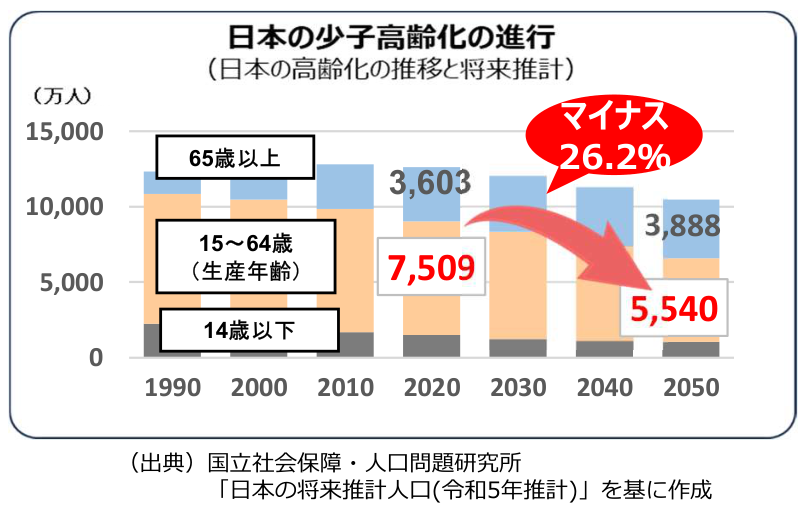
Source: Ministry of Internal Affairs and Communications, "FY2025 Information and Communications White Paper (Summary)," p.8 In the government survey behind the same white paper, 60.4% named "labour shortage accompanying the declining birthrate and ageing population" as an important social issue to tackle as a priority1. Labour shortage is recognised not as the worry of a single company but as an issue the whole country is facing. HR has to keep hiring, evaluating and developing on the premise that people are short. This is the ground HR stands on.
On top of this ground, HR work drifts toward one-person knowledge if left alone. The reason is simple: it is work with a lot of human judgment in it. Who to pass, how to evaluate, how to develop. None of these has a single fixed answer, and the more experienced the person, the faster they can process it on their own feel. The result is that the way of doing it piles up inside the individual without ever being put into words. Add a heavy workload, and there is no room to leave records either, so the gut feel and the know-how get shut inside one particular person. The moment that person is gone through a transfer or a resignation, the organisation can no longer reproduce the same judgment.
In other words, the outside pressure of a small candidate pool, and the nature of the work that tends toward one-person knowledge. These two mesh together and keep reproducing the pain of hiring, evaluation and development. Try to power through on manpower alone without fixing this, and the exhaustion continues. That is exactly why you need the idea of leaving the judgment itself to people while moving the preparation and the records into a system.
Looking for AI training and consulting?
Learn about WARP training programs and consulting services in our materials.
How does AI-driven HR change hiring, evaluation, development and placement?
This is where AI-driven HR comes in. There is no need to brace yourself for something difficult. Across the flow of HR work, you let AI help with the heavy parts, such as organising information and preparation, and people concentrate on making better judgments. That is the frame of AI-driven HR. The final judgment always rests with people, and AI stays strictly an aid. Let me organise it across four scenes.
In hiring screening, AI organises the key points of the application documents. Screening is the step of narrowing down, from many applications, the people who advance to the next stage. The work of reading each work history and statement of intent one by one is prepared by AI in the form of summaries and extracted points of discussion. The HR team can then judge from organised information, and can shift the time spent buried in documents into time spent facing candidates. The point is not to have AI decide the pass or fail itself, but to lighten the load of reading.
Against uneven evaluation, making skills visible works well. You gather the experience and skills each employee holds, and the records of their past work, into one place and organise them, so that who holds what strength is put into a visible form. When the wording of evaluation comments is uneven, you can also have AI help draft a version that aligns the perspectives. Once the bar is made visible, you can shrink the wobble between evaluators and explain more easily to the person being evaluated.
In the development scene, support for 1-on-1s comes up. A 1-on-1 is a short, regular one-to-one meeting between a manager and a team member. The work of leaving notes on what was discussed tends to get pushed back, but if you let AI handle organising the key points, it becomes easier to keep up the handover to the next session and the accumulation of development themes. It becomes a foothold for leaving records of development, which used to live in one person's head, as an asset of the organisation.
In considering placement too, visible skill information becomes the foundation. Which department holds people with which strengths, and where is thin. You become able to think about how to place people from organised information, rather than relying on gut feel alone.
One step beyond this kind of AI use lies a hiring trend often talked about lately. It is the idea that a single person who uses AI deeply can carry the work of many, and you even hear it put as "hire one AI-driven person and get the work of a hundred." The phrasing runs a little to hyperbole, but it is certainly true that the value of people who can work on the premise of AI is rising. How the leadership should take this change is organised in a guide to using AI for executives.
If you are unsure how to design where and how to bring AI in so that your own HR actually gets easier, the hands-on support of AI consulting such as WARP is one option. What matters is not the act of bringing in a tool, but working out which step of your own HR to make it work on.
AI use at companies today, and its spillover into HR, in the numbers
Even hearing "AI-driven HR," it may still sound like the story of a few advanced companies. So let me confirm, with government primary data, how far companies today are using AI. I attach a source to every figure.
According to the main text of the Ministry of Internal Affairs and Communications' Information and Communications White Paper, 55.2% of Japanese companies answered that they use generative AI in some task2. More than half of companies are already taking AI into their work in some form. Of these, the usage rate for purposes such as "assistance with creating information and documents" is put at 47.3%2. This is not an HR-only figure, but it can be said to be an area transferable to the many routine clerical tasks HR also has, such as creating meeting minutes, internal notices and explanatory materials. This is not government data that lets you assert what share of HR can be cut, so please take it strictly as a rough guide to the room for transfer.
Let me also look at how companies position AI. The share of companies that have set a policy for using generative AI is about 50% across Japan1. Look at the breakdown, though, and while large companies stand at about 56%, SMEs stop at about 34%1. Turned around, this gap also means it is an area where smaller companies can more easily pull ahead by moving early. One note: this "about 50% that have set a policy" and the earlier "55.2% using it in tasks" are separate survey questions, so these are not figures to compare in size directly.
The temperature difference on the ground shows up in the data too. Individuals' experience of using generative AI is 26.7% across Japan, but by age group there is a spread, from 44.7% among people in their 20s to 19.9% among those in their 50s and 15.5% among those in their 60s1. This is grounds for AI use turning out well or badly depending on the age makeup of the HR department. That is exactly why there is meaning in starting by aligning the team's level of understanding.
The reason companies stumble on adoption is clear too. The challenge companies feel most strongly with generative AI adoption was "not knowing the concrete way to use it"2. More than the technology itself, the design of what to use it for and how is the brake on its spread. On this point, some private-sector surveys report a result that use focused on specific tasks lifted productivity, but such figures are self-reported or reported-in-the-press values that depend on the survey's subjects and conditions, and they need to be taken separately from government primary data.
For reference, let me offer one simplified estimate of the screening load. Suppose you read 100 applications at 10 minutes each, that comes to about 16.7 hours, and if you could halve the pre-read time with AI summaries, that would be a saving of a little over 8 hours. This is only a simplified estimate, and the real effect changes with the content of the posting and how it is run. Please note this is not a reduction rate the government has presented.
Behind the convenience, the lines HR in particular must hold
The story has been upbeat so far, but HR is the department that handles people's information most deeply. That is exactly why, before using AI, you need to make clear the lines you must hold. Overconfidence is out of the question.
First, the handling of personal data. The Personal Information Protection Commission has issued an official caution on the use of generative AI services3. It asks that, when you enter text containing personal data into AI, you check carefully whether it is within the scope necessary to achieve the purpose of use you specified in advance, and that you confirm with the provider whether the personal data you enter is used for any purpose beyond generating a response, such as machine learning3. HR has scenes where it handles special-care personal information such as medical history and beliefs, and this kind of information calls for caution in the very act of obtaining it. Before casually pasting an applicant's documents into AI, checking your internal input rules and the specifications of the service you use is the starting point.
Next, bias in evaluation. The Ministry's white paper organises the risks of AI systematically, listing as technical risks "biased output," "discriminatory output" and "inconsistent output," as well as the "black-boxing" that makes the grounds for a judgment hard to see1. Use AI directly for hiring or evaluation, and AI can inherit the biases contained in past data and produce results that disadvantage a particular attribute. That is exactly why the division of roles is indispensable: rather than have AI decide the pass or fail, or the evaluation, people take the final judgment and AI stays strictly with organising information.
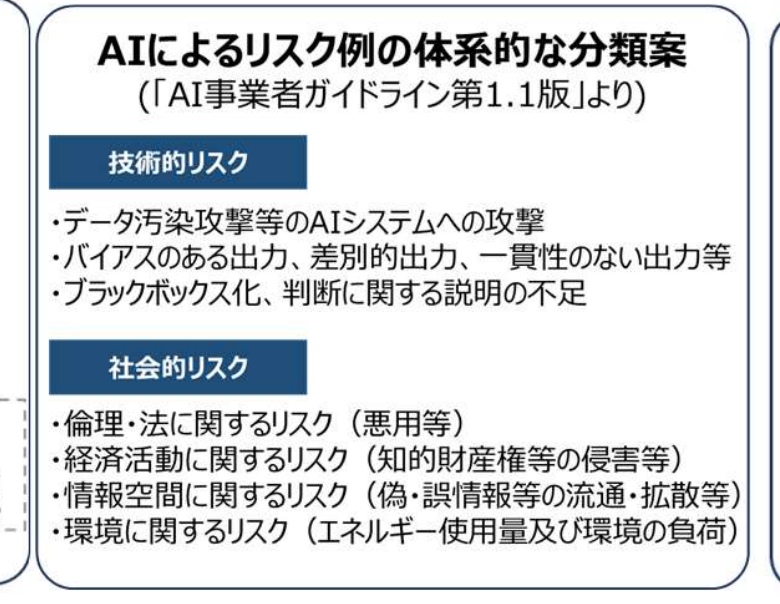
Source: Ministry of Internal Affairs and Communications, "FY2025 Information and Communications White Paper (Summary)," p.9 (from the AI Business Operator Guidelines, ed. 1.1) The accuracy of output cannot be trusted blindly either. Because a generative AI's responses are built on probabilistic correlations, there is a risk that personal information different from fact is output, the same caution points out3. You need the habit of not swallowing AI-summarised candidate information whole, but going back to the original documents to take confirmation.
For what it is worth, there are frameworks overseas that position AI used in hiring as high-risk and require human oversight. This is the story of EU regulation, not Japanese law. The corresponding domestic document in Japan is positioned as a guideline without legal binding force. While keeping an eye on overseas trends, holding to the personal data protection law at your feet and your internal rules comes first.
The first step starts from working out "where it works"
With the lines you must hold pinned down, then, what should you begin with? I think this is the part HR leaders most want to know.
What you must not do is try to replace your whole company's HR process with AI all at once. Since the reason companies stumble most on adoption was "not knowing how to use it," the more you spread out a grand plan, the easier it is to fall apart. What I would recommend is the reverse: write out where the time and load in your own HR are concentrated, then pick just one routine task where the effect is easy to see and try it small. Summarising documents, organising notes after an interview, drafting internal notices. This kind of task is an entrance where the damage is small even if it fails, and the effect is easy to feel.
One more thing to do before you start is to grasp your own HR team's level of understanding of AI. As the data showed, there is a gap in how well people can use it by age group, and if the understanding of the side doing the teaching is not aligned, no tool you bring in will take root. Checking where you stand with the free AI literacy self-check makes it less likely the design of where to start educating and which tasks to entrust will wobble.
On top of that, if you find yourself unsure how to design where AI works in your own HR, or how to set the input rules, please talk to the WARP team. Specialists who have led DX and data strategy at major companies walk alongside you month by month, helping you bring AI down into the HR shop floor. Between the order from above and the shop floor, translation is always needed. Let us start from moving that translation forward together.
To sum up
It ran long, so let me organise the key points.
- Too small a candidate pool, uneven evaluation, one-person development and attrition are not each independent problems; the structure of labour shortage and one-person work links them and keeps reproducing them
- The working-age population is projected to fall from about 75.09 million in 2020 to about 55.40 million in 2050, so a thinning candidate pool is a premise that sits ahead of any individual posting1
- AI-driven HR is the idea that AI helps with the preparation of screening, making skills visible, organising 1-on-1 records and considering placement, while people concentrate on judgment. The final judgment stays with people
- 55.2% of Japanese companies use generative AI in some task, and areas transferable to HR, such as document-creation support, are widening2
- Because HR handles special-care personal information, you must firmly hold three points: the rules for entering personal data, bias in evaluation, and the accuracy of output13
- To begin, pick one routine task where the effect is easy to see and try it small. Checking your team's level of AI understanding alongside keeps the design from wobbling
HR is work that deals in people's possibility. That is exactly why there is meaning in leaving the heavy parts, such as preparation and records, to AI, and building a state where you can pour your strength into the judgment and dialogue only a person can do. From gut feel and one-person knowledge to a system. Please try taking that first step from working out where, in your own company, AI actually works.
References and primary sources
Footnotes
-
Ministry of Internal Affairs and Communications, "FY2025 Information and Communications White Paper (Summary)" (July 2025). Working-age population projection (p.8), labour shortage as a social issue at 60.4% (p.10), companies' generative-AI policy and individuals' usage experience by age group and by country (p.6), classification of AI risks (p.9). https://www.soumu.go.jp/main_content/001019264.pdf ↩ ↩2 ↩3 ↩4 ↩5 ↩6 ↩7 ↩8
-
Ministry of Internal Affairs and Communications, "FY2025 Information and Communications White Paper," main text, "The current state of AI use at companies." 55.2% of companies use generative AI in some task, a 47.3% usage rate for assistance with creating information and documents, and "unclear how to use it" as the top adoption challenge. https://www.soumu.go.jp/johotsusintokei/whitepaper/ja/r07/html/nd112220.html ↩ ↩2 ↩3 ↩4
-
Personal Information Protection Commission, "On Cautions Regarding the Use of Generative AI Services" (2 June 2023). Points to check when entering prompts containing personal data, the acquisition of special-care personal information (Article 20, Paragraph 2 of the Act on the Protection of Personal Information), and the risk of inaccurate output based on probabilistic correlation. https://www.ppc.go.jp/news/careful_information/230602_AI_utilize_alert/ ↩ ↩2 ↩3 ↩4
![Three Strategic Options for AI-Agent-First Management: CEO, Talent Development, or M&A — Which Path to Choose [2026 Edition]](/images/columns/ai-agent-driven-management-3-strategic-options/cover.en.png?dpl=dpl_GTagW71VKjD4VDo3w4ymrXrCfn1y)