Hello, this is Ryuta Hamamoto from TIMEWELL.
When people hear "AI in education," many picture a flashy overhaul of lessons with the newest tools. But the thing I feel most strongly when I talk with teachers on the ground lies before all that, in a more pressing reality. Before you get to face the lesson itself, the day dissolves into documents, contact and coordination. You want to work for your students, yet the time to actually face your students is what gets cut first. This article is written for teachers living that kind of day, and it lays out, gently and from the government's primary sources, why it is worth making AI your ally now. I will break down every technical term as it comes up. By the time you finish reading, I want you to be able to see the first step: how to lighten just one of tomorrow's heaviest administrative tasks. If you first want to gauge where you or your school stands with AI, taking our free AI literacy self-check beforehand will make the second half of this piece far more concrete.
Are you chasing document deadlines instead of preparing lessons?
Does this scene feel familiar? After school, just as you finally sit down at your desk, the first thing you reach for is not tomorrow's handout but an in-school document whose deadline is looming. You polish the wording of the grade newsletter, write the notice for an event, and key in the tallies from a survey. In between there is club supervision, and once the students have gone home you reply, one message at a time, to contact from parents. Before you notice, it is dark outside, and the lesson preparation that actually matters has been "put off again, one more day."
The morning is no calmer. Recording health checks, handling absence reports, sudden timetable swaps. Take on a homeroom and the small clerical tasks of the class pile up, with committee duties and the making of meeting materials stacked on top. During exam periods there is marking and grade processing, and comments for report cards. You know every one of these is work that is necessary for the students, which is exactly why you cannot cut corners. Yet each task on its own is plain, and it steals your time with certainty.
And here is what I think is the hardest part. Much of this is not necessarily work that only a teacher can do. Polishing wording, aligning formatting, tallying, adjusting schedules. This kind of work only squeezes the time that should go into thinking about "how do I engage with my students," and it does not raise the quality of education itself. Looking at the expression on the child in front of you and deciding how to build the next lesson. The energy that could go into that most important part is used up first by miscellaneous clerical work. This structure, I feel, is the true nature of the fatigue that so many teachers carry.
Why is a teacher's time worn down this much?
So why is a teacher's time worn down this far? Grasping this as a structure lets you see where AI ought to be applied.
The Ministry of Education's teacher working-conditions survey (FY2022 preliminary figures, published April 2023) backs up the situation with numbers. A teacher's average in-school hours per weekday (the total of hours spent at school and the like) came to ten hours forty-five minutes at elementary schools and eleven hours one minute at junior high schools, averaged over October and November. Both are about thirty minutes shorter than in the previous FY2016 survey, yet many teachers still work long hours1. In-school hours on weekends reach two hours eighteen minutes at junior high schools, which can be read as reflecting club supervision and the like.
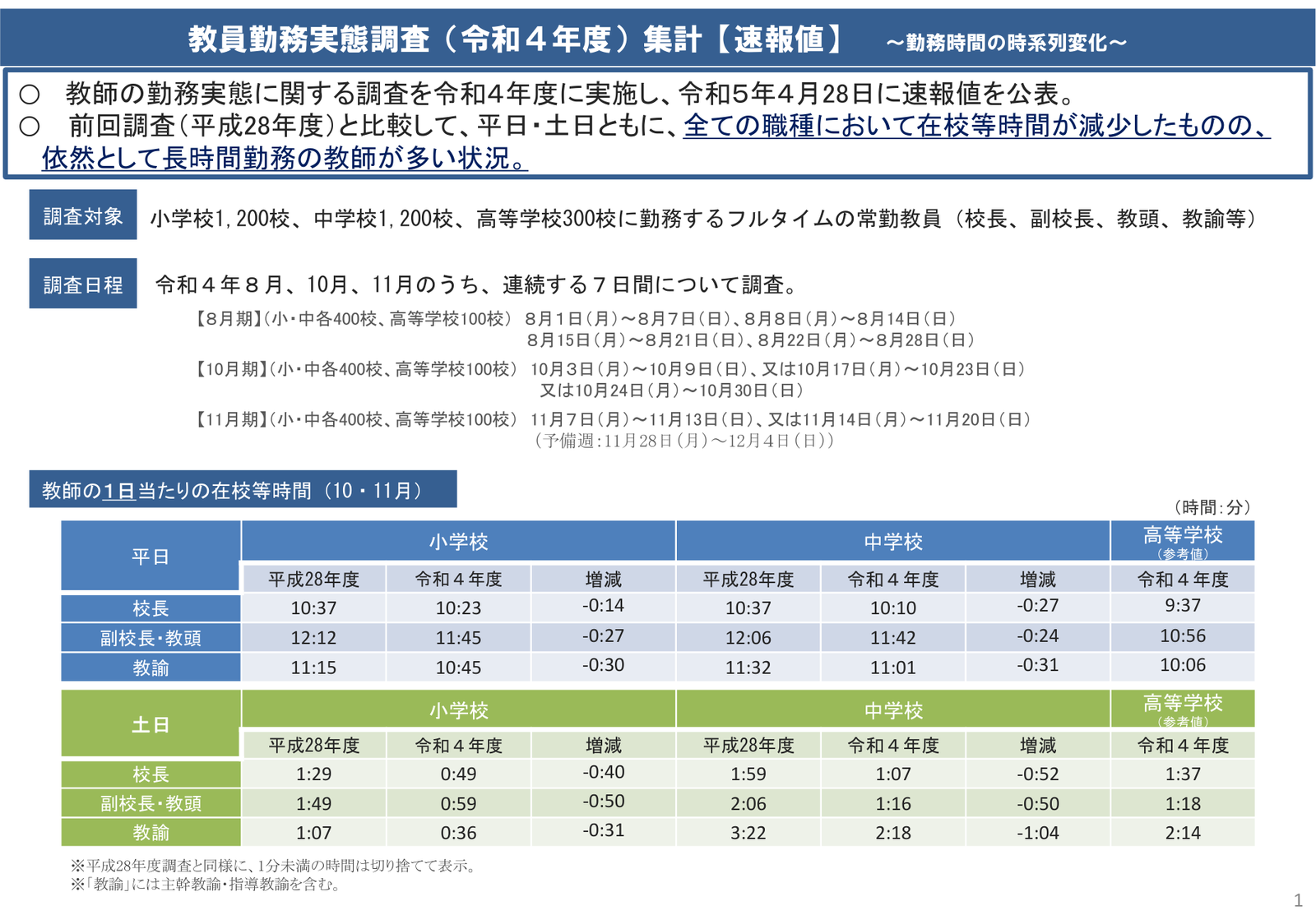
Source: Ministry of Education, "Teacher Working-Conditions Survey (FY2022), Preliminary Figures" What the numbers say is not that effort is lacking. If anything, the ground is moving toward improvement, and even so the hours are long. The reason is simple: the total volume of a teacher's work is large, and a considerable share of it is mixed with "work that does not require a teacher." Writing documents, coordinating contact, tallying, checking. Each item is small, but stacked up they become vast. And however much you want to reduce this kind of work, if there is no one to carry it, the teacher ends up holding it after all.
What matters here is the view that the fault lies not with any individual teacher's way of working, but with how the work is "held." It is hard to add people, the timetable cannot be moved, events cannot be cut. Within those constraints, could you at least shift the "work that does not require a teacher" to a different carrier? The option that has now become genuinely realistic as that carrier is AI.
Looking for AI training and consulting?
Learn about WARP training programs and consulting services in our materials.
AI-driven teaching starts by lightening the weight of administration
"AI-driven teaching" may sound grand, but the starting point is very down to earth. It begins with letting generative AI take over the drafts and checks in the administrative work that is wearing teachers out. Generative AI is AI that automatically produces text, tables and the like in response to human instructions (prompts). Picture a conversational tool such as ChatGPT.
On 26 December 2024, the Ministry of Education published the "Guidelines on the Use of Generative AI in Primary and Secondary Education Ver.2.0." This is reference material showing how to use generative AI in schools, a revision of the July 2023 interim version. What matters is that these guidelines neither blanket-ban nor mandate use in schools; they are guidance for using AI appropriately under a human-centred principle. And they state clearly that active use in administrative work, such as lesson preparation and drafting various documents, is expected to lead to more efficient administration, higher quality, and work-style reform for staff2. In other words, the state positions administrative AI use not negatively but positively.
What concretely changes? Let me translate the administrative examples the guidelines give into everyday scenes.
| The work so far | How it changes with AI |
|---|---|
| Writing a grade newsletter or event notice from scratch | Convey the key points, have it produce a draft, and the teacher concentrates on touching it up |
| Building a check quiz from zero | Have it make a draft, then reselect to fit the aim |
| Producing minutes from a training or meeting recording | Have it make a summary draft, verify the facts, and finish it |
| Adjusting parent-interview dates one by one | Delegate the organising of candidate dates and the drafting of the notice |
The point is the mindset of having AI produce not the "final deliverable" but the "draft." Work that creates from zero eats both time and energy, but the work of correcting a draft that has appeared is far lighter. Adjusting the tone of the wording, filling in what is missing, tailoring it to your own school's circumstances. That part only a teacher can judge. But if you can shorten the very time spent facing a blank screen, that alone changes the margin left in your after-school hours.
This way in, starting from administration, is far safer and shows results more clearly than trying to change lessons with AI straight away. First the teacher personally becomes less burdened. A little time comes back. Only once you have that tangible sense does the next question, of how to use AI for students' learning, take on reality. On how to design this flow across a whole school, I hope you will also look at my piece on how to root AI education as a culture in a high school.
The numbers show "the build-out is done; use comes next"
Even when told to use AI for administration, some may feel "our school has no such environment." Yet the primary sources show that premise has already changed.
According to the Ministry's "Survey on the Actual State of Educational Informatisation in Schools" (FY2022 final figures, as of 1 March 2023), the number of students per educational computer was 0.9. That is above one device per student, meaning device provisioning is all but achieved. The wireless-LAN provisioning rate in ordinary classrooms was 95.7%, and the internet connection rate (100 Mbps or more) was 98.0%, so the communications environment has come into shape too3. What has supported this build-out is the GIGA School initiative. And now, in its second phase as NEXT GIGA, the renewal of one device per student is advancing. Through a fund established under the FY2023 supplementary budget, prefectures hold a five-year fund, and with a subsidy standard of 55,000 yen per device and a subsidy rate of two-thirds, the mechanism is to provision about 70% of the renewals on a planned basis by FY20254.
The digital base for administration is the same. The provisioning rate for integrated school-administration support systems, which handle multiple administrative tasks together, has reached 86.8% across all school types, and 97.5% at high schools. This rate has risen consistently from 52.5% in FY20183. In other words, the foundation for handling grade processing and roster sharing by system is already in place at many schools.
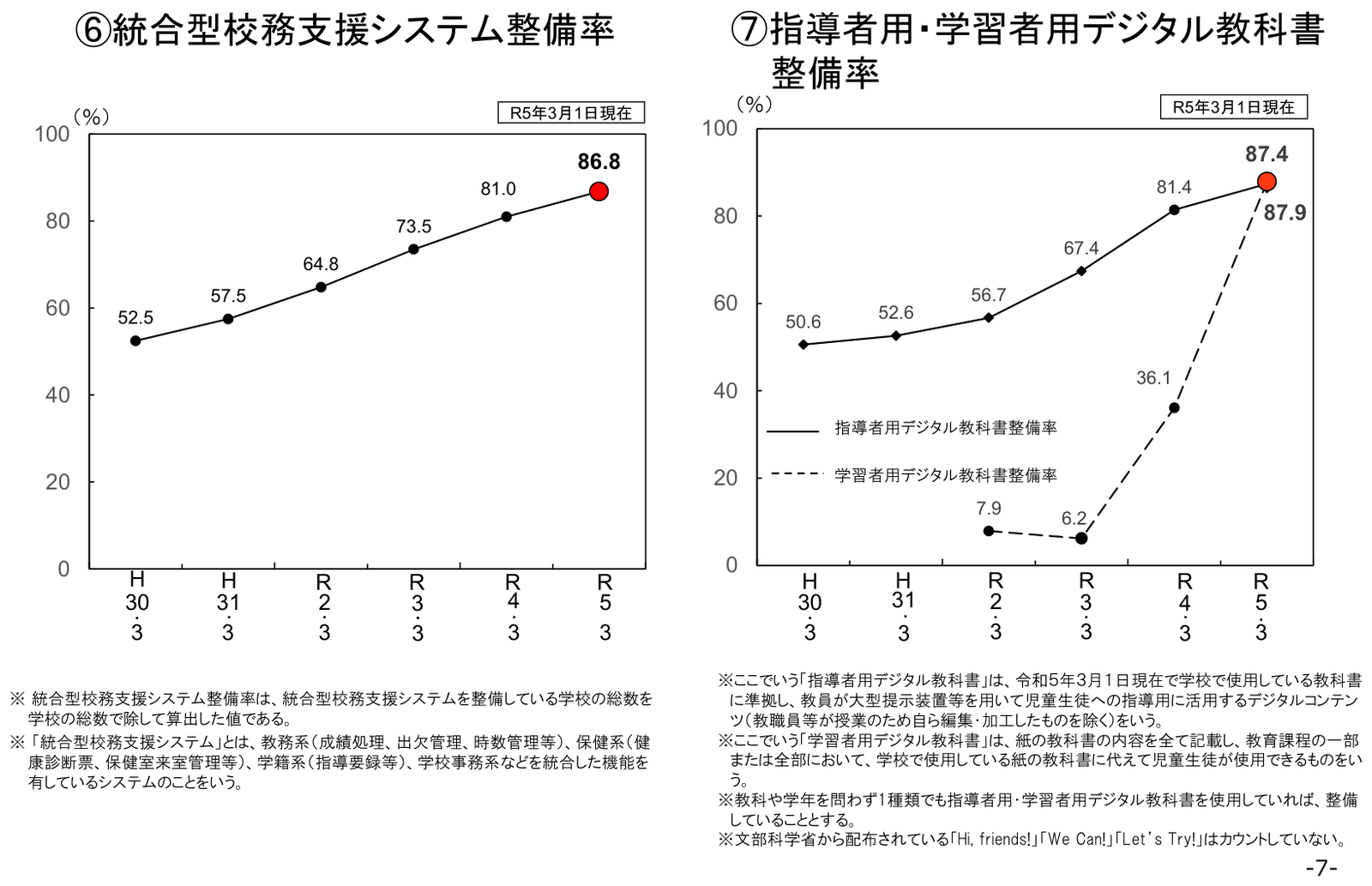
Source: Ministry of Education, "Results of the Survey on the Actual State of Educational Informatisation in Schools (FY2022, Final Figures)" Furthermore, in the working-conditions survey, almost all elementary and junior high schools (97.1% of elementary, 96.5% of junior high) answered that they carry out at least one workload-reducing effort using ICT, such as in grade processing1. Paid-leave days taken also rose, from 11.6 to 13.6 days a year at elementary schools and from 8.8 to 10.7 days at junior high schools. It can be read as evidence that efficiency gains using ICT are steadily beginning to give teachers their time back.
And at the high-school stage, DX High School (the High-School DX Acceleration Programme) is under way. This is a national programme supporting high schools that strengthen education in fields such as information and mathematics, along with cross-disciplinary, inquiry-based learning that uses ICT, and in FY2024 a total of 1,010 schools nationwide were selected (746 public, 264 private)5. It is based on a flat subsidy of roughly 10 million yen per school in principle, with additional brackets set up in some years according to the requirements6. The build-out is nearing completion, and the state's push is shifting toward "the side that uses the environment." This change of phase is precisely why I believe now is the time to start moving.
In inquiry-based learning, AI becomes the student's companion
Once administration is lightened and time comes back, what lies beyond? This is the most forward-looking part of AI-driven teaching. You become able to use the time you have reclaimed to face your students' inquiry.
Inquiry-based learning is a way of learning in which students raise their own questions, investigate, think and pull it together. Because it deals with themes that have no single fixed answer, the teacher's involvement leans less toward teaching the correct answer and more toward the role of a companion who draws out and deepens thinking. But it is genuinely very hard for one teacher to accompany the inquiry of dozens of students at once. Here generative AI can be a supplementary partner standing beside each individual student.
The guidelines I mentioned also carefully show examples of use in learning scenes. Finding a problem and setting a task, shaping one's own thinking, and organising, comparing and deepening differing views. For instance, when a group discussion has stalled, you can ask the AI about the missing perspective and push the discussion forward. You can practise as many times as you like with it as an English-conversation partner. You can have it help you give shape to an idea in programming. Such uses are listed as "examples where use can be considered"2. A partner is beside the student that they can try again and again, at their own pace and without embarrassment. This surely changes the quality of inquiry.
That said, the guidelines also drive home one point clearly. Using generative AI must not become an end in itself, reads one line2. If you have AI produce the answer and stop there, the power to think will not grow. Balance with activities where students actually use their hands, converse with people and experience things is essential, and in the end a human judges and takes responsibility. Not letting go of this premise is the single most important pivot when bringing AI into inquiry. For readers interested in the concrete approach at the high-school stage, my piece organising how to teach AI development in high school and my piece on what high-school AI education should look like going forward should also be useful references.
If you are uncertain how a school should build AI into lessons and inquiry, and how to design that, WARP for Schools shows a form of support that stays close to the education setting. Barking an order alone does not move the ground. Only when it comes paired with concrete measures that do not add to teachers' burden and that connect to students' learning does it move forward.
What you must not trade away for convenience
I have kept the tone forward-looking so far, but there are cautions you absolutely must not drop when bringing AI into education. Unless you look squarely at the risks behind the convenience, you can end up damaging trust instead.
First, the handling of information. You must not casually enter sensitive personal data such as students' names, grades or family circumstances into an outside AI service. It is essential to decide in advance, as a school-wide usage rule, which tool may handle what kind of information. Next, do not take outputs at face value. Generative AI can state content that differs from fact in plausible prose. Teaching materials, notices and exam questions must always be fact-checked and given a final check by staff before use. You must not skip this one step of effort.
Further, you need to hold the premise that AI answers may contain bias. Bias stemming from the training data can emerge as expressions leaning toward a particular view. Especially when dealing with values or social themes, an attitude of confirming multiple perspectives is called for. And keeping a record (an audit trail) of who checked what and when lets you trace the course later and brings peace of mind.
Finally, let me convey the most important thing. Do not over-trust AI. AI is a tool that aids the teacher's judgment; it is not something that teaches in the teacher's place. Reading the subtle signs in a student's expression and offering words suited to that particular child. This is work that, going forward too, only a human teacher can do. What you hand to AI is strictly the part before the judgment: drafts and adjustments. Discern where it works and where it does not. Not misjudging that line is the starting point for getting along well with AI.
The first step, and the staffroom to come
So what should you do from tomorrow? My recommendation is to pick just one administrative task, the one you feel is heaviest. Try to change everything at once and you usually run out of breath. A grade newsletter, an event notice, a check-quiz draft, any of them. First switch that one task from building it from scratch to having generative AI produce a draft that you touch up. Once you feel that lightness, the idea "maybe I could delegate this too" spreads naturally.
If you take this on across a whole school, the order matters. Rather than entering from lesson reform straight away, start from administrative AI use that makes the teachers themselves less burdened. Then direct the time and trust that arise there toward inquiry and dialogue with students. In this order, it takes root on the ground without strain. Even so, which tool to choose, what rules to lay down, and where to begin, the best answer changes with each school's circumstances. Teachers and administrators who want to design an approach to AI that fits your own school together, please consult the WARP team. Specialists who have led DX and data strategy at major companies walk alongside you month by month and help you shape it into something that lands on the ground.
To sum up
It ran long, so let me organise the key points.
- The true cause of so many teachers' fatigue lies less in lessons themselves and more in the structure that steals their time for "work that does not require a teacher," such as writing documents and coordinating contact
- Generative AI is a realistic option for taking over the drafts and checks of that administration. The Ministry's Guidelines Ver.2.0 also positions active administrative use as leading to work-style reform
- Devices have reached one per student (0.9 per device), and integrated school-administration support systems have spread to 86.8%. The build-out is nearing completion, and the state's push has shifted to the stage of use
- Time reclaimed in administration can be redirected to facing students in inquiry-based learning. AI can also be a student's companion, but using it must not become an end in itself
- Take full care over information leaks, factual errors and bias, and always have a human do the final check and keep the records. AI is a tool that aids the teacher; it is not a substitute for the teacher
- The first step is to have AI draft just one of your heaviest administrative tasks. Widening out from there without strain is the realistic path
For every bit of miscellaneous work a teacher hands to AI, time to face students comes back. It looks like a story about technology, but it is also a story about what kind of staffroom you want to be. Toward a way of working that leaves, even a little more, of the energy you can spend on the child in front of you. Try starting that first step from just one of tomorrow's heaviest administrative tasks.
References and primary sources
Footnotes
-
Ministry of Education, Culture, Sports, Science and Technology, "Teacher Working-Conditions Survey (FY2022), Aggregation [Preliminary Figures]," published 28 April 2023. https://www.mext.go.jp/content/20230428-mxt_zaimu01-000029160_1.pdf / Publication page https://www.mext.go.jp/b_menu/houdou/mext_01232.html ↩ ↩2
-
Ministry of Education, Culture, Sports, Science and Technology, Elementary and Secondary Education Bureau, "Guidelines on the Use of Generative AI in Primary and Secondary Education Ver.2.0," 26 December 2024. https://www.mext.go.jp/content/20241226-mxt_shuukyo02-000030823_001.pdf ↩ ↩2 ↩3
-
Ministry of Education, Culture, Sports, Science and Technology, "Results of the FY2022 Survey on the Actual State of Educational Informatisation in Schools (Summary)" (final figures, as of 1 March 2023, published October 2023). https://www.mext.go.jp/content/20231031-mxt_jogai01-000030617_1.pdf ↩ ↩2
-
Ministry of Education, Culture, Sports, Science and Technology, "Advancing the GIGA School Initiative: Steady Renewal of One Device per Student" (FY2023 supplementary budget, programme overview). https://www.mext.go.jp/content/20240201-mxt_shuukyo01-000033777_001.pdf / NEXT GIGA explainer page https://www.mext.go.jp/a_menu/shotou/zyouhou/mext_02624.html ↩
-
Ministry of Education, Culture, Sports, Science and Technology, "On the Selection of Schools for the High-School DX Acceleration Programme (DX High School)," press release of 16 April 2024. https://www.mext.go.jp/content/20240416_mxt_koukou01_000033692_005.pdf ↩
-
Ministry of Education, Culture, Sports, Science and Technology, "FY2024 High-School DX Acceleration Programme (DX High School)," programme page. https://www.mext.go.jp/a_menu/shotou/shinkou/shinko/1366335_00009.htm ↩
![A “Third Path” for High School Careers in the AI Era: Rethinking White-Collar Competition and Skilled Trades [Part 1]](/images/columns/highschool-ai-skilled-trades-part1-2026/cover.en.png?dpl=dpl_GTagW71VKjD4VDo3w4ymrXrCfn1y)
![Piping, HVAC, Electrical, Maintenance: How to Choose Fields and License Ladders for Field × AI [Part 3]](/images/columns/highschool-ai-skilled-trades-part3-2026/cover.en.png?dpl=dpl_GTagW71VKjD4VDo3w4ymrXrCfn1y)