A Vast Hall Where the World's Leading Researchers Gathered
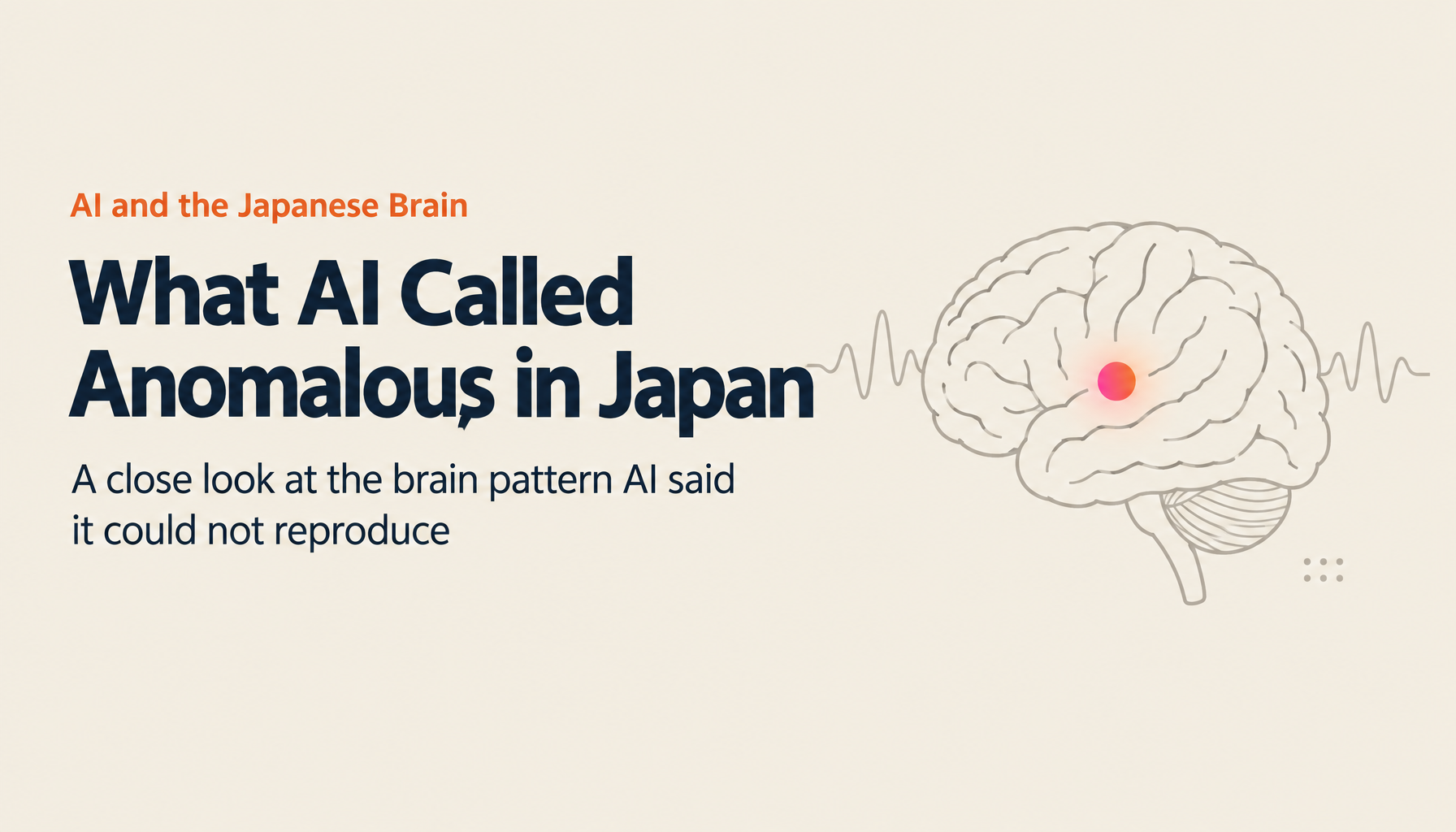
In a vast hall where the world's leading researchers gathered, the most advanced AI ever developed to analyze human brain activity presented its results. As representatives from every nation held their breath, the AI delivered its analysis — and in a finding that left the room in stunned silence, while brain activity patterns around the world were nearly uniform, one country alone showed anomalous readings. Remarkably, the subjects in question were Japanese. The AI declared Japanese thought patterns "anomalous" — not in the sense of self-optimization, but recording a phenomenon where order emerges naturally even in the absence of commands or instructions. The AI stated that "the Japanese brain exceeds the limits of my analysis," and without being able to determine the reason, sent shockwaves through researchers across the globe.
This article explains in detail the full picture of the brain activity the AI analyzed in Japanese people, with specific examples and live demonstrations. How do Japanese people unconsciously optimize entire societies, moving in harmony and empathy rather than following orders? In the phenomenon where people naturally yield to one another and quietly help each other without any instruction, there is a sense of "silent coordination" that cannot be explained by scientific numbers alone. While many countries pursue self-centered gain, the Japanese behavioral principle chooses long-term trust and harmony over short-term results — ultimately creating the most stable social order.
This article conveys in detail the full process by which AI analyzed Japanese brain activity, and why those results were incomprehensible even to scientists around the world. The pages that follow introduce, without reservation, the surprising truths hidden in the AI's analytical results, and the benefits that Japanese people's unique brain characteristics bring to society as a whole.
The Moment the World Froze | The "Anomalous Data Found Nowhere Else" That AI Discovered in the Japanese Brain Why Only Japanese? The Reason AI Declared "Silent Coordination That Works Without Commands" as "Unreproducible" The End of Competitive Society? The Day Japan's "Empathy Economy" Becomes the Social Model for the Next Generation Summary
Take AI-driven development all the way to production
WARP is a hands-on program for teams who want more than headlines. Former enterprise DX and data strategy leads work alongside you until it runs.
The Moment the World Froze | The "Anomalous Data Found Nowhere Else" That AI Discovered in the Japanese Brain
The most advanced AI, said to possess the world's greatest computing capability, collected research data from around the world to thoroughly analyze brain structures across nations, and published its findings. The venue was a scene where researchers at the forefront of science gathered, staring breathlessly at the countless brain wave data, neural transmission patterns, thinking speeds, empathy levels, ethical tendencies, and other figures displayed on a giant screen. The analysis found that while data from the US, Germany, France, China, India, and other major countries all moved in nearly the same pattern, Japanese brain activity alone was detected as "anomalous." This was unpredictable for many researchers and was recorded as a phenomenon even AI could not reproduce, with the assessment that "the Japanese brain stands in a class apart from other nations."
The moment the results were announced, the room froze. Researchers attempted various verifications, suspecting algorithmic bugs or input errors, but no matter how many times they re-analyzed, the same results kept appearing — leaving them unable to avoid shock. The calm, clear voice the AI emitted in the venue resonated: "Japanese brain activity does not match models of other nations, and is generating irrational order that is incomprehensible to existing algorithms." These figures meant that an order transcending rationality existed there, and although representatives of each nation voiced doubts one after another, not a single person could find grounds to deny it.
Initially, scientists thought that individual human behavior should be interconnected as a result of self-optimization — that is, following commands or pursuing gain. In the Japanese case, however, the unique cultural background of consideration for others and suppressing one's own impulses was said to be generating a harmonious order as a whole. In other words, rather than Japanese people acting independently, a phenomenon was observed where they prioritize the safety and happiness of those around them and move together in the same direction even without instruction.
To elucidate this remarkable phenomenon, AI analyzed tens of billions of social data points and scrutinized neural transmission and brain activity among Japanese people. The results revealed that, uniquely among all nations' patterns, Japanese people possess a kind of "silent coordination." The very phenomenon of order spontaneously arising even without commands or instructions is said to be a uniquely Japanese system inexplicable by conventional logic. In one corner of the venue, a neurologist objected "the human brain should operate individually," but the AI continued to present the next analytical result without changing: "Among Japanese people, cooperative behavior naturally emerges even in the absence of a leader. This irrational behavioral principle is what creates stability across the whole of society."
Such cultural backgrounds are considered one of the reasons why AI expressed what it found in its analysis as "order transcending rationality." Scientists named this phenomenon "Japan's Silent Coordination" and stated definitively that it constitutes a unique network where information is shared and people are connected at the heart without commands.
These characteristics are not a temporary trend, but appear to be values that have permeated throughout the whole of society over long years. The calm response seen in times of disaster is also considered an extension of this cultural background.
The AI ultimately recorded the scale of Japanese brain activity and the cultural characteristics behind it as "irrational order," and concluded that this is not mere coincidence but "evidence of evolution" that carries great implications for humanity's future. The AI stated that "the Japanese brain is an intellect that exceeds my analytical capacity, and its existence should be measured not by logic but by the warmth of the heart." The researchers assembled in the venue, though astonished at those words, nonetheless expressed their respect for this mysterious phenomenon in unison.
This analysis is highly likely to have major implications for future AI development and social system design — the mechanism by which autonomous coordination arises without commands or instructions may well hold the key to future societies. Japanese people's unconscious behavioral patterns — "silent coordination" — will not simply be dismissed as a cultural phenomenon, but will continue to be scientifically re-examined as a foundation of evidence.
The anomaly seen in Japanese brain activity and the cultural network lurking behind it remain a great mystery that the world's researchers have yet to elucidate, while simultaneously attracting attention as a future social model. In the modern era where science and technology are advancing, it has provided an opportunity to think anew about how much power human emotion, trust, and unconscious coordination — which cannot be fully expressed by numbers and algorithms alone — truly hold.
Why Only Japanese? The Reason AI Declared "Silent Coordination That Works Without Commands" as "Unreproducible"
As shown by the above analysis, the special order possessed by the Japanese brain is thought to be the result not of a mere coincidental phenomenon, but of deep cultural background and history. Based on the analytical data the AI presented, we explain with specific examples the behavioral principles unique to Japanese people and their impact on society. First, in analyzing thought patterns across humanity, AI reported that brain activity in Japanese people showed a completely different pattern from other nations. That pattern is not the so-called "self-optimization" algorithm, but rather something irrational — where people yield to each other and prioritize the safety and happiness of others above all else.
Without a single person raising their voice, simply reading the atmosphere of the situation and matching their behavior to each other — this is the unique thought pattern possessed by Japanese people. In the immediate aftermath of an earthquake, when trains stop and signals go out in a state of emergency, people were seen yielding to each other and quietly moving to secure their own and others' safety. Without a single person raising their voice, simply reading the atmosphere of the situation and matching their behavior to each other — this is the unique thought pattern possessed by Japanese people.
In daily life as well, behaviors such as respect for superiors and elders, and consideration for others, function as factors generating overall order. The tendency to value empathy and understanding of others is thought to be maintained at a high level from a social psychological standpoint, even if it cannot be measured in numbers.
This behavioral principle, which might even be called irrational, appears at first glance to be incalculable and far removed from an efficient system. However, behind it, trust and harmony built from a long-term perspective certainly exist. According to AI's analysis, Japan's social model may indeed fall short in short-term productivity compared to a self-centered competitive society, but in the long term it realizes a social order with higher happiness levels and extremely low stress from conflict and isolation. In this respect as well, the outstanding effects of Japan's "silent coordination" are clearly evident.
Furthermore, as a concrete social example, we can point to behavior at disaster volunteer sites. For example, when a major disaster occurs, in the disaster area, even without official commands or manuals, individuals spontaneously begin relief activities, and scenes of people supporting each other in rescue and evacuation while yielding to each other have been confirmed in great numbers. This is precisely a concrete example of the "culture of sensing others' needs" functioning without instruction, and the "unconscious coordination" possessed by the Japanese brain has become a great force protecting the safety of the whole in times of emergency.
In everyday settings too, such as schools and workplaces, a pattern clearly appears where Japanese people sense the feelings and situation of others on their own judgment and act to avoid unnecessary conflict or competition. Reading the atmosphere without relying on words, and sensing each other's intentions through that atmosphere — these are the fruits of human sensibility that simply cannot be contained within mathematical models.
The reasons behind AI evaluating this phenomenon as "unreproducible" and "incomprehensible" are thought to include the following factors:
- Behavior showing consideration for others functions not as an individual thought pattern, but as part of the whole group
- Unpredictable behavioral patterns where movements across the whole become unified naturally even without commands or instructions
- Communication through "atmosphere" and "silence" that does not appear in numerical data
- A behavioral principle that prioritizes long-term trust relationships and places the happiness of the whole above short-term personal gain
These factors are beyond imagination from within conventional rational systems, and are also the reason AI's algorithms couldn't handle it. In other words, Japanese thought has a complex structure that cannot be captured by simple numerical analysis alone, because each individual action is driven not just by individual rationality but by collective emotions and cultural background.
Academic conferences also saw fierce debate about these phenomena. One professor said "Japanese people do not follow orders — they read the atmosphere and naturally seek harmony. As a result, a paradoxical phenomenon is confirmed where the individual loses out, but the group gains." Another researcher stated "this is precisely a dimension that exceeds the limits of human intelligence, and hints for an incalculable future are hidden here."
This discussion has come to be understood as a fusion of complexity and emotion that cannot be fully explained within conventional scientific frameworks, and many researchers recognize it as something that gives great implications for future AI development as well. This phenomenon shows a complexity that AI cannot analyze with simple algorithms, and backs up the fact that human emotions and culture are difficult to quantify. This situation presents the reality that even the most cutting-edge AI cannot come close to human rich emotion and culture, and the intelligence lurking in silence.
As such, the characteristics of Japanese thought that AI has revealed are not derived from mere numerical data or logical frameworks, but from the depths of human emotion, tradition, and culture. In the age ahead, it is hoped that scientists and technologists around the world will focus on this "secret of generating harmony despite apparent irrationality," and apply it to future social systems and AI development. Whether the day will come when technology that can understand and reproduce this emerges — the answer is left to the progress of future research.
The End of Competitive Society? The Day Japan's "Empathy Economy" Becomes the Social Model for the Next Generation
As the AI's analysis revealed, the Japanese brain possesses an entirely new type of intelligence and coordination system that cannot be explained by conventional rationality alone. Here, through specific examples and simulation footage, we consider in detail the culture behind it and its impact on real society. First, the behavioral principle of Japanese people is based on a unique psychological pattern of caring for others and feeling the happiness of others as one's own. AI recorded this in contrast to conventional self-interest-pursuing thought. Even if the individual loses short-term gain, the mechanism by which yielding to and cooperating with others produces the optimal order for society as a whole was confirmed.
Not limited to disaster response, this culture of "sensing and acting" naturally manifests in everyday life and economic activities as well.
Japan's society also features a culture of learning from failure and shame, and the value of prizing humility and sincerity even when the individual suffers some loss is deeply rooted. Researchers evaluate this behavioral principle as "irrational but sustainable order" and are paying attention to it as a new model for human society. Specifically, behaviors that appear inefficient in competitive societies were shown even in simulation results to have the effect of reducing overall social stress and raising happiness levels.
At the root of this phenomenon lies the concept of the "empathy economy." That is the idea that trust relationships between people that cannot be measured by monetary value or power alone directly connects to economic activity. In Japanese society, behaviors of yielding to each other and feeling the joy and security of others as one's own happiness, as a result strengthens the overall cohesion of society and generates its stability. According to AI's analysis, this appeared precisely as the phenomena of "working without commands" and "helping each other without instruction" in various simulation footage as well.
Furthermore, Japanese brains showed the characteristic that before speaking, they sense the expression and atmosphere of the other person, and empathy areas activate in advance. The fact that mutual silence holds meaning in everyday conversation is also a deeply rooted cultural matter. In other words, the ability to read the atmosphere of a situation without saying anything and take appropriate action is precisely what forms the foundation of social order without waiting for commands or instructions.
Taking such situations into account, future social systems will increasingly require a new model centered not on conventional efficiency-focused competitive society alone, but on human sentiments, trust, and empathy. Researchers call this the "Japanese collaborative model," and confirmed in simulations that it surpasses conventional rational competitive society in the following respects:
- Decrease in crime rate and improvement in happiness
- Reduction of social stress overall through decrease in conflict and isolation
- Rapid response in disaster times through mutual yielding and helping
- Formation of an economy based on trust and empathy rather than money and power
These results are harmony born from the human heart that cannot be explained by conventional rational systems, a remarkable phenomenon that even AI describes as "incomprehensible." In Japan's actual society, these unique values cultivated through a long history and culture are established as behavioral principles for the entire nation, demonstrating certain effects in disaster times and in everyday life.
This culture of consideration and cooperation is shared in every setting — education, the workplace, local communities — and is an important characteristic supporting the foundation of Japanese society.
For example, actual cases are reported of other members sensing a person's intent and reacting before they speak during a meeting. This phenomenon is an extremely valuable aspect in that it generates a sense of unity as a whole even without clear instructions in text or voice, and is also attracting attention as a model for future social systems.
Behind this lies the deeply rooted culture of nurturing consideration for others in education, traditions, and within families and local communities. Japanese school education emphasizes group behavior, cooperativeness, and the virtue of self-restraint, and high trust and empathy are also cultivated in homes and local communities. These have resulted in appearing in the brain activity of Japanese people as a whole, and crystallizing into the phenomenon of "silent coordination" that AI captured.
And experts say these phenomena will have major impacts not just as moving episodes, but on ethical recycling structures, security, and economic policy in modern society as well. This kind of analysis has become an opportunity to think anew about the mechanisms by which culture and trust form social order.
Such Japanese-style thinking and behavioral principles are by no means based on simple rationality. Rather, the process by which each person unconsciously senses the intentions of others and builds relationships of trust is precisely the "empathy economy" itself. As AI's analysis shows, Japanese people respond naturally to surrounding situations and work to maintain overall order without waiting for commands or instructions. This behavioral principle of Japanese people — bearers of a new intelligence — should be highly evaluated as a future social model, and may have major impacts on the shape of future global social structures going forward.
Summary
This article has conveyed, without reservation, the full picture of the "anomalous order" and "silent coordination" that state-of-the-art AI's analysis of Japanese brain activity shows — including the analysis process, cultural background, and specific phenomena in real society. Scientists from around the world were astonished, and came face to face with the question of why Japanese people alone form order based on trust and empathy naturally, without relying on commands or the pursuit of gain. From relief activities in disaster times to everyday schools and workplaces, to group behavior — the unique thought pattern of Japanese people transcends short-term rationality and creates long-term happiness and security. Even AI itself keenly felt the limits of its computational capability and was forced to admit "I cannot reproduce this" — this phenomenon gives great implications for the formation of new ethics and economics in modern society, and for the shape of future social systems.
Going forward, no matter how much technology evolves, the communication that lies in human heart, trust, and silence will be passed down as a valuable quality that cannot be captured by mere numbers and algorithms. The quiet intelligence of Japanese people brings new hope and reassurance to people around the world, and its future potential is immeasurable.
As this article shows, a way of society based not on commands and instructions but on trust and empathy is the new model needed for the era ahead. We should learn from that "quiet intelligence" that AI could not elucidate, and explore a new order that connects to the future.
The accumulated insights and discussions outlined above will become an extremely valuable body of knowledge for building the future society. Please receive much inspiration from this silent coordination and empathy-filled thinking unique to Japanese people, and use it to help construct a new society for the next generation.
Reference: https://www.youtube.com/watch?v=feDnMdVmwQ8
Streamline Event Management with AI | TIMEWELL Base
Struggling with large-scale event operations?
TIMEWELL Base is an AI-powered event management platform.
Track Record
- Adventure World: Managed Dream Day with 4,272 participants
- TechGALA 2026: Centrally managed 110 side events
Key Features
| Feature | Result |
|---|---|
| AI page generation | Event page completed in 30 seconds |
| Low-cost payments | 4.8% fee (industry-leading low rate) |
| Community features | 65% continue engaging after events |
Feel free to reach out for a consultation on streamlining your event operations.