Nvidia GTC 2025 Deep Dive: The Shift to the AI Inference Era and the Impact of Next-Gen GPU "Vera Rubin"
Nvidia GTC 2025 Deep Dive: The Shift to the AI Inference Era and the Impact of Next-Gen GPU "Vera Rubin"
Nvidia's annual GPU Technology Conference (GTC) returned this year with the latest technology and roadmap announcements shaping the future of AI. As Frank Downing discussed in Brainstorm Episode 82, GTC 2025 stood sharply apart from past conferences — most notably in its dramatic focus on AI "inference" rather than training. Nvidia has long emphasized improvements to AI model training performance, so why has the company now pivoted its strategy so decisively toward inference?
This article draws on Frank Downing's analysis to examine the hardware and software evolution announced at GTC 2025 — including the stunning performance leaps delivered by the next-gen "Blackwell" GPU architecture and the "Vera Rubin" beyond it, the intensifying competition from custom silicon, and Nvidia's expansion into physical AI applications including humanoid robots and autonomous driving. What future does Nvidia, the dominant force in AI chips, envision — and what changes will it bring to our society? Let's break it all down.
- The Strategic Pivot to Inference: GTC 2025's New Era for Nvidia and Hardware Evolution
- The Intensifying Competitive Landscape: The Rise of Custom Silicon and Nvidia's Response
- Deploying AI in the Physical World: The Frontlines of Humanoid Robots and Autonomous Driving
- Summary
Take AI-driven development all the way to production
WARP is a hands-on program for teams who want more than headlines. Former enterprise DX and data strategy leads work alongside you until it runs.
The Strategic Pivot to Inference: GTC 2025's New Era for Nvidia and Hardware Evolution
Nvidia's spring GTC — one of its two major annual conferences — has historically been known primarily as a venue for announcing datacenter products, particularly new GPU hardware and roadmaps. As AI's influence has grown, the conference has evolved to focus increasingly on AI, but GTC 2025 marked a clear and distinctive shift. As Frank Downing points out, the biggest takeaway from this year's GTC is the dramatic pivot in focus from AI model "training" to "inference."
Nvidia has long emphasized training efficiency — for example, the Hopper architecture delivering 4x training performance improvements over the previous Ampere generation. At GTC 2025, however, training received only minimal mention, with the bulk of announcements devoted to inference.
Why has inference become so central? The context is that when actually delivering AI models to billions of users, inference efficiency has become a major bottleneck. Reasoning models such as large language models (LLMs) generate far more tokens per query than conventional models, and the ability to process this at real time and low cost is now a critical requirement. Nvidia is addressing this challenge on two fronts: software-side efficiency gains and hardware-side evolution.
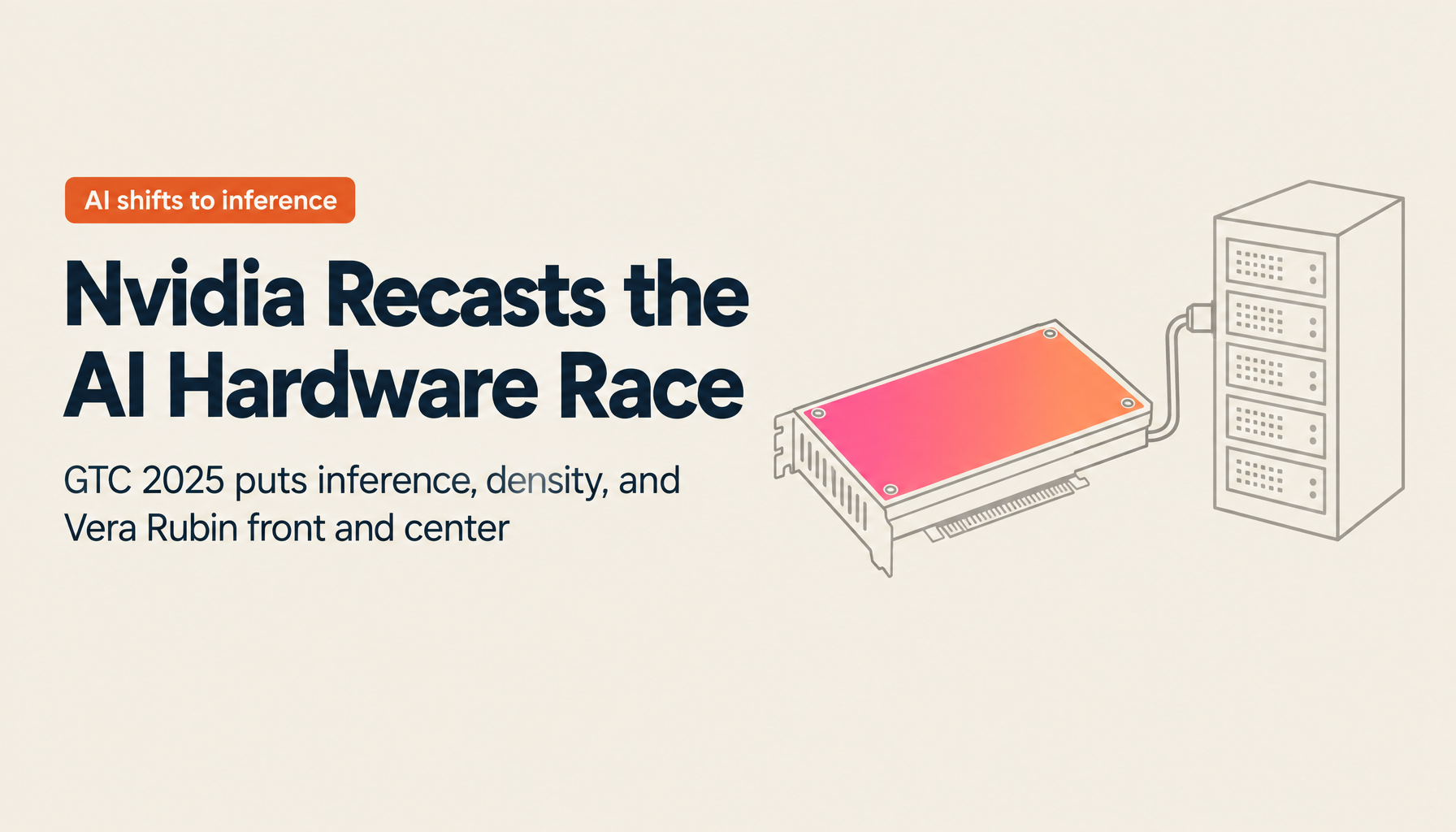
On the hardware front, Nvidia announced a long-term roadmap extending to 2027. The next generation after the "Blackwell" architecture currently being rolled out was revealed under the codename "Vera Rubin," signaling the future direction of Nvidia's evolution.
Rather than continuing to push the performance of individual GPU chips, Nvidia is shifting toward maximizing computational density and efficiency across entire datacenters. The focus has moved from what any single chip can do to how much high-density computation a datacenter "rack" can sustain.
The performance gains from this densification are dramatic. As a concrete figure: the "Vera Rubin Ultra" expected in 2027 is said to deliver up to 14x the theoretical peak compute (FLOPS) of today's Blackwell. This signals the potential for dramatically greater AI processing capacity alongside significant cost reduction.
It's worth revisiting the distinction between AI "training" and "inference." According to Frank Downing, training is the process of building an AI model, while inference is the process of running that model. Efficient training has historically required "scale-out" — synchronizing as many GPUs as possible for massively parallel computation. A few years ago, connecting 256 GPUs was considered remarkable; today clusters like xAI's Colossus link 100,000 GPUs, drastically reducing model training time.
Inference, on the other hand, places greater emphasis on "scale-up" — boosting the capacity of individual chips and racks — in addition to scale-out. Since inference requires responding to massive numbers of user requests in real time on constrained hardware, memory capacity becomes especially critical.
Over the past two to three years, AMD has offered products that surpassed Nvidia's H100 and H200 (Hopper generation) in memory capacity — and in theory, more memory should confer an advantage in inference. Yet Nvidia's chips have maintained their edge. This is because Nvidia's software ecosystem — particularly CUDA and its mature software stack built over many years — enables optimizations that more than compensate for any hardware spec gap.
With Blackwell Ultra and the subsequent generation now shipping, however, Nvidia is reaching parity with AMD on per-chip memory capacity. This should further cement Nvidia's advantage in inference performance. The focus on inference and the hardware evolution it demands represent Nvidia's clear strategy for maintaining and expanding its leadership in AI computing.
The Intensifying Competitive Landscape: The Rise of Custom Silicon and Nvidia's Response
Even as Nvidia cements its dominant position in AI computing, efforts to challenge that dominance are accelerating. Particularly notable is the rise of custom silicon designed for specific applications. This includes chips developed in-house by hyperscalers like Google's TPU and Amazon's Inferentia/Trainium, as well as startups like Cerebras and Groq. As Frank Downing notes, many of these companies are trying to establish performance advantages over Nvidia's general-purpose GPUs — particularly for inference workloads.
Cerebras leverages its enormous wafer-scale chips, while Groq uses its proprietary ultra-fast architecture to tout advantages in inference latency and throughput. These approaches carry the potential to outperform Nvidia on specific workloads, and in the long run represent credible competitive threats. Nvidia's pace of evolution is, however, extraordinary and extremely difficult to match.
The fact that Nvidia dedicated more than 90 minutes at the opening of this year's GTC presentation to inference — from the very first slide — is a clear signal to custom silicon startups: this is Nvidia's response and its preemptive defense. Nvidia was sending a strong message that its GPUs can maintain performance leadership in inference while retaining their general-purpose flexibility.
One interesting exchange in Frank Downing's discussion involved "Grok." The observation was made that for Elon Musk's xAI LLM "Grok" (starting with "K") to scale to more users, it might ironically need Groq (starting with "Q") — the inference-specialized hardware startup. This hints at the deep interdependencies between hardware and software across the AI ecosystem.
Whether GTC's announcements represented a major surprise to markets is debatable. Nvidia advancing steadily along its roadmap and delivering the expected performance gains could be read as "business as usual." But this very consistency — meeting expectations — is precisely what is necessary to solve the AI industry's biggest long-term challenge: cost reduction. AI chip performance is advancing at a pace that dramatically exceeds Moore's Law, and sustaining this trajectory requires continuous innovation from Nvidia or new entrants. The fact that Nvidia is pushing the frontier forward without major stumbles or stalls is itself a meaningful signal that the foundation for AI's future is being steadily reinforced.
One critical additional context is Jensen Huang's mention of Waymo (Google's autonomous driving subsidiary) on the GTC stage. Waymo was confirmed — publicly, for the first time — to be using Nvidia chips for both datacenter model training and the inference engines in its vehicles. This carries significant weight because Google is one of the very few companies that designs and operates its own high-performance custom silicon in the form of TPUs. The fact that Google chooses Nvidia's GPUs for autonomous driving — a domain where performance and reliability demands are exceptionally high — powerfully demonstrates Nvidia's competitive advantage.
According to Frank Downing's analysis, Nvidia's GPUs sit in a "Goldilocks zone" between full generality (like a CPU) and extreme specialization (like Groq). They're highly optimized for AI and parallel processing while retaining the flexibility to handle a wide range of workloads. This balance of flexibility and high performance is precisely why companies like Google adopt Nvidia's products even when they have their own TPUs. Too specialized and the use case narrows; too general and performance suffers. Nvidia has established the optimal position in this tradeoff — a position validated once again by the Waymo example.
Deploying AI in the Physical World: The Frontlines of Humanoid Robots and Autonomous Driving
The strategy Nvidia unveiled at GTC 2025 extends well beyond datacenter computing. The conference made clear that Nvidia is expanding into "Physical AI" — AI that operates in the real world. Two areas received particular attention: humanoid robots (a major current focus) and autonomous driving (a long-standing challenge).
On autonomous driving, Nvidia announced a new partnership with General Motors (GM) — an effort to overcome the challenges faced by GM's autonomous driving subsidiary Cruise and accelerate its progress in self-driving technology. Nvidia's high-performance automotive computing platforms are essential for processing complex sensor data in real time and making safe driving decisions. As noted above, Waymo's use of Nvidia chips in both datacenters and vehicles was also highlighted, reinforcing Nvidia's critical role in this space.
If anything drew even more attention than autonomous driving at this year's GTC, it was humanoid robots. Nvidia announced new open-source models and datasets to accelerate humanoid robot development. Of particular note is "Project GR00T" — a foundation model for humanoid robots — alongside a new computer called "Jetson Thor." Libraries for robot arm manipulation and autonomous mobile robots, "Isaac Manipulator" and "Isaac Perceptor," were also enhanced. Additionally, 15 tabulated datasets covering physical robot movement — encompassing both real-world and simulation (synthetic) data — were released. This is intended to reduce the development barrier by addressing the shortage of training data in the early stages of humanoid robot development.
Frank Downing offered an interesting observation about Nvidia's open-sourced model "GR00T N1": it appears structurally very similar to the "Helix" system announced by Figure AI a few months earlier — a two-model, two-chip architecture. In Figure AI's Helix, one model/chip understands the surrounding environment while the other controls the robot's physical actions based on that understanding. For example, the system can understand the instruction "Frank, grab my glasses and hand them to me," identify who "Frank" is and which item "the glasses" refers to, and execute the grasp-and-handoff through coordinated situational understanding and motor control. By open-sourcing this type of architecture, Nvidia may enable far more companies and researchers — not just early movers like Figure AI — to develop high-performance humanoid robots.
Recent videos show Boston Dynamics' robots acquiring locomotion capabilities through reinforcement learning, a meaningful step toward greater generality. One video showed a humanoid robot performing a torso rotation physically impossible for a human. This suggests robots may not merely mimic humans but leverage their mechanical properties to exceed human physical capability — a genuinely fascinating prospect. While much remains uncertain in humanoid robot development, Nvidia's intent to become an ecosystem-enabling platform provider in this space is clear.
The physical AI discussion is also tied to China's trajectory. China is advancing rapidly across AI, with numerous companies pursuing humanoid robot development. Chinese companies are also increasingly open-sourcing AI models. Frank Downing notes that this open-sourcing trend may actually increase — rather than decrease — demand for Nvidia's chips. Chinese tech giants like DeepSeek, Tencent, and Baidu are each developing their own ChatGPT-like services, with domestic demand expanding — and all face the same constraint: a shortage of compute. The availability of open-source models is expected to further accelerate AI development and service deployment within China, creating demand for even more high-performance chips.
Finally, the semiconductor industry's cyclicality must be addressed. Demand for Nvidia's GPUs is surging in the AI agent era, but this will not go on indefinitely. In the long run, there is a plausible scenario in which companies over-invest in AI infrastructure, creating a temporary "over-buy" phase where demand temporarily exceeds rational need. Recent reports of Microsoft reducing its Nvidia chip purchases may be one early signal — a development likely directly connected to OpenAI (Microsoft's largest AI customer) diversifying its compute procurement beyond Microsoft Azure. Individual players' strategic shifts can ripple through industry-wide demand dynamics. Nvidia's multi-pronged strategy — pivoting to inference, expanding into physical AI — may be designed in part to build resilience against this inevitable cyclicality.
Summary
Nvidia GTC 2025 was a landmark event, signaling that the frontier of AI computing has entered a new chapter. What Frank Downing's analysis reveals is that Nvidia is not merely continuing its prior emphasis on training efficiency — it is now treating inference efficiency and scalability as the top priority, offering strong hardware and software solutions on both fronts. The dramatic leaps in computational density and performance from the next-gen "Blackwell" architecture and the "Vera Rubin" beyond it will form the foundation for the continued proliferation of large language models and generative AI.
The emergence of custom silicon startups like Cerebras and Groq signals an intensifying AI market. Yet as the Waymo example shows, Nvidia's GPUs retain powerful competitive advantages through their balance of general-purpose flexibility and high performance — and GTC's focus on inference is a clear declaration of intent to maintain and extend that advantage.
Furthermore, the expanding commitment to physical AI — humanoid robots and autonomous driving — signals that Nvidia is working to dramatically extend the scope of AI's applications from the digital world into the physical one. By providing open-source models and datasets, Nvidia is poised to accelerate ecosystem development in this domain and catalyze new waves of innovation.
External factors — China's AI trajectory and the semiconductor industry's inherent cyclicality — present considerations worth monitoring. But the vision and technology roadmap Nvidia presented at GTC 2025 leave a strong impression: the company intends to remain the central actor in the AI revolution for the foreseeable future. AI technology's evolution will not stop, and it will bring further transformation to our businesses and lives. Nvidia's trajectory remains one of the most important indicators for understanding what that future holds.
Reference: https://www.youtube.com/watch?v=uYyoEB6Xu58
TIMEWELL AI Adoption Support
TIMEWELL is a professional team supporting business transformation in the AI agent era.
Services
- ZEROCK: High-security AI agent running on domestic servers
- TIMEWELL Base: AI-native event management platform
- WARP: AI utilization and workforce development program
In 2026, AI is evolving from a tool you use to a colleague you work with. Let's think through your company's AI strategy together.