This is Hamamoto from TIMEWELL
This is Hamamoto from TIMEWELL.
Looking for AI training and consulting?
Learn about WARP training programs and consulting services in our materials.
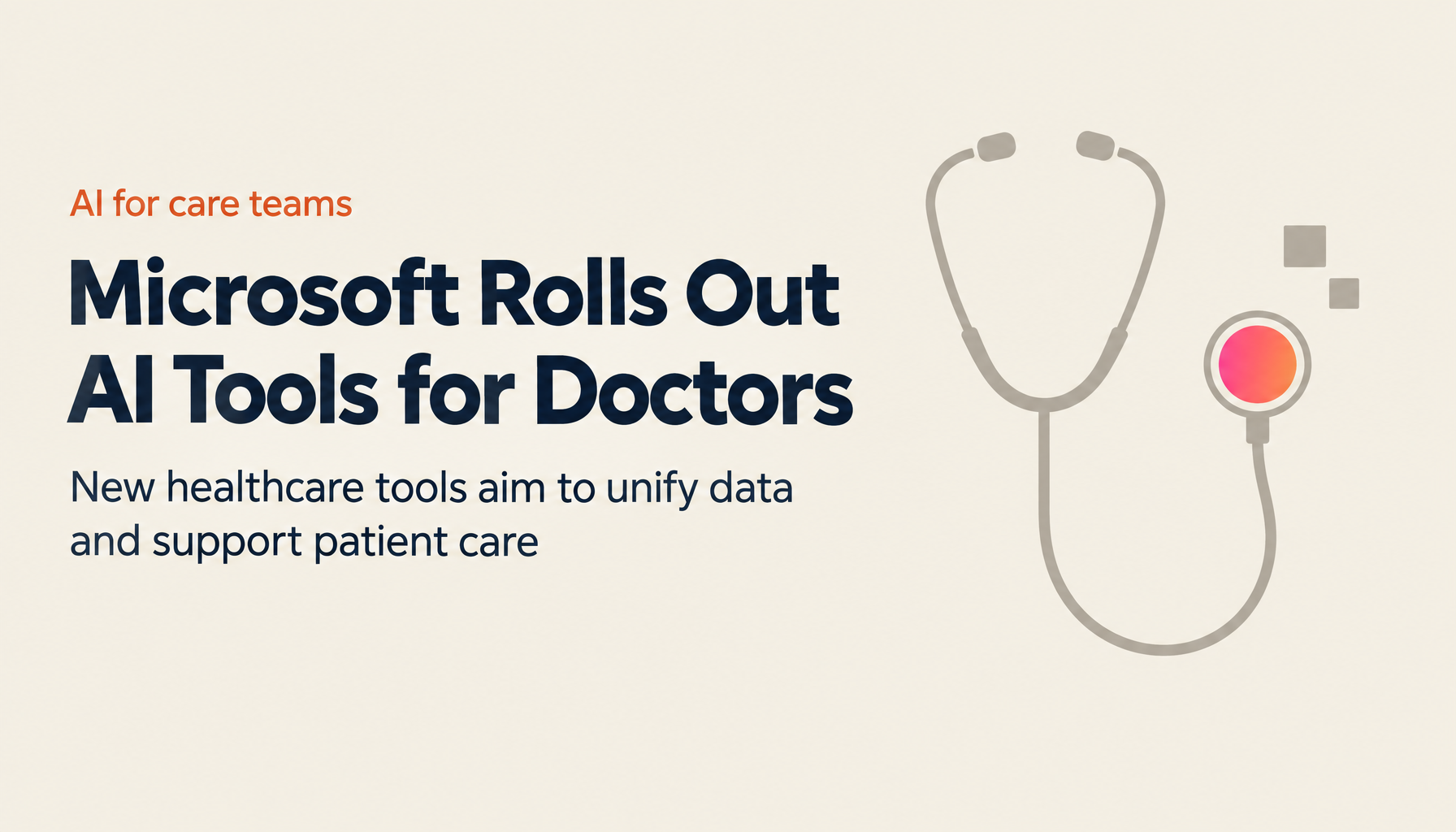
Microsoft Announces New AI Tools for Doctors
Microsoft Announces New AI Tools for Doctors
Microsoft has announced new data and AI tools to help healthcare organizations manage and learn from the vast amount of data they collect.
Fabric, a data and analytics platform, combines and standardizes data from various health sources to make it easily accessible to healthcare providers.
Azure AI introduces three models — AI Health Bot, Text Analytics for health, and Azure AI Health Insights — to support patient care.
These tools aim to improve patient experiences, help healthcare professionals make informed decisions, and streamline data processes.
Many of the new solutions are available in preview starting Tuesday.
Published: Tuesday, October 10, 2023, 12:00 PM EDT
Updated: Tuesday, October 10, 2023, 1:58 PM EDT
Updated: Tuesday, October 10, 2023, 1:58 PM EDT
Microsoft introduced new tools in Microsoft Fabric and Azure AI for healthcare organizations.
The new products combine data from sources such as electronic health records, imaging, laboratory systems, medical devices, and billing systems, allowing organizations to standardize it and access it all in one place.
Microsoft said the new tools will also help eliminate the "time-consuming" process of searching each of these sources one by one. This allows healthcare providers to focus on care.
On Tuesday, Microsoft announced new data and artificial intelligence products aimed at helping healthcare organizations easily access and learn from the mountains of information collected by doctors and hospitals.
According to a recent Deloitte report, the healthcare and life sciences industry generates more than 30% of all data produced worldwide. However, it can be difficult to leverage all that information because it is stored across different systems and formats. For example, approximately 97% of data generated in hospitals is said to go unused.
To address this problem, Microsoft announced at the HLTH conference in Las Vegas on Tuesday that it had developed new healthcare-specific tools within Fabric, a data and analytics platform announced in May. This will combine data from sources such as electronic health records, imaging, laboratory systems, medical devices, and billing systems, allowing organizations to standardize it and access it all in one place. Microsoft said the new tools will help eliminate the "time-consuming" process of searching each of these sources one by one.
Microsoft Fabric for Healthcare
Microsoft Fabric for Healthcare
Microsoft is testing healthcare Fabric with select customers including Northwestern Medicine, Arthur Health, and SingHealth, and it became available in preview starting Tuesday.
Doug King, Chief Information Officer of Northwestern Medicine, said that while Northwestern is still in the process of migrating data to the Fabric system, the organization is already excited about its potential.
He said that integrating different data will ultimately contribute to improved care and increased patient numbers in healthcare systems.
"Data is now king in healthcare, and it's relevant to understanding what's happening in the operating room, how many patients are coming in, how many patients are leaving the hospital or home, and how to get them in faster," he said in an interview with CNBC.
King said that while Northwestern is carefully implementing Microsoft's technology, if done well it will be "a game changer." He said the organization is thinking about future applications such as managing patient flow and staffing, and how to integrate broader population health data like where food deserts are located into care.
"The current state of technology — including Microsoft Fabric, Azure, generative AI, all of it — will change the way we live. And it will change the way we provide patient care. That's probably one of the best ways to solve some of the biggest problems we have in healthcare," he said.
Microsoft's New Patient Timeline Model
Microsoft's New Patient Timeline Model
On Tuesday, Microsoft introduced new tools within Azure AI services for healthcare organizations.
The company plans to offer a new generative AI chatbot called Azure AI Health Bot, which can draw from the organization's internal data as well as trusted external sources such as the Food and Drug Administration and the National Institutes of Health.
Linishya Vaz, Principal Product Manager at Microsoft Health and Life Sciences, said this chatbot can be used to help staff within organizations ask questions about how to treat specific conditions and about internal protocols and processes. She added that patients can also use the chatbot within their patient portal to ask clear questions about symptoms and medical terminology they encounter.
"Very Importantly, We've Built
"Very importantly, we've built guardrails and safeguards into this process," Vaz told reporters at a press briefing. "There are ways to validate this information, and we enable customers to audit the answers to make sure they're reliable."
Microsoft also announced another solution called Text Analytics for health. This can label and extract key medical information from various unstructured data sources such as clinical documents and notes. According to Vaz, this tool will be released in Spanish, French, Italian, German, Portuguese, and Hebrew in addition to English.
Finally, Microsoft announced three new models within Azure AI Health Insights. This provides tools to help doctors, nurses, and researchers make more informed decisions.
The First Model, Patient Timeline, Uses
The first model, patient timeline, provides clinicians with a simple, chronological overview of a patient's medical history by integrating information from different unstructured data sources using generative AI.
"You can immediately visually see that there was a medical encounter here, a procedure was performed here, this is a medication someone was taking, and [clinicians] can get a very good picture," said Vaz.
The second model, clinical report simplification, allows clinicians to use generative AI to simplify reports filled with complex medical terminology into language that patients can more easily understand. And the final model, radiology insights, is designed to assist clinicians and radiologists by identifying errors and inconsistencies arising across different reports. This model can also provide follow-up recommendations.
Vaz said Microsoft's new healthcare tools within Azure AI will improve patient experiences and help clinicians focus on providing better care. According to Microsoft, the new solutions are available in preview capacity starting Tuesday.
Reference: https://www.cnbc.com/2023/
Image reference: https://image.cnbcfm.com/api/v1/image/107313014-1696619431671-Fabric.jpg?v=1696619460&ffmt=webp&vtcrop=y https://image.cnbcfm.com/api/v1/image/107313010-1696619293246-Azure-AI-services.jpg?v=1696619335&ffmt=webp&vtcrop=y
This AI news is produced by the online assistant service "TIMEWELL."
Related Articles
- From full-time to part-time: the reality of working through two maternity leaves and how it changed my perspective on work | TIMEWELL
- Before taking parental leave: the 3 must-do points to ensure you can take leave even during busy season
- Embracing the role of a hands-on certified architect: finding my own path as the 5th generation of Fujita Construction