iPhone 17 Launch Event Deep Dive: New Features, Design, and What Comes Next
Apple's latest iPhone event at Steve Jobs Theater in Apple Park captivated not just the tech industry but a wide audience of consumers and technology enthusiasts. The iPhone 17 lineup represents a bold evolution from previous generations — incorporating camera advances, new cooling technology, and new accessories including a crossbody strap — delivering meaningful changes on multiple fronts.
The event was covered in depth by a panel including Sherin Low (managing editor), Carissa Bell (senior reporter), and Alison Johnson (senior reviewer at The Verge), who got hands-on time with the devices and shared candid assessments of what they actually felt like to hold, use, and critique. Their firsthand impressions and discussion — grounded in press images and direct handling — offer real texture to what the official presentation communicated. From camera bump design and color options to iMessage ecosystem advantages and the industry direction implied by these choices, their conversation provides a comprehensive picture of where iPhone 17 fits in the broader smartphone landscape.
- iPhone 17 Lineup and New Design: The Striking Camera Bump and the Crossbody Strap
- Battery, Cooling, and Storage: New Technology and the Real-World Tradeoffs
- Looking Ahead: Foldable Smartphones and the Evolution of Apple's Ecosystem
- Summary
Take AI-driven development all the way to production
WARP is a hands-on program for teams who want more than headlines. Former enterprise DX and data strategy leads work alongside you until it runs.
iPhone 17 Lineup and New Design: The Striking Camera Bump and the Crossbody Strap
The event introduced the full iPhone 17 series, with reviewers paying particular attention to the iPhone 17 Pro and iPhone Air. Alison Johnson noted that the Pro is the clear choice for camera-focused users — the new smaller Pro addresses the weight complaints she had with the previous Pro Max, while maintaining equivalent telephoto camera performance. She praised the overall balance of the lineup: rather than segmenting features across models, this generation offers a more coherent progression where users at each tier get a package that fits their needs across design, camera, and usability — not just a spec sheet.
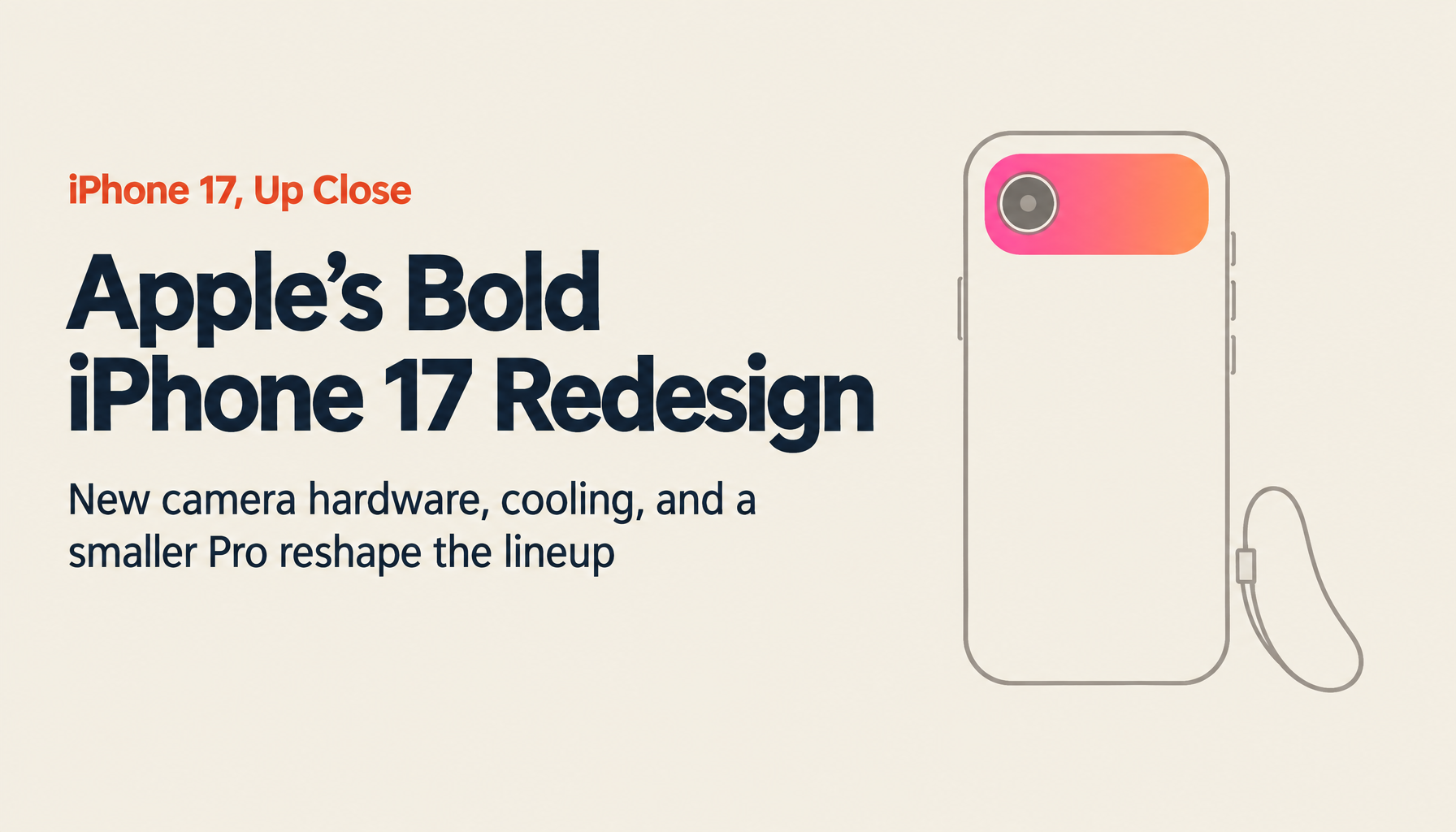
Carissa Bell welcomed the arrival of a "small Pro" that's genuinely pocketable. She emphasized that single-hand usability matters — for daily carry, a device you can actually grip without conscious effort changes the experience in ways raw specs don't capture. The orange Pro model shown at the event drew particular attention: its vivid color is bold enough to stand out as a design statement, giving users a meaningful way to express individuality through device choice. Sherin Low was more measured about the camera bump, noting that while the new module design is visually distinctive, users accustomed to the previous aesthetic will need to adjust. The bump now extends across a larger portion of the rear, and while some pre-event leaks had predicted something even more prominent, the actual implementation came across better in person than expected.
The crossbody strap accessory generated enthusiastic applause at the event, but hands-on impressions were mixed. Sherin Low observed that most people keep their phone in their hand or pocket, which limits the situations where a strap provides real utility — though she acknowledged the fashion angle and the genuine need for strap-based carrying when wearing clothing without pockets. Alison Johnson found it more appealing, noting she has seen similar styles abroad and sees real appeal in a design that combines practicality with aesthetic intentionality. Carissa responded positively to the security aspect — the confidence of knowing your phone can't drop — while noting that strap length and balance adjustability would determine whether it actually works well in practice.
Display sizing across the lineup offers multiple options: iPhone 17 Pro in 6.3 and 6.9 inches, iPhone 17 Air at 6.5 inches. This range addresses one of the persistent complaints about the Pro Max — that its sheer size made it uncomfortable to carry. The tradeoffs between screen real estate and one-handed ergonomics are inherently personal, and the expanded lineup acknowledges that different users optimize differently.
On the camera hardware itself: the new front-facing camera features a 24-megapixel sensor supporting a square-format design that enables natural framing in both portrait and landscape orientation within a single shooting session. This directly addresses a longstanding limitation — the feeling that selfie cameras were designed for one orientation and suffered in the other. The expectation from reviewers is that this translates to meaningfully better results in everyday shooting, not just benchmark comparisons.
Battery, Cooling, and Storage: New Technology and the Real-World Tradeoffs
Among the most discussion-generating announcements at the event were the advances — and remaining challenges — in battery endurance, thermal management, and storage capacity. Apple's pattern of announcing "best battery life ever" is well established, and user experience with previous generations has often revealed a gap between headline claims and daily reality, particularly under sustained load.
A concrete new development this generation is the vapor chamber cooling system, designed to address the A19 processor's thermal output. Apple has redesigned the internal component layout — repositioning the processor and placing the vapor chamber strategically to dissipate heat more efficiently. The promise is that Pro models will run notably cooler during charging and intensive workloads compared to their predecessors. Reviewers' initial impressions confirmed the "seems to manage heat more effectively" read, while maintaining appropriate skepticism: actual sustained performance under real workloads will need time to evaluate properly. The initial units show promise; firmware updates and extended use will tell the fuller story.
The storage upgrade is unambiguous good news: all new iPhone models now ship with 256GB as base storage. For users who have repeatedly run into the wall of inadequate base storage — photos, videos, apps, and offline content accumulating faster than expected — this removes a friction point that affected a meaningful portion of the user base. Carissa Bell shared personal experience with frequent storage warnings on previous devices, and characterized the change as a straightforward quality-of-life improvement. Not having to immediately pay for a storage upgrade or manage aggressive iCloud offloading changes the daily experience in a quietly significant way.
Key points on battery and thermal performance:
- The A19 processor combined with the new vapor chamber provides improved thermal management, particularly in Pro models
- 256GB base storage across all models removes a persistent pain point for storage-conscious users
- Battery endurance improvements are present but require real-world validation beyond controlled test conditions
The iPhone Air — discussed in more detail below in the context of foldable device futures — presents the starkest battery tradeoff: its ultra-thin form factor demands compromises in cell capacity that reviewers directly flagged. Carissa noted that for photo-heavy users and those who rely on their phone for extended day-to-day use, storage and battery are the variables that most directly affect lived experience, not abstract performance benchmarks. The Air's design elegance is real; its battery limitations are equally real.
Alison Johnson connected the vapor chamber and cooling advances to a broader argument about platform reliability: for professional users who push devices hard with camera work, video editing, or intensive applications, improvements in sustained performance directly translate to workflow confidence. The Pro models' cooling advances make them more genuinely capable tools for professional-grade use cases, not just headline specification upgrades.
Looking Ahead: Foldable Smartphones and the Evolution of Apple's Ecosystem
The iPhone 17 launch prompted reviewers to look beyond the current lineup to where Apple's device strategy is heading. The most substantial forward-looking discussion centered on foldable and flip-style smartphones.
Carissa Bell situated Apple's potential foldable entry in the context of an industry already normalizing the category — Samsung, Google, and others have been shipping foldable devices with increasing refinement. She argued that iPhone Air's existence is already a signal: the relentless push toward thinner form factors reveals Apple's design philosophy and sets up the technology foundations (materials, thermal management, structural integrity) that a foldable would require. A true foldable or flip-style iPhone would represent a fundamental change in how users relate to the device — not just a larger screen, but genuinely different use modes: phone, tablet, something in between.
Alison Johnson brought personal context — the satisfaction of using a flip-style phone — to a genuine argument for the category's appeal. She sees Apple's combination of design discipline and ecosystem integration as uniquely positioned to deliver a foldable that goes beyond the current competition. Her framing: current foldables have validated the category and worked out many of the mechanical kinks; an Apple entry would bring the software optimization, accessory ecosystem, and cross-device integration that have made the iPhone ecosystem sticky.
The discussion of foldables also connected naturally to Apple's broader ecosystem advantages, which reviewers repeatedly cited as a differentiating factor that raw specs don't capture. iMessage, iCloud, seamless cross-device handoff — these create switching costs that are genuinely rational for users who are embedded in the Apple ecosystem. For many users, the choice is as much about continuity and integration as it is about camera megapixels or processor benchmarks.
Wearables also came up: reviewers expressed curiosity about whether Apple might enter the smart ring category, noting that Apple Watch's health and sleep tracking capabilities are central to how many users interact with the device. The smart ring form factor offers persistent wear that watches sometimes don't — particularly during sleep — and the combination of a ring's unobtrusiveness with Apple's health platform could be compelling.
Summary
The iPhone 17 event confirmed a lineup that is coherent, meaningfully advanced over previous generations, and reflective of Apple taking user feedback seriously across multiple dimensions. The new camera bump design landed better in person than leaked renders suggested. The orange Pro model offers genuine design personality. The 24-megapixel square-format front camera addresses a real usability limitation. The vapor chamber cooling makes the Pro models more capable sustained-use tools.
The 256GB standard storage is a straightforward win. The crossbody strap is a credible accessory for a real — if niche — use case. iPhone Air's ultra-thin design is aesthetically striking, but its battery limitations are real constraints that prospective buyers need to evaluate honestly against their usage patterns.
Looking forward, the iPhone 17 series represents not just product updates but signals about Apple's direction: toward thinner devices, toward better thermal management that could enable future foldables, toward camera systems that will increasingly anchor AI capabilities. The ecosystem story — iMessage, iCloud, cross-device integration — remains a powerful differentiator that hardware specs alone don't capture.
The ultimate test, as always, is sustained real-world use rather than launch-day impressions. Field testing across a range of users and workloads will surface both the genuine advances and the places where further improvement is needed. The foundation that iPhone 17 establishes, however, gives reasonable grounds for confidence in where Apple is heading.
Reference: https://www.youtube.com/watch?v=771FveCFj2k
TIMEWELL AI Consulting
TIMEWELL is a professional team supporting business transformation in the AI agent era.
Services
- AI agent implementation support: Business automation leveraging GPT-5, Claude Opus 4.5, and Gemini
- GEO strategy consulting: Content marketing strategy for the AI search era
- DX advancement and new business development: Business model transformation using AI
In 2026, AI is moving from "something you use" to "something you work alongside." Let's think through your AI strategy together.