AWE 2025: Where AR and AI Convergence Becomes Tangible
The technology industry's forward-looking statements about augmented reality often outpace the demonstrable reality at the show floor. AWE (Augmented World Expo) in Long Beach is different — it's where the devices under active development get their first real-world exposure to people willing to engage critically. The atmosphere is a specific mixture of genuine excitement and visible tension: staff noting that designs are still being finalized, products still being weight-optimized, integrations still being tested. This is technology that is actually being built, which makes it more interesting and more instructive than polished product launches.
The demonstrations at AWE 2025 covered several distinct threads: AR glasses with AI-powered location-based experiences (Snap and Niantic Spatial), light-field displays designed for automotive applications (Distance), theme park AR experiences (Epic Universe's Mario Kart demo), and next-generation haptic gloves and walking assist devices that push the physical interface layer beyond what screen-based systems can deliver.
This article examines each thread and what it implies for where enterprise AR adoption is heading.
- AR Glasses and Smart Device Integration: Location AI and Wearable Technology Convergence
- From Vehicle Displays to Theme Park Experiences: Physical-Digital Fusion and New Market Opportunities
- Next-Generation Interfaces: Haptics and Mobility Assist Devices as Practical AR Infrastructure
- Summary
Take AI-driven development all the way to production
WARP is a hands-on program for teams who want more than headlines. Former enterprise DX and data strategy leads work alongside you until it runs.
AR Glasses and Smart Device Integration: Location AI and Wearable Technology Convergence
Walking the AWE floor, the first thing that registers is how far the hardware has come — and how much work remains. The phrase "design still being finalized" appeared on more than one exhibit, and staff members' visible nervousness communicates something important: these are not vaporware demos, but products under genuine development pressure. The prototype-to-production gap is being closed in real time.
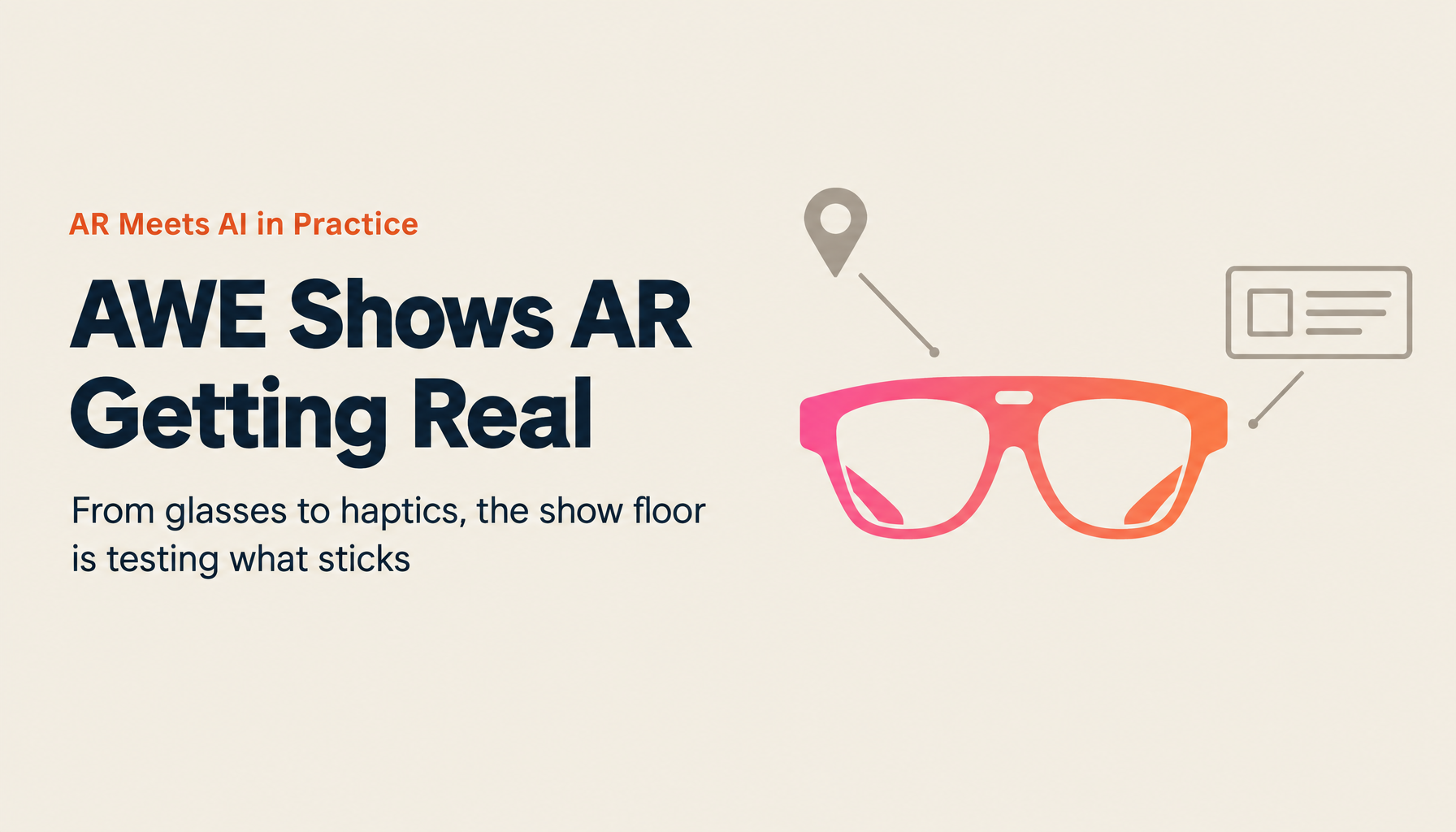
Snap's AR glasses represent the most commercially mature AR headwear on the floor. They combine lightweight outdoor-usable optics with real-time position tracking that anchors digital objects to physical locations — the device knows where you are and what you're facing, and presents AR content that responds to your actual movement rather than floating independently of the environment. The integration with smartphone positioning infrastructure means the glasses don't need to solve location independently; they leverage existing network services while adding the display layer on top.
The collaboration with Niantic Spatial for location-based AR experiences demonstrates what this infrastructure enables at the experiential layer. A character called "Dot" guides users through physical spaces, providing location-aware navigation and context — historical information, directional guidance, situational annotation — that responds to where the user is actually standing. The comparison to conventional map applications is instructive: what changes is not the underlying geographic data but the modality of its presentation. Instead of looking down at a phone, the user looks at the physical environment with digital information overlaid.
The potential six-degrees-of-freedom tracking through additional eye cameras in devices like the XRL 1 Pro glasses enables "spatially anchored virtual displays" — the sensation that a screen exists at a specific point in physical space, remaining stable as you move around it. This creates the possibility of working environments where information panels, control interfaces, and collaborative tools occupy defined spatial positions rather than appearing exclusively on physical screens.
The smartwatch and smart ring integrations shown on the floor hint at the multi-device ecosystem model that makes these glasses most useful: biometric data from a health sensor, notification content from a connected phone, interface control from a ring gesture, all coordinated through the glasses as the primary display surface. The individual devices matter less than their coordination.
For enterprise deployment, the questions this raises are practical: What workflows benefit from hands-free information overlay? In which physical environments is ambient AR genuinely useful rather than distracting? How does the privacy framework work when always-on cameras are in professional settings? AWE doesn't fully answer these questions, but it demonstrates the hardware capability that makes them real rather than hypothetical.
From Vehicle Displays to Theme Park Experiences: Physical-Digital Fusion and New Market Opportunities
Distance's light-field display system addresses one of the most technically demanding AR application areas: the automotive windshield. Standard HUD systems project flat information onto the windshield — useful but limited in what they can communicate. A light-field display creates the perception of depth, making digital objects appear to exist at actual distances in the driver's visual field rather than pasted onto the nearest surface.
The practical implication: safety-critical information can be presented in a way that doesn't require the driver to refocus their eyes. Navigation guidance, obstacle alerts, speed and proximity warnings — these can appear at the distance of the relevant object rather than at windshield distance. The cognitive load reduction is real: the driver processes information where they're already looking rather than in a separate visual register.
Distance has positioned this technology with defense and medical applications also in scope, not just automotive. The reliability requirements for mission-critical applications are higher than for consumer use, and the qualification process is correspondingly rigorous. But the display's core capability — high-fidelity depth representation in a semi-transparent format — is valuable across any context where overlaying information on a real-world view must not compromise that view's integrity.
The Epic Universe Mario Kart theme park experience demonstrated AR at the opposite end of the application spectrum: pure entertainment, pure immersion. The demonstration involved a dedicated visor that placed users inside what appeared to be an actual race track environment. For theme park operators, the business case is clear: AR allows physical spaces to support experiences that would be economically or physically impossible to create through purely physical means. The investment in the AR layer can be updated; a physical track cannot.
What connects the automotive HUD and the theme park experience is the underlying technical challenge: synchronizing digital content with physical space at the speed required to maintain the illusion of co-presence. Latency that is imperceptible in a stationary display becomes obvious and disorienting in a moving vehicle or a physically active attraction. Both applications require solutions to this challenge, and both are pushing the engineering forward.
For enterprise buyers, the vehicle display opportunity is the most immediately relevant. Fleet operators, logistics companies, and any organization with vehicles in complex operating environments have an interest in systems that reduce cognitive load on drivers while increasing the information available to them. The distance and depth representation capabilities that Light Field displays provide address real operational challenges.
Next-Generation Interfaces: Haptics and Mobility Assist Devices as Practical AR Infrastructure
The haptic glove demonstrations at AWE represent the most technically ambitious hardware on the floor — and the most instructive about where the physical interface layer is heading. Current VR controllers provide limited proprioceptive feedback: you know you pressed a button, but the button doesn't push back with the weight a real object would have. Haptic gloves change this fundamentally.
The Quest-compatible gloves shown at AWE track hand and finger movements with high precision while delivering force and vibration feedback that creates the sensation of physical resistance when interacting with virtual objects. The application space extends well beyond games: surgical simulation, remote physical assistance, precision industrial training, rehabilitation support. In all of these cases, the value is the ability to practice or perform physical interactions without the object being physically present — with feedback that maintains the skill-building value of physical practice.
The practical limitation at this stage of development is clear to anyone who handles the devices: they're large, constrained in their force profile, and require careful setup. These are engineering challenges that will be addressed as the category matures. The question for enterprise buyers is not whether today's haptic gloves are deployable at scale — they are not — but whether the underlying capability is valuable enough to justify tracking the development closely. For simulation-heavy industries, the answer appears to be yes.
The Free Aim motorized roller skate — essentially a powered platform that responds to the wearer's walking movements to enable locomotive navigation in VR environments — demonstrates a different approach to the physical interface problem. Rather than adding haptic sensation to hand interactions, it makes the act of moving through virtual space physically embodied. Users shown in demonstrations adapted to the device within minutes, developing confidence in the locomotion it provides. The entertainment application is obvious; the therapeutic and rehabilitation applications are potentially significant for physical therapy contexts.
The XRL 1 Pro glasses with six-degrees-of-freedom eye tracking enable virtual display anchoring in physical space — creating what appears to be a floating screen at a defined point in the physical room. The use case for remote collaboration is direct: shared virtual workspaces where participants in different physical locations interact with the same virtual objects, with high-fidelity spatial consistency. Early versions of this exist in desktop VR; the AR glasses version makes it available in environments where people are physically mobile.
Summary
AWE 2025 presents a coherent picture of where the AR-AI convergence is actually heading: not the dramatic overnight transformation that product launches sometimes suggest, but a steady expansion of capability that is creating genuine opportunities for businesses willing to track the development carefully.
The most deployment-ready technologies are the location-based AR experiences enabled by Snap and Niantic Spatial — building on existing smartphone infrastructure to add a display layer that makes spatial information ambient rather than screen-bound. The automotive HUD opportunity from Distance is technically compelling and addresses a real safety challenge. The haptic and locomotion interface work is earlier-stage but points toward interface modalities that will matter significantly as the technology matures.
For enterprise leaders evaluating AR investments:
- Location-based AR on lightweight glasses is approaching a quality threshold where real deployment makes sense
- Vehicle AR displays are viable for specific high-value applications now, not just on a future roadmap
- Haptic interfaces are worth tracking closely for simulation-intensive industries, even if broad deployment is still ahead
The cross-company collaboration that enables these systems — sensor manufacturers, display specialists, software developers, AI platform providers — means that AR adoption is as much an ecosystem question as a hardware question. Organizations that build relationships and technical fluency with the ecosystem now will be better positioned when the deployment threshold is reached.
Reference: https://www.youtube.com/watch?v=NXxqVY9GHu0
Streamline Event Management with AI | TIMEWELL Base
Struggling with large-scale event operations?
TIMEWELL Base is an AI-powered event management platform.
Track Record
- Adventure World: Managed Dream Day with 4,272 participants
- TechGALA 2026: Centrally managed 110 side events
Key Features
| Feature | Result |
|---|---|
| AI page generation | Event page completed in 30 seconds |
| Low-cost payments | 4.8% fee (industry-leading low rate) |
| Community features | 65% continue engaging after events |
Feel free to reach out for a consultation on streamlining your event operations.