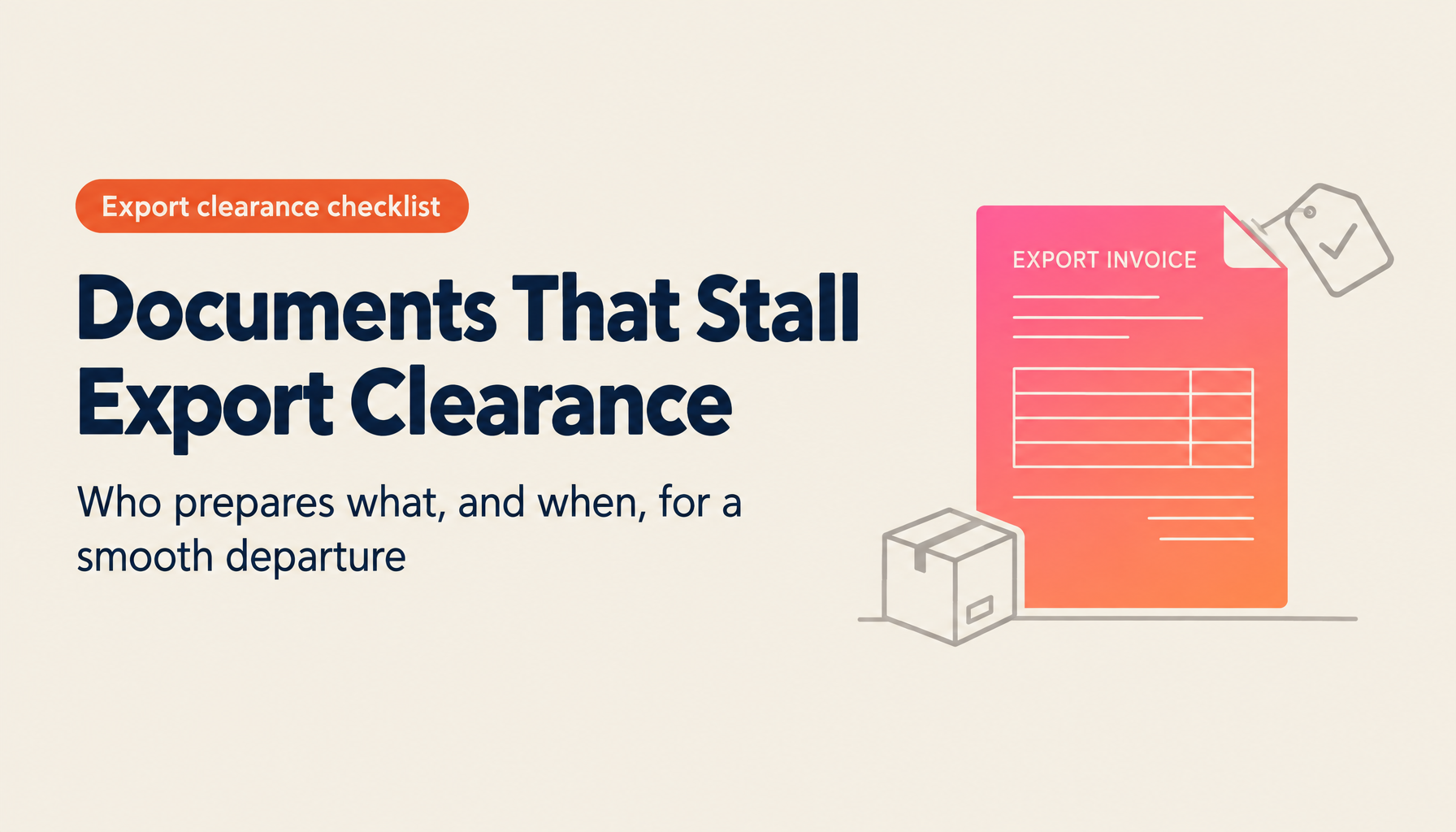
Hello, this is Ryuta Hamamoto from TIMEWELL. Something you see on the shipping floor more often than you would expect: the goods themselves are fine, but a single missing document keeps the cargo from leaving the bonded area. Ships do not wait. Export customs clearance is built so that you can only load cargo after you have brought it into a bonded area or similar location, filed an export declaration with the Director-General of Customs, and received export permission following examination and, where applicable, inspection1. If a document is missing anywhere in that flow, the shipment stops there.
That is exactly why it pays to sort out "who prepares what, and when" before you hand things over to a customs broker. In this article I take stock of the documents required for export customs clearance in checklist form, and confirm the role and legal basis of each one against primary sources — Japan Customs' official guidance (Customs Answer), METI, JETRO, and e-Gov. If you first want a rough read on what kind of checks your own cargo will call for, run our free export-control readiness check to get your bearings; the rest will feel a lot more concrete.
Export documents come down to "who, when, and what"
The trick to keeping export documents straight is to split them into two kinds: documents for declaring to Customs, and documents that substantiate that the goods may lawfully be exported. The first group — the invoice, the packing list — tells Customs what is inside the shipment and what it is worth. The second group — the classification certificate, permits and approvals under other laws — shows that the goods are legally cleared to leave the country. Because their roles differ, so do the timing and the person responsible for each.
Laid out chronologically: once a deal is firm, the exporter first prepares the invoice and packing list, then hands the shipping instructions to the forwarder (the freight forwarding operator). In parallel, the exporter confirms for itself whether the goods or technology are subject to security trade controls and documents that in a classification certificate. That is the core of the exporter's job. If you delegate the procedure to a customs broker, you execute a customs power of attorney at the outset. Then, after the cargo is brought into the bonded area, the broker files the export declaration with Customs, and export permission follows examination and inspection1.
It helps to know what goes on the declaration, too. An export declaration states the marks, numbers, item name, quantity, and value of the cargo, and the declared value is expressed in Japanese yen at the price with the goods placed on the deck of the vessel at the port of export in Japan — the so-called FOB value23. The basis for the value you enter here is the invoice. Although the documents look independent, they are in fact linked to one another as the backing for the declared value. Holding onto that sense makes it much easier to see why each document is needed.
Replace siloed classification work with AI.
METI's FY2024 data shows 52% of foreign exchange law violations stem from classification errors. Download the TRAFEED product catalog covering features and rollout.
The four core documents to gather first, and the checklist
Let me start with a list of the documents worth having ready before you turn to a customs broker. The "necessity" column is a practical rule of thumb that reflects both the legal position and how the document is treated in practice.
| Document | Necessity | Prepared/issued by | Main role and basis |
|---|---|---|---|
| Invoice | All but mandatory | Exporter | Basis for declaring item name, quantity, and value. Customs may request it (Customs Act Art. 68, Customs Answer 5009)45 |
| Packing list | Recommended (may be requested) | Exporter | Verifies number of packages, weight, and volume (JETRO)5 |
| Shipping instructions (S/I) | Recommended | Exporter to forwarder | Instructs preparation of the bill of lading or air waybill (JETRO)5 |
| Customs power of attorney | Mandatory when using a broker | Exporter | Grants authority to act as agent for customs procedures (Customs Business Act, JETRO)5 |
| Classification certificate (non-applicability certificate) | All but mandatory for applicability checks | Exporter determines it | Confirms applicability against Appended Table 1 of the Export Order, etc. (FEFTA, CISTEC)67 |
| Export permission (Minister of METI) | Only when list-controlled | METI | Export permission under FEFTA Art. 48(1)8 |
| Permit/approval under other laws | Only for covered goods | Each competent ministry | Certification/confirmation under Customs Act Art. 70 (cultural property, CITES, etc.)910 |
| Certificate of origin | When required by destination, contract, or EPA | Chamber of Commerce and Industry | Certifies origin. General: local Chamber; EPA: Japan Chamber of Commerce and Industry111213 |
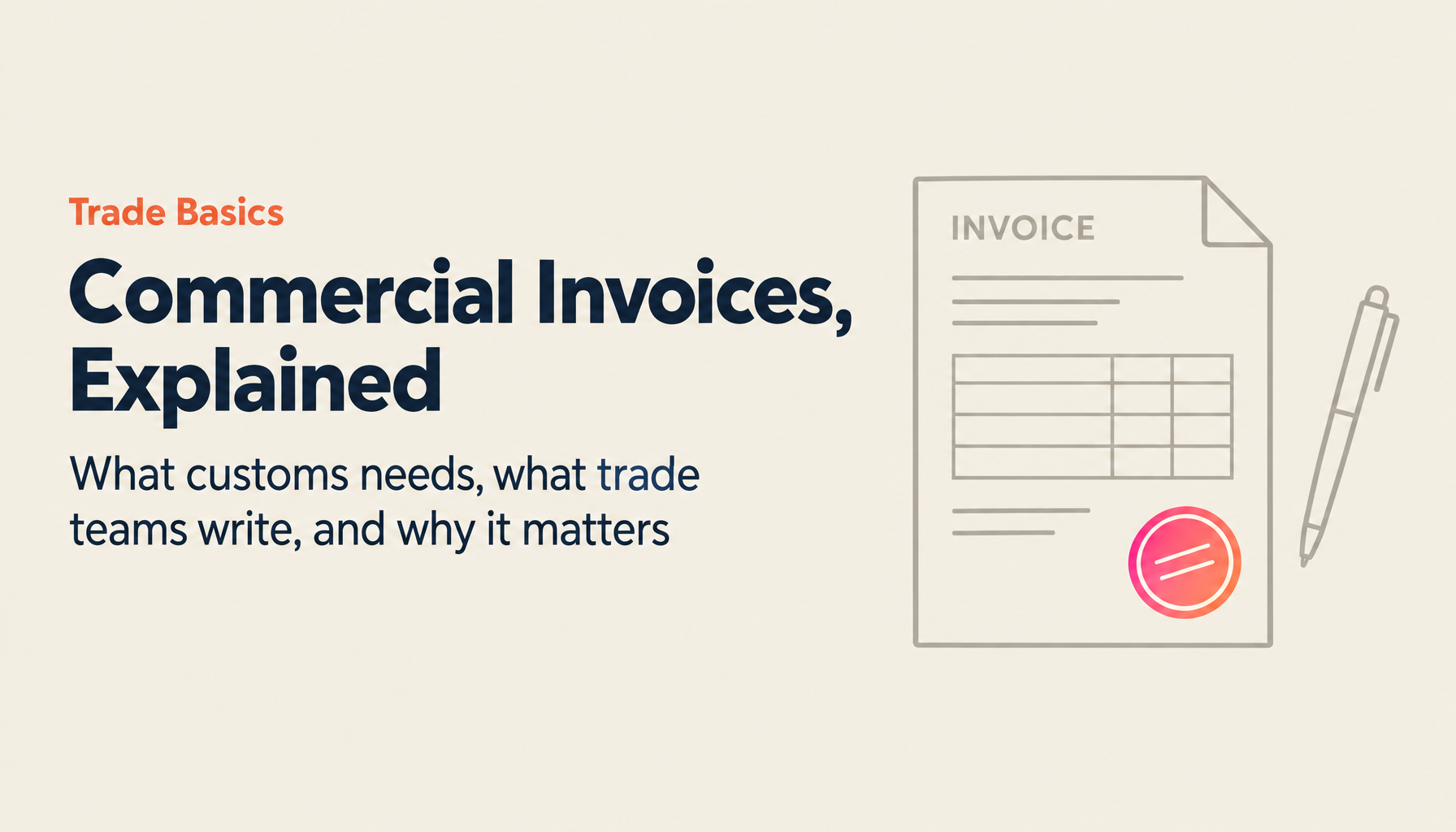
Start with the invoice. This is the document that records the item name and type, quantity, value, method of payment, and the names and addresses of the shipper and consignee, and it is the basis for the item name, quantity, and value on the export declaration5. Japan Customs' guidance also lists the invoice, or a document that stands in for it, among the documents needed at the time of an export declaration4. If you are unsure how to draw up the invoice itself, running through the required fields in our guide to preparing a trade invoice first will set your mind at ease.
The packing list is not a document the law requires you to attach. That said, Customs may request it to verify the number of packages, weight, and volume, so preparing it in advance is advisable5. It normally omits price and settlement information. For how the roles divide and how to fill it out, see how to prepare a packing list.
Shipping instructions (S/I) are the instruction sheet you give the forwarder so it can produce the bill of lading or air waybill. This too is not mandatory, but having it ready makes the loading procedure go smoothly5. The thinking behind what to include is covered in the basics of shipping instructions.
Then there is the customs power of attorney. To have a customs broker handle the clearance procedure on your behalf, you need a power of attorney showing that the broker is authorized to act as your agent5. It is usually executed the first time you engage that broker; after that, it depends on how you operate. One caution here: it is a mistake to think that leaving things to a broker means the broker prepares all the documents. What the broker handles on your behalf is the declaration procedure; the underlying materials — the invoice, packing list, and the classification certificate discussed below — are prepared by the exporter. Export classification in particular presupposes a determination by the exporter itself; the broker does not make that determination in your place.
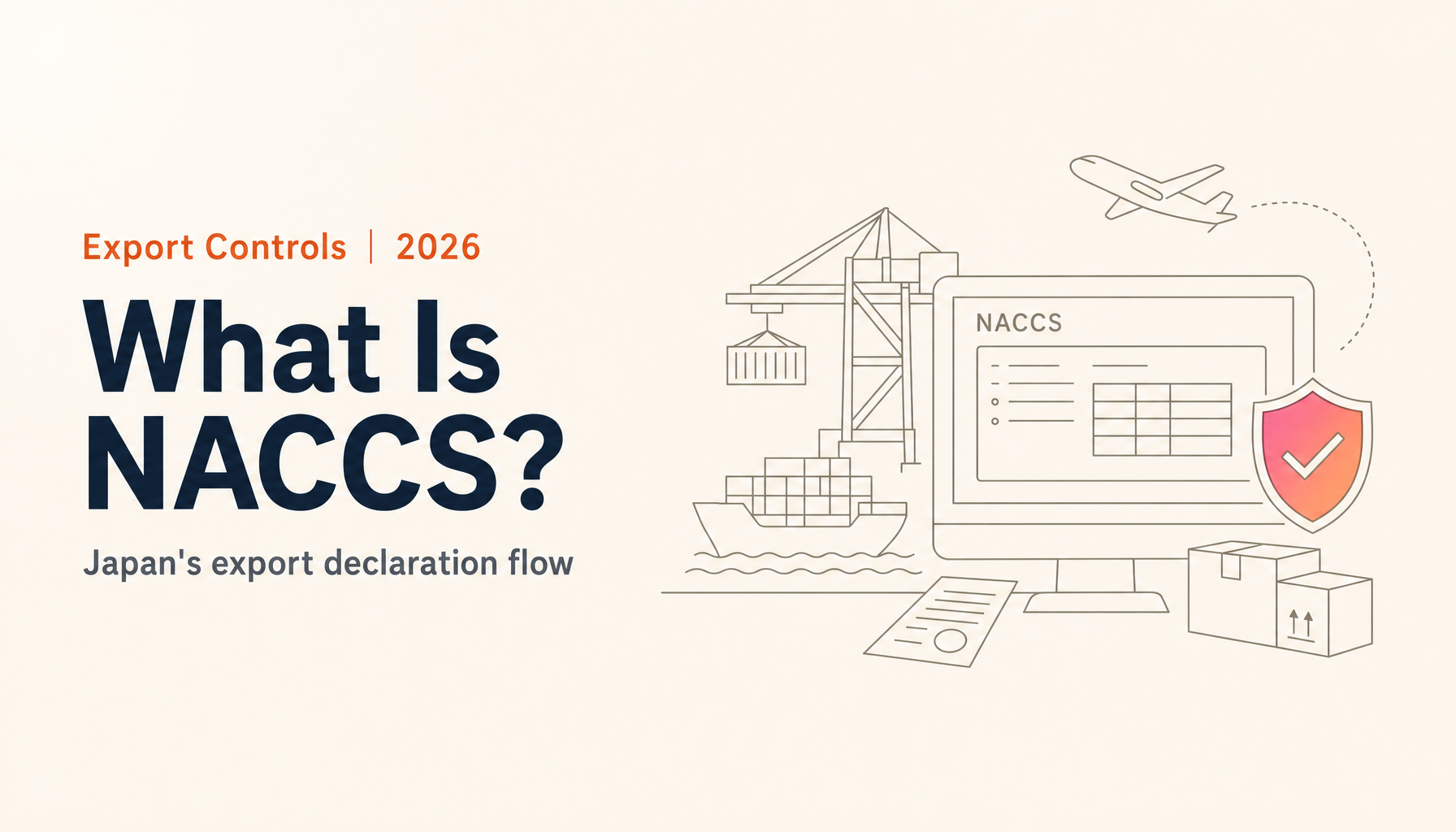
Note that in almost all cases these documents are now registered and submitted electronically through NACCS (the Nippon Automated Cargo and Port Consolidated System). The overall shape of electronic filing is explained in the flow of an export declaration in NACCS, which should help you picture how the practice works.
The classification certificate (non-applicability certificate) is made by the exporter itself
Of all the documents in export customs clearance, the classification certificate draws the most misunderstanding. Export classification means determining and confirming whether goods or technology fall under list controls — rows 1 through 15 of Appended Table 1 of the Export Trade Control Order (goods) or rows 1 through 15 of the Appended Table of the Foreign Exchange Order (technology) — or under the row-16 catch-all controls6. The point where many people stumble is the assumption that "METI must do this classification for me." The answer is clear: export classification is not performed by METI; the exporter performs it67. Even when you obtain a classification certificate from a manufacturer or elsewhere, you must confirm the specifications yourself before reaching a determination.
There is no fixed format for a classification certificate. It should, however, identify the subject clearly (item name, model, and so on), state the applicable row number, the determination result, the basis for the determination, and the date of determination, and it should be kept in a state where you can later judge how to respond to amendments in the law6. If the determination finds that the goods fall under list controls, then no matter the destination, you need advance export permission from the Minister of Economy, Trade and Industry68. This is where intuitions like "it's going to the US, so we're fine" or "they're a friendly country, so it's unnecessary" simply do not hold — list controls bite regardless of the counterparty country.
Another misunderstanding is that "if it is non-applicable, you don't need a certificate." In practice it is the opposite: counterparties and internal export-control departments frequently ask for a document showing non-applicability — a classification certificate serving as a non-applicability certificate. So you keep the record even when the goods are non-applicable. Skip that small step and you will find yourself stalling later when someone asks "has the classification been confirmed?" When you are not yet confident in how to work through a determination, it helps to build a flow that pairs a tool like TRAFEED — which matches the row numbers of list and catch-all controls against your goods' specifications and visualizes the level of concern — with a final check by your export control officer. Keep the premise intact: the final classification determination belongs to your company's export control officer.
Other-law confirmation under Customs Act Article 70, and the certificate of origin
Even with the invoice and classification certificate in hand, there are goods you still cannot clear on that alone. Article 70 of the Customs Act provides that, for goods requiring permission, approval, or the like under laws other than the customs-related laws, export will not be permitted unless the exporter has obtained that permission or approval and has proven the fact to Customs — and received confirmation — at the time of the export declaration or during examination and inspection9. This is the so-called confirmation under other laws.
As for which laws are actually involved, the list of "other laws related to exports" published by Customs spans a wide range of fields: security trade control under the Foreign Exchange and Foreign Trade Act (FEFTA) and the Export Trade Control Order; the Act on Protection of Cultural Properties; the Washington Convention (CITES), which protects endangered species of wild fauna and flora; controls relating to narcotics and psychotropics; the Explosives Control Act; the Act on Pharmaceuticals and Medical Devices; inspections under the Act on Domestic Animal Infectious Diseases Control and the Plant Protection Act; and various laws bearing on the export of agricultural products910. If your cargo touches any of these, you must first obtain the relevant ministry's permit, approval, or inspection certificate, and then present it to Customs. Because the covered items and required procedures break down finely by item, use the representative examples to get your bearings, then always confirm the specifics case by case against the primary sources from the competent ministry and Customs.
The certificate of origin is another prime example of a document that is "needed in some cases." It is not required for every export — you obtain it where the destination country requires it, or where you use EPA (Economic Partnership Agreement) preferential tariffs. There are two kinds: a general certificate of origin is issued by the local Chamber of Commerce and Industry, while the First-Category Specified Certificate of Origin used for EPA preferences is issued by the Japan Chamber of Commerce and Industry111213. Both require prior trade registration with the Chamber — so-called signatory registration — and an application needs supporting documents such as a commercial invoice12. Applications are made before export as a rule, but you may still apply after shipment within six months; beyond six months and up to one year, you will be asked for additional materials such as a statement explaining the delay12. The steps for obtaining one are organized in how to obtain a certificate of origin.
How clearance gets stuck on missing documents, and how to prevent it
The reasons clearance stalls on the ground tend to resemble one another. In my experience they boil down to three.
The first is getting the document's author wrong in the first place. You wait for the classification certificate as "something the manufacturer will provide," then take the certificate that finally arrives at face value. Or you dump everything on the broker and confirm nothing on the exporter's side. When the principle that export classification is the exporter's responsibility falls out of view, this is where you get tripped up6. The second is missing an other-law confirmation. Convinced that "as long as we have the invoice it will clear," you declare cultural property, CITES-covered items, or regulated chemicals — and permission does not come down because the Article 70 certification is missing9. The third is the timing of the certificate of origin. The destination country requires it, but the arrangement is late, and you scramble to apply after shipment. You can apply within six months, true, but a situation that demands an extra statement of reasons is one you want to avoid12.
The idea for preventing all three is simple: for each shipment, list out both the "documents for declaring" and the "documents that substantiate that the goods may be exported" before the shipment is finalized. Export classification and other-law confirmation in particular — start them the moment the contents of the cargo are set, and you can cut down the last-minute clearance stalls considerably. Running determinations and confirmations by hand alone tends to get heavy, because every amendment to the law forces you to reinterpret row numbers. TRAFEED is designed to visualize the level of classification concern in a short time while reflecting each country's regulations, supporting — not replacing — the final judgment of the export control officer. Start by grasping which checks your own cargo calls for with our free export-control readiness check; the gaps in your required documents will begin to surface.
Summary
The documents for export customs clearance can feel numerous by count, but when you view them along two axes — "documents that tell Customs the cargo and its value" and "documents that substantiate that the cargo may be exported" — what your own company needs comes into focus. Here are the key points to hold onto.
- The basics are the invoice, packing list, shipping instructions, and — if you use a customs broker — the customs power of attorney. The declared value is expressed as the FOB value in Japanese yen2435
- Export classification is performed by the exporter itself, not by METI, and even non-applicable goods are recorded as a classification certificate. If the goods are list-controlled, you need export permission from the Minister of METI regardless of destination68
- Depending on the goods, you may need permits or approvals under other laws pursuant to Article 70 of the Customs Act. Cultural property, CITES-covered items, and chemicals are representative examples910
- Obtain a certificate of origin where the destination country or an EPA requires one — a general certificate from the local Chamber of Commerce and Industry, and an EPA certificate from the Japan Chamber of Commerce and Industry111213
Preparing the documents, at bottom, is the work of confirming for yourself whether the goods are cleared to export and keeping that in a state you can explain to a third party. Rush the loading while that remains vague, and the cargo stops at the very moment you least want it to move. Put the other way around: make the pre-shipment stocktaking a habit, and clearance grows a great deal quieter. If you would like to talk through your own export control framework or how to use TRAFEED in concrete terms, reach out via our export control consultation. We will map out, together, the points where documents most easily go missing.
One note: this article organizes the overall shape of the system from primary sources. For the precise structure of the current text of Article 68 of the Customs Act, the effective date of the amendment that reviewed the blanket obligation to attach an invoice, the article number underpinning the customs power of attorney, and the article number of the enforcement order that prescribes the items on the export declaration, secondary sources were also consulted in writing this piece. For any specific export matter, always confirm against the primary sources from Customs, METI, the competent ministry, and e-Gov, and check with your customs broker as well.
References
Footnotes
-
Overview of Export Customs Clearance Procedures (Customs Answer 5001) — Japan Customs — confirmed as of July 2026 ↩ ↩2
-
How to Complete an Export Declaration (Customs Answer 5010) — Japan Customs — confirmed as of July 2026 ↩ ↩2
-
Order for Enforcement of the Customs Act (Cabinet Order No. 150 of 1954) — e-Gov Law Search — confirmed as of July 2026 ↩ ↩2
-
Documents Required for an Export Declaration (Customs Answer 5009) — Japan Customs — confirmed as of July 2026 ↩ ↩2 ↩3
-
Documents Required When Asking a Customs Broker to Handle Export Clearance: Japan (Trade and Investment Q&A) — JETRO — confirmed as of July 2026 ↩ ↩2 ↩3 ↩4 ↩5 ↩6 ↩7 ↩8 ↩9
-
How to Confirm Applicability Against Regulated Items and Content Under Security Trade Control for Exports: Japan (Trade and Investment Q&A) — JETRO — confirmed as of July 2026 ↩ ↩2 ↩3 ↩4 ↩5 ↩6 ↩7
-
Basic Course on Export Classification Procedures — CISTEC (Center for Information on Security Trade Control) — confirmed as of July 2026 ↩ ↩2
-
Security Trade Control: The Application Flow (For First-Time Exporters) — METI — confirmed as of July 2026 ↩ ↩2 ↩3
-
Overview of Other Export-Related Laws Confirmed by Customs (Customs Answer 5501) — Japan Customs — confirmed as of July 2026 ↩ ↩2 ↩3 ↩4 ↩5
-
List of Other Export-Related Laws — Japan Customs — confirmed as of July 2026 ↩ ↩2 ↩3
-
Issuance of Certificates of Origin by the Japan Chamber of Commerce and Industry (First-Category Specified Certificate of Origin) — METI — confirmed as of July 2026 ↩ ↩2 ↩3
-
Certificate of Origin: Preparing the Application Documents — Tokyo Chamber of Commerce and Industry — confirmed as of July 2026 ↩ ↩2 ↩3 ↩4 ↩5 ↩6
-
Issuance of Specified Certificates of Origin Based on EPAs — Japan Chamber of Commerce and Industry — confirmed as of July 2026 ↩ ↩2 ↩3
![Looking for Export Classification Outsourcing or Support? Outsourcing vs. Tools vs. Hands-On Support, and a Roadmap for Building In-House Capability [2026 Edition]](/images/columns/export-classification-outsourcing-support-guide/cover.en.png?dpl=dpl_HiqV7MMG1sLWq45T9QvvdyGY9EYx)
![What Is METI's "Matrix Table"? A Beginner's Guide to Using It for Export Classification — Where to Get It, How to Read It, and the Pitfalls [2026 Edition]](/images/columns/meti-matrix-table-guide/cover.png?dpl=dpl_HiqV7MMG1sLWq45T9QvvdyGY9EYx)