Hello, this is Ryuta Hamamoto from TIMEWELL. People at companies that are just starting to export from Japan often ask me the same question: "So how do you actually file with Customs?" Our own search data shows a related pattern. People look up "NACCS CEA" and "electronic export license," which tells me that the codes and the license workflow are where they get stuck. They have heard of NACCS, but they cannot yet picture what the system does or where it sits between an export declaration and goods leaving port.
This article was first published in July 2026 and has been rewritten against primary sources as of October 4, 2026. I checked the meaning of each procedure code against the business specifications that the NACCS Center publishes, and added METI's electronic export license workflow and the changes that came with the seventh-generation NACCS in October 2025. Technical terms are explained the first time they appear.
Key points in 30 seconds. NACCS is Japan's national system for handling, online, the procedures that vessels, aircraft, and import and export cargo must complete with Customs and other agencies; Japan Customs says about 99.9% of import and export declarations are processed through it. An export declaration is registered with the code EDA and filed with EDC. NACCS assigns examination category 1 (simplified), 2 (document examination), or 3 (inspection), and for categories 2 and 3, Customs grants permission by entering CEE. The frequently searched code CEA is the import-side equivalent, "import declaration examination completed." When goods need a license under Japan's Foreign Exchange and Foreign Trade Act (FEFTA), METI issues an electronic license in NACCS, and the customs broker registers the endorsement (JTA01) and runs the matching check (JTZ) before filing the declaration.
If you would like to check first whether your products or technology may be subject to Japan's export controls, TRAFEED's export-control compliance check gives you a quick read, and it will make the license section later in this article much more concrete.
What NACCS Is: The National System Linking Customs and Other Ministries
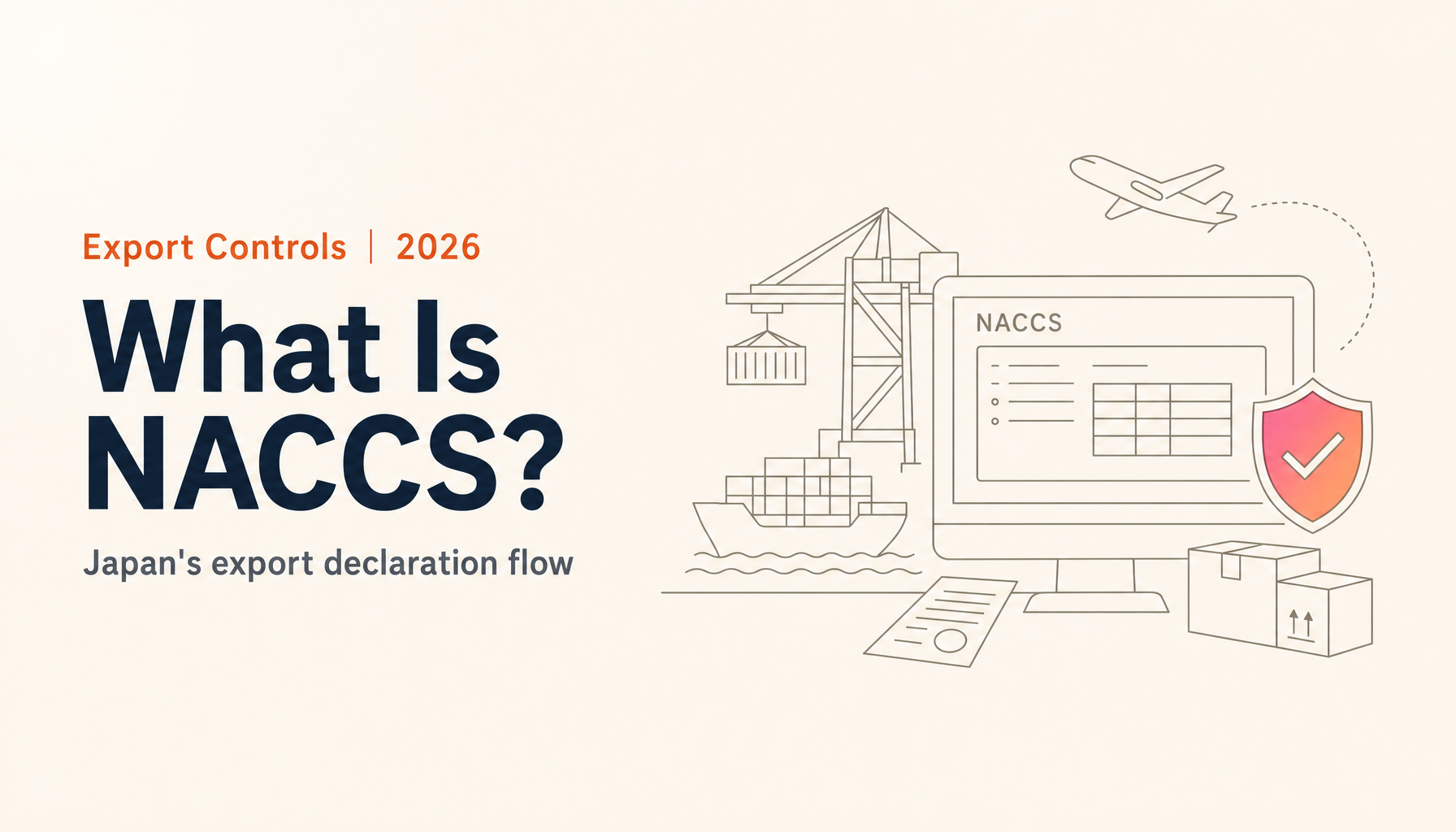
NACCS stands for the Nippon Automated Cargo And Port Consolidated System. Its Japanese name translates roughly as the "Import/Export and Port-related Information Processing System." In plain terms, it is the national system that handles, online, the procedures that vessels and aircraft entering or leaving Japan, and the cargo they carry, must complete with Customs and other government agencies, along with the private-sector work tied to those procedures1.
How widely is it used? Japan Customs states in one of its brochures that NACCS processes about 99.9% of import and export declarations electronically2. A paper declaration handed in at a customs counter is now very much the exception. The system is run by Nippon Automated Cargo and Port Consolidated System, Inc. (the NACCS Center), which became a special-purpose stock company on October 1, 2008, after operating as an incorporated administrative agency3. Its legal basis is Act No. 54 of 1977, commonly called the NACCS Act4. It is both national infrastructure and a working tool that private operators use every day, and that dual nature is part of why outsiders find it hard to place.
The history helps. Air-NACCS for air cargo and Sea-NACCS for sea cargo used to be separate systems. They were unified around the Sea-NACCS upgrade in October 2008 and the Air-NACCS upgrade in February 2010, and at the same time other ministries' trade systems were folded in, including the Ministry of Land, Infrastructure, Transport and Tourism's Port EDI system and METI's trade control system, JETRAS1. The sixth-generation NACCS went live in October 2017, and the seventh generation in October 20253.
The point to hold onto is that NACCS is not a customs-only system. It looks like a customs window, but the procedures of several ministries sit on one platform. That is why quarantine, food safety, and the check of export licenses under FEFTA can all be connected on the same system when goods cross the border. The electronic license workflow later in this article is exactly that connection at work.
From Export Declaration to Export Permission (EDA, EDC, CEW)
What actually happens in NACCS when you export? The legal skeleton is simple. Anyone exporting goods must declare them to Customs, have them inspected where required, and receive export permission (Article 67 of the Customs Act)5. A declaration takes effect when Customs accepts it (Customs Act Basic Circular 67-1-1), but taking effect is not the same as being permitted6. Acceptance only puts you at the starting line.
In NACCS, this flow is broken into procedure codes, three-letter identifiers for each operation. Tracing the business specifications, the core export steps look like this78.
| Stage | Code | Procedure | Entered by | What happens |
|---|---|---|---|---|
| Register the declaration | EDA | Export declaration registration | Customs broker (for air cargo, also air cargo agents) | Goods description, quantity, value, and other-law details are entered. They can be corrected freely until EDC |
| File | EDC | Export declaration | Customs broker | The declaration is filed and an examination category (1 to 3) is assigned. You can also file before the goods arrive, or schedule automatic filing |
| Post-arrival processing | CEW (auto-run as 1CE) | Post-arrival processing of export declaration | Customs broker (runs automatically on arrival) | When goods declared before arrival enter the bonded area, the category is assigned |
| Examination completed | CEE | Export declaration examination completed | Customs | Records that document review or inspection is finished and grants permission; an export permission notice is issued |
| Corrections after filing | EDA01, EDE | Export declaration amendment registration and amendment | Customs broker | Corrects a declaration after filing |
Note: Compiled from the NACCS Center's business specifications for the seventh-generation NACCS (sea cargo procedures).
Timing around the bonded area causes the most confusion. A bonded area is a place designated by the Minister of Finance or licensed by a Director-General of Customs for holding goods to be exported or goods arriving from abroad9. You may file the export declaration before the goods are brought into the bonded area, but permission is, as a rule, granted only after they are in9. NACCS mirrors that order: when goods declared in advance enter the bonded area, CEW runs automatically, checks the declaration, and assigns the category. One useful detail is that if Customs finishes its review of an advance declaration before the goods arrive, permission is granted the moment they arrive8. File early, but permission follows the physical goods. Keeping that sequence in mind makes shipment schedules much easier to get right.
EDA also has fields that tie the declaration to export control, including the Export Trade Control Order table code, the license and approval category, and the FEFTA Article 48 code. If you enter a code for Appended Table 1 of the Export Trade Control Order, NACCS will not accept the registration unless the license category and the Article 48 code are also filled in7. In other words, the result of your export classification becomes input data on the declaration itself. For what Appended Table 1 actually covers, see our guide to Appended Table 1 of the Export Trade Control Order.
Templates for keeping the record. Before Customs confirms other-law compliance, someone has to decide whether a license is needed at all. We publish a free Japanese-language set of classification and non-applicability certificate forms with a fill-in Q&A (Word), plus Excel sheets such as a catch-all check sheet and a classification log, updated for the amendments effective February 14, 2026. Download the classification template pack (free; requires your company name and work email address).
Replace siloed classification work with AI.
METI's FY2024 data shows 52% of foreign exchange law violations stem from classification errors. Download the TRAFEED product catalog covering features and rollout.
Examination Categories 1 to 3, the CEE Code, and What "CEA" Means
When an export declaration is filed through NACCS, it is sorted on the spot into one of three examination categories based on risk criteria set by Customs. The category decides how much review and inspection follows, and therefore the route to permission. Japan Customs' published flow chart shows the same picture: category 1 goes straight to permission, category 2 passes through examination, and category 3 passes through examination and inspection10.
| Category | Common name | What Customs does | Route to permission | Code that grants permission |
|---|---|---|---|---|
| 1 | Simplified handling | No document review or inspection | Permitted on filing | EDC (CEW for advance declarations) |
| 2 | Document examination | Reviews the declaration and documents | Permitted after examination | CEE (Customs) |
| 3 | Inspection | Document review plus physical inspection | Permitted after examination and inspection | CEE (Customs) |
Note: Based on Japan Customs' flow chart for declarations filed through NACCS outside office hours10 and the NACCS business specifications for EDC, CEW, and CEE78.
Category 1 is what people call immediate permission. In category 2, Customs reads the documents and moves to permission if nothing is wrong. Category 3 involves a physical inspection, and under the NACCS specifications a declaration selected for inspection is further assigned to either an on-site inspection or an inspection at a designated inspection facility7. When the category 2 or 3 review is finished, a customs officer enters "export declaration examination completed" (CEE). For declarations filed after the goods arrived, permission is granted at that point, and the declarant receives the export permission notice8. The policy on physical inspection is set out in Customs Act Basic Circular 67-1-7: inspections focus on goods judged to need them, taking into account the declarant, the cargo owner, the destination, and other factors6.
Now to the question people search for: what is "CEA" in NACCS? CEA is the code for "import declaration examination completed," and it is entered by Customs. It records that examination and inspection of an import declaration are finished. If there is no duty or tax to pay, or if payment has been deferred and the security has already been drawn down, import permission is granted immediately11. Otherwise, permission waits until payment of duty and taxes is confirmed (Article 72 of the Customs Act)5. CEA is, in short, the import-side twin of CEE. If you meet those three letters while following an export, you are looking at an import procedure; the export equivalent is CEE.
A common misunderstanding is that "filing through NACCS always means immediate permission." Only category 1 is immediate, and nobody knows the category until the declaration is filed. Even if your shipments have always cleared in category 1, I recommend leaving enough slack in the schedule to absorb an inspection.
Documents, Where to File, Who Files, and Getting Access to NACCS
The information required in an electronic export declaration maps onto the paper export declaration form (C-5010). Customs Act Basic Circular 67-1-2 requires that form to be submitted in three copies, and NACCS carries the same content as data6. On attachments, Circular 67-1-5 provides that an invoice is attached where needed, that goods requiring licenses, approvals, or completed inspections under other laws (Article 70 of the Customs Act) are accompanied by evidence of them, and that goods claiming tariff reductions or exemptions carry the prescribed documents6. For the full picture of what to assemble, see our checklist of documents for export customs clearance.
Where do you file? The rule is the customs office with jurisdiction over the bonded area or similar place where the goods will be held (Article 67-2 of the Customs Act)5. Since October 8, 2017, there has been an important exception: AEO operators, such as authorized exporters and authorized customs brokers, may file through NACCS with any customs office regardless of where the goods are stored12. An AEO (Authorized Economic Operator) is a business whose cargo security and compliance systems have been approved by Japan Customs, so ordinary exporters cannot assume the exception applies to them. The NACCS specifications also show that declarations carrying a code for Item 1 (arms) of Appended Table 1 are excluded from this office-of-choice treatment7.
Who files? Under the law, the exporter may file directly or delegate the filing to a licensed customs broker9, a business defined in Article 2 of the Customs Business Act13. METI's guidance likewise describes declaration and endorsement as operations performed by "customs brokers or importers and exporters that handle their own clearance"14. Using a broker is common but not mandatory. If you have the expertise and staff in-house, you can file yourself; if not, a broker handles it. In my view, the right answer depends on your shipment volume and the strength of your internal export control program.
To use NACCS yourself, you apply to the NACCS Center through its contract system (NSS) and receive a user ID. If you will apply for FEFTA licenses electronically, you must also register the applicant name with METI under that ID before your NACCS start date14. Applications for the FEFTA-related services are limited to one per company, and you operate them through the NACCS package software, after installing a digital certificate, or through WebNACCS15. Fees are set per office: Plan A combines a basic fee of 5,000 yen a month with per-transaction fees, and Plan B charges per-transaction fees only (both before tax). Procedures not listed in the per-transaction fee table are free, and new applications for the FEFTA-related services default to the per-transaction-only plan for netNACCS15.
Electronic Export Licenses and the NACCS FEFTA-Related Services
The step I most want to flag is the other-law check. Article 70 of the Customs Act provides that, for goods requiring a license or approval under another law, Customs confirms at the time of declaration that it has been obtained5. The leading example is export control under FEFTA. For controlled goods and technology, you must obtain a license from the Minister of Economy, Trade and Industry before you file with Customs; these are two separate procedures.
As a rule, both the license application and the license itself now live in NACCS. The NACCS FEFTA-related services (formerly the Trade Control Subsystem) digitize the process from applications for FEFTA licenses and approvals to the endorsement of those licenses at customs declaration14. The service began with an interface to JETRAS in November 2002, ran as the Trade Control Subsystem from February 2010, and was fully integrated into NACCS in June 202016. Since July 2022, export license applications have been electronic-only, apart from a few procedures not yet supported17. Licenses are issued as electronic licenses, which is almost certainly what people mean when they search for an "electronic export license" in Japan.
According to the briefing material published by METI and the NACCS Center, an export using an electronic license proceeds in this order16.
- The exporter applies for the license with JAA (FEFTA new application or correction of an electronic license), and METI issues the electronic license.
- The exporter designates, with JCA, the customs broker that may use the license for declarations.
- After registering the declaration with EDA, the broker retrieves and registers the endorsement with JTB and JTA01 (endorsement registration, export).
- The broker runs JTZ to match the declaration data against the electronic license and the endorsement.
- Only after matching does the broker file the declaration with EDC, and Customs examines it and grants permission.
An endorsement records how much of the licensed quantity and value a given declaration uses. As the Japanese term (uragaki, "writing on the back") suggests, it was originally written on the back of the paper license. With electronic licenses, NACCS records and checks it automatically, and an endorsement that exceeds the remaining licensed quantity returns an error16. At EDA, NACCS checks that the license is still valid, that the exporter matches the license holder, and that the license type entered (electronic or paper) matches the license. At EDC, it checks that JTZ matching has been completed16. Using another shipper's license, or filing without the endorsement, is stopped by the system.
Two practical cautions. First, the license image you can download as a PDF cannot be used for customs clearance. If you know you will need a paper license, request one in the application field for paper issuance14. Second, a shipper that does not use NACCS can still obtain an electronic license through its customs broker, which may apply on its behalf under a delegation16. With the seventh-generation NACCS in October 2025, some application forms can now be submitted through WebNACCS, although combined applications for goods and services still require the package software. The sixth-generation package software no longer works, and the codes for application offices have changed14.
Upstream of all this electronic filing sits export classification, called gaihi hantei in Japan. It is the work of checking, by specifications and performance, whether goods or technology fall under the control lists such as Appended Table 1 of the Export Trade Control Order. If they do, a license from the Minister of Economy, Trade and Industry is required; even if they do not, catch-all controls still have to be checked. NACCS verifies the license and the endorsement, but it does not tell you whether a license is needed. For the process, see the five steps of Japan export classification; for the paperwork that evidences a non-listed result, see our explainer on the certificate of non-applicability.
Export classification is the most labor-intensive and error-prone step in the whole chain. TRAFEED, our export-control AI agent, drafts the Japan export classification against the Export Trade Control Order, screens counterparties against Japanese, U.S., EU, and other restricted-party lists (a listing is a regulatory designation, not a judgment on the company), and keeps the evidence on file. It works upstream of customs. TRAFEED does not file export declarations in NACCS, apply for licenses, or register endorsements, and your export control officer makes the final call on every classification.
What Has Changed Since the First Version (July 2026)
Here is how the picture changed between the first version of this article on July 19, 2026, and October 4, 2026. The rules themselves did not change much. What changed is that points the first version left readers to check for themselves could now be settled with primary sources, and that the first version did not answer the questions people were actually searching for.
| Topic | First version (July 19, 2026) | Now (October 4, 2026) |
|---|---|---|
| Seventh-generation NACCS | Said only that NACCS was "at the time of the upgrade to the 7th generation (October 2025)" | Live since October 2025 (NACCS Center company history); some FEFTA application forms can be filed through WebNACCS |
| Share of declarations | Avoided stating a figure for "most" import and export procedures | Japan Customs brochure confirms about 99.9% of declarations are processed electronically |
| Procedure codes | Not covered | Added EDA, EDC, CEW, CEE, and the import-side CEA, checked against the business specifications |
| FEFTA licenses | Covered electronic applications (electronic-only from July 2022) | Added the electronic license workflow through endorsement (JTA01), matching (JTZ), and declaration |
| Using NACCS directly | Not covered | Added the application, applicant registration with METI, and fee plans |
The procedure codes are the part I left out last time, treating them as "the customs brokers' world." Exporters never type CEA or CEE themselves, because Customs enters them. Still, when those three letters come up in a specification or in an exchange with your broker, not knowing what they mean is unsettling. This time I prioritized writing them exactly as the business specifications define them.
METI and the NACCS Center note that more functions will be added to the FEFTA-related services over time16. Detailed specifications can be revised, so in practice always check the current business specifications on the NACCS bulletin board and METI's electronic filing page.
In Closing
Let me tie it into one line. NACCS is the shared national platform that bundles the procedures of several ministries, and about 99.9% of Japan's import and export declarations pass through it. An export is registered with EDA, filed with EDC, and permitted either immediately (category 1) or when Customs enters CEE (categories 2 and 3). Goods declared before arrival trigger CEW when they reach the bonded area. CEA is the import-side code for completed examination, the counterpart of CEE.
Goods that need a FEFTA license add an electronic license stage before all this: the exporter applies with JAA and designates a broker with JCA; the broker endorses with JTA01, matches with JTZ, and only then files with EDC. NACCS will catch a wrong license holder or a missing endorsement, but the export classification that decides whether a license is needed stays outside the system and remains the exporter's responsibility.
The legal anchors are worth knowing once: the export clearance framework in Article 67 of the Customs Act and Basic Circulars 67-1-1 to 67-1-7, where to file in Article 67-2, the other-law check in Article 70, and the operation of NACCS in the NACCS Act. Knowing where each rule is written lets you go back to the source when a judgment call gives you pause.
Getting through the other-law check at the customs gateway depends on running classification and export review properly beforehand. If you are unsure whether your products are controlled, or how to build an export control program that works for shipments from Japan, tell us about your situation in a one-on-one consultation on TRAFEED. We will start by working out, together, where you stand today.
References and Primary Sources
Footnotes
-
NACCS Center (Nippon Automated Cargo and Port Consolidated System, Inc.), "What Is NACCS / Business Overview" (Japanese) https://www.naccs.jp/aboutnaccs/aboutnaccs.html ↩ ↩2
-
Japan Customs, "Chapter 4: More Efficient Customs Clearance with ICT" (brochure; NACCS processes about 99.9% of import and export declarations electronically; retrieved October 4, 2026) https://www.customs.go.jp/zeikan/pamphlet/report/pdf/report_005j.pdf ↩
-
NACCS Center, "Company Overview" (became a stock company on October 1, 2008) https://www.naccs.jp/aboutcenter/summary.html / "Company History" (sixth-generation NACCS launched October 2017; seventh-generation NACCS launched October 2025) https://www.naccs.jp/aboutcenter/history.html ↩ ↩2
-
NACCS Act (Act No. 54 of 1977, Japanese) / e-Gov Law Search https://laws.e-gov.go.jp/law/352AC0000000054 ↩
-
Customs Act (Act No. 61 of 1954), Articles 67, 67-2, 70, and 72 / e-Gov Law Search https://laws.e-gov.go.jp/law/329AC0000000061 ↩ ↩2 ↩3 ↩4
-
Customs Act Basic Circulars (Zeikan No. 100 of March 1, 1972), Chapter 6, Section 1, General Export Clearance, 67-1-1 to 67-1-7 (Japan Customs PDF) https://www.customs.go.jp/kaisei/zeikantsutatsu/kihon/TU-S47k0100-s06-01~02.pdf ↩ ↩2 ↩3 ↩4
-
NACCS Center, Business Specifications (seventh-generation NACCS), "3001 EDA Export Declaration Registration (sea)" https://bbs.naccscenter.com/system/ref_7nac/docs/2016012900052/ / "3003 EDC Export Declaration (sea)" https://bbs.naccscenter.com/system/ref_7nac/docs/2016012900090/ ↩ ↩2 ↩3 ↩4 ↩5
-
NACCS Center, Business Specifications (seventh-generation NACCS), "3028 CEW Post-Arrival Processing of Export Declaration (sea)" https://bbs.naccscenter.com/system/ref_7nac/docs/2015101600637/ / "3011 CEE Export Declaration Examination Completed (sea)" https://bbs.naccscenter.com/system/ref_7nac/docs/2015081200469/ ↩ ↩2 ↩3 ↩4
-
Japan Customs, "5001 Overview of Export Clearance Procedures" (Customs Answer, Japanese) https://www.customs.go.jp/tetsuzuki/c-answer/extsukan/5001_jr.htm ↩ ↩2 ↩3
-
Japan Customs, "Handling of Import and Export Declarations Made Through NACCS Outside Office Hours" (flow chart of categories 1, 2, and 3) https://www.customs.go.jp/tsukan/naccs-time.pdf ↩ ↩2
-
NACCS Center, Business Specifications (seventh-generation NACCS), "5017 CEA Import Declaration Examination Completed (sea)" https://bbs.naccscenter.com/system/ref_7nac/docs/2015081301524/ ↩
-
Japan Customs, "Liberalization of the Customs Office for Import and Export Declarations" (implemented October 8, 2017) https://www.customs.go.jp/zeikan/seido/jiyuka.html ↩
-
Customs Business Act (Act No. 122 of 1967), Article 2 / e-Gov Law Search https://laws.e-gov.go.jp/law/342AC0000000122 ↩
-
METI, "Electronic Filing (NACCS FEFTA-Related Services)" (seventh-generation changes, license images not usable for clearance, paper issuance option, applicant registration) https://www.meti.go.jp/policy/external_economy/trade_control/05_naccs/naccs.html ↩ ↩2 ↩3 ↩4 ↩5
-
NACCS Center, "New Application (Business Type: FEFTA-Related Services)" (Japanese) https://bbs.naccscenter.com/nss/7ji-shinki/nyuuryokurei-b/1-3_shinki_bousubsys.pdf / "System Usage Fee Plans" (Japanese) https://bbs.naccscenter.com/qanda/docs-keiyaku/2014052100043/ ↩ ↩2
-
METI and NACCS Center, "NACCS FEFTA-Related Services for Customs Brokers" (October 2025 edition, Japanese) https://bbs.naccscenter.com/_files/00157254/gaitame_gyomushiryo.pdf ↩ ↩2 ↩3 ↩4 ↩5 ↩6
-
NACCS Bulletin Board, "Digitization of Export License Applications (FEFTA-Related Services)" (electronic-only as a rule from July 2022) https://bbs.naccscenter.com/pickup/gaitame.html ↩