The Evolution of AI Technology Has Recently Been Remarkable
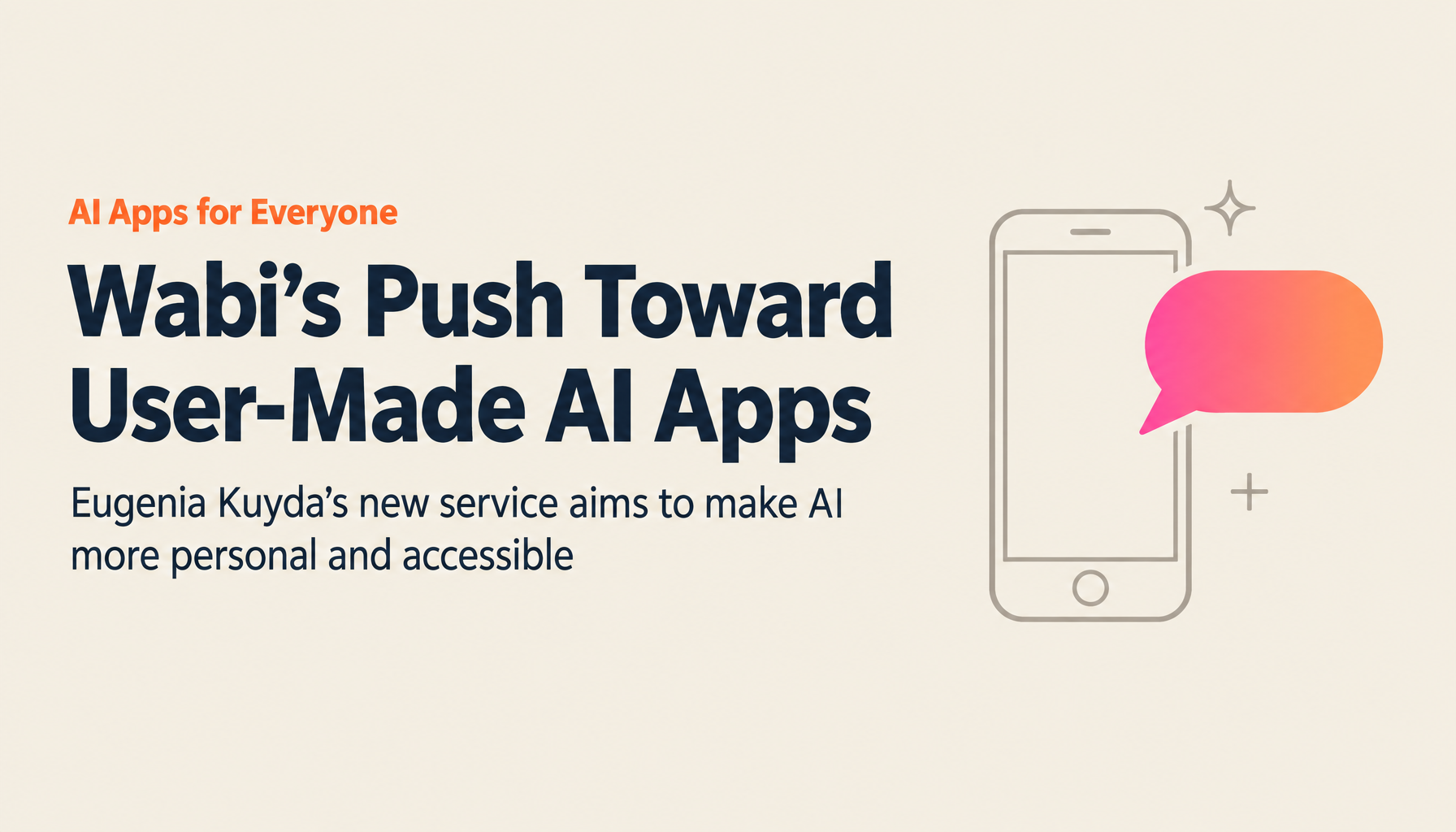
Recently, the evolution of artificial intelligence technology has been remarkable, bringing innovative changes one after another to our daily lives and business environments. Among these, Eugenia Kuyda — known as the founder of Replika — is exploring a new form of AI that goes beyond "just another app." Her new service, "Wabi," offers a system through which users themselves can create their own personal AI apps in minutes, opening up the world of app development — once the domain only of those with specialist knowledge — so that anyone can freely experience it. Rather than relying on a specific communication medium like phone calls or WhatsApp, Wabi realizes an environment where anyone can easily build their own personal AI app and put it to use in daily life and work. This concept evolves AI into an experience that feels more familiar — spreading beyond conventional app use toward supporting the challenges and creative activities of each individual.
This new service is meaningful not only in providing an intuitive, approachable experience for users, but also in enabling people to incorporate AI into daily life in a more individualized form while premised on an online environment. In particular, for those in regions where communication infrastructure is not fully developed, and for those unfamiliar with digital device operations such as elderly users, this service may open new possibilities. Furthermore, the philosophy Kuyda champions is "returning AI to the creative hands of all people." The thinking that technology should be available not just to a handful of companies or developers but to anyone in the world lies at the root of Wabi.
This article focuses on the new service "Wabi" that Eugenia Kuyda is working on — explaining its mechanisms and features, the behind-the-scenes of a system that lets anyone build an AI app, and the vision of AI's future this initiative suggests. Please read to the end and see the possibility of how AI is trying to change our lives.
From "Using" AI to "Building Together": The New Conversational Experience Wabi Brings The Possibilities of AI Apps Expanded Through WhatsApp Integration: The Era of Co-Creation by Users Worldwide Returning AI to Individual Hands: The Social Transformation and Future Vision Wabi Envisions Conclusion
Taking on AI-driven work? You do not have to do it alone
WARP is a hands-on program for people who want to build with AI themselves, from training through implementation support.
From "Using" AI to "Building Together": The New Conversational Experience Wabi Brings
Eugenia Kuyda notes that "just existing as an app on a smartphone is insufficient for AI," and is challenging the realization of a more human-like interface. What she proposes is the idea of changing the relationship with AI from "using" to "building together" — a world where users can freely leverage AI according to their own needs. Wabi does not offer the service via phone lines; rather, it provides a system where users themselves design AI within an app and can freely make use of it. Through this, users can quickly create and use AI apps suited to their purposes through intuitive text-based operations.
The appeal of Wabi lies above all in its "accessibility." Without complex settings or specialist knowledge, anyone can create their own personal AI app in minutes. The point that AI can be assembled to fit life and work purposes without programming experience has earned support. Wabi aims for everyone to be able to leverage AI to match their own ideas and purposes, focusing primarily on providing individual AI experiences through app generation.
Wabi is a text-based AI design service, not a voice recognition technology. Users can build their own AI apps through intuitive operations without using voice — realizing an interactive AI experience tailored to individual purposes and sensibilities.
Key points are as follows:
- Users can create their own personal AI app in minutes
- AI use tailored to life and work is possible without programming
- An intuitive UI means even beginners can operate it easily
In Wabi, a system is in place for sharing and improving apps that users have created, making it possible to evolve one's own AI while incorporating other users' ideas. This extensibility will be a major element further broadening the user base going forward. In fact, Wabi is creating a new relationship of not just "using" AI but "growing it together." As users accumulate improvements, AI continues to grow not as a mere tool but as a presence that is part of life and creativity. Such movements symbolize the spread of a more flexible and personalized AI experience, going beyond conventional app use.
Furthermore, this approach draws a clear line from conventional phone-based and chatbot-centered AI use. From the picture of people adapting to AI, Wabi reverses this — "designing AI to your own specifications" — opening an era of user-led AI utilization. This current will greatly change the shape of future AI services.
Furthermore, OpenAI's initiatives also contribute to overcoming various challenges that conventional phone services had. For example, many problems had been pointed out with phone inquiries in the past — the limited number of operators, long wait times, and lack of consistency in responses. However, with ChatGPT mediating phone conversations, these challenges could be significantly resolved. Users can obtain the latest information and consistent answers at all times regardless of the time of day or the quality of the person responding, and the overall quality of service is expected to dramatically improve. As the fusion of technology and society advances, systems like Wabi are expected to see practical application across diverse fields going forward.
Given this background, Wabi can be said to be an initiative trying to deliver AI to more people in an open form. In particular, its innovation lies in removing the barrier of specialist knowledge and enabling individuals to create AI tailored to their own purposes. Together with the expansion of specific use cases, it will be a step contributing to resolving the digital divide across all of society and building an environment where more people can easily access information and knowledge.
The Possibilities of AI Apps Expanded Through WhatsApp Integration: The Era of Co-Creation by Users Worldwide
Kuyda described current chatbots as "the AI of the MS-DOS era," and spoke of the arrival of the next evolution — "the era where anyone can build an AI app." Kuyda aims not to confine the AI experience to limited platforms but to make it freely usable for anyone in a familiar environment. Based on that thinking, Wabi provides a "next-generation gateway" for all users to engage with AI through natural conversation.
Her new project "Wabi" comes equipped with a system where anyone can build a small AI app (mini-app) in minutes and share it with friends and family. After registering, users can converse with the AI they have created through text messages. Through this, the environment is set up so that, in any environment where the internet is available, anyone anywhere in the world can conveniently use their own personal AI app. It is designed with high compatibility with major mobile operating systems such as iOS and Android, allowing users to send and receive conversational messages naturally within the app.
With this kind of thinking, AI is no longer merely a tool for search or text responses — she says it is evolving into a "co-creation partner" supporting daily actions and creativity. For example, it can present rapid and accurate answers to any question — unfamiliar local information at travel destinations, recipes, health advice, and so on. Since it is text-based conversation, users can pose questions at their own pace and carefully read through the responses, improving the ease of receiving information more flexibly compared to conventional one-way communication like phone calls.
Additionally, Wabi has a major benefit in that the history and settings of apps one has created are saved, enabling continuous improvement and reuse. It is easy to later check questions and answers made in the past, useful for further accumulating knowledge and organizing information. Furthermore, Wabi users can share ideas with each other worldwide, and global exchange is born regardless of English-speaking and non-English-speaking regions. AI development is changing from something only for a handful of people to an open activity anyone can participate in.
Such fusion of global platforms and AI is not limited to mere technical innovation. Integration with WhatsApp promotes smooth intercultural communication while simultaneously meaning new challenges to information accuracy and reliability. In a situation where different information sources and local services existed in each country, the addition of ChatGPT's unified information provision means the major benefit is expected that users worldwide can obtain unified information on a single platform. On the other hand, cases where users seek information customized to their own culture, language expressions, and differences in background knowledge will also increase — making subtle adjustment of the information OpenAI provides and updates reflecting user feedback an important challenge. Wabi's evolution is not limited to mere technical innovation; it is connected to the creation of a new culture where humans and AI learn together.
Additionally, the content of conversations when users make inquiries is continuously learned by the system — so feedback obtained from past conversations directly connects to improving the accuracy of subsequent answers. In other words, as users each ask different questions, AI continues to improve itself and is able to always provide the most reliable information. Such a cyclical feedback system will, seen over the long term, greatly contribute to improving information quality and will support the realization of an information service that users worldwide can confidently use.
Furthermore, another benefit of using WhatsApp is that since users are accustomed to the existing chat system, there is no need to install complex new operations or dedicated apps. Users can enjoy easy interaction with AI on a tool they are already accustomed to using daily, without incurring additional learning costs. Such a seamless user experience will undoubtedly greatly contribute to the spread of the service as a whole. In this way, the advent of Wabi has accelerated the flow of opening AI from a handful of specialists to general users. As people have become able to design and share AI apps themselves, AI is beginning to naturally meld into daily life and business.
Returning AI to Individual Hands: The Social Transformation and Future Vision Wabi Envisions
Eugenia Kuyda, who worked on developing Replika, has for many years pursued "an empathetic relationship between people and AI." The concept behind Wabi this time is an attempt to return AI — not as a large mechanism of all of society — to individual hands. The aim is for anyone to be able to create, through AI, apps that match their purposes and values. Kuyda holds a strong conviction about sharing AI's benefits with as many people as possible, and behind it lies the philosophy of opening technology not just to a handful of specialists but to general users as well.
This new initiative allows users to freely build AI apps according to their interests and purposes, opening new doors even for those who have had few opportunities to engage with AI until now. For example, it can be said to be very meaningful that even elderly people unfamiliar with digital device operations, users living in remote areas, and regions where high-speed internet environments are not in place can receive sophisticated AI-based information provision with simple operations. Of course, situations also exist where there are points to be improved in such technology introduction, and where flexible responses tailored to users' usage environments are required — but the Wabi team is also sincerely taking in user feedback and continuing to make functional improvements.
Also, as users have become able to design and share AI apps themselves, there is potential to bring transformation even to the shape of society's information infrastructure as a whole. In this way, the scope of AI application is expanding across specific domains to a movement bringing new systems to all of society.
Wabi's initiatives also place importance on technological transparency and ethical use. Regarding concerns about the accuracy and bias of AI-generated content, Kuyda states that "it is necessary to blend AI into society in a form trustworthy to humans" — continuing improvements that reflect users' voices. Through this, realization of a safer and more reliable AI environment is expected to advance.
On the other hand, in the midst of rapidly evolving technology, there is no shortage of negative evaluations and voices of concern. For example, some users may raise concerns such as "wouldn't using it by phone have slow response times?" and "there may be insufficient voice recognition accuracy." Additionally, concerns about privacy issues and security on the information exchange side through WhatsApp are also raised in some quarters. Facing such critical opinions openly and continuing to improve problem points is an indispensable attitude for Wabi to earn long-term trust.
Such technological innovation and how it is received is an important theme that greatly influences the role of AI in all of future society. By accessing broad users through phone and WhatsApp, a picture emerges of AI melding into daily life and becoming a means to truly improve the quality of each individual's life — not just convenience and efficiency. The initiatives led by Kuyda with Wabi are drawing a grand vision of not only the perspective of technological evolution but also of rooting that technology in society and making it a form where anyone can benefit.
Looking to the future, ChatGPT and other advanced AI technologies hold the potential to transform society's very way of being — going beyond mere improvements in convenience. That is the process of evolving into a safer and more reliable information service by listening to users' voices and continuing flexible improvements — and the knowledge gained in that process will greatly contribute to the technology development of the next generation as well. And as these technologies spread widely, the ideal of people of different cultures, backgrounds, and languages gathering together and building the future together becoming a reality is also thought to not be far off.
Conclusion
The Wabi initiative introduced here shows a future where AI individualizes human life more deeply and everyone can design their own AI experience with their own hands. Wabi's distinctive feature lies in realizing "individual-led creation" that leverages AI while staying close to everyday life. For example, AI apps can be freely built according to one's purposes — play with children, health management, learning support — and used immediately.
Such movements mean that AI is evolving from a mere tool to a "presence to create together." What Eugenia Kuyda envisions is a society where AI draws out human creativity and naturally melds into daily life. With the advent of Wabi, the era of AI being confined within apps is coming to an end — and we are shifting to an era where people and AI grow together and generate new value.
Reference: https://www.youtube.com/watch?v=-KfrrWRl3FA
TIMEWELL's AI Consulting
TIMEWELL is a professional team supporting business transformation in the AI agent era.
Services Offered
- AI Agent Implementation Support: Business automation leveraging GPT-5.2, Claude Opus 4.5, and Gemini 3
- GEO Strategy Consulting: Content marketing strategy for the AI search era
- DX Advancement & New Business Development: Business model transformation through AI
In 2026, AI is shifting from "something you use" to "something you work with." Shall we think through your company's AI strategy together?