Sam Altman: The Sales Genius Shaping the Future and the Journey of OpenAI
Sam Altman: The Sales Genius Shaping the Future and the Journey of OpenAI
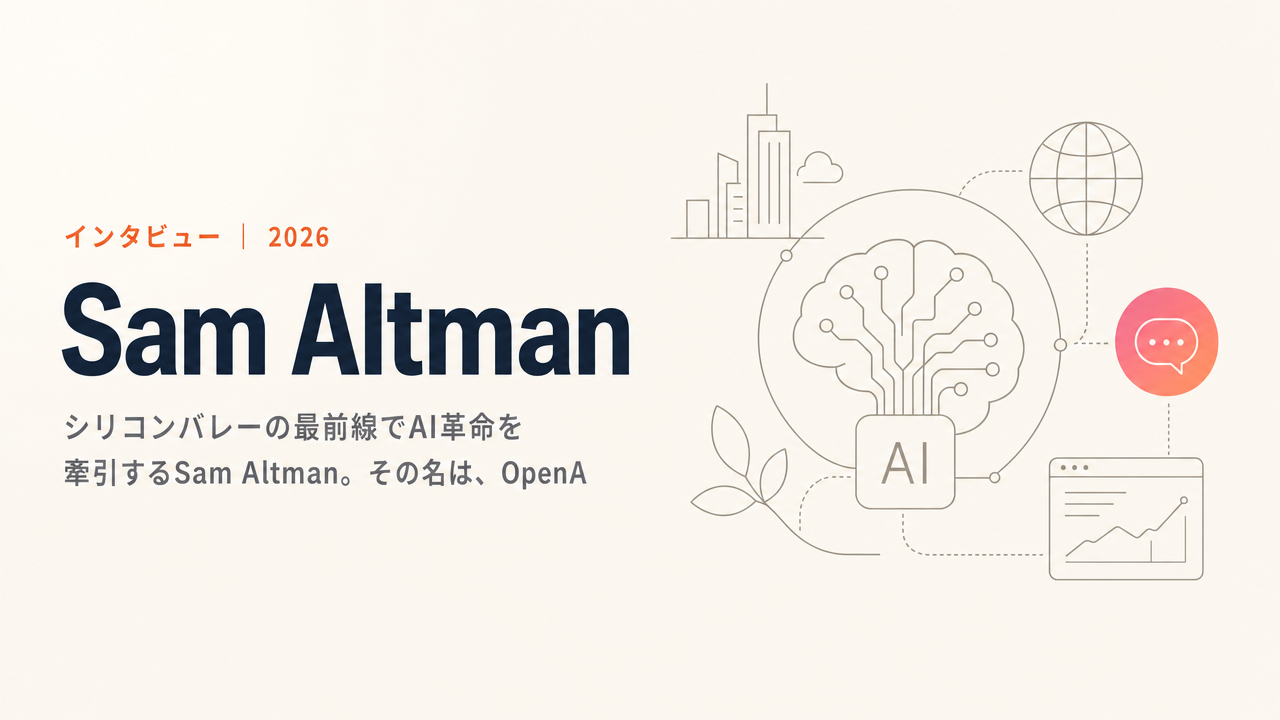
Sam Altman drives the AI revolution from the very forefront of Silicon Valley. Known worldwide as the face of OpenAI, he is not merely an entrepreneur but a "salesman" who, despite his youth, captivates people — wielding a bold vision of the future and extraordinary fundraising power.
This article draws on the content of a conversation between Wall Street Journal reporter Keach Hagey and Sam Altman to explore his career, how he generated new power in Silicon Valley, and the future vision OpenAI is working toward.
From a young age, Altman demonstrated a grasp of systems and a drive to push the boundaries of human capability and technological innovation — making him less a technologist than a "prophet of the future." His energy, influence, and occasional management weaknesses also reveal the risks lurking beneath the surface of success.
How does he manage risk, raise capital, and earn trust? What impact will he have on the AI industry and Silicon Valley as a whole? Reading on, you'll glimpse the appeal hidden within this one entrepreneur, and how OpenAI might evolve going forward.
◆ Sam Altman: His Path as Silicon Valley's Reality Distortion Salesman ◆ OpenAI's Journey and Sam Altman's Influence: Corporate Mission and the Future of AI ◆ Future-Oriented Management Strategy and Multifaceted Challenges — The New Frontiers Sam Altman Opens ◆ Conclusion: Sam Altman and OpenAI's Path Toward an Open Future
Taking on AI-driven work? You do not have to do it alone
WARP is a hands-on program for people who want to build with AI themselves, from training through implementation support.
Sam Altman: His Path as Silicon Valley's Reality Distortion Salesman
Sam Altman is, in his very existence, a symbol of Silicon Valley's beliefs and its challenges toward the future. His background and character have been described in detail by many associates and reporters, and it is worth noting that he possesses not only the ability to create new technology but also the face of a "salesman" who makes people believe in the future. This speaks to how powerfully he can lead people toward dreams, hope, and investment.
From childhood, Altman was already regarded as someone who operated outside ordinary limits. According to his mother, by the age of ten he already had the systems knowledge and street smarts to navigate a major city like New York on his own. In high school, even his teachers described him as "not just a tech geek, but a rare individual who combines rich humanity" — his versatility was unmistakable.
Altman went on to study computer science at Stanford, where he developed a deep interest in AI. During his university years, he cultivated broad knowledge and deep insight by engaging not only with science but also literature and politics. His appeal lies precisely in his natural fusion of technology and the humanities, and a charisma that draws in anyone who meets him. This background became the wellspring of his extraordinary salesmanship.
Altman discovered his investor instincts at an early stage. Through the failure of his first venture and his subsequent experience pioneering Y Combinator, he became convinced that "taking risks is the key to growth." Indeed, he has an extremely high tolerance for risk — during university he was drawn to risky hobbies like poker and race cars — and that energy would later be put to great use in investment decisions and fundraising.
What Keach Hagey's book probes deeply is how Altman built strong networks with many prominent investors and Silicon Valley heavyweights, and how he used "reality-changing words" to attract trust and capital. In the companies he founded, he owned no equity himself; instead he raised funds by leveraging his relationships and outstanding charisma as a salesman, and rapidly escalated the companies' value. This approach could be described as "defying common sense," and it has indeed been evaluated as such across his career.
Not everything in Altman's story is spectacular success, however. OpenAI's board of directors' sudden dismissal of Sam Altman was a major shock to businesspeople, technologists, and investors worldwide. When a CEO is dismissed, there are normally warning signs from management or the board — yet in Altman's case, it was completely unexpected, landing like a "seismic event" that no one outside had anticipated.
Behind that incident lay something beyond mere management decisions: the complexity of power relationships and personal networks within Silicon Valley. In a sense, he was revered both inside and outside the organization as a "salesman of the future," but in internal management decisions, contradictions and ambiguities surfaced, creating distrust. Specifically, he was criticized for a lack of consistency in decision-making — making different promises to multiple people for the same role — which ultimately triggered conflicts among executives. After a series of events shook confidence in him, the board made a harsh decision.
Nevertheless, as many associates attested, Altman was less a leader driven by technology and market trends than an investor-type executive who advanced fundraising and business development by skillfully managing human relationships. His network was supported by allies cultivated during his Y Combinator days and fellow industry heavyweights like Airbnb's Brian Chesky. The moment the dismissal was announced, these figures quickly spoke out in his support, and employees launched a movement demanding his return. Indeed, voices from inside mounted — "if Sam Altman leaves, employees will flee and the company's future will be imperiled" — and public opinion coalesced around him.
Against this backdrop, Sam Altman became a singular figure in Silicon Valley: a symbol of vision, fundraising, and risk-taking. As both entrepreneur and investor-network manager, his journey holds many lessons in both success and the failures and challenges lurking beneath it.
Altman also holds deep convictions about technology itself. He pushes toward the ultimate goal of AGI (Artificial General Intelligence), connecting it to broad themes including energy, longevity, and the transformation of labor markets. He invests broadly across nuclear fusion, biotechnology, and social science, painting a comprehensive vision for the future. All of it rests on his optimistic belief that "humanity is a being that transcends limits." This singular conviction justifies the risks he takes and further sharpens his strengths as a salesman.
His way of life is not merely a success story; it is an important case for understanding the complex mechanisms by which innovative technology impacts real economic activity and the evolution of society as a whole. On the stage of Silicon Valley, watching how a figure like Altman shapes the future is a deeply meaningful theme for all of us living in the modern age.
OpenAI's Journey and Sam Altman's Influence: Corporate Mission and the Future of AI
From its founding, OpenAI attracted attention worldwide. It set out to "realize AI that benefits all of humanity," pursuing both technological advancement and ethical use. The impact Altman had on this organization extends beyond mere technological innovation to corporate culture, power dynamics, and the investment environment itself.
In conversation, reporter Keach Hagey elaborates on Altman's fundraising abilities at OpenAI and the distinctive relationship-building he deployed — delving into how this contributed to realizing the organization's mission.
Under the vision that OpenAI's AGI research would bring enormous benefits to humanity's future, Altman drew in large-scale capital one after another. The partnership with Microsoft and alignment with major Silicon Valley investment funds stand as prime examples. Many investors, resonating with Altman's vision, provided funding in hopes for the future.
His management approach contains something almost religious — "selling belief." OpenAI's stated mission of opening the future of humanity through AGI goes beyond mere technology development to carry a philosophical dimension. He has consistently held the belief that we humans are tool-using beings, and that those tools have driven the advancement of civilization — and that very belief has been the driving force for investors and employees alike.
The reporter also examines in detail how Altman's corporate optimism and the investment strategy linked to it have influenced internal and external stakeholders. His message that "humanity harbors unlimited potential" has, alongside accelerating technological innovation, brought a massive influx of capital and talent — while simultaneously placing enormous pressure on internal decision-making and management structures. As a result, while bold innovation continued early on, management deficiencies and risk management challenges became apparent, ultimately leading to a harsh judgment from the board. These episodes are cited as weaknesses in management, contrasting with his charisma and salesmanship.
Yet behind his repeated recovery from adversity lay a strong conviction in his own beliefs and "the next move." It was precisely because employees, investors, and the industry at large resonated with his vision and a culture of accepting risk had already formed that his words and actions carried such enormous influence.
Altman's presence at OpenAI is something more than merely driving technological innovation. He is an "investor" and "salesman" who skillfully orchestrates capital flows, talent mobility, and even the broader power structure of Silicon Valley to realize the company's mission.
Thus, the trajectory of OpenAI and Altman's influence extends beyond the success of a single company, offering profound implications for the power dynamics of all of Silicon Valley and the shape of the modern technology industry. His bold fundraising strategy, intense optimism, and associated risk management failures stand as symbols of entrepreneurship that encompasses both success and failure — making him a fascinating subject of study for many readers. There is no doubt that Altman's face as a "sales genius" will remain a critical factor in weaving OpenAI's future.
Future-Oriented Management Strategy and Multifaceted Challenges — The New Frontiers Sam Altman Opens
Sam Altman's ambitions do not stop at advancing AI technology at OpenAI; they spread across nuclear energy, longevity science, a global currency project, social welfare discussions, and many other fields. He recognized early on that the technological innovation brought by AI would require infrastructure investment, reduced energy costs, and a reorganization of people's living foundations. Rather than concentrating on a single technology sector, he actively invests in companies and projects across different fields, working to build the foundations necessary to realize his vision of the future.
Altman's approach to the future also looks beyond the frame of technological innovation to encompass major transformations of real economic systems and social institutions. He actively seeks solutions to the social challenges arising from AI's transformation of every industry. For example, confronting concerns that AI will dramatically change the work environment and disrupt traditional occupational structures, he actively participates in discussions about introducing Universal Basic Income (UBI) and restructuring the labor market.
Against this backdrop, his management strategy is deeply colored by the aspect of an "investor who invests in the future itself" rather than merely a "manager at the cutting edge of technology." To realize technology and spread its utility across all of society, he demonstrates his skills in multiple fields — nuclear fusion, clean energy, and projects leveraging cryptographic technology. Taken together, these endeavors form a structure like a grand puzzle: each project appears independent, yet they are united by the theme of a great vision of the future — humanity using technology as a tool to advance toward eternal life and limitless mastery of the universe.
In such circumstances, the future Altman envisions includes not merely technological innovation but the reconstruction of entire social systems. He works with specialists, investors, and policymakers across various fields, pursuing holistic optimization across technological, economic, and social frameworks. For example, as AI technology advances rapidly, he sparks debate about who will truly be needed in the future, and about the ethical issues and legal preparations required for coexistence with AI. In response, Altman consistently holds up "optimism toward the future," asserting that any difficulty can be overcome. While risks certainly accompany technological progress, he believes they can be overcome through appropriate investment and management strategy.
Behind all these projects and investments lies a conviction unique to Altman: "Humanity is a being of infinite potential, destined to evolve without ceasing." His ventures can be described as attempts to materialize that belief in concrete form. For example, the global currency project and the identity authentication system utilizing cryptographic technology offer new value never seen in conventional social systems, carrying the potential to bring innovation to the design of future society. Indeed, such projects attract attention not only as business successes but also as potential solutions to global social challenges.
At the same time, Altman continuously confronts his own weakness: the management side. Rather than directly handling products himself, he pursues a strategy of gathering talented people and delegating operations to them, maximizing his strengths as an investor-type executive. This strategy, distinguishing him from the conventional Silicon Valley executive archetype, produces excellent results in crisis management and fundraising. His future orientation — combining grand dreams and flexible adaptability — will surely continue to be a source of innovation not only in the AI industry but across the broad technology sector.
Conclusion: Sam Altman and OpenAI's Path Toward an Open Future
Sam Altman is simultaneously one of Silicon Valley's brightest figures and a person whose shadow conceals many challenges and risks. Through his rich knowledge and varied curiosity from early childhood, and his bold fundraising capabilities, Altman has had an enormous impact on many investors, employees, and the technology industry as a whole. The passion he has poured into OpenAI not only shapes the future of artificial intelligence but has shown us the importance of corporate management, the mechanisms of power, and human networks in Silicon Valley.
Despite conflict with the board, internal management difficulties, and even the shock of a dismissal, Altman has continued to reappear and work to open the company's future. His risk-taking, investor's intuition, and strong relationships will continue to exert a major influence on future technological innovation. OpenAI, through his vision and fundraising capabilities, has grown from a mere research institution into an entity that shapes the futures of people worldwide. For investors, technologists, and all stakeholders, Altman's journey will be remembered as an extremely important business case study encompassing both success and failure.
The future of the company, and the evolution of AI, are not the achievement of any single person but the crystallization of the human network formed around Altman and a bold vision — and there is no doubt that its trajectory will continue to generate much discussion. His optimism sometimes becomes a powerful weapon for bridging the gap between ideal and reality, while simultaneously casting a shadow of challenge, both internally and externally, across the organization.
The journey of OpenAI and Sam Altman plays a role in technological innovation in future society while also serving as an important key for understanding the evolution of power dynamics in Silicon Valley, corporate management, and the global investment environment. How will AI's evolution and corporate activity fuse going forward, and what benefits will they bring to our lives? That future may be one that Sam Altman and OpenAI open for us.
Reference: https://www.youtube.com/watch?v=8keooiBqUDY
TIMEWELL's AI Implementation Support
TIMEWELL is a professional team supporting business transformation in the AI agent era.
Services Offered
- ZEROCK: A high-security AI agent running on domestic servers
- TIMEWELL Base: An AI-native event management platform
- WARP: An AI skills development program
In 2026, AI is shifting from "something you use" to "something you work with." Shall we think through your company's AI strategy together?
Related Articles
- Behind the Development of GPT-5.2-Thinking: OpenAI's Challenges and Future in Building Large-Scale Models
- Could Unemployment Hit 20% Within Five Years? The Risks of AI Growth as Warned by the Anthropic CEO
- The Future NVIDIA is Opening — AI Revolution and the Outlook for Next-Generation Infrastructure