By June 2026, the amended law has already been promulgated
Hello, this is Hamamoto from TIMEWELL. Whenever economic security comes up, I still hear people say that "the bill to amend the Economic Security Promotion Act passed the House of Representatives." That is half right, but when you are briefing colleagues internally, accuracy is everything, so I want to set the timeline straight from the outset. This amendment is not mid-deliberation. It cleared the House of Representatives, then passed the House of Councillors to complete enactment, and it has already advanced all the way to promulgation.
Let me start from the law that forms the foundation. The Economic Security Promotion Act, formally titled the Act on the Promotion of Ensuring Security by Taking Integrated Economic Measures, was promulgated on May 18, 2022 as Act No. 43 of 20221. It is a single law that bundles together four mechanisms of different character: stable supply of critical goods, security of core infrastructure, support for advanced technology development, and non-disclosure of patents. Its supplementary provisions wrote in a review three years after entry into force, and this amendment can be understood as what emerged at that milestone2.
On March 19, 2026, the government approved at a Cabinet meeting a bill that revises both the Promotion Act and the Japan Bank for International Cooperation Act (the JBIC Act) together, and submitted it to the Diet that same day3. It was a consolidated bill, numbered Cabinet Bill No. 30 of the 221st Diet session, that revises two laws at once. Tracking what followed by date: the House of Representatives passed it on May 19, 20263, the House of Councillors passed it on June 10, 2026 to complete enactment4, and it was promulgated as Act No. 38 on June 17, 20263. Entry into force is phased, with provisions coming online in sequence within a window of one month to one year and six months after promulgation. The supply-assurance provisions are set to enter force within six months of promulgation5. If you stop the story at "it passed the lower house," your understanding is half a year behind, so please do update it here.
This amendment breaks down into five main pillars: securing the supply of critical goods, adding the medical field to core infrastructure, expanding support for advanced technology development, promoting important overseas projects, and establishing an economic security think tank together with a public-private council5. Of these, the expansion of support to services and the addition of medical infrastructure were covered in a separate article, "The Economic Security Promotion Act Amendment (Expansion to Services and Medical Infrastructure)." Here, to avoid repetition, I will focus on just two: "the promotion of important overseas projects," which is most deeply tied to cooperation with like-minded countries, and the "mutual coordination and requests for cooperation" provisions that keep supply from being cut off. Let me state my position up front: this amendment is one that "widens the scope outward" for the export control front line. It requires us to redirect eyes that had been watching only for outflow prevention toward our overseas counterparties as well. That is my candid reading.
Replace siloed classification work with AI.
METI's FY2024 data shows 52% of foreign exchange law violations stem from classification errors. Download the TRAFEED product catalog covering features and rollout.
A new pillar called "promotion of important overseas projects"
What was added entirely fresh in this amendment is the fourth pillar, "the promotion of important overseas projects." The words "promotion of designated overseas projects" were written into the article that sets out the purpose of the Promotion Act, and the government is now to draw up a basic policy that shows how to proceed6. The Promotion Act up to now placed its center of gravity on protecting domestic supply networks and domestic infrastructure. It is easiest to grasp the new pillar as an attempt to extend that center of gravity beyond the country's borders.
The law defines the "designated overseas projects" eligible for support in three categories6. The first is projects that build and operate facilities and equipment needed for the international transport of goods. The concrete example envisioned is a hub for refueling ocean-going vessels, that is, a bunkering hub. The second is projects that build and operate facilities and equipment used for services that underpin Japan's social infrastructure, among those located overseas. The example given is developing the ground-side equipment of satellite communications systems. The third is projects that build and operate facilities and equipment that use technologies important to social-infrastructure services, with the introduction of Open RAN, which lets you assemble a communications network without being locked to a particular vendor, cited as an example. A maritime fueling station, a space ground station, the foundation for next-generation communications. Lined up side by side, all of them turn out to be infrastructure that amounts to the arteries of the nation, not something that can be settled by a single company's profit and loss.
In terms of mechanics, the flow is that a private company draws up a plan for a designated overseas project and obtains certification from the competent minister6. A certified operator reports on the status of implementation each fiscal year. The law states that the competent ministers are the Prime Minister and the Minister of Finance, and because overseas finance is involved, the structure brings in the fiscal authorities as well. Why does the state go this far to back overseas projects? The grounds lie in recommendations compiled on January 30, 2026 by an expert panel under the Cabinet Secretariat. The recommendations state that, while most past support records have been confined to domestic measures, foreign countries are advancing investment into important overseas regions through diverse means, and the need is growing to carry out important overseas projects as a unified public-private effort in collaboration with allies, like-minded countries, and the nations of the Global South7. Join hands with trusted partner countries to diversify supply networks and investment destinations. This idea is the backbone of the new pillar.
Subordinated investment as "priming water," with the state absorbing risk first
The provider of the money that actually drives the new pillar is JBIC (the Japan Bank for International Cooperation). This is why not only the Promotion Act but also the JBIC Act was amended this time. JBIC becomes able to extend loans and the like to certified designated overseas operators, and a sentence was added to the JBIC Act's purpose stating that, through such finance, it contributes to ensuring security6. The key word here is subordinated investment. For those unfamiliar with it, let me explain as plainly as I can.
When several parties put money into a company, they receive distributions if there is profit and share the burden if there is a loss. Subordinated investment is an investment that deliberately makes this order unfavorable. It lines up at the very back of the queue to receive profit, and absorbs losses first when they occur. In other words, the state takes on the risk of loss ahead of everyone else. Why would JBIC volunteer for such an unfavorable role? Private banks and investors rarely step into strategic overseas projects whose recovery is hard to read. So by having the state stand at the front and show its resolve to bear the loss, the message becomes "if that project has the state behind it," and private capital is drawn in. Priming the pump is exactly this image.
Let me restate it with a familiar example. Suppose you are opening a new shop with friends, and the person with the most money declares, "If we go into the red, I will absorb the first losses entirely. I am fine taking my share of the profit last." How would the other backers feel? They become far more willing to put up a little themselves, thinking, "If so, I will give it a try too." What the state is trying to fulfill through subordinated investment is precisely this role of being the first to raise its hand. By laying down a cushion against loss, the state draws private money toward strategic overseas infrastructure whose profitability is hard to read and which no one would invest in if left alone. Put the other way around, because this is a system premised on the state shouldering the loss, and because the source of funds is taxpayer money, it is essential to be able to verify afterward what kinds of projects the money goes into. The mechanism itself may be rational, but if operated wrongly it risks breeding a complacency that "the state will absorb any amount of loss," and that tension always remains.
To make this subordinated investment possible, the JBIC Act partially waives several principles. It excludes certified projects from the principle of certainty of redemption, which demands assurance of recovery, and the principle of balanced revenue and expenditure, which requires expenditures to be covered by income6. On top of that, it sets up a new account separate from existing ones, and supplies the subordinated investment and the like from there. The seed money for the new account is expected to be drawn from the general account, meaning that the nation's taxes are included in the source of funds. That is precisely why cautious views also emerged in the Diet. How will its role be divided from existing policy finance and public-private funds? Would it not be putting the cart before the horse if it leaned toward overseas projects and hollowed out domestic industry? Since it broadens the range of risk-taking, how will the appropriateness, transparency, and fiscal discipline of the investment be ensured? Is there support for small and medium-sized enterprises to become certified operators? These were the questions raised6. I do not take this caution as something that throws cold water on the system. It is precisely because the state takes losses first that a mechanism to keep watch on how the money is used is required. Accelerator and brake should be designed as a set, and I believe it is important that those of us on the front line not switch off our thinking with "it is safe because the state is putting up the money."
How far are "semiconductors and shipbuilding" actually written into the law?
Much of the news reporting on this amendment ran headlines like "Government to support semiconductors and shipbuilding overseas projects." Coverage of the March Cabinet decision pushed semiconductors and shipbuilding to the front, and articles reporting the June enactment cited semiconductors, shipbuilding, drones, rare earths, and ports as fields that could become targets8. Many readers will have come away with the impression that "the state is apparently going to fund overseas factories for semiconductors and shipbuilding." Here I want to pause for a moment, because the way the coverage characterizes things and what the law actually defines differ in granularity.
As we saw in the previous section, the concrete examples of the three categories of designated overseas projects defined by the law were a refueling hub for ocean-going vessels, ground equipment for satellite communications, and Open RAN6. The law does not enumerate semiconductors themselves or shipbuilding itself by name as support targets. Shipbuilding does connect, in the form of bunkering hubs for ocean-going vessels, to the context of infrastructure that underpins the arteries of international cargo transport. Semiconductors, on the other hand, are more accurately understood as being discussed in a separate stream. In September 2025, Japan exchanged a memorandum with the United States over a large-scale investment initiative to advance investment into the U.S. in fields such as semiconductors, and in response, in October 2025 a "Japan Strategic Investment Facility" was established at JBIC, with a framework to back the overseas expansion of Japanese companies beginning to move ahead first6. This amendment is positioned as layering further new operations on top of that stream. So the claim that "semiconductors will be supported" is not a lie, but it is not in the sense of being a named target of this amendment's designated overseas projects; it is the bigger picture that includes a neighboring, separate framework, and it is safest to draw that distinction9. If you are writing it into internal materials, the accurate way is to lay it out side by side: it is true that the government and the media have semiconductors and shipbuilding in mind, but the designated overseas projects the law defines are international transport networks such as ports, social-infrastructure facilities located overseas, and facilities using critical technologies.
The talk of reconfiguring supply networks toward like-minded countries is, flipped around, also talk of forging new relationships with countries and companies you have never dealt with before. Even if the counterparty is a company in a trusted like-minded country, the effort of confirming who the end user really is and where things ultimately flow does not shrink. If anything, as the number of trading partners grows, the load of classification (gaihi) determination and transaction screening rises without fail. The export control AI agent we provide, "TRAFEED," cross-checks against sanctions lists, end-user lists, and the regulatory lists of various countries around the world simply by importing your counterparty list, and shows in a short time whether risk exists and the grounds for it. It supports classification determination aligned with the Ministry of Economy, Trade and Industry's standards, as well as name-matching of multilingual counterparty names, so it comes into its own precisely in the phase of expanding supply networks overseas.
Supply-assurance "requests for cooperation" and practice in the age of allied cooperation
Alongside the promotion of overseas projects, what comes to bear on the export control front line are the "mutual coordination and requests for cooperation" provisions concerning the supply assurance of critical goods. This amendment establishes a best-effort obligation for the state, supply operators, demand operators, and others to cooperate while pursuing mutual coordination, and puts in place a mechanism for the state to seek cooperation from operators when there is a risk of disruption to supply5. Concretely, this includes requesting the provision of necessary materials and information, and encouraging the drafting of plans to secure supply. I take these as provisions whose character is less about compulsion and more about having the public and private sectors exchange information in normal times so as to build relationships that keep supply from stopping when the moment comes.
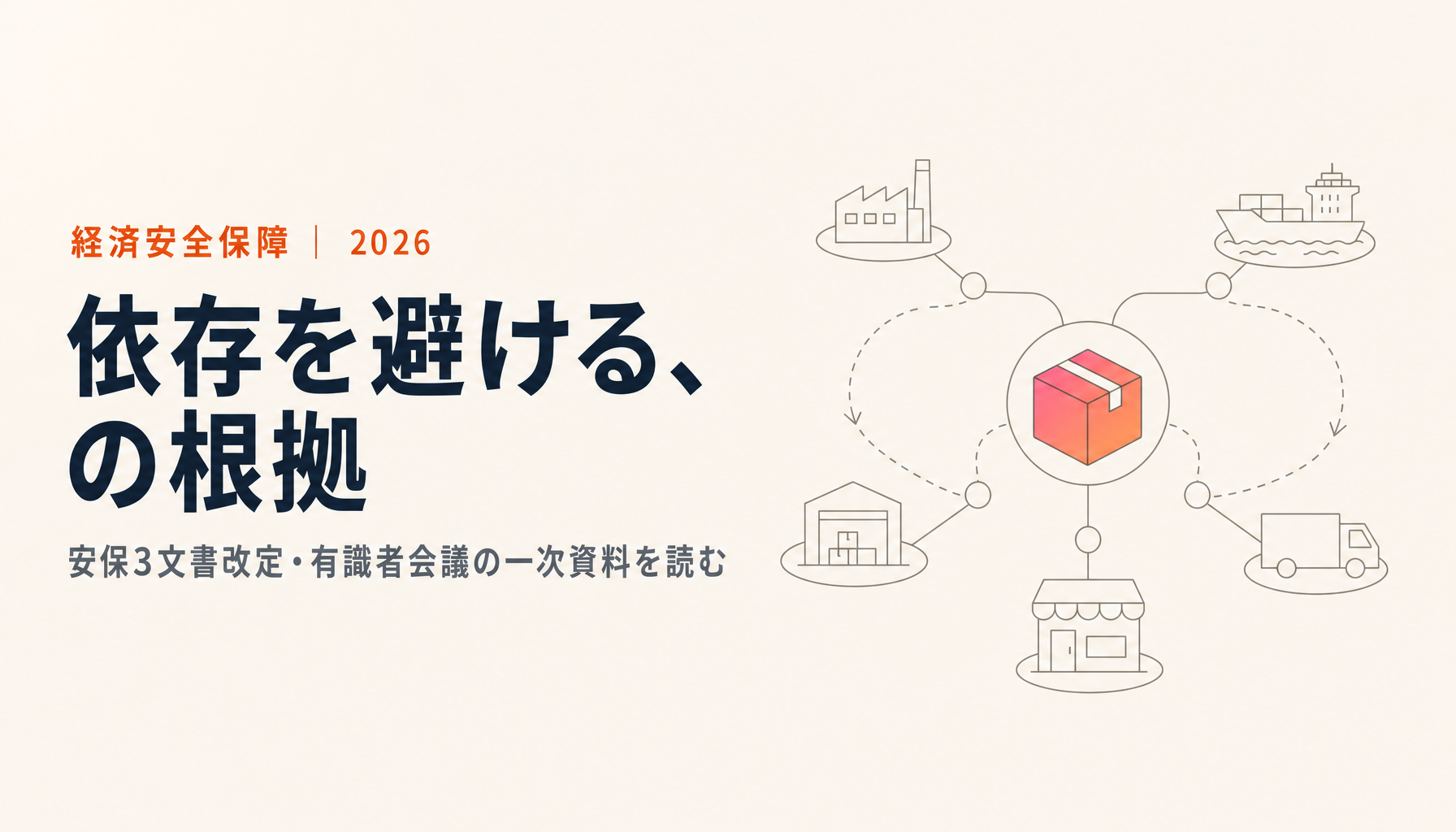
Why did this become necessary? Behind it lies wariness toward excessive dependence on a particular country for critical goods or services. If you rely entirely on a single country for the supply of goods such as critical minerals and rare earths, storage batteries, or ship components, that dependence can be turned into a means of economic pressure in forms like export restrictions10. The idea that eases this anxiety is friendshoring, which diversifies supply networks and investment destinations among trusted allies and like-minded countries. When you read the supply-assurance coordination provisions and the promotion of overseas projects as two wheels of the same cart, one being a move to firm up preparations at home and the other a move to re-spread the net overseas, the aim of the amendment comes into three-dimensional view. The policy foundation also includes the so-called crisis-management investment line of preemptively investing in economic security, food, energy, medical care, and the like6.
This is where the export control practitioner steps in. Reconfiguring supply networks toward like-minded countries means that both the partner countries and the partner companies you deal with increase in number. Procurement sources in emerging economies, overseas partners you are dealing with for the first time, equipment and services placed abroad. The structure in which the scope to be watched widens outward is exactly the same as the addition of services and medical care covered in the separate article: the number of staff does not grow, yet only the range to be inspected lengthens. If you keep doing the cross-checking by hand, oversights are only a matter of time, as I see it. If you have plans to extend your supply network overseas, I recommend inspecting the screening setup for those partner countries and partner companies early. If you want to nail down concretely what risks lurk in your own transactions and where to begin, please reach out through our individual consultation. Matching the movement of the system against your own circumstances, we will think through realistic preparations together, including where to draw the line between cross-checking entrusted to machines and judgment carried by people.
If you are reviewing export-control operations or classification workflows, download the TRAFEED product catalog (PDF) or contact us.
References
Footnotes
-
Act on the Promotion of Ensuring Security by Taking Integrated Economic Measures (Act No. 43 of 2022) — e-Gov Law Search (Digital Agency) — promulgated 2022-05-18 — https://laws.e-gov.go.jp/law/504AC0000000043 ↩
-
Economic Security Promotion Act — Cabinet Office, Economic Security Promotion Office — updated as needed — https://www.cao.go.jp/keizai_anzen_hosho/suishinhou/suishinhou.html ↩
-
Bill deliberation progress information (Cabinet Bill No. 30 of the 221st Diet, Bill to Partially Amend the Act on the Promotion of Ensuring Security by Taking Integrated Economic Measures and the Japan Bank for International Cooperation Act) — House of Representatives — accessed 2026-06-29 — https://www.shugiin.go.jp/internet/itdb_gian.nsf/html/gian/keika/1DE20F6.htm ↩ ↩2 ↩3
-
For economic security, the state to shoulder the risk of important overseas projects: amended law enacted — Nikkei — 2026-06-10 — https://www.nikkei.com/article/DGXZQOUA092GU0Z00C26A6000000/ ↩
-
Bill to Partially Amend the Act on the Promotion of Ensuring Security by Taking Integrated Economic Measures and the Japan Bank for International Cooperation Act (Overview) — Cabinet Office — 2026-03 — https://www.cao.go.jp/houan/pdf/221/221_1gaiyou.pdf ↩ ↩2 ↩3
-
Rippo to Chosa No. 483, "Legal Amendments Toward Further Advancing Economic Security: The Bill to Partially Amend the Economic Security Promotion Act and the JBIC Act" — Research Offices of the Standing and Special Committees, House of Councillors — 2026-04 — https://www.sangiin.go.jp/japanese/annai/chousa/rippou_chousa/backnumber/2026pdf/20260430003.pdf ↩ ↩2 ↩3 ↩4 ↩5 ↩6 ↩7 ↩8 ↩9
-
Recommendations Toward Further Advancing Economic Security — Expert Panel on the Economic Security Legal Framework (Cabinet Secretariat) — 2026-01-30 — https://www.cas.go.jp/jp/seisaku/keizai_anzen_hosyohousei/r8_dai15/teigen.pdf ↩
-
Semiconductors and shipbuilding: government to support overseas projects, Cabinet approves Economic Security Act amendment bill — Nikkei — 2026-03-19 — https://www.nikkei.com/article/DGXZQOUA1610H0W6A310C2000000/ ↩
-
Economic Security Policy — Ministry of Economy, Trade and Industry — updated as needed — https://www.meti.go.jp/policy/economy/economic_security/index.html ↩
-
Research and Information — ISSUE BRIEF — No. 1356, "Basic Concepts of Economic Security and Trends in the Promotion Act" — National Diet Library — 2026-03-31 — https://dl.ndl.go.jp/view/prepareDownload?itemId=info%3Andljp%2Fpid%2F14696213 ↩