Hello, this is Ryuta Hamamoto from TIMEWELL.
It usually starts with an email. The subject line says "CMRT" or "EMRT," the body asks you to respond by a certain date, and the attachment is an Excel workbook with eight or nine tabs, a long list of yes-or-no questions, and a table of smelters you have probably never heard of. If this is the first time it has landed on your desk, it is easy to stall.
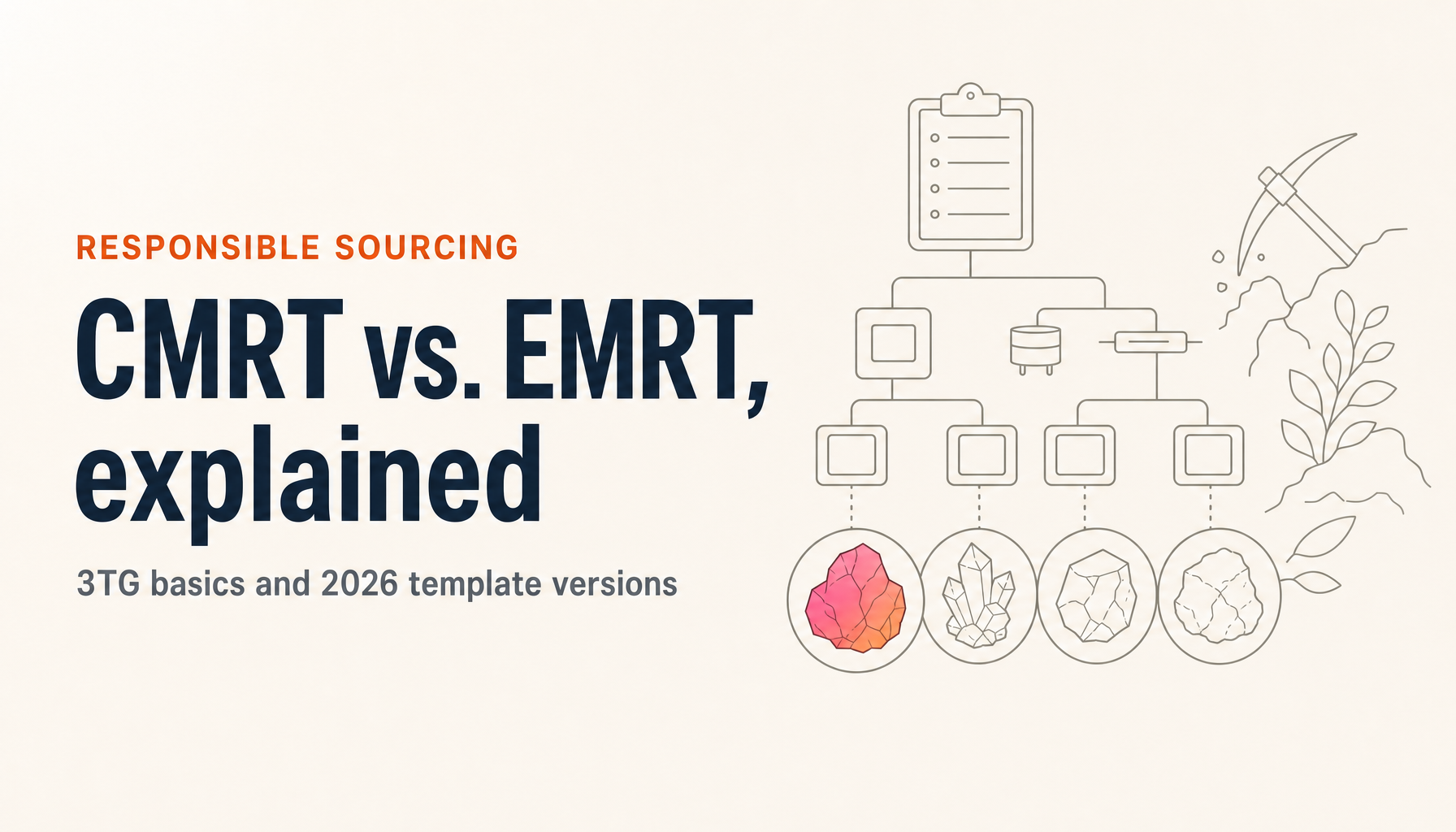
Those workbooks are the industry's standard way of tracing where the tin, tantalum, tungsten and gold (3TG) in your products came from, and increasingly cobalt, lithium and other minerals as well. They sit at the center of what used to be called conflict minerals compliance and is now more often called responsible minerals sourcing.
The templates changed this year. On April 17, 2026, the RMI released CMRT 6.6 and EMRT 2.11, and the EMRT now covers six minerals. At the same time, a bill to repeal the SEC disclosure requirement is waiting for a House floor vote, and some people are wondering whether they can stop answering these surveys. The short answer is no, at least not for the 2026 reporting cycle. Below I walk through how the CMRT and EMRT differ, how to fill in the CMRT, what 3TG means, and where the U.S., EU and Japanese frameworks stand, then close with how all of this connects to export classification.
Version numbers and dates in this article were rechecked against RMI, government and industry association sources on October 4, 2026. This is general information, not legal advice. When you actually respond, follow your customer's instructions and the RMI's latest guidance.
The short version (AIO summary)
- The CMRT (Conflict Minerals Reporting Template) covers 3TG: tin, tantalum, tungsten and gold. The EMRT (Extended Minerals Reporting Template) covers six minerals: cobalt, copper, natural graphite, lithium, natural mica and nickel. Both are free Excel templates from the Responsible Minerals Initiative (RMI).
- The current versions are CMRT 6.6 and EMRT 2.11, both released April 17, 2026. The RMI expects the next versions in spring 2027.
- The heart of both templates is the smelter and refiner list. The receiving company checks whether each listed facility has been assessed as conformant under the RMI's third-party program, the Responsible Minerals Assurance Process (RMAP).
- The SEC conflict minerals rule under Dodd-Frank Section 1502 remains in effect as of October 2026, and the repeal bill (H.R. 7085) is awaiting a House floor vote. The EU Conflict Minerals Regulation (2017/821) has applied in full since January 1, 2021, and in October 2025 the European Commission recognized RMAP as an equivalent due diligence scheme.
- Conflict minerals due diligence and export classification share the same foundation: breaking a product down to its bill of materials (BOM) and tracing what is inside each part. Running them off one set of part-level data saves a lot of duplicate work.
What 3TG means, and what makes a mineral a "conflict mineral"
3TG is shorthand for four metals: tin, tantalum, tungsten and gold. Three start with T and one with G, hence 3TG.
| Metal | Symbol | Typical uses |
|---|---|---|
| Tin | Sn | Solder, plating |
| Tantalum | Ta | Capacitors |
| Tungsten | W | Carbide, electrodes, filaments |
| Gold | Au | Electrical contacts, wiring, plating |
Put them in a table and it becomes obvious why these surveys reach nearly every electronics and metal parts supplier. Almost any product with a circuit board or a precision metal part contains at least one of them.
"Conflict minerals" are minerals whose extraction or trade risks financing armed groups. Both the U.S. Dodd-Frank Act and the EU Conflict Minerals Regulation focus on 3TG. The U.S. rule defines its "covered countries" as the Democratic Republic of the Congo (DRC) plus the nine countries that share a border with it, ten in total, and that term appears in the CMRT questions. The EU takes a broader view. It treats any area in the world affected by armed conflict, or with weak governance and widespread human rights abuses, as a conflict-affected and high-risk area (CAHRA). An indicative, non-exhaustive CAHRA list is maintained on the Commission's behalf and updated periodically, but an area's absence from the list does not mean it carries no risk.
One point is worth stating plainly. None of this is meant to cast any country or region as the bad actor. Many people in these regions mine and trade legitimately, and mining is an important livelihood. The OECD Due Diligence Guidance for Responsible Supply Chains of Minerals from Conflict-Affected and High-Risk Areas (third edition, 2016), which underpins every framework in this article, does not tell companies to walk away at the first sign of risk. It sets out three options: continue trading while measurable risk mitigation is under way, temporarily suspend trade while mitigation continues, or disengage after mitigation has failed.
The OECD Guidance organizes due diligence into five steps: establish strong management systems; identify and assess risk in the supply chain; design and implement a strategy to respond to identified risks; rely on independent third-party audits of smelter and refiner due diligence; and report annually. Annex II of the Guidance lists the risks to look for: serious abuses associated with extraction, transport or trade; direct or indirect support to non-state armed groups; illegal conduct by public or private security forces; bribery and fraudulent misrepresentation of origin; money laundering; and non-payment of taxes, fees and royalties. If you read the CMRT and EMRT questions as the five steps and Annex II rephrased as questions to your suppliers, the templates make a lot more sense.
Beyond 3TG, battery minerals such as cobalt, lithium, nickel and natural graphite, along with mica used in insulation and cosmetics, have become part of responsible sourcing too. Those are what the EMRT is for.
Check where your own program stands first: We publish a supply-chain due diligence self-check sheet with a dedicated conflict minerals (3TG) section. It walks you through whether you collect CMRTs from suppliers and trace them back to the smelter, and whether you handle any of the EMRT minerals. Fill it in and you also have something concrete to show when a customer asks what your company actually checks. → Download the Supply-Chain Due Diligence Self-Check Sheet (Free. Your company name and work email are required.)
Replace siloed classification work with AI.
METI's FY2024 data shows 52% of foreign exchange law violations stem from classification errors. Download the TRAFEED product catalog covering features and rollout.
CMRT vs. EMRT vs. AMRT: scope and current versions
All three templates come from the RMI, an initiative run by the Responsible Business Alliance (RBA) with members across electronics, automotive and other industries. Their job is to replace a pile of customer-specific questionnaires with one shared format. Here is how they compare as of October 2026.
| CMRT | EMRT | AMRT | |
|---|---|---|---|
| Full name | Conflict Minerals Reporting Template | Extended Minerals Reporting Template | Additional Minerals Reporting Template |
| Minerals | Tin, tantalum, tungsten, gold (3TG) | Cobalt, copper, natural graphite, lithium, natural mica, nickel | Minerals not covered by the CMRT or EMRT (user selects up to ten) |
| Current version | 6.6 (April 17, 2026) | 2.11 (April 17, 2026) | 1.31 (April 17, 2026) |
| Next version expected | Spring 2027 | Spring 2027 | Fall 2026 |
| Main drivers | Dodd-Frank Section 1502, EU Conflict Minerals Regulation | Child labor risk at cobalt and mica sites, EU Battery Regulation | Locating processing facilities for additional minerals |
The EMRT has changed the most. When it launched on October 20, 2021, it covered only cobalt and mica. In September 2024 the RMI announced an expansion, and version 2.0 in April 2025 added copper, natural graphite, lithium and nickel, bringing the total to six. Supporting companies' due diligence obligations under the EU Battery Regulation was one of the main reasons. Version 2.1 followed in October 2025 and 2.11 in April 2026. Only natural graphite and natural mica are in scope; synthetic forms are not.
The EMRT lets you answer "Not declaring" for any mineral in question 1. If your customer only wants cobalt, you can decline to declare the other five. My advice is simple: when an EMRT request arrives, ask the requester which minerals they actually need before you start. Tracing six minerals upstream at once is rarely realistic, and the template is built to let you narrow the scope.
The 2026 changes themselves are modest. CMRT 6.6 adds "Requester Product Number" and "Requester Product Name" fields to the Product List, updates country and state names to ISO short names, and refreshes the smelter reference lists. On August 19, 2026, the RMI released versions of each template without RMI logos and branding, which it says are functionally identical to the April versions. One more thing that surprises people: the RMI does not collect completed templates. You send yours directly to the customer who asked for it.
How to complete the CMRT: scope, questions 1 to 8, and the smelter list
CMRT 6.6 has eight tabs: Revision, Instructions, Definitions, Declaration, Smelter List, Checker, Product List and Smelter Look-up. You only enter data on three of them (Declaration, Smelter List and Product List); the rest are there to read or to check your work. The template supports several languages. The notes below follow the RMI's completion guide and the 2026 guidance published by the Japan Electronics and Information Technology Industries Association (JEITA), with a focus on the places where people most often get stuck.
Pick one of three declaration scopes
The first decision on the Declaration tab is the "Declaration Scope or Class." A. Company covers all of your products. B. Product (or List of Products) covers specific products, and choosing it makes the Product List tab mandatory; from 6.6 onward you can also record the requester's product number and name there. C. User defined covers a product group you define, which you explain in the scope description field. The responding company may choose the scope, but customers sometimes dictate it.
A detail that is easy to miss is personal data. If you forward a supplier's completed CMRT to your own customer, you also forward the supplier contact's name, email and phone number. JEITA's guidance points out that this can run into data protection laws in some countries and recommends getting the supplier's permission first.
Questions 1 to 8 move from "do you use it" to "how much have you traced"
You answer each question separately for each metal. Question 1 asks whether 3TG is intentionally added or used in the product or in its production. Quantity does not matter; if the metal is there for a functional or production reason, the answer is yes. Tin compounds used as catalysts and tin used in float glass production count. Production equipment, such as carbide cutting tools, and packaging do not. A "No" on question 1 grays out the remaining questions for that metal.
Question 2 asks whether 3TG remains in the product; a "Yes" means you must complete the Smelter List. Questions 3 and 4 ask whether any smelter in your supply chain sources from the covered countries (question 3) or from CAHRAs (question 4). The answers are Yes, No or Unknown. Even if every CMRT you received says "No," you must answer "Unknown" unless you have identified every smelter in your chain.
Question 5 asks whether all 3TG comes from recycled or scrap sources. Question 6 asks what share of your relevant suppliers responded, with brackets of 100%, greater than 90%, greater than 75%, greater than 50%, 50% or less, and none. Suppliers of equipment and consumables, or of parts you know contain no 3TG, are excluded from the denominator. Question 7 asks whether you have identified all smelters, and you can only answer "Yes" if your own response rate is 100% and every CMRT you received shows 100% on question 6 and "Yes" on questions 7 and 8. Question 8 asks whether you have reported all the smelter information you received.
Rows of "Unknown" can feel uncomfortable, but accuracy matters more than a clean-looking form. The U.S. Government Accountability Office reported in October 2024 that, among companies filing with the SEC in 2023, an estimated 62% of those that went on to conduct due diligence reported being unable to determine the source of their minerals. That is the reality even for large U.S. registrants. Reporting work in progress, along with what you plan to do and by when, earns more trust than forcing a "No."
Company-level questions A to H
Questions A to H are about your own program and are independent of what your suppliers told you. A asks whether you have a responsible minerals sourcing policy, and B whether it is publicly available on your website (if so, put the URL in the comments). JEITA's guidance suggests that a policy supports a "Yes" if it names the minerals in scope (3TG), the risks in scope (OECD Annex II), the areas in scope (CAHRAs), and what you will do when a risk is identified. C asks whether you require direct suppliers to source from smelters whose due diligence has been validated by an independent audit program. D asks whether you have implemented due diligence measures, E whether you conduct a conflict minerals survey of relevant suppliers, F whether you review supplier responses against your expectations, and G whether your review process includes corrective action management. H asks whether you are subject to annual conflict minerals disclosure: SEC registrants answer "Yes, with the SEC," EU importers above the thresholds answer "Yes, with the EU," and most other suppliers answer "No."
The Smelter List and the Checker
The Smelter List is where you list every smelter and refiner in your supply chain. Enter the RMI's smelter identification number (the ID starting with "CID") in column A, and the metal, country and other fields fill in automatically. Without an ID, select the metal and then pick the smelter name from the drop-down. For a facility that is not in the reference list, choose "Smelter not listed" and enter the name and country by hand; if you cannot identify the facility at all, choose "Smelter not yet identified." Smelters must be reported even if your material is 100% recycled.
Before you start, consolidate the smelters from all the CMRTs you received, remove duplicates by ID, and strip out trading companies that are not smelters. When you are done, open the Checker tab and fill in anything still highlighted in red. The template is complete when the count of missing required fields reaches zero.
Why the smelter is the unit of analysis: reading RMAP status
The smelter and refiner list is the most important part of the CMRT. Ore from many mines is melted down into metal at a smelter, and once it is metal, there is no practical way to tell from the metal itself which mine it came from. Smelters are also far fewer in number than mines or component makers. That makes them a natural checkpoint between the source and the finished product, which the RMI calls a "pinch point."
Responsible sourcing therefore treats the smelter, not the mine, as the unit of analysis. Upstream of the smelter, RMAP third-party assessments do the work. Downstream, companies pass information along in a common format, the CMRT. The CMRT you receive from a supplier is itself built from CMRTs your supplier collected further upstream.
When you look up a facility in the RMI's public lists, you will see several statuses. Conformant means the facility was assessed and found conformant with the relevant RMAP standard. Active means it is undergoing an assessment or has committed to one. Eligible means the RMI recognizes it as a smelter or refiner, but it has not yet entered the program. Statuses change, so recheck against the current list before you reply to a customer. According to JEITA, the 2025 revision of the EPEAT ecolabel criteria made it a required criterion that at least 65% of 3TG smelters be conformant (with active facilities counted). If you supply computers, displays or phones, expect more requests to move toward conformant facilities.
The EU took a related step on October 16, 2025. Commission Implementing Decision (EU) 2025/2071 recognized RMAP as equivalent to the requirements of the EU Conflict Minerals Regulation, six years after the RMI first applied in 2019.
There is one distinction worth keeping in mind. Being RMAP conformant and being clear of sanctions are two different things. The RMI's own terms state that its information is not intended to be used to evaluate whether a smelter or refiner is a party U.S. persons are prohibited from dealing with. Some customers ask suppliers to remove sanctioned facilities from their supply chain, so screening smelter names against lists such as OFAC's SDN List is a separate step, done the same way you would screen any counterparty. Keep in mind that appearing on a sanctions list or the CAHRA list is a regulatory designation under a particular jurisdiction's rules, not a judgment on the merits of the company or area listed. For the lists involved and how to run the check, see our guide to the five sanctions list systems; for the broader approach to counterparty checks, see end-user screening and customer due diligence.
Where the rules stand in October 2026 (then vs. now)
A lot has moved since this article first ran on July 27, 2026.
| Item | Original version (July 2026) | As of October 4, 2026 |
|---|---|---|
| CMRT version | Not stated | 6.6 (April 17, 2026); next expected spring 2027 |
| EMRT minerals | Cobalt and mica | Six minerals: cobalt, copper, natural graphite, lithium, natural mica, nickel (current version 2.11) |
| SEC rule | Described as a disclosure rule | In effect; repeal bill H.R. 7085 awaiting a House floor vote; committee leaders have asked the President to end or waive it |
| EU Conflict Minerals Regulation | "Reported to apply from 2021" | Applies in full since January 1, 2021; RMAP recognized as equivalent in October 2025 |
| EU Battery Regulation | Not covered | Battery due diligence obligations apply from August 18, 2027 (postponed by two years) |
United States: the SEC rule stands, and the repeal bill awaits a floor vote
Congress passed the Dodd-Frank Act in July 2010, and the SEC adopted its conflict minerals rule under Section 1502 in 2012. Covered SEC registrants file Form SD each year by May 31, disclosing whether 3TG is necessary to products they manufactured in the prior calendar year and describing their reasonable country of origin inquiry. Because May 31, 2026 fell on a Sunday, filings for calendar year 2025 were due June 1, 2026. On April 7, 2017, the SEC's Division of Corporation Finance said it would not recommend enforcement action if companies filed only under paragraphs (a) and (b) of Item 1.01 of Form SD. In practice, that statement took the conflict minerals report, with its due diligence and audit elements, off the enforcement table and left the reasonable country of origin inquiry (RCOI) and disclosure at the center of compliance.
In 2026, the disclosure requirement itself came under challenge. On January 15, Rep. Bill Huizenga introduced H.R. 7085, which would repeal Section 13(p) of the Securities Exchange Act and strike Section 1502 of Dodd-Frank. The House Financial Services Committee ordered it reported by a 30 to 24 vote on January 22, and it was placed on the Union Calendar on March 19. On June 2, Committee Chairman French Hill and Vice Chairman Huizenga wrote to the President asking him to use his authority under the statute to terminate the disclosure requirement, or at minimum to revise or waive it. Their letter cites the DRC-Rwanda peace agreement signed in Washington on June 27, 2025, and the U.S.-DRC Strategic Partnership Agreement of December 4, 2025. Separately, in October 2024 the GAO reported that it had found no empirical evidence that the rule decreased violence in the eastern DRC.
None of this means the rule is gone. As far as we could confirm on October 4, the bill has not received a floor vote, and no presidential determination or SEC rule change has been announced. Even if repeal goes through, survey requests driven by the EU regulation, customer sourcing policies and product standards such as EPEAT would remain. JEITA told its members in June 2026 that it does not expect any impact on the 2026 survey cycle. My own view is that throwing away the smelter data you have built up would be a mistake at this stage.
European Union: full application since 2021, RMAP recognized as equivalent
Regulation (EU) 2017/821 has applied in full since January 1, 2021. Its obligations fall on EU importers of 3TG ores and metals above annual volume thresholds set per product; for unrefined gold, the threshold is 100 kg. The thresholds are set so that at least 95% of import volumes are covered. Companies importing components or finished products are not directly in scope, so for most parts suppliers the regulation arrives indirectly, through EU customers and the smelters themselves.
Where the U.S. rule is about investigating and disclosing, the EU rule requires importers to carry out due diligence in line with the OECD Guidance. The October 2025 equivalence decision formally positions RMAP as a way of meeting that obligation. The Commission published a call for tender on June 16, 2026 for a study to support the review of the regulation, and the next review is expected around 2027.
On batteries, Regulation (EU) 2025/1561 pushed the start of the EU Battery Regulation's due diligence obligations from August 18, 2025 to August 18, 2027. Those obligations cover cobalt, natural graphite, lithium and nickel, and the expanded EMRT is partly built to support them. For how far upstream battery materials need to be traced, see our piece on the EU Battery Passport (mandatory from 2027).
Japan: what to expect from Japanese suppliers
If you source from Japan, it helps to know that Japan has no dedicated conflict minerals law comparable to the U.S. or EU rules. Japanese suppliers respond to these surveys because their customers ask, within the framework of the government's Guidelines on Respecting Human Rights in Responsible Supply Chains, adopted on September 13, 2022.
The main industry player is the Responsible Minerals Sourcing working group at JEITA, which works with the RMI on the templates and runs annual briefings on new developments and on how to complete them. In June 2026 it published guides to CMRT 6.6 and EMRT 2.11, with English versions of the briefing materials posted alongside the Japanese ones. The working group had 52 member companies as of April 2025, and more than 18,000 people had attended its briefings since 2013. The RMI also publishes Japanese versions of its completion guides. In practice, many Japanese electronics suppliers have been answering these templates for years, so a request in the standard RMI format is familiar territory for them. JEITA notes that most Japanese companies answer question H "No."
For the wider framework that also covers human rights and forced labor, see What Is Supply Chain Due Diligence? (UFLPA, forced labor).
Tracing at the BOM level: the overlap with export classification
This is where conflict minerals meet export control, which is the work we do every day through our product, TRAFEED.
Export control requires you to classify products and technology against control lists before you ship them. In Japan, that means checking a product against Appended Table 1 of the Export Trade Control Order under the Foreign Exchange and Foreign Trade Act (FEFTA); in the United States, the equivalent exercise is finding the ECCN on the Commerce Control List. Either way, you cannot classify a product as a single lump. You need to break it down to the bill of materials, every screw, board and capacitor, and look at the materials and specifications of each part.
That part-level work contains several separate checks. One is the chemical check: confirming the composition of each part's materials using the safety data sheet (SDS) and CAS numbers, the unique identifiers assigned to chemical substances. We cover the export control side of chemicals in Export control in the chemical industry and how to read an SDS in A practical guide to SDS (safety data sheets) and export control. Another is the conflict minerals check: confirming via the CMRT whether a part contains 3TG and, if so, which smelters supplied it.
In other words, one continuous task, breaking a product down and tracing each part's substances, minerals and origins, feeds both export control and responsible sourcing. The goals differ, but the groundwork is the same: an accurate BOM, a way to get information from suppliers, and evidence on file. The part-level data and supplier inquiries you build for one are directly reusable for the other, and in my view that is the most practical point in this whole topic. If you want a sense of how granular classification gets, our free export compliance check is a quick way to see how your own products would be approached.
The volume is the hard part. Hundreds or thousands of parts, each with a supplier, CMRTs coming back, smelters to recheck against the latest lists, CAS numbers to match against control lists. Doing all of that by hand is a heavy load, and matching large datasets and flagging what needs a closer look is exactly the kind of first-pass work AI is good at.
TRAFEED supports that first pass on the export control side. It drafts the Japan export classification for your officer to review and screens counterparties against U.S., Japanese, EU and other restricted party and sanctions lists, with the evidence kept on file. AI speeds up the groundwork; it does not make the decision. Your export control officer makes the final classification call, and your conflict minerals policy remains your company's decision. For more on building AI into classification work, see Export control classification using AI.
Summary
- The CMRT covers 3TG (tin, tantalum, tungsten and gold); the EMRT covers cobalt, copper, natural graphite, lithium, natural mica and nickel. The current versions are CMRT 6.6 and EMRT 2.11 (April 17, 2026), with the next versions expected in spring 2027.
- On the CMRT, choose a declaration scope (A, B or C), answer questions 1 to 8 for each metal and A to H for the company, and list smelters on the Smelter List. "Unknown" is a legitimate answer when it is the truth.
- The smelter is the unit of analysis. RMAP statuses change, so recheck them before you respond, and screen smelters against sanctions lists as a separate step.
- The SEC rule is still in effect as of October 2026, and the repeal bill awaits a House floor vote. The EU regulation has applied in full since 2021, and RMAP was recognized as equivalent in October 2025.
- Conflict minerals due diligence and export classification rest on the same foundation: tracing what is inside each part at the BOM level.
The CMRT and EMRT look intimidating mostly because of the number of questions. Once you see the goal, being able to explain, smelter by smelter, where the metal in your products came from, each field starts to make sense. Whatever happens to the U.S. rule, I expect customers to keep favoring suppliers who can explain what their products are made of and where it came from.
For tracing raw materials through a forced labor lens, see also our practical guide to the UFLPA.
If you would like to talk through setting up BOM-level tracing for your products, or running conflict minerals and export control off the same data, please reach out to the TRAFEED team.