Hello, this is Ryuta Hamamoto from TIMEWELL.
If you handle chemicals, or products that contain chemicals, you will inevitably run into the moment when a business partner says, please send us the SDS. And once you start exporting, you may be asked to check the SDS to confirm the chemical is not subject to controls. Yet when you actually open an SDS, you are met with unfamiliar numbers and technical terms, and many people feel lost about where to look and how to read it.
In this article, I explain what an SDS (Safety Data Sheet) is, breaking it down piece by piece so that even those encountering export control and supply-chain work for the first time can follow along. We will walk through its difference from the former name MSDS, the 16 sections it contains, and how this single document is used in export-control classification. By the time you finish reading, you should see that the SDS is the resume of a chemical, and the very first step in supporting transparency across the supply chain.
As an aside, when you want to get a rough sense of whether a chemical can be exported, starting from a free export-control classification check makes it easier to picture where the contents of this article connect to real-world practice.
What Is an SDS (Safety Data Sheet)?
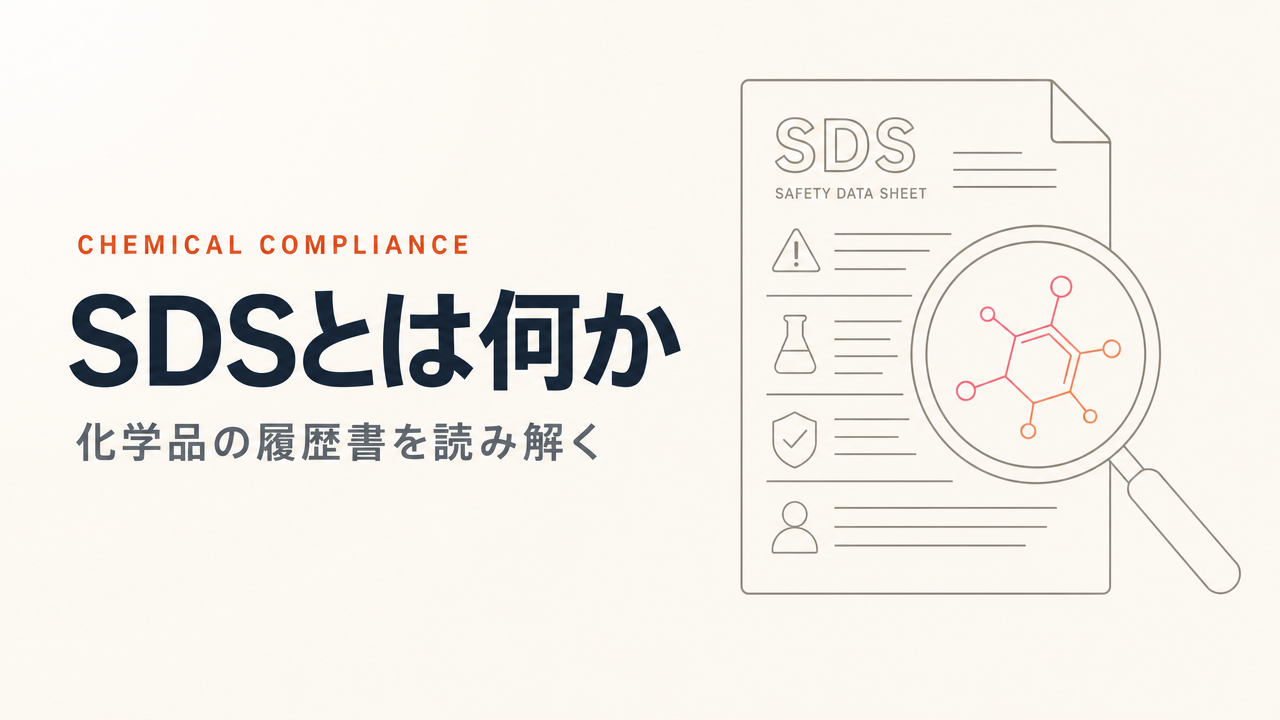
SDS stands for Safety Data Sheet. It refers to a document that gathers information about a given chemical, its hazards, how to handle it, and what ingredients it contains, into a single sheet (in reality, several pages).
For example: is a certain solvent flammable? What happens to the body if you inhale it? How should you clean it up if it spills? Which laws does it fall under? An SDS is exactly this kind of information, organized according to a prescribed format. It is an instruction manual that lets people handle a chemical safely, and at the same time it acts like an ID document that reveals the chemical's identity.
You cannot tell a chemical's hazards or ingredients from appearance alone. A colorless, transparent liquid may in fact be toxic, or may risk igniting during transport. That is precisely why the party handing over a chemical (the supplier) states its contents and hazards in writing and communicates them to the party receiving it. The SDS sits at the center of this information-transfer mechanism.
The Difference from MSDS
When you look into SDSs, you will almost always come across the term MSDS. To put the conclusion first: MSDS is the former name for SDS.
MSDS stands for Material Safety Data Sheet, and this term used to be common. So why did the name change? Behind it lies an international movement to bring the rules for classifying and labeling chemicals into step around the world.
The United Nations established GHS (the Globally Harmonized System of Classification and Labelling of Chemicals) as a framework for classifying chemical hazards under common rules and displaying them on labels and in documents. If different countries express hazards in scattered ways, judgments about how to handle the same chemical can diverge, becoming a source of accidents and misunderstandings. The idea behind GHS is to harmonize the pictograms and classification criteria internationally.
Japan has developed its domestic standards in a way that aligns with GHS. At the center of this is a standard called JIS Z 7253. During this alignment, the document's name was matched to the internationally used SDS, and in Japan the name was standardized to SDS around the 2012 revision of the JIS standard.
In short, it is enough to understand that MSDS and SDS are the same kind of document, and that the name was simply updated. You will still see the notation MSDS in older materials and in some places overseas, but what it refers to is fundamentally the same safety data sheet.
Replace siloed classification work with AI.
METI's FY2024 data shows 52% of foreign exchange law violations stem from classification errors. Download the TRAFEED product catalog covering features and rollout.
An SDS Is Made Up of 16 Sections
An SDS is, in principle, composed of 16 sections. This structure, too, is standardized in line with GHS and JIS Z 7253. Across manufacturers, an SDS generally lists the same kinds of information in roughly the same order, so once you get used to the format, you can quickly reach the part you need.
Here is a quick list of the representative sections.
- Identification of the chemical and the company (product name, supplier contact details, and so on)
- Summary of hazards (GHS classification, pictograms, signal words, and so on)
- Composition and information on ingredients (names of constituents, CAS numbers, concentrations, and so on)
- First-aid measures (responses for inhalation, skin contact, contact with the eyes, and so on)
- Firefighting measures
- Measures for accidental release
- Handling and storage precautions
- Exposure controls and personal protection
- Physical and chemical properties
- Stability and reactivity
- Toxicological information
- Ecological information
- Disposal considerations
- Transport information
- Applicable regulations
- Other information
Among these, the one you open first for export control and supply-chain checks is Section 3, composition and information on ingredients. This is where you find which ingredients the chemical contains, and in what proportions. And a key point is that a CAS number is listed for each ingredient.
The CAS Number, a Registry Number for Chemical Substances
A CAS number is an international number for uniquely identifying a chemical substance. CAS (Chemical Abstracts Service), a division of the American Chemical Society, assigns one to each substance.
Why is such a number necessary? Because the names of chemical substances are surprisingly unreliable. The same substance may differ between its Japanese and English names, carry a common nickname or trade name, or have inconsistent notation. It is actually difficult for a person to judge, from a name alone, this is the same substance or this is a different one.
A CAS number, by contrast, works like a globally shared registry number: if the number matches, you can determine mechanically that it is the same substance. You confirm the CAS number in Section 3 of the SDS and reconcile it against the CAS numbers on the regulatory lists. This ease of matching is precisely why CAS numbers are so valued in export-control practice.
The Three Main Japanese Laws That Require Providing an SDS
An SDS is not merely a helpful reference document. In Japan, for certain chemical substances, providing an SDS when transferring or supplying them between businesses is required by law. The main laws are the following three.
- The Industrial Safety and Health Act. From the standpoint of protecting workers from chemical hazards, it requires the provision of information on designated substances.
- The Act on Confirmation of Release Amounts of Specific Chemical Substances (the PRTR Act). From the standpoint of grasping and managing releases into the environment, it requires an SDS for designated substances.
- The Poisonous and Deleterious Substances Control Act. It requires the provision of information for handling substances classified as poisonous or deleterious.
Under these laws, when you transfer or supply a covered chemical substance to another business, label display on the container is also required alongside the SDS. It helps to see it as a division of roles: the SDS provides detailed information in writing, while the label provides a concise warning on the physical item.
Which substances are covered, and the finer operational rules, can change with regulatory revisions, so in practice I recommend confirming the latest content with the official information from the responsible ministries. Here, it is enough to grasp that an SDS is backed by a legal obligation to provide it.
How to Check SDSs Across the Supply Chain
So how should you handle SDSs in an actual transaction? Let me organize the basic flow.
- Obtain the SDS from the supplier. When you procure raw materials or parts, you receive the SDS for that chemical. Normally the supplier provides it on request.
- Confirm the ingredients, CAS numbers, and concentrations in Section 3. Understand which ingredients, and how much of each, are contained in the chemical your company handles.
- Grasp how they are contained in your products and processes. If you make something using the procured chemical, trace how those ingredients are carried over into the final product or intermediate goods.
- Check whether it is the latest version. SDSs are revised in response to regulatory changes and new findings. If the SDS on hand is out of date, it can diverge from reality. It is important to manage the revision date and version number and to keep the latest edition.
Put into words, it sounds simple, but at companies handling many kinds of chemicals, this work quickly becomes heavy. SDS formats and layouts differ subtly from one supplier to another, and SDSs from overseas suppliers arrive in foreign languages. Handling multiple languages, storing documents and managing versions, reconciling ingredient information. Keeping all of this running by hand alone is steady but demanding work.
How to Use an SDS in Export Control
From here, we take the export-control perspective. When you ship a chemical, or a product containing a chemical, overseas, you must confirm that its contents do not touch on export controls. This confirmation is called classification. For more on classification, please also see an approach to making export-control classification more efficient with AI.
Where the SDS comes into its own for classification is precisely the composition information in Section 3. You cross-reference the CAS numbers and concentrations written in the SDS against the regulatory lists. Here are representative references to check against.
- The list in Appended Table 1 of the Export Trade Control Order under the Foreign Exchange and Foreign Trade Act (FEFTA). This is the foundation of Japan's export controls, where the goods subject to control are set out item by item. Chemicals are included.
- The relevant Australia Group lists. The Australia Group is an international export-control framework aimed at preventing the proliferation of chemical and biological weapons. Substances that can serve as precursors to chemical weapons, among others, are listed.
- The substances in the annexes to the Chemical Weapons Convention (CWC). The treaty's annexes set out chemical substances classified into Schedules 1 through 3 according to the regulatory approach.
You reconcile the CAS numbers on the SDS against the CAS numbers on these lists and confirm whether any apply. This is the basic operation of chemical classification.
It does not end with matching against lists, however. For chemicals, in addition to list-based controls, there is the concept of catch-all controls. This means that even for items not on the lists, confirmation and procedures are required for exports involving end uses that could contribute to weapons of mass destruction, or end users of concern. In other words, you cannot simply declare it is fine because it is not on the list, and this is what makes chemicals difficult: you also need to keep an eye on end use and the counterparty.
Furthermore, you need to watch for concentration thresholds (de minimis). Even when a controlled ingredient is present, how it is treated when its concentration falls below a certain criterion differs by regulation. The concentration on the SDS becomes material for this judgment.
The concrete way to proceed with such matching and judgment also draws on the approach set out by Japan's Ministry of Economy, Trade and Industry. I have organized the practicalities of classification in how to read METI's classification guidelines, so please refer to that as well. For the document you use to show a business partner that an item is not applicable, the basics of a non-applicability certificate (classification statement) is also helpful. I have summarized the key points of export control for chemicals in general in the essentials of export control in the chemical industry.
An SDS Is the Resume of a Chemical, and the First Step Toward Transparency
As we have seen, an SDS is a single document that tells a chemical's identity. Which ingredients it contains, in what amounts, what hazards it carries, and which laws it falls under. It is, in effect, the resume of a chemical.
And this resume is also the entrance to export control. Classification is not something you can judge for a whole product as simply dangerous or not dangerous. It is the work of breaking a product down into its individual parts and materials and tracing whether each one touches on controls. This idea of decomposing a product down to the level of a BOM (bill of materials) and tracing each element is indispensable in export-control practice.
For chemicals, what shows the identity of each element is the SDS and the CAS number. For metals and minerals, the conflict-minerals checks covered in the next article (the mechanisms of 3TG and CMRT/EMRT) play the same role. The SDS that traces the composition of materials, the conflict-minerals survey that traces the origin of minerals, and the reconciliation against regulatory lists, these are all different facets of the same endeavor: breaking a product down to the BOM level and clarifying the origin and nature of each element. Reading the sister article, how to complete the CMRT and EMRT for 3TG and other minerals, should make this continuous relationship come into sharper focus.
TRAFEED's Perspective: Supporting Vast SDS Reconciliation with AI
Here, let me speak from the perspective of the export-control AI agent we are developing, TRAFEED.
Chemical classification is, in principle, simple. You pick up the CAS numbers from Section 3 of the SDS and reconcile them against the regulatory lists. In practice, though, the number of these reconciliations becomes enormous. A single product uses dozens of chemicals, each SDS lists multiple ingredients and CAS numbers, formats and languages differ by supplier, and the lists are updated in each country. Keeping this matching running by hand alone, and without omissions, is a considerable burden.
That is exactly why I believe reading SDSs and reconciling against lists is an area where AI can play to its strengths. Extracting CAS numbers and concentrations from documents and mechanically reconciling them against regulatory lists. Making this repetitive work efficient is at the heart of TRAFEED's concept. TRAFEED is designed to conform to the standards of the Ministry of Economy, Trade and Industry, supports SDSs in multiple languages, reflects the laws and regulations of various countries, and aims to handle the groundwork of reconciliation. Regarding classification accuracy, we have published figures based on a joint demonstration with Okayama University and on our own research, though I would ask you to confirm the details through each party's official sources.
There is one thing I want to state clearly. AI is, at most, a tool that supports vast reconciliation and the reading of primary materials. The final classification is made by your company's export-control officer, and that responsibility does not transfer to the AI. By having AI take on the groundwork, the officer can devote time to the judgments they should truly focus on. That is where TRAFEED positions itself.
Summary
Finally, let me organize the key points of this article.
- An SDS (Safety Data Sheet) is a document that gathers a chemical's hazards, handling, and composition onto a single sheet. Its former name was MSDS, and following alignment with the UN GHS and JIS Z 7253, the name was standardized to SDS in Japan around the 2012 revision of the JIS standard.
- An SDS is, in principle, composed of 16 sections, and Section 3 (composition and information on ingredients) in particular lists the names of constituents, CAS numbers, and concentrations. A CAS number is an international identifier for a chemical substance and is the key to matching.
- In Japan, the Industrial Safety and Health Act, the PRTR Act, and the Poisonous and Deleterious Substances Control Act require providing an SDS when transferring or supplying covered substances between businesses. It operates as a set together with label display.
- Across the supply chain, the basic procedure is to obtain the SDS from the supplier, confirm the CAS numbers and concentrations in Section 3, grasp how they are contained in your own products, and manage whether you hold the latest version.
- In export control, you use the CAS numbers and concentrations on an SDS by reconciling them against Appended Table 1 of the Export Trade Control Order under FEFTA, the Australia Group, and the annexes to the Chemical Weapons Convention (CWC), among others, for classification. Beyond list-based controls, you also need to watch for catch-all controls and concentration thresholds.
- Classification is the endeavor of breaking a product down to the BOM level and tracing each element, and the SDS is the basic reference on the chemical side. Making the vast reconciliation efficient with AI is TRAFEED's concept, but the final judgment is made by your company's export-control officer.
Export control for chemicals begins with carefully reading the humble single sheet that is an SDS. If you are troubled by the sheer number of items or by multilingual handling, first try taking inventory of which chemicals are contained in your products, using SDSs as your clue. Then, when you consider making the reconciliation work more efficient, please reach out to the TRAFEED team.
Relatedly, on the theme of supply-chain transparency, reading a practical guide to conflict minerals (3TG) and CMRT/EMRT, and on regulatory developments surrounding AI and export control, the issues around the US AI Kill Switch Act (2026), will help you grasp the bigger picture. For the wider framework that manages the whole chain, see What Is Supply Chain Due Diligence?, and for a new rule that traces battery raw materials back to their origin, the EU Battery Passport (mandatory from 2027).
![A Beginner's Dictionary of Japanese Export Control Jargon: "Betsu-ichi," "Toku-ippan," "White Country," and 30 Other Terms Your Colleagues Keep Using [2026 Edition]](/images/columns/export-control-jargon-glossary/cover.en.png?dpl=dpl_GTagW71VKjD4VDo3w4ymrXrCfn1y)