Hello, this is Ryuta Hamamoto from TIMEWELL.
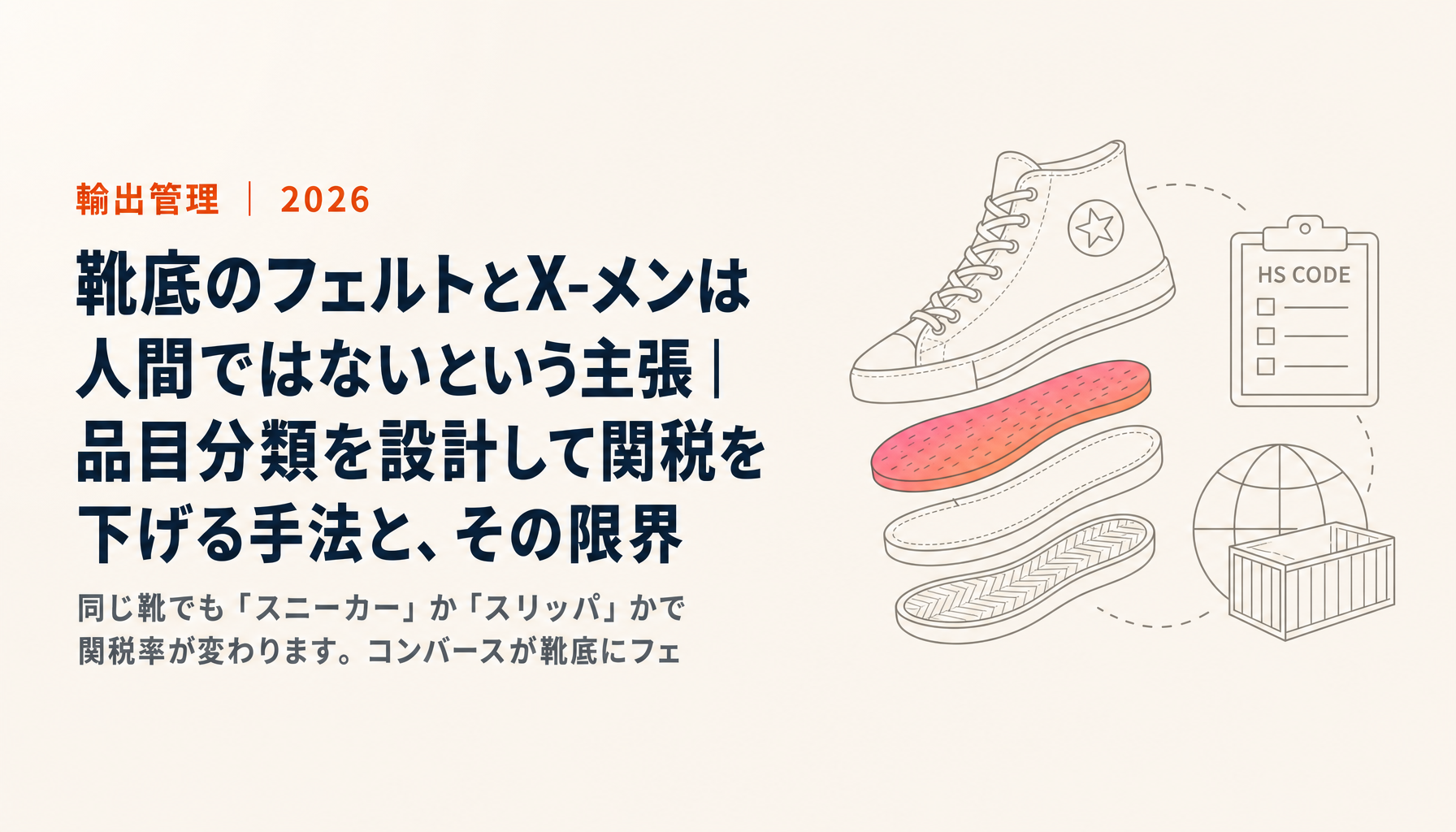
Turn over a pair of Converse All Stars and you will find a patch of felt on the sole. Thin cloth that wears through and disappears within days of wearing them.
It is not decoration, and it is not cushioning. It is reported to be about tariffs.
In the U.S. tariff schedule, footwear and slippers are taxed differently. If a sufficient proportion of the sole is covered in textile material, the item falls into the slipper category and a lower rate applies. Reporting puts duty on imported footwear as high as 37.5%, against roughly 3% to 12.5% for slippers.
The previous piece in this series looked at how duty changes depending on whether you ship assembled or ship parts. Of the three elements CBP uses — HTS code, country of origin and declared value — this one is about designing the HTS code itself.
And it has a lawful range, and a clear limit.
The argument that X-Men are not human
There is a second well-known example.
In the U.S. tariff schedule, dolls and toys carry different rates. Dolls represent human beings; toys represent everything else.
In 2003, Marvel's side argued in U.S. court that X-Men action figures do not represent human beings, and are therefore toys rather than dolls. The argument succeeded. Reporting put the resulting rate at roughly half.
Given that X-Men has spent decades telling stories about mutants as a persecuted minority within human society, the conclusion has an irony to it that fans noticed at the time.
As a classification argument, though, it holds together. Classification is a factual question about what an article represents, not a question about the themes of the fiction. If the premise is that mutants are not human, the toy category has a basis.
What both examples show is that the same object can cost meaningfully different amounts depending on which category it falls into — and that companies can think about that category from the design stage.
Replace siloed classification work with AI.
METI's FY2024 data shows 52% of foreign exchange law violations stem from classification errors. Download the TRAFEED product catalog covering features and rollout.
Why this is lawful
The reason sits in a basic principle of classification.
Goods are classified in the condition in which they are imported.
Customs looks at the thing that arrived, not at why it came to be that way. Not the intent behind the design, but what was actually imported. Because of that principle, deciding the imported condition at the design stage is legitimate.
This is tariff engineering. In the United States it is established practice, with its own entry in the standard legal reference works.
The difference from evasion sits here. Evasion misstates the facts. Tariff engineering makes the facts. If a shoe with felt on the sole is genuinely what you imported, the shoe is classified as a shoe with felt on the sole. Nothing has been misstated.
But there is a limit
Not everything survives. U.S. practice draws a line:
A change made solely to obtain a lower rate, which serves no role in the product, tends not to hold up.
The reasoning is that steps in manufacturing should serve some purpose toward the functionality of the good.
This is where it gets delicate, and Converse's felt has been discussed as sitting right on that boundary. Thin felt that wears away in days carries almost no functional meaning. It has nonetheless been accepted in practice. Meanwhile, a configuration that simply bolts on a visibly pointless component would stand a fair chance of being rejected if challenged.
A workable way to think about it:
| Position | What it looks like |
|---|---|
| Generally holds | The design change means something as a product. Real difference in material, structure or function |
| Arguable | The change exists but its functional role is thin. The classification effect looks like the main point |
| Does not hold | No underlying reality — the classification is simply declared differently. Components fitted on the understanding they come off after import |
That third row is not tariff engineering. It is misclassification. As the previous article noted, misclassification is named explicitly among CBP's enforcement priorities. DOJ's Trade Fraud Task Force passed $1 billion in penalties and recoveries as of July 2026, with misclassification on the list.
Why this matters outside the United States
"We don't export to the U.S., so this doesn't apply" — the topic still arrives through three routes.
One: exports to the U.S. The classification of what you supply to a U.S. customer becomes that customer's duty burden. Being able to propose specifications with classification in mind is negotiating leverage. Conversely, if the classification lands differently than assumed on the customer's side, you may be asked to absorb the difference.
Two: procurement. When you are the importer, the same analysis applies to you. Tariff schedules everywhere carry rate differences between categories, and the choice affects procurement cost.
Three: supplier management. If a supplier has been optimising classification, whether they can explain the basis is your exposure too. A supplier caught by a misclassification action stops shipping.
Handling it in practice
For items where the answer could reasonably go either way, do not proceed on your own read.
Use the advance ruling systems. CBP binding rulings in the U.S., Japan Customs advance rulings domestically. Both give written responses on classification before importation. When classification can move the rate by tens of percentage points, the effort pays for itself.
Document the basis for the classification. Why that category, and which part of the specification supports it. As in the previous piece, customs asks not only what you concluded but how you got there.
Make the design change explicable as a product decision. A change you can only justify by its classification effect is weak when challenged. If there is a genuine product reason for a material or structural choice, put it in the design record.
And involve a customs broker. Final classification calls belong to customs professionals. Before applying any of this to your own items, run it through a broker and, where appropriate, an advance ruling.
This is not export control classification
One frequently confused point to close on.
HS-based tariff classification and export control classification are entirely separate exercises.
| Tariff classification | Export control classification | |
|---|---|---|
| Decides | How much you pay | Whether you may ship at all |
| Criteria | HS code (tariff schedule) | Japan: Appended Table 1 / U.S.: ECCN on the CCL |
| Owner | Importer (supported by a customs broker) | The exporter's export control officer |
The same specification, applied against different criteria. Settling the tariff classification does not settle the export control question, and the reverse holds too.
And here is the awkward part: a design change made to optimise tariff classification can move the export control answer. Change the material or the structure and the fit against control list entries changes with it. A specification adjusted for duty quietly alters whether a licence is required. This gets missed in practice.
TRAFEED covers the export control side. It does not handle tariff classification, but checking how a classification outcome moves when a specification changes, with the supporting evidence attached, is squarely what it does. If you are redoing classifications by hand every time engineering revises a spec, the three-minute self-check is a reasonable place to look at your current setup.
Key takeaways
- Duty rates turn on classification. The same shoe, depending on the sole material, can fall into the slipper category and attract a lower rate
- In 2003 Marvel's side argued X-Men figures represent non-humans and are therefore toys, and prevailed. Reporting put the resulting rate at roughly half
- This is lawful because goods are classified in the condition in which they are imported. Deciding that condition at the design stage is legitimate
- The limit: a change made solely to lower the rate, serving no role in the product, tends not to hold up
- Declaring a different classification with no underlying reality is not tariff engineering — it is misclassification, a stated priority of DOJ's Trade Fraud Task Force, which passed $1 billion as of July 2026
- Use advance rulings, and document both the classification basis and the product reason for design changes. Final calls go to a customs broker
- Tariff classification and export control classification are separate — and a change made for one can move the other
The rest of this series
- Ship It Assembled, or Ship the Parts and Build It There? — HTS code × origin, and the Cyber Power case
- Lowering the U.S. Dutiable Value with First Sale — the declared value
If there is something on the export control side you want to work through, get in touch.
Sources
- Tariff Engineering — Legal Information Institute, Cornell Law School — https://www.law.cornell.edu/wex/tariff_engineering
- This Is Why Your Converse Sneakers Have Felt on the Bottom — Smithsonian Magazine — https://www.smithsonianmag.com/smart-news/this-is-why-your-converse-sneakers-have-felt-on-the-bottom-6016648/
- A Resource Guide to Trade Fraud Enforcement — U.S. Department of Justice — July 2026 — https://justice.gov/fraud/media/1452331/dl?inline=
- Harmonized Tariff Schedule of the United States — U.S. International Trade Commission — https://hts.usitc.gov/
- CROSS (Customs Rulings Online Search System) — U.S. Customs and Border Protection — https://rulings.cbp.gov/
- Advance ruling system — Japan Customs — https://www.customs.go.jp/
※ The Converse and Marvel examples are described from published reporting and practitioner commentary. Individual rates and classifications vary by item and by date. Before applying any of this in practice, check the current tariff schedule and work through a licensed customs broker and, where appropriate, an advance ruling. Content reflects publicly available information confirmed as of 2 August 2026.