Hello, this is Ryuta Hamamoto from TIMEWELL.
The previous article in this series covered first sale — how in a factory → trading house → U.S. importer structure, the dutiable value can be based on the first sale rather than the last.
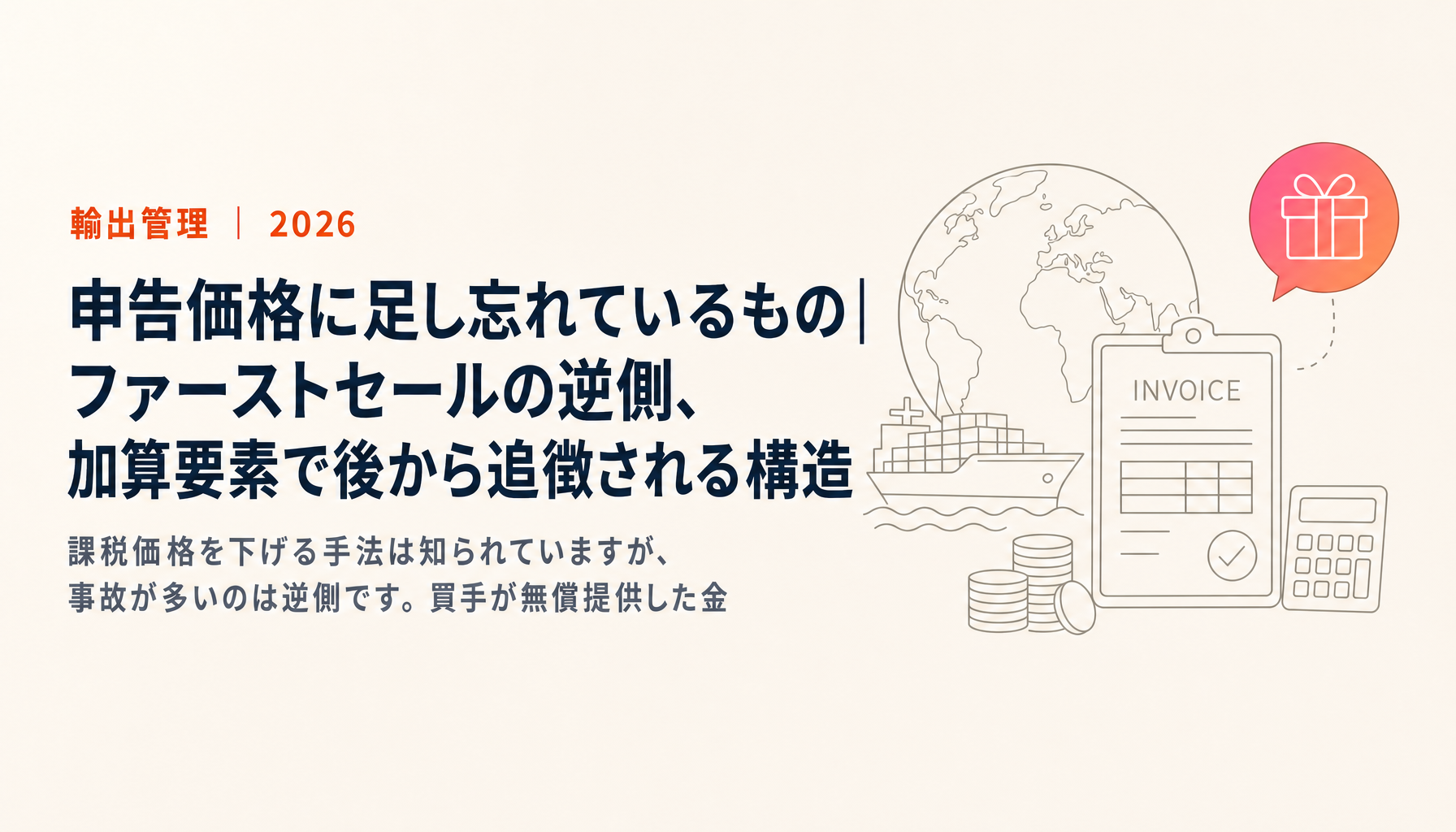
That is a story about lowering the value. It attracts attention, and commentary on it is plentiful.
The losses, though, come from the other direction.
What you were required to add, and did not.
This side is unglamorous and rarely discussed. It is also where most of the retroactive assessments come from. And it has an awkward property: you are being told to add things you never paid for, so nothing in the accounting records will surface them.
This piece works from the statutory text of 19 U.S.C. § 1401a and Japan's Customs Tariff Act Article 4, both read directly.
The two regimes side by side
Both build on the WTO Valuation Agreement, so the structures line up closely.
| What gets added | Japan (Customs Tariff Act Art. 4(1)) | United States (19 U.S.C. § 1401a(b)(1)) |
|---|---|---|
| Freight and insurance to the port of import | item (i) | not listed — generally not added |
| Commissions | item (ii)(a) (buying commission excluded) | (B) selling commission |
| Containers | item (ii)(b) | (A) packing costs |
| Packing | item (ii)(c) | (A) packing costs |
| Buyer-supplied goods and services | item (iii)(a)–(d) | (C) assists |
| Royalties | item (iv) | (D) royalty or license fee |
| Proceeds accruing to the seller | item (v) | (E) proceeds of subsequent resale |
The first row already runs in opposite directions.
Japan adds freight and insurance to the port of import — effectively a CIF basis. U.S. transaction value does not list freight and generally does not include it — effectively FOB. Read a U.S. practice manual and apply it to a Japanese entry and you drop the freight entirely. The reverse holds too.
The additions are mandatory, and the list is closed
Before the details, the structure. The U.S. flush text reads:
The price actually paid or payable for imported merchandise shall be increased by the amounts attributable to the items (and no others) described in subparagraphs (A) through (E) only to the extent that each such amount (i) is not otherwise included within the price actually paid or payable; and (ii) is based on sufficient information.
Three things are happening:
- shall be increased — the additions are mandatory, not elective
- and no others — the list is closed; nothing outside (A)–(E) gets added
- based on sufficient information — each amount must be supportable
And that last requirement carries a consequence people miss:
If sufficient information is not available, for any reason, with respect to any amount referred to in the preceding sentence, the transaction value of the imported merchandise concerned shall be treated, for purposes of this section, as one that cannot be determined.
If you cannot substantiate an addition, transaction value itself falls away.
That is heavier than a duty adjustment. Appraisement then works down the sequence in § 1401a(a)(1) — identical merchandise, similar merchandise, deductive value, computed value. Your goods get valued by a method other than what you actually paid.
The statute defines "sufficient information" as information that establishes the accuracy of the amount. Which means you need to be able to show what the tooling was worth and how you apportioned it. "Roughly this much" does not clear the bar.
Replace siloed classification work with AI.
METI's FY2024 data shows 52% of foreign exchange law violations stem from classification errors. Download the TRAFEED product catalog covering features and rollout.
Where the losses actually happen: buyer-supplied items
Japan's text:
Article 4(1)(iii) The cost of goods or services listed below, supplied directly or indirectly by the buyer free of charge or at reduced cost in connection with the production of, and the import transaction for, the imported goods: (a) materials, components, parts and similar items incorporated in the imported goods (b) tools, dies and similar items used in the production of the imported goods (c) goods consumed in the production of the imported goods (d) technology, design and other services relating to the production of the imported goods as specified by Cabinet Order
The U.S. side calls these assists, defined at 19 U.S.C. § 1401a(h)(1)(A). The chapeau requires three things — supplied by the buyer, directly or indirectly, free of charge or at reduced cost — and then lists four categories:
(i) Materials, components, parts, and similar items incorporated in the imported merchandise. (ii) Tools, dies, molds, and similar items used in the production of the imported merchandise. (iii) Merchandise consumed in the production of the imported merchandise. (iv) Engineering, development, artwork, design work, and plans and sketches that are undertaken elsewhere than in the United States and are necessary for the production of the imported merchandise.
Nearly the same structure. And this is where it goes wrong most often, for a plain reason.
No money changed hands.
- Lent tooling to a supplier free of charge → no payment. Still dutiable
- Handed over drawings your own team produced → no payment. Still dutiable
- Supplied materials → no payment. Still dutiable
- Provided prototype parts at no cost → same
None of it appears in the ledger. None of it appears on a purchase order. "We didn't pay for it, so it doesn't concern us" — and the entries continue that way for years.
When it surfaces in an audit, the assessment reaches back. One mould is a small number on its own; a mould that produced goods imported over several years, apportioned across those entries, is not.
The statute says "apportioned as appropriate" for a reason: the tooling value is meant to be spread across production volume and carried on each entry.
The geographic limit applies to design work only
Look again at the U.S. (iv):
Engineering, development, artwork, design work, and plans and sketches that are undertaken elsewhere than in the United States
There is a geographic limit. CBP's own regulatory example confirms it: where a U.S. importer supplies a foreign producer with detailed designs purchased from a U.S. engineering firm, "No, design work undertaken in the U.S. may not be added to the price actually paid or payable."
Here is the part you must not misread.
That limit sits on (iv) alone. Categories (i) materials and components, (ii) tools, dies and moulds, and (iii) goods consumed in production carry no geographic limit at all.
Which means: a mould manufactured in the United States and supplied free of charge to an overseas plant is an assist. Where it was made is irrelevant.
CBP's regulation addresses exactly this. In 19 CFR 152.103(d) Example 2, a U.S. importer supplies moulds to a foreign shipper, some made by U.S. firms and some in a third country. The question is whether the appraised value should include the moulds. The answer: "Yes. It is an addition required to be made to transaction value."
CBP's practitioner guidance puts it the same way — moulds are a required addition "regardless of where they are manufactured."
Remember it as "U.S.-origin items are outside the rules" and you will get caught on tooling. Design work is the exception; nothing else is.
One more, while we are here. If U.S. design costs are already inside the price actually paid or payable, there is no authority to deduct them. CBP's guidance states it plainly: "No authority exists to deduct such costs when included in the price actually paid or payable." Not being added and being deductible are different things.
Japan's item (iii)(d) carries no such geographic limit. For companies with design functions on both sides of the Pacific, that asymmetry lands directly in practice.
Royalties are not automatically dutiable
Item (iv) and the U.S. (D) are both conditional.
Japan:
item (iv) Consideration for the use of patents, design rights, trademark rights or similar rights relating to the imported goods (excluding the right to reproduce the imported goods in Japan) as specified by Cabinet Order, which the buyer pays directly or indirectly in order to carry out the import transaction for the imported goods, judged from the circumstances of the transaction and other factors
United States:
(D) any royalty or license fee related to the imported merchandise that the buyer is required to pay, directly or indirectly, as a condition of the sale of the imported merchandise for exportation to the United States
Both ask the same question: is the payment a condition of the transaction?
Is the trademark royalty something you must pay in order to buy those goods, or is it an independent domestic licence unrelated to the import? The answer turns on the facts.
Japan's text also carries an explicit carve-out — "excluding the right to reproduce the imported goods in Japan." Reproduction rights are not added. A small point that matters for imports involving software and content.
This is exactly the kind of question to put through an advance ruling.
Buying commission is not dutiable — with one exception
Japan's item (ii)(a) has a parenthetical:
Commissions and brokerage (excluding commissions paid to a person representing the buyer in respect of the purchase, as consideration for services relating to that purchase)
So commissions paid to a buying agent are not added. Selling commission is dutiable; buying commission is not. The U.S. reaches the same result by listing only "selling commission" in (B).
Japan, however, has an exception.
Toll processing: the statute rewrites the whole treatment
Customs Tariff Act Article 4(3) takes a transaction structure Japanese manufacturers use constantly and treats it as something else entirely.
Where a person in Japan (the "consignor") entrusts another person (the "consignee") with raw materials or materials supplied directly or indirectly by the consignor, and the consignee processes or assembles them abroad, and the consignor acquires the resulting product, and that product arrives in Japan under that transaction, then that transaction shall be deemed an import transaction, the consignor deemed the buyer, the consignee deemed the seller, and the amount actually paid or payable as consideration for the processing deemed the price actually paid or payable for the imported goods, and the preceding two paragraphs shall apply accordingly.
Unpack it. You send materials abroad, someone processes them, you take back the finished product. There is no sale in that arrangement. The statute nonetheless deems it an import transaction, deems the consignor the buyer and the consignee the seller, and deems the processing fee to be the price actually paid.
Then it continues:
In this case, the phrase "commissions and brokerage (excluding commissions paid to a person representing the buyer...)" in paragraph (1) item (ii)(a) shall read "commissions and brokerage."
The buying-commission exclusion falls away.
In a toll-processing transaction, commissions that would ordinarily be outside the dutiable value come inside it. Miss that sentence, process the entry like any other, and you have underdeclared.
And in toll processing, the materials you supplied are themselves an addition under item (iii)(a). Processing fee plus supplied materials plus freight — that stack is the dutiable value. Declaring the processing fee alone does not get there.
Overseas toll processing is widespread in Japanese manufacturing. Operations running without knowing this structure exist.
The relationship to the previous article
The previous piece was about lowering the value. This one is about the obligation to add.
Opposite directions, same structure underneath.
| First sale | Additions | |
|---|---|---|
| Direction | Down | Up |
| Burden | Importer (displacing the presumption) | Importer (duty to declare correctly) |
| What you need | Documents showing the reality of the transaction | A complete picture of what was supplied and paid |
| How it fails | Not accepted; assessment follows | Addition missed; assessment follows |
Both come down to whether you can show the declared amount matches reality. The line from two articles ago — if the reality is there it is design, if not it is disguise — holds here as well.
And there is an irony worth naming: the companies using first sale to lower the value are often the ones with the largest gaps on the additions side. Attention flows toward lowering; nobody volunteers the additions. An audit looks at both at once.
Closing the gap in practice
Missed additions happen because nobody knew. So the fix is a mechanism for knowing.
1. Inventory what you hand over to suppliers.
Ask engineering and quality, not procurement. Moulds, jigs, inspection gauges, drawings, specifications, supplied materials, prototype parts. Things given away for nothing are not in the purchasing system.
2. Comb the royalty clauses.
Whatever legal holds. Is there a royalty tied to imported goods, and is that payment a condition of buying them?
3. Treat toll processing separately.
Identify transactions falling under Article 4(3) and check you are not declaring the processing fee alone — including the point about the buying-commission exclusion.
4. Put close calls through an advance ruling.
Japan Customs advance rulings cover customs value, not just classification. CBP binding rulings do the same.
5. And involve a customs broker.
Valuation is customs professionals' territory. Before putting anything here into operation, run it through a broker and, where appropriate, an advance ruling. The declaration remains the importer's responsibility.
Seen from the export control side
The additions analysis asks what you are handing to your suppliers.
Export control asks the same question for entirely different reasons. Providing technology, designs or drawings across a border can constitute a controlled technology transfer — in Japan, under Article 25 of the Foreign Exchange and Foreign Trade Act. The same drawing counts twice: once as an addition to customs value, once as a technology release.
You send a mould to an overseas plant. You hand over drawings. You share specifications. The customs person asks whether it is dutiable; the export control person asks whether it needs a classification and a licence. In most companies those two sit in different departments with different records — and one of them ends up missing something.
TRAFEED covers the export control side: how the technology and designs you provide are treated in classification, whether the recipient appears on the control lists of the jurisdictions involved, and how to keep the evidence behind those calls. It does not handle customs additions — but the inventory of "what we send abroad" is the common entry point for both. The three-minute self-check is a place to start.
Key takeaways
- Lowering the value gets attention; the obligation to add is where the losses are. And no payment means nothing in the ledger
- The two regimes line up closely (WTO Valuation Agreement), except freight and insurance — Japan adds them, the U.S. generally does not
- The largest gap is buyer-supplied items: Japan Art. 4(1)(iii), U.S. 19 U.S.C. 1401a(b)(1)(C) assists
- The U.S. geographic limit sits on (iv) design work alone. Materials, tooling and consumed goods carry no limit — a U.S.-made mould supplied free of charge is an assist (19 CFR 152.103(d) Example 2). Remember it as "U.S. items are outside" and you get caught on tooling
- The additions are mandatory (shall be increased) and the list is closed (and no others). And without sufficient information, transaction value itself becomes unusable — heavier than an assessment
- Royalties are not automatic. The test is whether the payment is a condition of the transaction. Japan expressly carves out reproduction rights in Japan
- Buying commission is generally not dutiable — except under Japan's Article 4(3) toll processing, where the exclusion is removed
- In toll processing the processing fee is deemed the price actually paid, and supplied materials are an addition. The fee alone is not enough
- Valuation belongs to customs professionals. Use advance rulings and a customs broker
This series
- Ship It Assembled, or Ship the Parts and Build It There? — HTS code × origin
- Felt on the Sole and the Argument That X-Men Are Not Human — designing the classification
- Lowering the U.S. Dutiable Value with First Sale — lowering the declared value
- This article — the obligation to add
- The $800 De Minimis Threshold Is Gone — when a declaration became necessary at all
For export control questions, get in touch.
Sources
- 19 U.S.C. § 1401a — Value — Legal Information Institute, Cornell Law School — https://www.law.cornell.edu/uscode/text/19/1401a
- Customs Tariff Act, Article 4 (Principles for Determining Customs Value) — e-Gov Law Search (Act No. 54 of 1910) — https://laws.e-gov.go.jp/law/143AC0000000054
- 19 CFR 152.103 — Transaction value (including the examples at (d)) — eCFR — https://www.ecfr.gov/current/title-19/chapter-I/part-152/subpart-E/section-152.103
- What Every Member of the Trade Community Should Know About: Customs Value — U.S. Customs and Border Protection (Informed Compliance Publication, July 2006) — https://www.cbp.gov/sites/default/files/assets/documents/2020-Feb/ICP-Customs-Value-2006-Final.pdf
- Advance ruling system — Japan Customs — https://www.customs.go.jp/
- CROSS (Customs Rulings Online Search System) — U.S. Customs and Border Protection — https://rulings.cbp.gov/
※ Statutory text quoted here reflects the position as of 2 August 2026, and statutes are amended. Check the current text before applying any of this, and work through a licensed customs broker and the advance ruling systems. The declaration remains the importer's responsibility.