Hello, this is Ryuta Hamamoto from TIMEWELL.
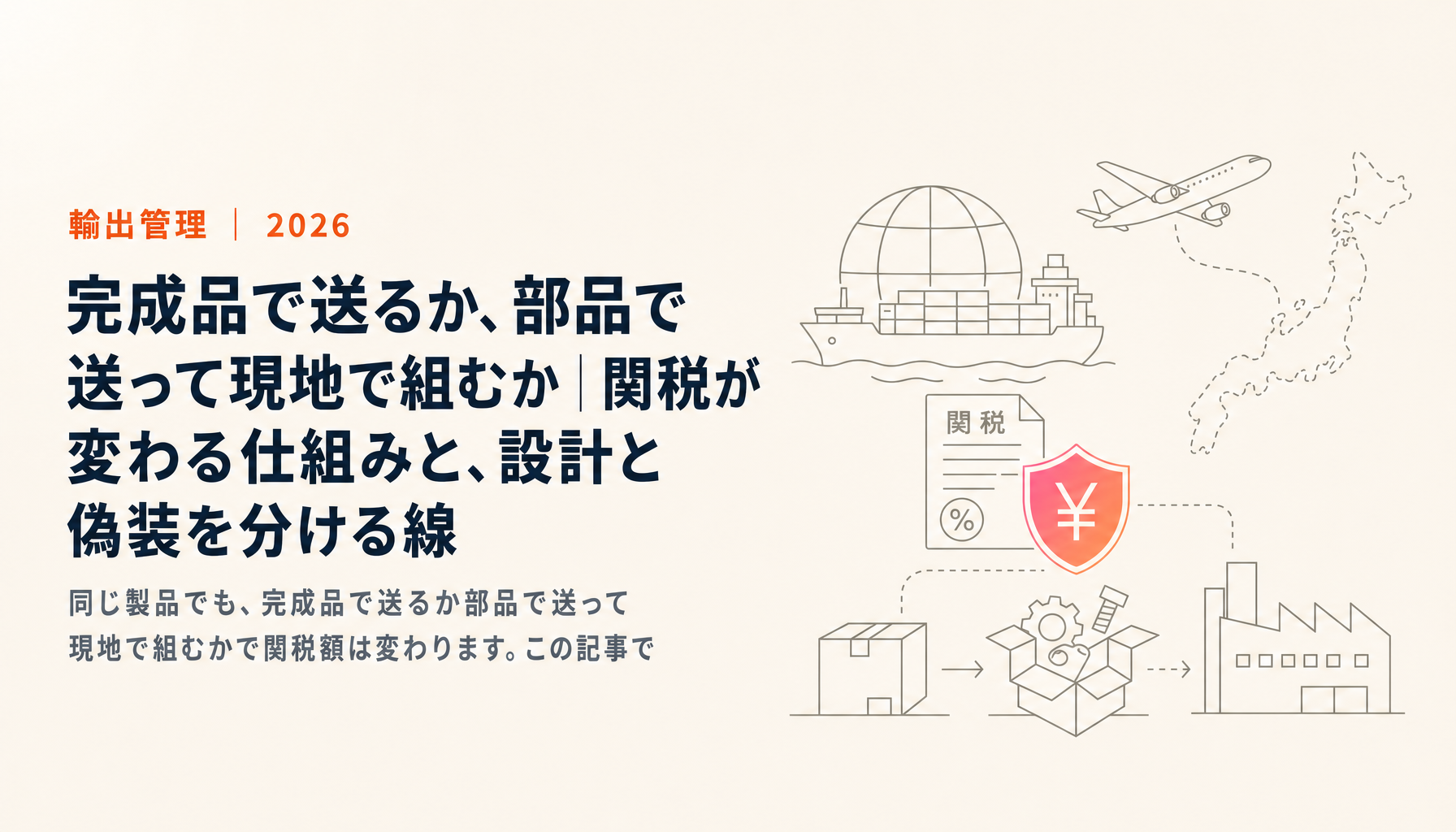
Years ago, at Panasonic, we were preparing to ship a product into China. The duty on the finished unit turned out to be far heavier than anyone had assumed, so we changed the shape of the shipment: break it into components, route through Singapore, assemble on the Chinese side. The burden dropped substantially.
Nobody in manufacturing finds this surprising. If anything, the longer someone has worked in trade operations, the more familiar it is. But there is a hard legal line running through this territory, and crossing it turns planning into misrepresentation. Since 2025, enforcement against the cases that cross it has visibly intensified.
This piece covers how the duty figure is actually determined, how much it can move between shipping patterns, and — the part that matters most — where design ends and disguise begins. The numbers are illustrative and labelled as such. The legal line is drawn only from U.S. primary sources.
Three data points decide the number
U.S. Customs and Border Protection describes the liability on a commercial entry as calculated from three data points.
| Element | What it is |
|---|---|
| HTS code | The classification. What you declare it as |
| Country of origin | Which country's goods it is treated as |
| Declared value | What you declare it is worth |
That is the whole list. Which also means the room to influence the burden exists only in those three places.
Of the three, manufacturers can usually move the HTS code and the origin. Shipping assembled or shipping as parts changes the classification; where the substantive work happens changes the origin. The arrangement I described at the start was moving both at once.
Worth noting: misstating any one of the three produces the same outcome. CBP's enforcement priorities list false origin declarations alongside misclassification and undervaluation. This is not a topic where getting origin right covers you.
A worked example: the same product, three ways
To make the mechanism concrete, here is a simplified example. The rates are assumptions used for illustration. Actual rates vary by item, by date and by applicable agreement — check the current tariff schedule before applying any of this to your own numbers.
Assume an industrial machine with a production cost of ¥1,000,000. Assume the finished-goods classification carries 25% and the classification for major components carries 7.5%.
| Pattern | Dutiable base | Rate (assumed) | Duty | Added cost |
|---|---|---|---|---|
| A. Ship assembled | ¥1,000,000 | 25% | ¥250,000 | — |
| B. Ship as components, assemble in the destination country | ¥1,000,000 | 7.5% | ¥75,000 | Local assembly, management overhead |
| C. Ship components to a third country, process there, then on to the destination | ¥1,000,000 | Depends on the processing | Depends | Freight, inventory, lead time |
A to B is a difference of ¥175,000 — about 70%. At one unit that is interesting; at 500 units a year it is ¥87.5 million. This is why manufacturers take the question seriously.
But the cell that actually matters in that table is "depends on the processing" in row C. That is where design and disguise separate.
Replace siloed classification work with AI.
METI's FY2024 data shows 52% of foreign exchange law violations stem from classification errors. Download the TRAFEED product catalog covering features and rollout.
Substantial transformation decides everything
When goods pass through a third country, whether that country becomes the origin turns on substantial transformation.
CBP's test: did the processing produce a new article with a different name, character or use?
And critically:
Simple assembly, packaging and labelling generally do not change origin.
"We assemble it there, so it is theirs" does not hold on its own. In practice the analysis turns on two questions: whether the incoming components lose their identity and become an integral part of a new product, and how extensive the operations in that country actually are.
The same factory, the same work — different answers model by model
The clearest illustration of how unstable this ground is comes from Cyber Power Systems (USA) Inc. v. United States, litigated before the U.S. Court of International Trade.
The importer assembled uninterruptible power supplies at its own plant in the Philippines from hundreds of discrete components originating primarily in China, and entered them as Philippine origin. The question was whether the Philippine operations amounted to a substantial transformation.
The court's answer: one model of six (CP600LCDa) was of Philippine origin. The remaining five were Chinese.
Same company. Same factory. Broadly the same assembly work. And the answer split by model. That single fact should be enough to retire "we assemble it locally, so we're fine" as a self-assessment.
The decision also rejected reasoning CBP had been applying in many origin determinations. The court declined to decide the question by where the majority of components came from, and declined to decide it by which critical component imparts the essence of the finished item. The opinion observed that pushing a component-by-component approach to its conclusion would make it practically impossible for downstream assembly ever to qualify as substantial transformation.
In other words, the test itself is not settled. Which is precisely why advance rulings exist, and why you should use them rather than running on your own read.
Where it becomes illegal
Everything above is lawful planning. The line is crossed when an origin is declared that the facts do not support.
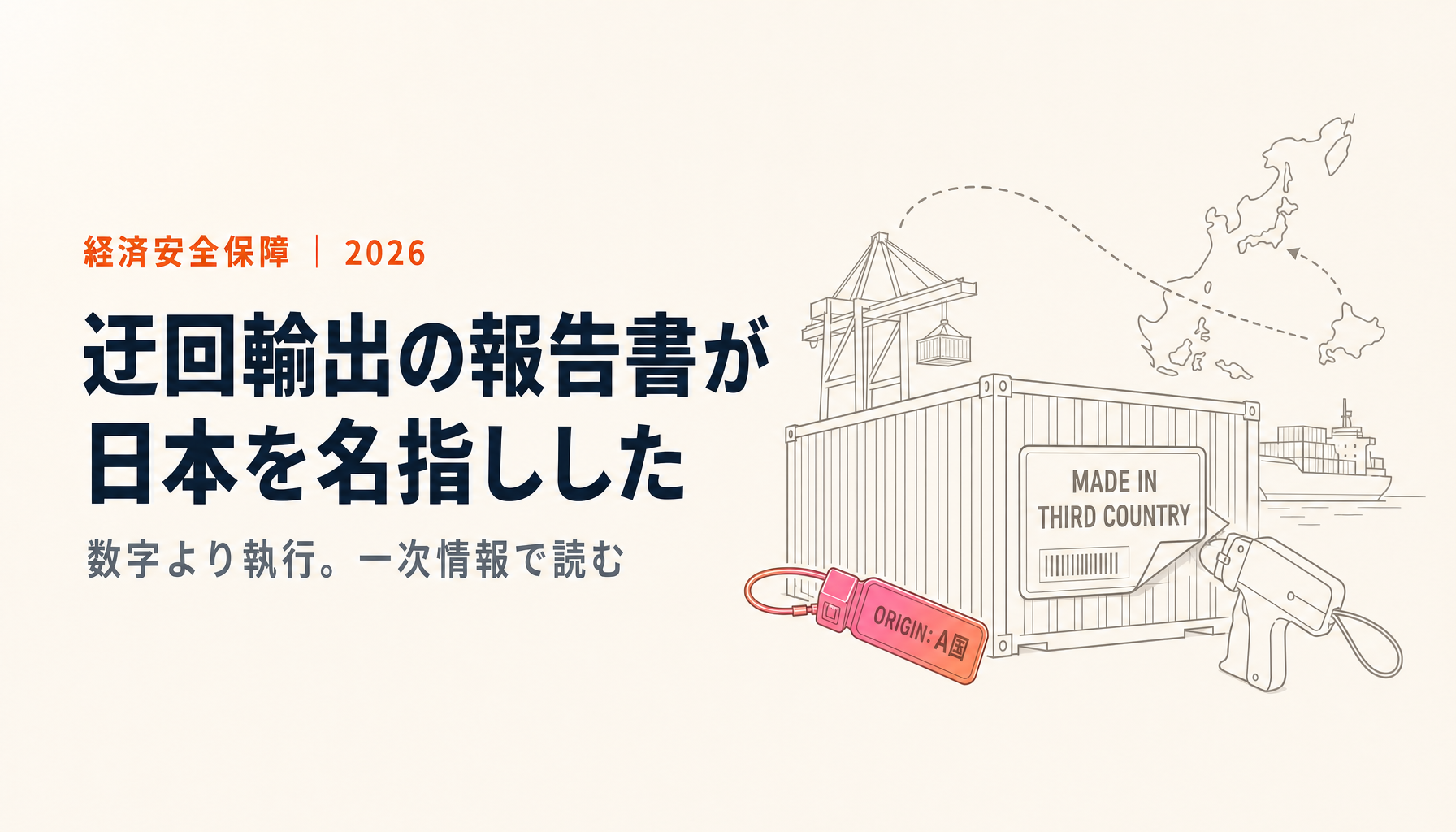
CBP issued an alert dated 18 December 2025 warning that schemes routing goods through third countries to disguise true origin are increasing. The stated targets are evasion of antidumping and countervailing duties, Section 301 tariffs, Section 232 tariffs and other trade restrictions.
And the enforcement architecture changed. In August 2025 a Trade Fraud Task Force was established jointly by the Department of Justice, the Department of Homeland Security and CBP — combining CBP's customs enforcement authority, HSI's criminal investigative capability, and DOJ's civil and criminal tools.
On 14 July 2026, DOJ announced that the task force had surpassed $1 billion in penalties and recoveries.
The stated priorities are evasion of Section 301 tariffs and AD/CVD through transshipment, misclassification, undervaluation and false country-of-origin declarations. The three data points from the opening reappear here as the three angles of attack.
Concrete cases are landing. In December 2025 a U.S. company settled allegations of importing Chinese-origin tungsten carbide cutting tools through third countries to avoid Section 301 duties.
The important distinction: routing through a third country is not itself unlawful. Transit points get used for ordinary logistical reasons every day. What is unlawful is declaring the transit country as the origin when no substantial transformation occurred there. The question is not the conduct — it is whether the declaration matches the facts.
What to actually do
If you handle products where the answer could reasonably go either way, do not push through on your own reading. There are mechanisms.
United States — CBP binding rulings. A written determination on classification or origin, obtained before importation, that you can keep on file.
Japan — Customs advance rulings. Written responses covering tariff classification, origin and customs value.
And responsibility for the declaration sits with the importer. Origin, HTS selection, declared value — "somebody told us" does not survive review. Get a licensed customs broker involved and keep the reasoning on file. Before applying anything here to a specific transaction of yours, run it through a customs broker and, where appropriate, an advance ruling.
The practical points:
- Document why you chose the HTS code. Be able to explain the choice afterwards
- Record the origin analysis against the process. Which components came from where, what work happened in which country, mapped to the process sheet
- Put borderline products through advance rulings. When a case like Cyber Power can split model by model, confirm product by product
- Do not conflate this with export control classification. Tariffs decide how much; export classification decides whether at all
That last point catches people. Settling the HTS code tells you nothing about export control classification, which runs separately against Japan's Appended Table 1 or the U.S. CCL. Run both in parallel, or you will clear one and stop at the other.
What TRAFEED does and does not do
Plainly: TRAFEED is an export control AI agent, and it does not currently calculate duty or determine origin. The question this article covers — what the duty comes to under which shipping pattern — sits with customs brokers.
There is adjacent ground, though. The item classification TRAFEED performs and tariff classification under the HS are structurally similar: the same product specification applied against a different set of criteria. Extending along that line — surfacing candidate tariff classifications from item data, organising the process information an origin analysis needs — is on the roadmap rather than in the product.
Where we can help today is the export control side: whether a counterparty appears on the control lists of the jurisdictions you ship to, how an item is treated in classification, and how to keep the evidence behind those calls. If your export control programme feels thin, the three-minute self-check is a reasonable place to start.
Key takeaways
- Duty is decided by HTS code, country of origin and declared value — nothing else. Manufacturers can usually move the first two
- Shipping assembled versus shipping as parts moves the number substantially. In the worked example, 25% versus 7.5% is roughly a 70% reduction (rates assumed; actuals vary by item, date and agreement)
- Third-country processing changes origin only where it amounts to substantial transformation — a new article with a different name, character or use. Simple assembly, packaging and labelling generally do not
- In Cyber Power, the same factory doing broadly the same work produced five Chinese-origin findings out of six models. The test is not settled ground, and self-assessment is risky
- What is unlawful is not the routing — it is declaring an origin the facts do not support. DOJ's Trade Fraud Task Force passed $1 billion in July 2026, with transshipment, misclassification, undervaluation and false origin as stated priorities
- Use advance rulings (CBP binding rulings, Japan Customs advance rulings) and keep the reasoning on file. The declaration is the importer's responsibility; involve a customs broker
- Tariff classification and export control classification are separate. Clearing one says nothing about the other
Understanding the rules and building a supply chain around them is ordinary commercial diligence. What matters is being able to show that the arrangement genuinely satisfies the rule, and that the declaration reflects what actually happened. With both in place, design stays design.
The rest of this series
This piece covered HTS code and origin. The remaining element is handled separately.
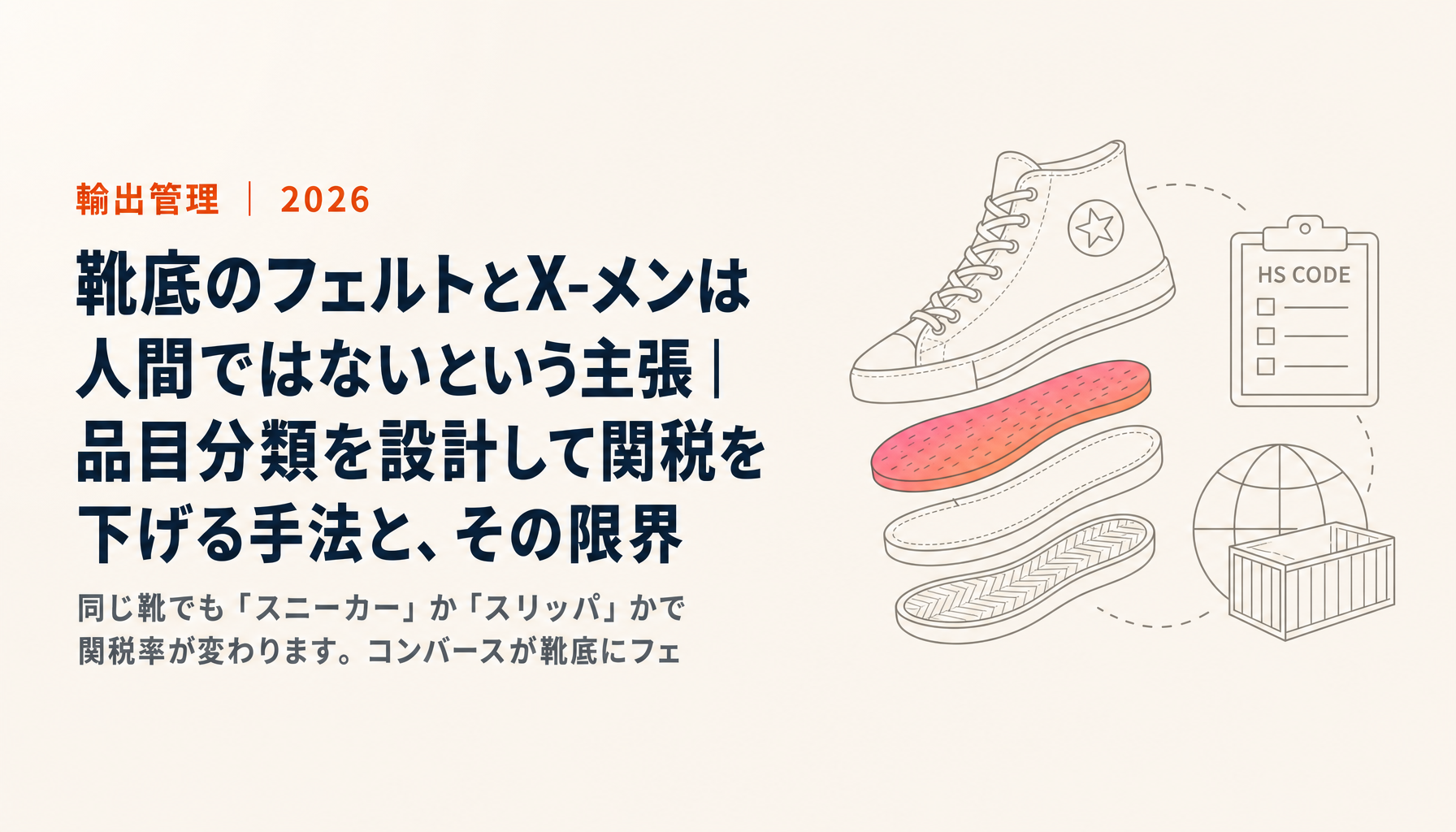
- Felt on the Sole and the Argument That X-Men Are Not Human: Designing Classification to Lower Duty, and Where It Stops Working — designing the HTS code itself
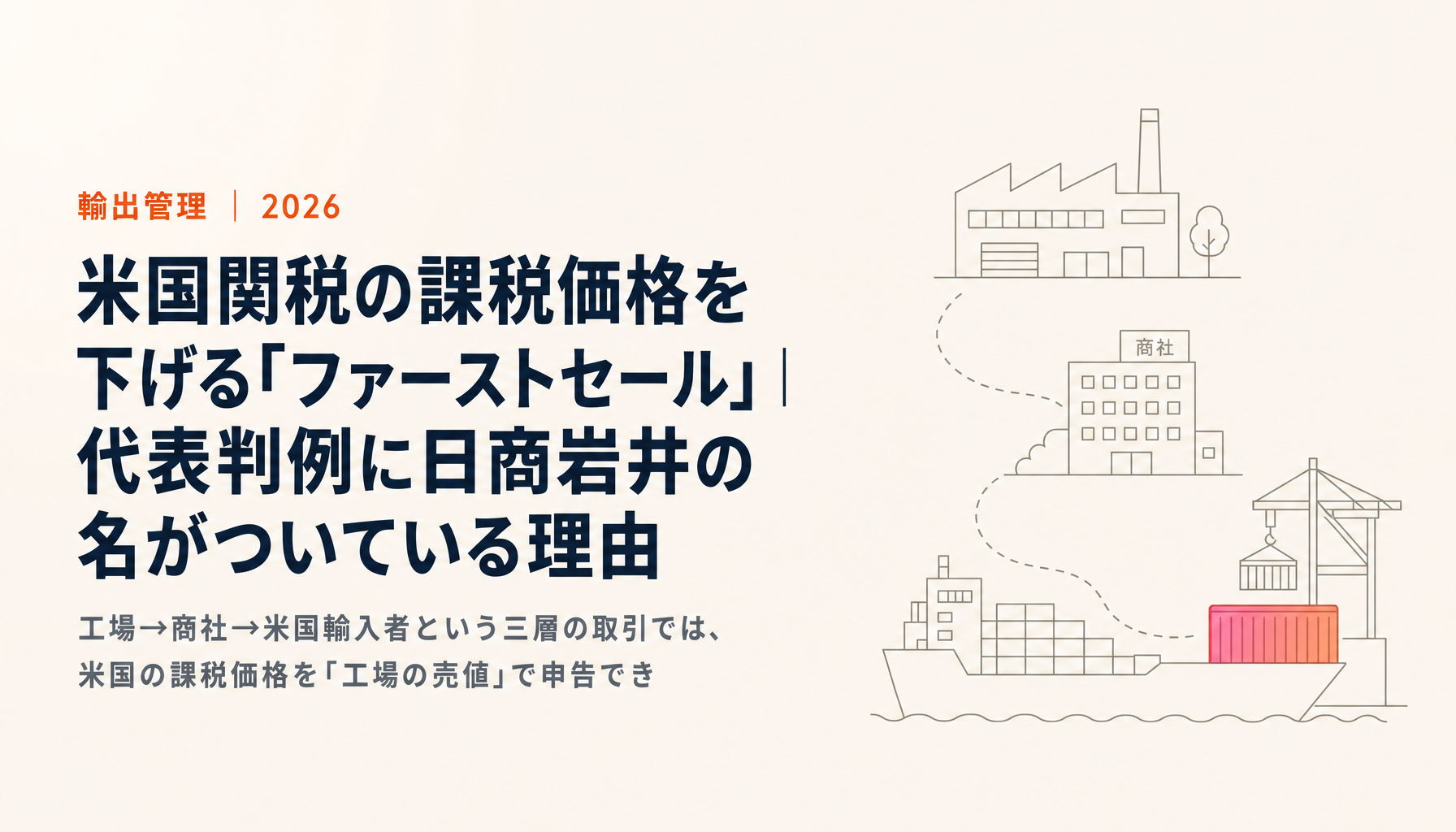
- Lowering the U.S. Dutiable Value with First Sale: Why the Leading Case Carries a Japanese Trading House's Name — the declared value
If there is something on the export control side you want to work through, get in touch. Tariffs and customs clearance themselves belong to customs brokers, but the adjacent ground we can map together.
Sources
- Cyber Power Systems (USA) Inc. v. United States — U.S. Court of International Trade — https://www.cit.uscourts.gov/sites/cit/files/23-24.pdf
- Cyber Power Sys. (USA) Inc. v. United States, 471 F.Supp.3d 1371 (Ct. Int'l Trade 2020) — U.S. Court of International Trade
- "Substantial Transformation" — U.S. Court of International Trade — https://www.cit.uscourts.gov/sites/cit/files/Substantial%20Transformation.pdf
- A Resource Guide to Trade Fraud Enforcement — U.S. Department of Justice — July 2026 — https://justice.gov/fraud/media/1452331/dl?inline=
- CROSS (Customs Rulings Online Search System) — U.S. Customs and Border Protection — https://rulings.cbp.gov/
- Harmonized Tariff Schedule of the United States — U.S. International Trade Commission — https://hts.usitc.gov/
- Advance ruling system — Japan Customs — https://www.customs.go.jp/
※ The rates in the worked example are assumptions used to explain the mechanism. Actual rates, classifications and origin determinations vary by item, by date and by applicable agreement. Before applying any of this in practice, check the current tariff schedule and work through a licensed customs broker and, where appropriate, an advance ruling. Content reflects publicly available information confirmed as of 2 August 2026.