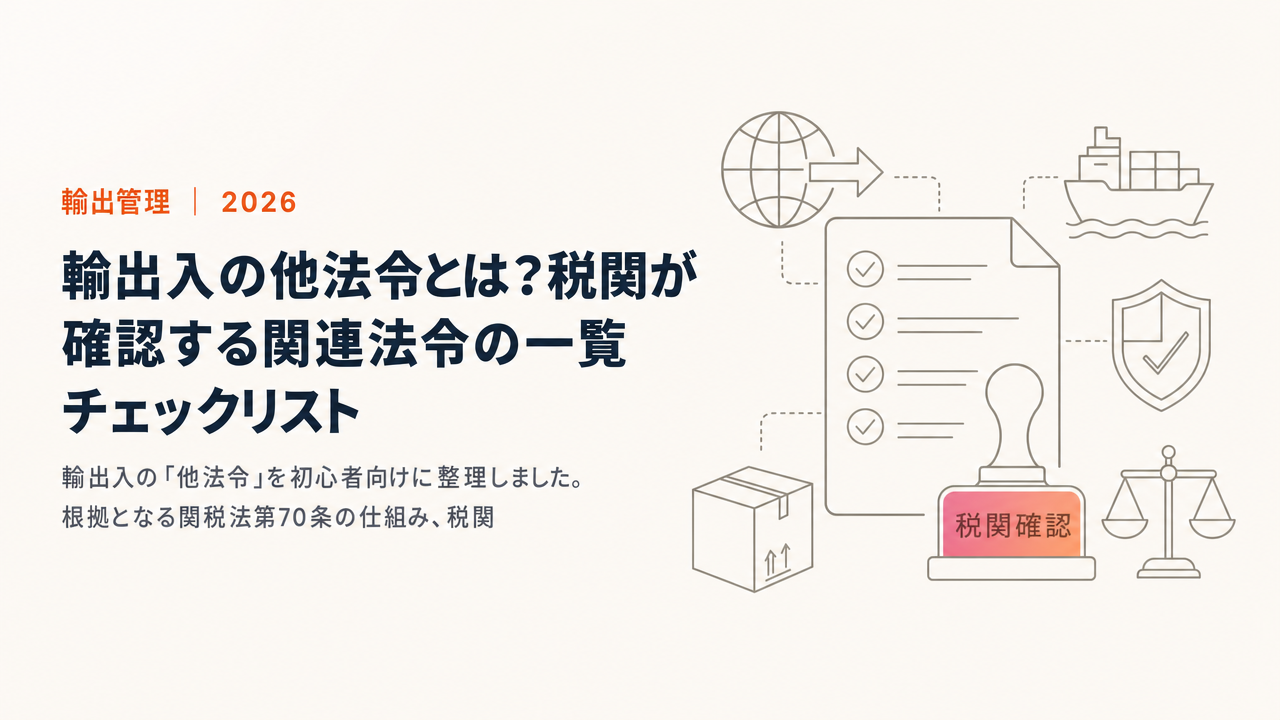
Hello, this is Ryuta Hamamoto from TIMEWELL. "I thought I could import it as long as I paid the duty, but my cargo got held up at Customs." I have heard versions of this story countless times in trade consultations. The cause, more often than not, is not the duty at all — it is a missed check on an "other law" (tahorei). Import food and the Food Sanitation Act applies; import plants and the Plant Protection Act applies; export a used car and the Road Transport Vehicle Act applies. Separate from the duty, Customs requires proof that these permits and inspections have been obtained. Without that proof, no matter how much duty you pay, Customs will not permit the import or export. This article organizes the topic of other laws around the governing statutory text and the reference tables Customs publishes, taking you far enough that even someone touching trade practice for the first time can check their own cargo. If you are wondering whether other laws might apply to the items your company handles, running the export compliance check first to map out the issues will make the rest of this article click faster.
What "Other Laws" Are: How Article 70 of the Customs Act Ties Into Customs Permits
Other laws are statutes, outside the customs framework, that impose permits, approvals, and similar requirements on exports or imports1. They range from the Food Sanitation Act and the Plant Protection Act to the Pharmaceuticals and Medical Devices Act, and even the Foreign Exchange Act familiar from security export controls — a collection of laws administered by scattered, unrelated ministries. Why are they all verified together at the Customs counter? The answer lies in Article 70 of the Customs Act (Proof or Confirmation).
Article 70 is built from three paragraphs2. Paragraph 1 provides that, for goods requiring a "permit, approval, or the like" under an other law, you must prove to Customs at the time of the export or import declaration that the permit has been obtained. Paragraph 2 provides that, for goods requiring "inspection or the fulfillment of conditions" under an other law, you must prove at the time of Customs examination (the inspection under Article 67, etc.) that the inspection is complete or the conditions are met, and receive Customs' confirmation. And paragraph 3 is the one that bites hardest in practice: it explicitly states that goods for which the proof under paragraph 1 is not made, or the confirmation under paragraph 2 is not obtained, will not be permitted for either export or import by Customs.
Here is the point that is easily misunderstood: Customs itself does not issue the permits for food or pharmaceuticals. The permits and approvals are issued by each competent ministry; Customs' role is simply to verify, at the border checkpoint, that those permits have been "properly obtained." The operational basis is split across circulars, too — imports are governed by Customs Act Basic Circular 70-3-1 and exports by 70-1-113. Think of this net of other laws as covering goods on an item-by-item basis, entirely separate from the calculation of duty.
Replace siloed classification work with AI.
METI's FY2024 data shows 52% of foreign exchange law violations stem from classification errors. Download the TRAFEED product catalog covering features and rollout.
[Checklist] The Other Laws Customs Verifies for Import and Export
So which statutes, specifically, are the other laws? Customs publishes separate reference tables for imports and exports. The list of import-related other laws (as of June 2025) contains 30 entries1, while the list of export-related other laws (as of April 2026) contains 113. The difference in number reflects the fact that imports involve more regulations aimed at keeping things out of the country, such as quarantine and food safety. Conversely, the Act on Protection of Cultural Properties (preventing the outflow of important cultural properties abroad) and the Road Transport Vehicle Act (used automobiles) appear only on the export side. The main statutes, with examples of covered items, the competent ministry, and whether they apply to import or export, are summarized below.
| Statute | Main covered items (examples) | Competent ministry | Import | Export |
|---|---|---|---|---|
| Foreign Exchange and Foreign Trade Act (Import/Export Trade Control Orders) | IQ items, sanctioned goods, CITES-listed items, weapons and chemical weapons, etc. | METI | ○ | ○ |
| Narcotics and Psychotropics Control Act | Narcotics, psychotropics, cannabis, narcotics raw materials | MHLW | ○ | ○ |
| Opium Act | Opium, poppy straw | MHLW | ○ | ○ |
| Stimulants Control Act | Stimulants, stimulant raw materials | MHLW | ○ | ○ |
| Act on Regulation of the Cultivation of Cannabis Plants | Cannabis plant seeds | MHLW | ○ | — |
| Poisonous and Deleterious Substances Control Act | Poisons, deleterious substances | MHLW | ○ | — |
| Explosives Control Act | Gunpowder, explosives, pyrotechnics | METI | ○ | — |
| High Pressure Gas Safety Act | High-pressure gas | METI | ○ | — |
| Act for Controlling the Possession of Firearms and Swords | Handguns, hunting guns, swords, etc. | National Police Agency | ○ | — |
| Food Sanitation Act | Food and drink, additives, utensils/containers/packaging, toys, etc. | MHLW | ○ | — |
| Pharmaceuticals and Medical Devices Act (PMD Act) | Pharmaceuticals, medical devices, cosmetics, veterinary drugs, etc. | MHLW / MAFF | ○ | — |
| Plant Protection Act | Plants, injurious animals and plants, used agricultural machinery, etc. | MAFF | ○ | ○ |
| Act on Domestic Animal Infectious Diseases Control | Cloven-hoofed animals, poultry, meat/ham/sausage, etc. | MAFF | ○ | ○ |
| Rabies Prevention Act | Dogs, cats, raccoons, foxes, skunks | MAFF | ○ | ○ |
| Infectious Diseases Control Act | Monkeys, prairie dogs, etc. | MHLW / MAFF | ○ | — |
| Agricultural Chemicals Control Act | Agricultural chemicals | MAFF | ○ | — |
| Act on Securing the Quality of Fertilizers | Fertilizers | MAFF | ○ | — |
| Act on Stabilization of Supply, Demand and Prices of Staple Food | Rice, wheat, etc. | MAFF | ○ | — |
| Act on Price Adjustment of Sugar and Starch | Sugar, starch | MAFF | ○ | — |
| Act on Stabilization of Livestock Management | Butter, skim milk powder, condensed milk, etc. | MAFF | ○ | — |
| Aquatic Resources Protection Act | Eyed eggs and fry of carp, goldfish, salmonids, etc. | MAFF | ○ | — |
| Chemical Substances Control Act (CSCL) | Chemical substances | METI | ○ | — |
| Act on the Stockpiling of Petroleum | Petroleum, gasoline, kerosene, diesel | METI | ○ | — |
| Alcohol Business Act | Alcohol of 90 degrees proof or higher | METI | ○ | — |
| Industrial Safety and Health Act | Hazardous substances (asbestos, etc.) | MHLW | ○ | — |
| Wildlife Protection and Management Act | Birds and beasts and their processed products, bird eggs (wildlife) | Ministry of the Environment | ○ | ○ |
| Invasive Alien Species Act | Black bass, snapping turtle, etc. | Ministry of the Environment | ○ | — |
| Act on Proper Distribution of Aquatic Products | Import: mackerel, Pacific saury, Japanese sardine, squid; Export: juvenile eel, abalone, sea cucumber, Pacific bluefin tuna | Fisheries Agency | ○ | ○ |
| Act on Protection of Cultural Properties | Important cultural properties, important art objects, natural monuments, etc. | Agency for Cultural Affairs | — | ○ |
| Road Transport Vehicle Act | Used automobiles | MLIT | — | ○ |
| Act for Control of Imitation of Revenue Stamps | Items with an appearance confusingly similar to revenue stamps | National Tax Agency | ○ | — |
| Act for Control of Imitation of Postage Stamps | Items with an appearance confusingly similar to postage stamps | MIC | ○ | — |
The sources are Japan Customs' Customs Answer 1801, "List of Import-Related Other Laws (as of June 2025)"1, and 5501, "List of Export-Related Other Laws (as of April 2026)"3. One thing worth emphasizing here: this list is not fixed. With every amendment, the listed statutes, the covered items, and the names of the responsible divisions are updated. When you use it in practice, always pull the latest version from the Customs website at the time you need it. The right way to engage with the table is not to memorize it, but to use it as a map for spotting whether any of your company's items might touch one of these laws.
Watch for Confusion: Other Laws vs. "Goods That Must Not Be Imported/Exported" (Prohibited Goods)
Other laws are frequently confused with Article 69-2 of the Customs Act (goods that must not be exported) and Article 69-11 (goods that must not be imported)2. Because the names sound similar, people assume they belong to the same category, but their nature is entirely different. Listed under Article 69-11 are prohibited goods whose importation or exportation is banned in the first place — narcotics, cannabis, opium, stimulants, opium-smoking paraphernalia, designated substances, firearms such as handguns, explosives, gunpowder, specified substances used as chemical weapons, class-I and class-II pathogens, counterfeit or imitation currency and securities, articles harmful to public safety and morals, child pornography, and articles infringing intellectual property rights.
In a single sentence, the difference is this: prohibited goods (Articles 69-2 and 69-11) are things that "cannot pass at all," while other laws (Article 70) cover things that "can pass once a permit, approval, or the like is obtained." The former is a matter of "out in principle"; the latter is "cleared if you follow the procedure." That said, some items — such as narcotics and stimulants — appear under both provisions, so the line is not as simple as it looks. I have organized the full picture of prohibited goods separately in The List of Prohibited Import Items Held at Customs, so reading the two together will cut down on confusion. At a minimum, keep in mind that whether the governing provision is Article 70 or the Article 69 series decides whether your action should be "obtain a permit from the competent ministry" or "do not handle it at all."
The Main Other Laws by Field
Because the table alone is hard to get a feel for, let me walk through the fields we field the most consultations about. First, food. Anything that touches the mouth or body — food and drink, food additives, tableware and containers/packaging, even toys for infants — falls under the Food Sanitation Act, and importing requires notification to the quarantine station. Next most common is animal and plant quarantine, which brings in three pillars: the Plant Protection Act, the Act on Domestic Animal Infectious Diseases Control, and the Rabies Prevention Act. Plants and seeds, meat, ham, and sausage, and living creatures such as dogs and cats are inspected to prevent the entry of pests and infectious diseases. Because the practical flow of this animal and plant quarantine is distinctive, grasping the overall procedure in the Fundamentals of Animal and Plant Quarantine will make your declaration go more smoothly.
If you import pharmaceuticals, cosmetics, or medical devices, the PMD Act applies; if you handle chemical substances themselves, the CSCL or the Poisonous and Deleterious Substances Control Act comes into play. What is easily overlooked here is the breadth of the Foreign Exchange Act. The Foreign Exchange and Foreign Trade Act is operated through two cabinet orders — the Export Trade Control Order and the Import Trade Control Order45 — and covers not only weapons and chemical-weapon-related items tied to national security, but also rare animals and plants listed under CITES (the Washington Convention) and their products, as well as the import and export of sanctioned goods. What makes CITES-covered items confusing is that there is no standalone statute for them; they are regulated through the Foreign Exchange Act. Leather goods, herbal medicines, and musical instruments can qualify in unexpected ways, so it is safer to check whether your merchandise is caught by consulting the Guide to CITES (Washington Convention) Covered Items. Unique to the export side are the Act on Protection of Cultural Properties (preventing the outflow of important cultural properties and important art objects abroad; administered by the Agency for Cultural Affairs) and the Road Transport Vehicle Act (used automobiles; administered by MLIT) — and with overseas sales of used cars growing, consultations on the latter increase year after year.
The Latest Amendments, 2024–2026
Other laws change almost every year. The one to watch most closely recently is the cannabis-related legislation. The former "Cannabis Control Act" was renamed the "Act on Regulation of the Cultivation of Cannabis Plants" (Act No. 124 of 1948) under an amendment that took effect on March 1, 20256. In tandem, under the portion that took effect on December 12, 2024, cannabis itself was placed under the Narcotics and Psychotropics Control Act — that is, positioned as a narcotic. As a result, in the current Customs list of other laws, cannabis plant seeds are classified under the Act on Regulation of the Cultivation of Cannabis Plants, while narcotics and cannabis plants/cannabis products fall under the Narcotics and Psychotropics Control Act1. Because the importability and component standards for cannabis-derived products such as CBD can change with post-amendment MHLW notifications, no blanket statement is possible. Confirm individual cases with the MHLW or the Narcotics Control Department of your Regional Bureau of Health and Welfare.
The other major development is the Act on Proper Distribution of Aquatic Products (Act on Ensuring the Proper Domestic Distribution of Specified Aquatic Animals and Plants, Act No. 79 of 2020). It took effect on December 1, 20227 and establishes a mechanism requiring notifications and certificates for transactions in covered species in order to prevent the distribution of illegally caught goods. Initially, abalone and sea cucumber were designated as Specified Class I on the export side, while mackerel, Pacific saury, Japanese sardine, and squid were listed as Specified Class II subject to import regulation. Subsequently, an amendment under Act No. 66 of 2024 (effective April 1, 2026) expanded the scope, adding juvenile eel (total length 13 cm or less, applicable from December 2025) and large Pacific bluefin tuna (30 kg or more). Because the effective dates are phased in by species and by whether the flow is domestic distribution, export, or import, the safest approach is to make a final confirmation of the precise classification against the latest Fisheries Agency notifications.
Note, too, that some statutes governing imports do not appear on the Customs list of other laws at all — such as the Forest Tree Seeds and Seedlings Act (Act No. 89 of 1970)8, which contains provisions on the importation of foreign-grown seedlings. It is worth keeping in the back of your mind that "not on the list" does not necessarily mean "not regulated."
How to Proceed in Practice: Confirm Applicability with the Competent Ministry, Make Pre-Declaration Checks a Habit
Finally, the steps for actually checking your own cargo. The first thing to know is that Customs will not determine other-law applicability for you. Customs officially states that it "cannot respond to inquiries regarding whether goods fall under other laws"1. In other words, if you ask Customs "does my product fall under the Food Sanitation Act?", no answer will come back. The correct flow is to get a rough idea from the other-law codes attached to the Customs Tariff Schedule9, then confirm the final applicability with the responsible division of each competent ministry. The counters are split — food with the MHLW, plants with the Plant Protection Division of the MAFF, and so on.
There is one more dangerous assumption: that other laws do not apply because it is a personal import or a small amount. Other laws apply on an item basis in principle, not by value or by whether the importer is an individual or a company. Pharmaceuticals, food, plants, animals, and CITES-listed items can be subject to permits, approvals, or quarantine even in small quantities. Hobby personal imports getting held up at Customs is a textbook example of this. That is precisely why I want you to make item checks a habit before you begin importing or exporting.
As we have seen, other laws are administered by scattered ministries under scattered provisions, and on top of that, they are amended every year. Classification under the Foreign Exchange Act (the Export Trade Control Order and the Import Trade Control Order), which concerns national security, is especially specialized among them — it requires judgment covering list controls, catch-all controls, and even assessments of a counterparty's level of concern. To lighten the load of this Foreign Exchange Act portion, we developed TRAFEED, an AI export control agent. It reflects each country's regulatory amendments on the same day and visualizes, in a short time, whether goods or technology are covered and how concerning a counterparty is. Based on joint field trials with Okayama University and others, its AI classification accuracy exceeds 95% (per our own measurement), and it holds a patent (No. 7862062). That said, what TRAFEED supports is primarily judgment based on the Foreign Exchange Act; the applicability of other statutes such as the Food Sanitation Act and the PMD Act still requires confirmation with each competent ministry. And even for the Foreign Exchange Act portion, the principle that the final classification is made by your company's export control officer does not change.
The other laws of import and export are not something to memorize; they are something to look up, item by item. Use the table in today's article as your map, and check whether even a single other-law line is drawn across the items your company handles. If you find yourself stuck on Foreign Exchange Act classification or on building your internal compliance framework, you can consult us on your specific items through our individual export control consultation. A little extra effort before you pay the duty is what prevents your cargo from being held at Customs.
References
Footnotes
-
Japan Customs, Customs Answer 1801, "Overview of Import-Related Other Laws Verified by Customs" (List of Import-Related Other Laws, as of June 2025) https://www.customs.go.jp/tetsuzuki/c-answer/imtsukan/1801_jr.htm ↩ ↩2 ↩3 ↩4 ↩5 ↩6
-
e-Gov Law Search, Customs Act (Act No. 61 of 1954), Articles 70, 69-2, and 69-11 https://laws.e-gov.go.jp/law/329AC0000000061 ↩ ↩2
-
Japan Customs, Customs Answer 5501, "Overview of Export-Related Other Laws Verified by Customs" (List of Export-Related Other Laws, as of April 2026) https://www.customs.go.jp/tetsuzuki/c-answer/extsukan/5501_jr.htm ↩ ↩2 ↩3
-
Ministry of Economy, Trade and Industry, "List of Foreign Exchange Act-Related Statutes (Export Trade Control Order, Import Trade Control Order, and others)" https://www.meti.go.jp/policy/external_economy/trade_control/01_seido/03_law/houreiitiran.html ↩
-
e-Gov Law Search, Export Trade Control Order (Cabinet Order No. 378 of 1949) https://laws.e-gov.go.jp/law/324CO0000000378 ↩
-
Ministry of Health, Labour and Welfare, "Part of the 'Act Partially Amending the Cannabis Control Act and the Narcotics and Psychotropics Control Act' Takes Effect on March 1, 2025" https://www.mhlw.go.jp/stf/newpage_43079.html ↩
-
Fisheries Agency, "Act on Ensuring the Proper Domestic Distribution of Specified Aquatic Animals and Plants (Act on Proper Distribution of Aquatic Products)" https://www.jfa.maff.go.jp/j/kakou/tekiseika.html ↩
-
e-Gov Law Search, Forest Tree Seeds and Seedlings Act (Act No. 89 of 1970) https://laws.e-gov.go.jp/law/345AC0000000089 ↩
-
Japan Customs, "List of Import-Related Other Laws (Customs Tariff Schedule / Other-Law Codes)" https://www.customs.go.jp/tariff/2018_4/data/import.htm ↩
![What Are "Goods Prohibited from Import" Under Japan's Customs Act? A Beginner's Guide to Article 69-11 and Its Penalties [2026 Edition]](/images/columns/customs-law-prohibited-imports/cover.en.png?dpl=dpl_Aee5SdhJRNJeokTdiXhsgFCCJcqw)