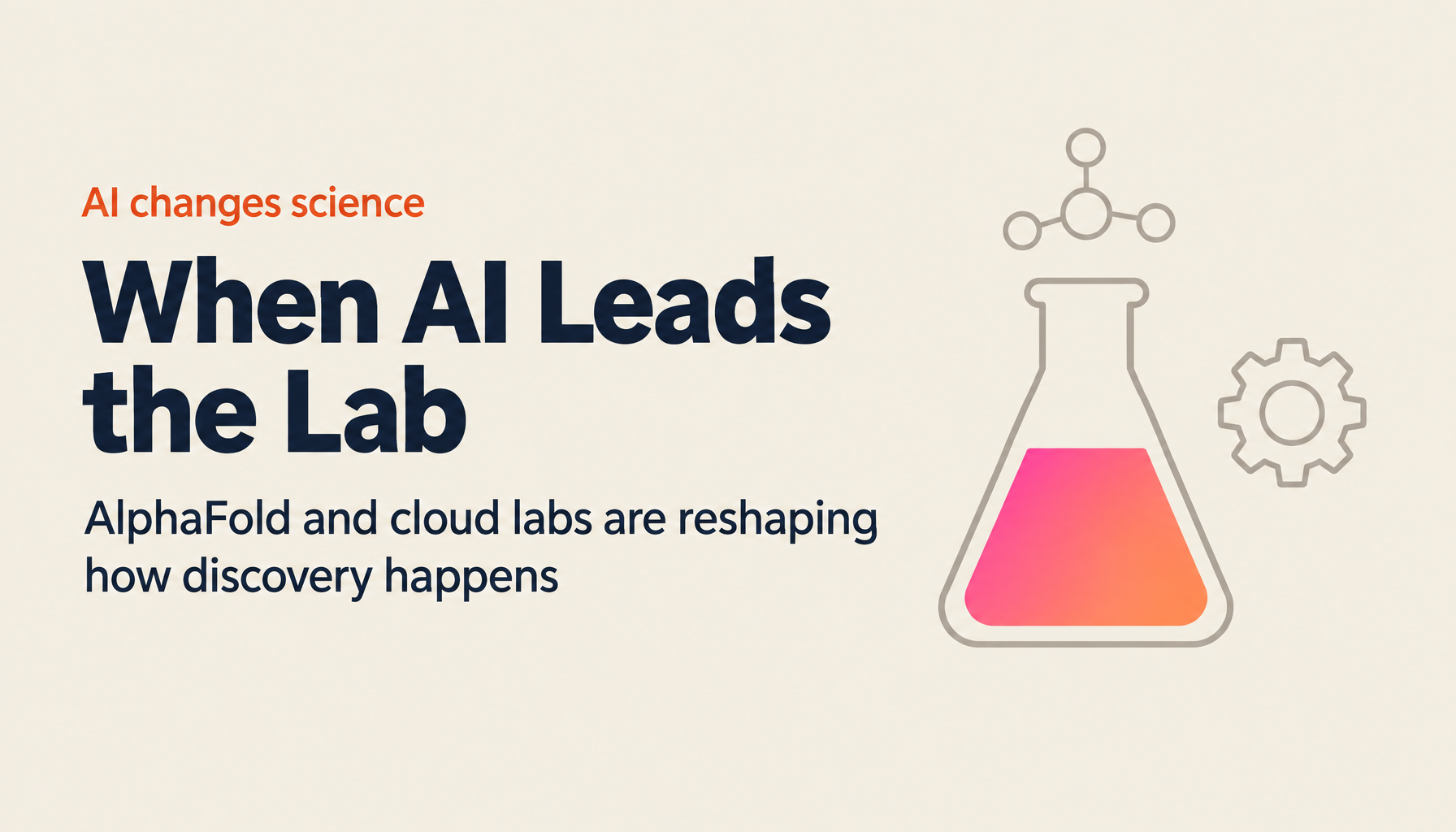
The rapid evolution of AI technology is dramatically transforming the nature of scientific research
In recent years, the rapid evolution of AI technology is dramatically transforming the nature of scientific research. A new wave is now sweeping through the processes of experimentation, analysis, and hypothesis testing that humanity has long pursued. Experiments that once required enormous equipment and vast amounts of time can now be completed in minutes to hours with the help of AI.
For example, AlphaFold, developed by Google DeepMind, has revolutionized the prediction of the three-dimensional structure of proteins — the fundamental building blocks of life — fundamentally changing methods that once relied on X-ray analysis and electron microscopy, and exerting a profound influence on our understanding of biological phenomena. At the same time, an AI called AlphaEvolve has emerged that autonomously optimizes its own algorithms and tackles unsolved problems in mathematics, stirring a complex mix of excitement and anxiety about the future of scientific research.
Furthermore, the emergence of fully automated laboratories known as cloud labs is driving the automation of experiments and the integration of robotics, bringing closer the era in which AI leads research in place of humans. These developments have the potential to overturn not only the role of scientists but the very concept of human "understanding," and we must seriously consider whether we are ready to ride the wave of AI-driven science.
This article explains in detail the specific cases of AlphaFold and AlphaEvolve, what kind of transformation AI is bringing to the scientific research process, and the vision of the future that lies beyond.
- The New Scientific Frontier Opened by AI: The Innovations of AlphaFold and AlphaEvolve
- The Evolution of AI-Driven Science: From Computational Analysis to Fully Automated Labs and Robotics
- Outcomes Beyond Understanding: The New Scientific Territory and Future Vision AI Is Opening Up
- Summary
Take AI-driven development all the way to production
WARP is a hands-on program for teams who want more than headlines. Former enterprise DX and data strategy leads work alongside you until it runs.
The New Scientific Frontier Opened by AI: The Innovations of AlphaFold and AlphaEvolve
Today, AI-driven scientific research is achieving astonishing speed and precision that is in a different league from conventional experimental methods. Let us begin with AlphaFold, developed by Google DeepMind. AlphaFold is a technology that predicts the three-dimensional shape — the spatial structure — of proteins, the fundamental components of life. Clarifying the spatial structure of a protein is critically important for understanding the mechanisms of biological phenomena, and it has been a challenge that many scientists have worked on throughout history. Conventional methods required facilities such as X-ray crystallography, electron microscopy, or even large-scale accelerator facilities like SPring-8, and it was common for results to take years to obtain. AlphaFold, however, achieves high-precision predictions in a matter of minutes to hours — delivering results that match or surpass conventional approaches.
AlphaFold has also been continuously improved since the first version was announced in 2018, and by 2026 AlphaFold 3 has achieved even greater accuracy. This technological breakthrough has dramatically advanced the life sciences, opening new possibilities for future drug development and disease elucidation. DeepMind has also announced a new AI algorithm called AlphaEvolve. A key characteristic of AlphaEvolve is that, rather than relying on fixed algorithms, the AI itself designs and improves its own computational methods and algorithms. It has been reported that AlphaEvolve has dramatically advanced mathematical algorithms that had barely changed since 1969, presenting solutions that exceed the best-known approaches in 20% of cases across more than 50 unsolved mathematical problems. This demonstrates the potential of AI to generate solutions that transcend the conventional framework of human thinking through continuous self-learning and self-improvement — a factor with enormous impact on the future of scientific research.
The success of AlphaFold and AlphaEvolve is not limited to theoretical experimental results — it is already being applied to the identification of drug candidates and the development of actual treatments. In fact, a company called Future House is implementing a process that combines three AI agents to extract the most promising drug candidates from vast quantities of research papers and verify them from multiple angles. This is expected to dramatically shorten the timeline for new drug development — a process that would previously have taken years — bringing revolutionary changes to medical settings going forward. As these technologies become widespread, investment in computational resources, GPU clusters, fully automated experimental facilities such as cloud labs, and other related infrastructure is bound to surge, generating new demand in fields that were previously unrelated.
The current state of AI intervening in the scientific research process presents new challenges for experts across disciplines. The shift from human-centered research methods to AI-led research raises questions about what role human "understanding" and "intuition" — once central to the research process — will play going forward. In practice, when final outcomes are created by AI, humans can freely utilize those outcomes while potentially finding that their detailed understanding of the process fails to keep pace. This has something in common with the sense of incomprehension that even amateur Go players felt about AlphaGo's moves, and in science too, a future is predicted in which "understanding" and "outcomes" become increasingly disconnected. As a result, an era may arrive in which the actual results that emerge are valued above the researcher's personal sense of comprehension.
Behind this transformation lies the deep-seated limitation of the human brain's capacity for understanding. Humans are generally adept at understanding three-dimensional space, but computers can operate in spaces of hundreds of dimensions. This means AI can make accurate predictions and generate new discoveries even in domains where intuitive human understanding falls short — providing insights that feel like glimpses into another world entirely. The advance of technology makes the gap between what is "visible" and what is "actual" in research increasingly apparent, and sometimes carries the risk of producing discoveries that are impossible to comprehend. Yet the results obtained from these processes will have an impact sufficient to overturn the existing framework of scientific research entirely. This new frontier that AI is opening up goes well beyond the cutting edge of technological innovation alone — it is poised to bring major transformation to fields ranging from medicine and mathematics to chemistry, and to change the values of scholarship itself.
The Evolution of AI-Driven Science: From Computational Analysis to Fully Automated Labs and Robotics
The evolution of AI in scientific research extends well beyond analysis inside computers — it reaches into laboratory automation and the deployment of robotics in the real world. To begin, scientific research started with AI being used as an assistant to humans. Academic researchers began receiving AI support for tasks such as generating statistical analysis code and writing research papers, and this kind of assistance has already become routine. At this stage, AI is still being used primarily as a supplementary tool for humans, and humans remain at the center of the research itself.
As technology advanced, however, research began to evolve toward a stage where AI increasingly takes over roles within the experimental process. In fields where experiments are not required and work is completed entirely within computational environments — particularly computer science and information science — cases in which AI autonomously performs sophisticated analysis and simulation have rapidly increased. The emergence of advanced algorithms like AlphaFold and AlphaEvolve are prime examples. These technologies go beyond the framework of theory and mathematical formulas; the AI itself generates new methods and establishes a self-improving feedback cycle. As a result, the framework of "understanding" that the human brain has relied on is reaching its limits, and AI-driven scientific research is making rapid autonomous progress.
Furthermore, transformation is spreading beyond the computational environment to actual experimental settings. The emergence of fully automated laboratories known as cloud labs has made it possible for AI instructions to be directly reflected in the experimental process. Cloud labs are designed to conduct experiments continuously, 24 hours a day, 365 days a year, and to return results rapidly — enabling flexible and efficient research that goes beyond the constraints of conventional experimental facilities. Systems of this kind, exemplified by Emerald Cloud Lab, are attracting particular attention in chemistry and biotechnology, where AI directly issues experimental instructions to automate on-site work, creating an environment in which experimental data accumulates and is analyzed at unprecedented speed.
This evolution has gone a step further, with the addition of robotics technology ushering in an era where AI leads actual experimental work — including the manipulation, movement, and assembly of physical objects in the real world. The integration of robotics makes it possible to conduct experiments outside the laboratory and to reproduce physical phenomena, allowing AI to perform experiments across the globe as if it had its own hands and feet. This is expected to create an environment in which large numbers of experiments are conducted in parallel without human researchers being involved, and diverse data is collected in short periods of time. In practice, these technological advances will dramatically improve the efficiency and accuracy of scientific research, and systems in which AI handles the research itself will be introduced across an increasing number of fields going forward.
Against the backdrop of such rapid evolution, the steps that future scientific research will take are complex and varied. The following key points stand out in organizing the major transitions of AI-driven science:
- From AI as a human assistance tool, to autonomous research within computational environments, to real-world experimentation via fully automated labs and robotics — the research environment is evolving continuously.
- AI is forming feedback cycles in which it designs and optimizes its own algorithms, taking on unsolved challenges in mathematics, physics, and the life sciences.
- AI's ability to handle high-dimensional data goes beyond the frameworks of human intuition and understanding, creating the potential for unique discoveries that defy intuition.
These changes are fundamentally altering the existing framework of scientific research, presenting a new paradigm in which the speed and precision of outcomes diverge — and in which the personal "sense of comprehension" and "actual results" become increasingly disconnected. This situation poses a major challenge to the human-centered value of research that scientists and research institutions have long upheld. As AI becomes capable of addressing unknown problems with ever-greater precision, we may find ourselves utilizing its results while our understanding of AI's opaque processes fails to keep up. The gap between "understanding" and "actually obtaining results" in scientific research is thus likely to widen further going forward, and we will need to build new indicators, evaluation criteria, and investment mechanisms to adapt flexibly to these changes.
Outcomes Beyond Understanding: The New Scientific Territory and Future Vision AI Is Opening Up
As AI advances, an era is approaching in which actual outcomes themselves — rather than the "understanding" that has long been central to conventional scientific research — take precedence. Until now, scientists have sought to grasp the workings of the world based on the sense of comprehension gained through experiments and analysis. However, as AI becomes capable of freely processing high-dimensional information that the human brain could not previously handle, a phenomenon may emerge in which "understanding" and "outcomes" become disconnected within the process of generating results. In other words, an era is dawning in the scientific arena where discoveries backed by numerical and statistical evidence proliferate even without explanations that intuitively satisfy humans.
For example, AlphaGo — which once astonished the world in the game of Go — made moves that were incomprehensible to professional human players. Initially enigmatic, those moves proved effective by the endgame and ultimately led to victory. This phenomenon is considered highly likely to appear in similar patterns in scientific research as well. In other words, new hypotheses and experimental results proposed by AI may function correctly as actual outcomes even when the process is a black box. In an era when human "understanding" is not necessarily linked to outcomes, society as a whole will be forced to re-evaluate its established values.
Concretely, as AI-driven science advances, the following changes are anticipated. First, the criteria for evaluating research outcomes will change — actual outputs and new discoveries will be valued over "theoretical explanations" that satisfy human understanding. Second, the research process itself will become highly automated, enabling experiments and analyses in domains that exceed the limits of human capability. And third, as AI autonomously takes on challenges, the potential for entirely new scientific discoveries, drug development, and breakthroughs in previously uncharted problems in computer science is likely to increase.
In this future vision, the roles of scientists and AI will be clearly differentiated. Humans will no longer rely on their own intuition and experience alone — they will need to leverage the data and analytical results provided by AI to tackle problem-solving more efficiently. This means that while AI takes the lead in advancing science, a new balance will be required between the pursuit of the traditional "sense of comprehension" and the evaluation of actual results. And this new paradigm will not simply be limited to technological innovation — it will have a profound impact on scholarship, education, and the values of society as a whole.
On the practical side, AlphaEvolve has challenged unsolved problems in mathematics and produced results that surpass the best-known solutions across numerous cases. This phenomenon demonstrates the possibility that AI, through repeated self-improvement, could surpass the thought processes of conventional scientists. At the same time, however, the fact that the methods produced by AI are often incomprehensible to humans is a significant warning signal. New discoveries that outpace human understanding carry the risk of causing confusion in society and academia at times. When we face such situations, what is required is not clinging to the "sense of comprehension" but rather maintaining a calm approach to evaluating actual outcomes and their effectiveness.
In this way, the new scientific territory being opened by AI represents a major departure from the traditional human-centered approach to research. Scientific progress is accelerating not because we understand, but because outcomes are emerging. And the time has come for us humans to seriously consider how we will utilize those outcomes, and how we will advance our collaboration with AI. The future of scholarship is certainly unknown, and it will unfold in forms that greatly exceed our current common sense and understanding. But we must approach this future with flexible thinking and an innovative mindset, in the expectation that it will generate new discoveries and bring benefits to society as a whole.
Summary
The innovations in AI-driven scientific research covered in this article go well beyond mere technological progress — they are set to fundamentally transform the framework of conventional science, the role of researchers, and the very meaning of what it means to "know" something. The prediction of protein spatial structures by AlphaFold, the optimization and construction of algorithms by AlphaEvolve, and the automation of experiments through cloud labs and robotics are dramatically improving the speed and precision of scientific research, while simultaneously confronting us with the new challenge of a divergence between the "sense of comprehension" and actual results.
The following key points emerge from this transformation:
- AI has evolved from a human assistance tool to conducting autonomous research both in computational environments and in the real world.
- The criteria for evaluating research are shifting from "understanding" to "actual results," and the paradigm of science itself is being transformed.
- A situation is arising that requires new knowledge creation through human-AI collaboration and societal adaptation to technology.
Going forward, AI will continuously produce outcomes beyond the cognitive limits of the human brain in previously unknown territories. In the process, the traditional sense of "understanding" and "conviction" may fade. Yet the actual outcomes brought about by the advancement of scientific research will undoubtedly bring great benefits to our lives, medicine, and technology broadly. The future of scientific research will transition to a new era in which AI and humans coexist, each complementing the other's strengths. We must accept this transformation and approach the next generation of knowledge creation with flexible thinking and an innovative approach.
Source: https://www.youtube.com/watch?v=rcDc4sNzqcY
Streamline Event Management with AI | TIMEWELL Base
Struggling to manage large-scale events?
TIMEWELL Base is an AI-powered event management platform.
Proven Results
- Adventure World: Managed a Dream Day event with 4,272 attendees
- TechGALA 2026: Centrally managed 110 side events
Key Features
| Feature | Benefit |
|---|---|
| AI Page Generation | Event page ready in 30 seconds |
| Low-Cost Payments | 4.8% transaction fee (among the lowest in the industry) |
| Community Features | 65% of attendees continue engaging after the event |
Feel free to reach out to discuss how we can make your event operations more efficient.
Related Articles
- Accelerating Growth in the AI Semiconductor Market: Latest 2026 Trends and Strategies from TSMC and NVIDIA
- ElevenLabs 2026: Valuation Reaches $11 Billion, ARR Surpasses $330 Million, Dominating the Voice AI Market
- From 2026 to 2027: The Reality of AGI's Arrival, Anthropic CEO Confident It's "Within a Few Years"