Hello, this is Ryuta Hamamoto from TIMEWELL.
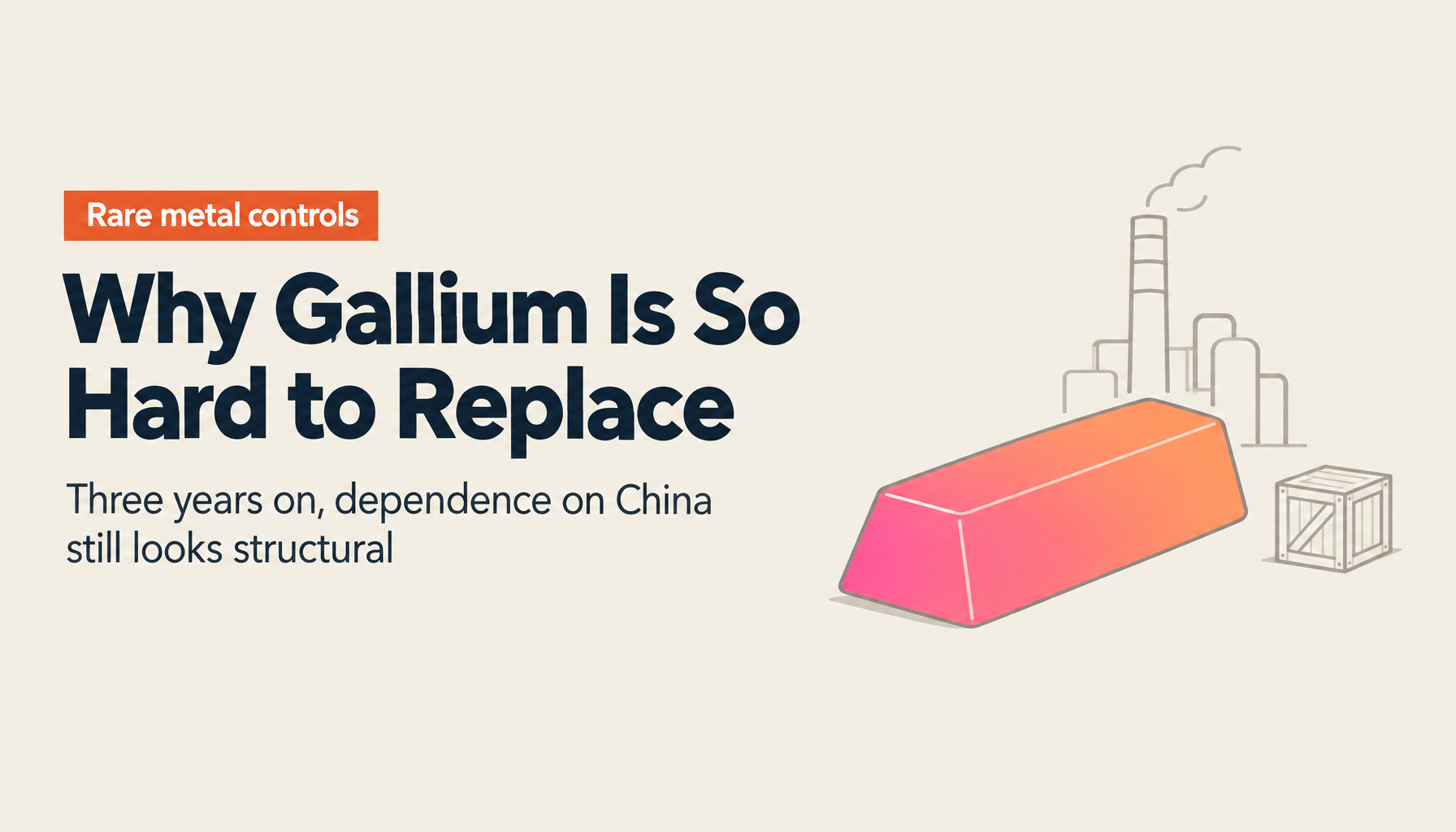
China began controlling exports of gallium and germanium in August 2023, so we have just passed the three-year mark. What has changed in that time is the price. What has not changed is the structure of the dependence.
Nikkei reports that gallium prices have risen ninefold since the controls began, and describes the path away from China as steep.1
Why has three years not moved it? The reason is not politics or negotiating leverage. It is how gallium is produced in the first place. Miss that, and you end up at the unhelpful conclusion that you should simply buy from somewhere else.
Working from US Geological Survey primary statistics, here is the structure and where alternative supply actually stands. Written to be readable without a materials background.
The short version
- Gallium cannot be mined on its own. It is a byproduct of turning bauxite into alumina, among other processes, so supply does not respond cleanly to price
- Per USGS, China accounts for roughly 99% of world primary low-purity gallium production. Against 900,000 kg estimated for 2025, Japan produces 3,000 kg and Russia 6,000 kg
- Japan is one of the few producers outside China, with 10,000 kg of capacity
- US average import unit value went from $277/kg in 2021 to an estimated $580 in 2025. Germanium metal went from $1,187 to $4,100
- Rare earth magnet exports to Japan hit 111 tonnes in July 2026, roughly half the level of a year earlier and of January
- New projects are announced in Australia, Canada, Greece, Kazakhstan, and Korea, and the US has started putting government money in
- But no effective substitute exists for GaAs and GaN in defense applications. Substitution has a ceiling
Groundwork: what these metals are for
Start with the uses, because that shows why losing them hurts.
Gallium
Gallium is used less as a metal than as the basis for compound semiconductors.
- GaAs (gallium arsenide): high-frequency integrated circuits, laser diodes, LEDs, photodetectors, solar cells
- GaN (gallium nitride): power semiconductors, integrated circuits, optoelectronic devices
They tolerate higher voltage, higher frequency, and higher temperature than silicon, which is why they show up in EV power conversion, telecom base stations, and defense applications such as radar. That is the context for "gallium rather than silicon."
Per USGS, integrated circuits account for 73% of US gallium consumption and optoelectronic devices for 26%.2
Germanium
Germanium goes mainly into infrared optics and optical fiber: infrared lenses and windows, fiber manufacturing, and substrates for satellite solar cells.
Infrared optics feed straight into night vision and thermal imaging, so this sits close to security applications too.
Replace siloed classification work with AI.
METI's FY2024 data shows 52% of foreign exchange law violations stem from classification errors. Download the TRAFEED product catalog covering features and rollout.
What happened over three years
| When | Event |
|---|---|
| August 2023 | China begins export controls on gallium and germanium related items |
| December 2024 | China bans gallium exports to the United States outright (germanium likewise) |
| January 6, 2026 | MOFCOM Announcement 2026 No. 1 tightens dual-use export controls toward Japan (prohibiting exports to Japanese military users and military end uses) |
| June 24, 2026 (effective July 1) | MOFCOM Announcement 2026 No. 26 establishes a reporting mechanism for violations involving strategic mineral dual-use items |
| November 2025 | China lifts the US gallium ban for one year2 |
| July 2026 | Rare earth magnet exports to Japan at 111 tonnes, roughly half both year-on-year and versus January3 |
Controls have not moved only in one direction. The US ban was lifted for a fixed one-year window in November 2025. This opens and closes with the diplomatic weather, which is what makes the area hard to plan around.
For Japan, China Customs data published on August 20, 2026 put July rare earth magnet exports at 111 tonnes — about half the year-earlier level, about half of January 2026, and 13.6% below June. Reporting attributes this to export restrictions toward Japan following Diet remarks on a Taiwan contingency.3 Dysprosium, which raises magnet performance, is said to be under strict control.
What happened to prices
"Ninefold" travels well on its own, so let me put numbers of different characters side by side.
Nikkei's ninefold figure presumably refers to a spot price for a particular grade and market; the article is paywalled, so I cannot confirm the grade or region. Useful as a reference point, but it does not mean your procurement price multiplied by nine.
Easier to verify is the US average import unit value published by USGS.
| 2021 | 2022 | 2023 | 2024 | 2025 (est.) | |
|---|---|---|---|---|---|
| Gallium metal ($/kg) | 277 | 432 | 365 | 439 | 580 |
| Germanium metal ($/kg) | 1,187 | 1,294 | 1,392 | 1,991 | 4,100 |
| Germanium dioxide ($/kg) | 770 | 828 | 883 | 1,281 | 2,500 |
Gallium is about 2.1 times its 2021 level, roughly 30% above 2024. Germanium has moved harder — roughly doubling from 2024 to the 2025 estimate and about 3.5 times its 2021 level.
The same "export control" lands differently by commodity. Germanium has a thinner supply base, so it transmits to price faster.
Why sourcing away from China is not happening
Three reasons.
Reason 1: gallium is a byproduct
This is the big one.
There is no gallium mine. USGS puts it plainly:
Globally, primary gallium is recovered predominantly as a byproduct of processing bauxite ores. Gallium may also be recovered as a byproduct of processing zinc ores.
And average gallium content in bauxite is 50 parts per million.
What follows from that: to make more gallium you need more alumina refining or zinc smelting capacity. A ninefold gallium price does not get an alumina plant built. The economics are decided on the alumina side.
China dominates less because it set out to produce gallium than because its alumina industry is enormous. The upstream industrial structure shows through directly.
Germanium works the same way, recovered from zinc concentrates and coal ash. In the US, a zinc mine in Alaska produces germanium-bearing concentrates that are shipped to a Canadian refinery. A Tennessee mine has been suspended since November 2023.4
Reason 2: the scale gap is extreme
USGS 2026 figures for primary low-purity gallium:2
| 2024 production | 2025 (est.) | 2025 capacity | |
|---|---|---|---|
| China | 839,000 kg | 900,000 kg | 1,600,000 kg |
| Japan | 3,000 kg | 3,000 kg | 10,000 kg |
| Russia | 6,000 kg | 6,000 kg | 10,000 kg |
| Other | — | — | ~100,000 kg |
| World total | 848,000 kg | 900,000 kg | 1,700,000 kg |
China is around 99%.
Worth noticing: Japan appears as a producer. Three tonnes a year against ten tonnes of capacity — running at about 30%. There is headroom there, but running Japan flat out still covers barely 1% of a 900-tonne world.
For context, USGS also records who stopped: Germany in 2016, Hungary in 2015, Kazakhstan in 2013, and Ukraine most likely in 2022. There is a history of contraction here. Three years does not reverse it.
Reason 3: substitution has a ceiling
"Use a different material" only works partway. USGS lists the substitutes: liquid crystals for LEDs in displays; silicon CMOS power amplifiers competing with GaAs in midtier handsets; indium phosphide for GaAs infrared laser diodes at specific wavelengths; helium-neon lasers competing in visible laser diodes; silicon in solar cells; silicon-germanium replacing GaAs in some heterojunction bipolar transistors.
And then:
In many defense-related applications, GaAs- and GaN-based ICs are used because of their unique properties, and no effective substitutes exist for GaAs and GaN in these applications.
Consumer applications have escape routes. Applications chosen for performance do not. The question becomes how to secure gallium, not how to stop using it.
Where the alternatives actually stand
Countries producing today
Japan and Russia. Russia carries its own geopolitical exposure, which makes Japan's domestic headroom — 10,000 kg of capacity against 3,000 kg of production — the first realistic option to look at. It is also the one that sits entirely within domestic policy reach.
Countries with announced projects
USGS records new gallium projects announced in Australia, Canada, Greece, Kazakhstan, and the Republic of Korea.
Every one of them has an alumina or zinc industry. Gallium only appears where bauxite or zinc is already being processed. The candidate list is really a map of alumina and zinc production.
What the US is doing
Government money has started moving:2
- In September 2025, the Department of Energy announced up to $6 million for domestic R&D toward a gallium supply chain, supporting recovery from alumina refining or primary zinc smelting, with the goal of restarting domestic primary gallium recovery for the first time in nearly 40 years
- In November 2025, the Department of War awarded $29.9 million under Defense Production Act Title III to a US company for a demonstration facility in Louisiana recovering gallium and scandium from industrial waste
Look at the amounts. Six million and thirty million dollars, orders of magnitude below chip subsidies. This is not the kind of investment that produces volume soon. It is technology demonstration.
Germanium sourcing
Germanium is less concentrated than gallium. US import sources for 2021–24:4
- Metal: China 41%, Belgium 27%, Germany 25%, Russia 3%
- Dioxide: Belgium 57%, Canada 37%, Japan 3%
Belgium and Canada function as real alternatives. Germanium also recycles better, recovered from machining swarf in infrared optics manufacturing, lenses and windows in decommissioned military equipment, optical fiber manufacturing waste, and solar cell wafers.
What a company can do
Honestly, this is not a problem one company solves. Within that, there are things worth doing.
1. Find where gallium and germanium sit in your own products. Surprisingly often, nobody knows. For a finished-goods maker, GaAs and GaN devices are components of components, so you have to walk the bill of materials down two or three levels. Start there.
2. Separate "substitutable" from "not substitutable" by application. As above, consumer applications have alternatives. You do not need to defend everything. Identify where substitution genuinely fails and concentrate inventory and supplier diversification cost there.
3. Look at sourcing by process, not by country. Because gallium is a byproduct, supply stability is subordinate to alumina and zinc production plans. Even when buying through a trading company, it is worth pushing to learn which refinery it came from.
4. Look at recycling. Germanium has a real track record. Gallium recovery from new scrap generated in GaAs device manufacturing also happens in practice — USGS notes a single facility in New York doing this in the US.
5. Keep tracking how China administers the rules. A monitoring mechanism for strategic minerals took effect in July 2026. Regimes shift through administration, not only through item lists. The list can be unchanged while licences behave differently.
One thing worth saying
Conversations like this tend to slide into "China is weaponizing resources." The fact worth holding onto is that Chinese gallium output is large first because its alumina industry is large. Concentration emerged from industrial structure, and then that concentration acquired value as a policy instrument. That is the order of events.
And Japan was a producer and still is one. The capacity sits underused because that was the economically rational answer for a long stretch, when buying from the cheapest source made sense. That reads to me less as anyone's failure than as conditions having changed.
Conditions changed, so you redo the arithmetic. Treating it that way seems the healthiest framing available.
Wrapping up
- Gallium is a byproduct of bauxite and zinc processing. It cannot be scaled on its own, and price does not pull supply
- Per USGS, China is around 99% of primary low-purity gallium. Against 900,000 kg estimated for 2025, Japan is 3,000 kg and Russia 6,000 kg
- Japan is one of the few non-Chinese producers, running 3,000 kg against 10,000 kg of capacity. There is domestic headroom
- US import unit values: gallium about 2.1 times 2021, germanium metal about 3.5 times. Germanium moved harder
- Rare earth magnet exports to Japan were 111 tonnes in July 2026, roughly half year-on-year and versus January
- New projects in Australia, Canada, Greece, Kazakhstan, Korea — all countries with alumina or zinc industries
- US government investment is $6 million and $29.9 million. Demonstration stage; volume is not imminent
- Consumer applications have substitutes, but no effective substitute exists for GaAs and GaN in defense applications
- Practically: walk the BOM to find your exposure, split substitutable from not, and concentrate effort where substitution fails
What three years have shown is that "sourcing away from China" is easy as a slogan and slow against the physics of a byproduct. Which is exactly why, instead of trying to switch everything at once, identifying the applications where substitution genuinely fails is the preparation that pays.
Footnotes
-
Nikkei, "中国、レアメタル輸出規制3年 パワー半導体のガリウム価格は9倍" (July 31, 2026). https://www.nikkei.com/article/DGXZQOUB307AS0Q6A730C2000000/ ↩
-
U.S. Geological Survey, Mineral Commodity Summaries 2026: Gallium. https://pubs.usgs.gov/periodicals/mcs2026/mcs2026-gallium.pdf ↩ ↩2 ↩3 ↩4
-
Kyodo News, "中国、対日レアアース磁石が半減 7月、規制前に比べ" (August 20, 2026, China Customs data). https://news.infoseek.co.jp/article/kyodo_1463128941718945875/ ↩ ↩2
-
U.S. Geological Survey, Mineral Commodity Summaries 2026: Germanium. https://pubs.usgs.gov/periodicals/mcs2026/mcs2026-germanium.pdf ↩ ↩2