Hello, this is Ryuta Hamamoto from TIMEWELL.
"What do we do if METI sends us a notice telling us to apply for a license?" In my introductory export control sessions, this is one of the questions that comes with real anxiety attached. The other one I hear a lot is whether you should consult METI before a deal or just move ahead quietly. I have heard people say that consulting costs you, and I have heard people say that not consulting is dangerous. Both claims make more sense once you split them into three concerns, namely time, lost business, and penalties. This article takes those three in turn and stays within what official sources can confirm.
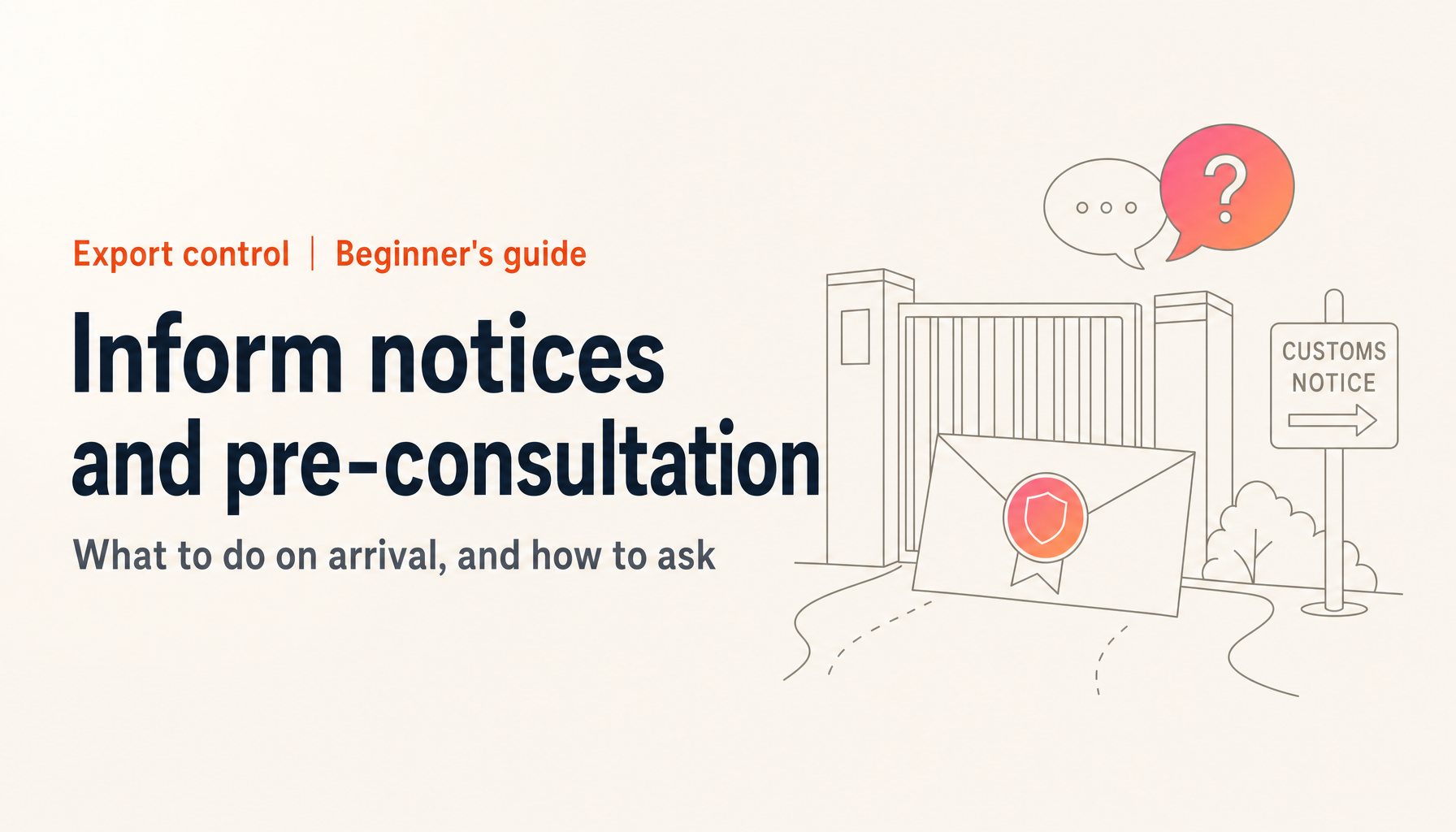
First, the short answer. An inform notice is a written message from the Minister of Economy, Trade and Industry saying that a particular item or technology requires a license application. Once it arrives, you cannot export that item or provide that technology until you obtain a license. Pre-consultation is not a legal obligation. If your own check concludes that no license is needed and you have not received a notice, you may proceed on your own judgment. For deals where you are unsure, or where you have come across worrying information, there is a route to consult the Security Export Licensing Division before you apply. Neither the statute nor official guidance says that consulting is always a loss or always a gain. What changes is when you act, with what information, and in what order.
You will learn four things here. Where the inform requirement sits in the law. What to do, step by step, when a notice arrives. Who to consult, what to prepare, and what a consultation can and cannot tell you. And what can happen if you skip consultation or overlook a notice. I will not repeat the basics of catch-all control or the full story of the October 2025 amendments. If you want those first, start with our explainer on how catch-all control came about or our guide to the October 2025 amendments, and for how to judge the objective requirements, our note on the Akiraka guideline. Then come back.
Terms to settle first
This field is full of look-alike terms. Here is the vocabulary used in this article.
| Term | Meaning | Think of it as |
|---|---|---|
| Catch-all control | Formally "supplementary export control". A license can be required for items and technology outside the control lists, depending on use or recipient | The lists mark the locked rooms. Catch-all says that outside those rooms, a person or purpose can still stop the shipment |
| Objective requirements | Requirements triggered when the exporter's own check of end use or end user reveals a concern. The two parts are the end-use requirement and the end-user requirement | The inspection you do yourself on contents and destination |
| Inform requirement | A license is required once the Minister notifies you in writing | A letter from the authorities saying this shipment now needs a pass |
| Inform notice | That letter itself. Formally, "notification that an application for permission should be filed" | The letter that says a pass is needed |
| Pre-consultation | Consulting the Security Export Licensing Division before applying. Not a legal obligation | Asking the guard at the gate whether this load can pass |
| Objective requirements checklist | A reference form METI provides for recording the result of the objective check | The inspection record sheet |
| Export caution notice (tsutatsu) | METI's administrative guidance setting out procedural detail for supplementary export control | The operating manual |
| End User List | Information on overseas entities whose concerns have not been resolved, provided to exporters for reference | The reference roster you consult during inspection |
One point before going on. Receiving a notice, or appearing on the End User List, is not a finding that a company has done something wrong. What METI describes is a regulatory classification, namely whether this item or technology might be used for a concern purpose. That holds the same way whether the company concerned is Japanese or foreign.
Where it appears in the law, and how to read Article 4
The inform requirement is written in the Export Trade Control Order (the Order) in a slightly awkward form. Article 4 opens with "the provisions of Article 48, paragraph 1 of the Act shall not apply in the following cases", so it is a list of exemptions from the licensing requirement.1 In other words, Article 4 defines the road where no license is needed. For goods in item 16, the catch-all category, the exemption is available only when none of the cases (a), (b), (c) and (d) applies. Cases (b) and (d) are where the exporter has received a notification from the Minister that an application should be filed.1 Once a notice arrives, you step off the no-license road and onto the license-required one. That is how I read the structure.
Here is where the notice appears, by situation.
| Situation | Provision | Role of the notice |
|---|---|---|
| Goods. Item 16(1), specified items. Weapons of mass destruction angle | Order, Art. 4(1)(iii)(b) | Receiving a notice takes you out of the exemption |
| Goods. Item 16(1). Conventional weapons angle | Same item, subitem (d) | Same |
| Goods. Item 16(2). Both angles | Order, Art. 4(1)(iv)(b) and (d) | Same |
| Goods to Group A destinations (Appended Table 3) | Order, Art. 1(3) and Art. 4(2)(iii)(a) and (b) | A license is needed only once a notice is received. Objective requirements do not apply |
| Provision of technology | Ministerial Ordinance on Trade-Related Invisible Transactions, Art. 9(2)(vii) and (viii), subitems (b) and (d), as organized in the export caution notice2 | A license is needed once a notice is received |
| Transactions between foreign countries (intermediary trade) | Foreign Exchange Order, Art. 17(5)(ii)(b)3 | Transactions covered by a notice need a license |
How the rules differ for item 16(1) versus 16(2), and for Group A versus other destinations, is laid out in the matrix in our guide to the October 2025 amendments. What matters here is that a notice appears in the text in every scenario. The export caution notice adds that once you receive a notice, you must apply for and obtain a license before exporting or providing the technology, whatever the result of your own objective check.4
A note on finding the right provision. If you go looking for the catch-all text, paragraphs 3 and 4 of Article 4 may catch your eye. They deal with exemptions to a different system, export approval under Article 2, and have nothing to do with inform notices.1 The relevant provisions are Article 1, paragraph 3, and Article 4, paragraphs 1 and 2. Watch this when you cite article numbers.
Replace siloed classification work with AI.
METI's FY2024 data shows 52% of foreign exchange law violations stem from classification errors. Download the TRAFEED product catalog covering features and rollout.
When does a notice arrive? What can and cannot be said
"When will it come to us?" is the question people most want answered. METI's Q&A says a notice is issued in writing when METI judges that the goods or technology may be used in the development of weapons of mass destruction or conventional weapons, or, for exports to Appended Table 3 destinations, when there is a concern about diversion.5
That is as far as official sources go. A notice is issued on METI's judgment. It is in writing. For Group A destinations, it is limited to cases with a diversion concern. The criteria and evidence behind the judgment, and concrete examples of past notices, did not appear in any official material I checked. I understand them not to be public. So I will not generalize about which kinds of companies or deals attract a notice.
There is one route that official materials connect to inform decisions. It is the public-private dialogue scheme that began in 2025. Before signing a contract to provide specified controlled technology, the company reports to METI in advance. METI then decides whether to issue an inform requiring a license application, and the stated target is, as a rule, within 30 days of the report. The details are in our article on advance reporting under the scheme. That 30-day figure comes from METI's Q&A as summarized in that article. METI's site limited repeated access during this work, so I could not retrieve the Q&A again and cannot confirm whether it has been revised. Please check the original before you cite it.
Another point matters. A notice is not addressed to the world at large. It attaches to the goods or technology you are about to export. The text reads "when the goods are the subject of a notification from the Minister that an application for permission should be filed".1 So first read the document to see how far it identifies the goods, technology, transaction and destination. Whether it spills over to other customers or other items depends on what the document says and, if needed, on what the division tells you. I will not guess.
When a notice arrives, seven steps and a flow table
Now the practical part. Official sources say that you cannot export or provide the technology without a license. They do not publish an internal checklist for companies. The steps below are my own working arrangement, built from the statute and the export caution notice.
- Record the date and time of receipt, the addressee, the title of the document, and the goods, technology, transaction and destination it names. Keep the original safe, and make sure there is a route that always brings it to your export control officer. The notice is given in writing.6
- Stop the covered shipments and technology transfers. That includes the order backlog, stock allocated to orders, packing and booking, the forwarder's instructions, and technical files shared by email or cloud. The channels people forget are usually the non-physical ones. Check whether anything has already left.
- Tell the people involved. Sales, logistics, purchasing, the customs broker, the technical team. Keep a record that shows who stopped what.
- Have the export control officer decide whether to apply for a license. If you export the covered goods, you must apply, and the application goes to the Security Export Licensing Division.6 Dropping the deal is also a legitimate decision.
- If you apply, plan on the basis that a license may not be granted. METI's Q&A says the notice is issued because METI itself has judged that there is a concern, so an application may be refused, and a license is granted only if the concern is resolved.5 Rebuild delivery dates and contract terms so they can survive a refusal.
- Explain to the customer. The purpose is to say that you are holding the shipment for a licensing procedure. Do not frame it as suspicion. Receiving a notice does not mean the customer did anything wrong. I could not find an official rule on how much of the notice you may show or describe to the customer. If in doubt, ask the division before you speak.
- Check other deals for spillover. List anything running with the same customer, the same goods or the same destination, and record the result. Add a "what we do when a notice arrives" procedure to your internal compliance program.
Here is the flow as a table.
| Order | Who | What | What to record |
|---|---|---|---|
| 1 | The department that received it | Hand the notice to the export control officer at once | Time of receipt, copy of the document |
| 2 | Export control officer | Read the covered goods, technology, transaction and destination | Memo of scope |
| 3 | Export control officer, sales, logistics | Stop covered shipments and transfers. Check for anything already shipped | List of stopped deals |
| 4 | Export control officer | Decide whether to apply or to drop the deal | Reasons for the decision |
| 5 | Sales, legal | Explain the hold to the customer. Adjust delivery and contract | Date and content of the explanation |
| 6 | Export control officer | Check other deals for spillover | Result of the check |
| 7 | Export control officer | Reflect the lessons in the internal program | Revision history |
Let me add a hypothetical example. It is not a real case. It is only to show the flow. Say a parts maker is preparing to export general-purpose electronic components to a trading company in an ordinary destination country. Three orders are in the backlog, and one is already on a truck to the port. A notice arrives. The first things to establish are which of the three orders it covers, and whether the truck can be stopped. The worst case is that a logistics person who has not heard about the notice carries on with the booking. A delay of a few hours in internal communication can change the options a lot.
Pre-consultation, who to ask, what to prepare, what you learn and what you do not
Now to what comes before a notice. The basis for pre-consultation is METI's export caution notice. If you plan to export item 16 goods or provide item 16 technology, and you find it hard to tell whether the transaction meets the application requirements, or anything else is unclear, you can consult the Security Export Licensing Division.4 The wording is "can consult". It describes an open channel for exporters, not an obligation.
The contact is the Security Export Licensing Division, Trade Control Department, Trade and Economic Security Bureau, METI. On METI's catch-all control page, consultation is split in two.6 One is for license-related and case-specific consultation, where you send documents by email. The other is for general questions about the system, with a separate email contact. I did not confirm whether a telephone or in-person channel exists. Email addresses can change, so I am not printing them here. Please read the current page.
For a case-specific consultation, METI's page lists four items to prepare.6
- Materials showing the commercial flow, logistics, contract content and end use, in any format
- Technical materials such as a catalog or specifications
- Materials on the business of the end user
- The review sheet recording whether the application requirements are met, which is the objective requirements checklist
The page adds that other documents may be requested as needed. In addition, the export caution notice sets out the documents for a written pre-consultation when you hold specific concern information and want to consult before applying. They include the pre-consultation form for supplementary export control (Form 1), a classification sheet, catalogs and specifications, something that shows the whole deal such as an order form or an existing contract, and documents showing the part that raises the concern.4 For a general consultation with no concern information, the way the notice is written suggests a written form is not demanded.
What do you learn from a consultation? The export caution notice says the answer on whether a license application is required under supplementary export control is given in the judgment column of the pre-consultation form.4 So what you get is METI's answer on whether you need to apply.
Let me also be plain about what I could not establish. First, whether the notice contains any assurance that no inform will be issued after an answer. I found no such statement in what I read. Second, the usual turnaround. The public-private scheme states a target of 30 days, but I found no official figure for ordinary pre-consultation. Third, whether the content of a consultation can lead to a notice. I found no official explanation of the relationship between the two. I will not guess at any of them. If it matters to you, ask directly when you consult.
There is also a private channel. CISTEC (the Center for Information on Security Trade Control) runs web and in-person consultation covering Article 25, paragraphs 1 to 4, and Article 48, paragraph 1 of FEFTA. The scope includes classification, internal compliance programs and license application documents. According to the terms I retrieved on 6 November 2026, the service is free for supporting members, and for ordinary companies costs 5,500 yen (tax included) for the first 20 minutes and 3,300 yen (tax included) for each additional 20 minutes. The terms also say the answer is advice, and CISTEC is not liable for harm arising from it except in cases of intent or gross negligence.7 Email consultation is open to supporting members, university members and other university corporations.8 It is worth keeping in mind as a way to add private expertise alongside the authorities.
Industry has also commented on how usable pre-consultation is. As set out in our article on the red tape debate in export controls, a trade association said in its requests to METI that pre-consultation tends to be email-based and makes detailed exchanges difficult. I read that as one group's request, not the view of every company, and I could not confirm how METI responded.
To consult or not, through the lens of time, business and penalties
Back to the "consulting costs you" question. Here is what official sources allow me to say on the three counts.
| Concern | If you consult | If you proceed without consulting |
|---|---|---|
| Time | You spend time assembling documents and waiting for an answer. I could not confirm a standard turnaround for ordinary pre-consultation | If your check concludes no license is needed and no notice has arrived, you can proceed on your own judgment6 |
| Business | The wait can affect contract and delivery. Early action lets you plan around it | If you learn later that a license was needed, you are dealing with it after shipment or signing, with fewer options |
| Penalties | Consulting itself carries no penalty | Exporting something that needed a license without one can expose you to penalties under FEFTA and to administrative sanctions |
The point of the table is that you cannot reduce the choice to gain or loss. Consulting costs effort and waiting time. That is true. At the same time, neither the statute nor METI's guidance says that a deal with complete records, no concern information and a clear "obviously not for a concern use" judgment must be taken to METI every time. Conversely, if the documents in your hands contain something that points to a concern and you skip the check, the party who ends up in trouble is the exporter.
When does consultation fit? Look at the export caution notice. One of its check items is that the importer or end user gives a clear explanation of the end use. It also says that if they are reluctant to give information on the final use, you should presume there is no clear explanation.4 Take a hypothetical case. You are exporting general-purpose machine parts and the buyer will not tell you what they are for. It becomes hard to say the use is obviously harmless, and you are close to what the notice calls a case where judgment is difficult. Putting your check records in order and then consulting the division is one of the uses the notice envisages.
One personal view. I think the value of consulting lies not only in the answer but in how it forces your own check into shape. Filling in the checklist puts into words what you do not know, and if you ask only about that, the burden is smaller on both sides. In practice, I find the bigger delay is often internal, a decision stuck because nobody has records, not the time spent waiting for METI.
What can happen if you skip consultation or overlook a notice
Here I stay with the text of the law.
If you export goods covered by a notice without a license, that can be characterized as an export without the permission required by Article 48, paragraph 1 of FEFTA. Article 69-7, paragraph 1 provides for imprisonment of up to seven years or a fine of up to 20 million yen, or both, and where five times the value of the goods exceeds 20 million yen, the fine can go up to five times that value. Attempted exports are also punishable. The especially grave category, relating to nuclear weapons and similar items, falls under paragraph 2, with up to 10 years or a fine of up to 30 million yen. I did not check the Cabinet Order designations that decide which goods fall into which paragraph, and actual application depends on the facts.9
For companies, Article 72 sets out a dual liability rule. The corporate fine is up to 700 million yen for a violation under paragraph 1 and up to 1 billion yen for paragraph 2, with the same five-times-value adjustment.9 Separately from criminal penalties, Article 53 provides for administrative sanctions. The Minister may ban a person who exported without permission from exporting, or from providing specified technology, for up to three years.9 For the overall penalty picture and what has happened in practice, see our guide to FEFTA penalties. For how violations are found and what causes them, our six-year analysis of METI violation data is a useful companion.
Please keep in mind that this describes how the statute is written. It is not a statement that overlooking a notice leads automatically to a given outcome. Whether criminal liability arises depends on the facts, including intent. How a company would be assessed if a notice reached an employee who did not pass it on cannot be read directly from the text. What I can say is that the text speaks of "receiving a notice", and I found no provision that excuses a failure of internal communication. That is why I strongly recommend a single point of receipt.
Three realistic measures help you avoid missing a notice. Put the addressee and receiving desk under the control of the export control officer. Write an internal rule that anything arriving by post or ordinary email goes to the export control officer, whichever department got it. And add "any notice?" to your pre-shipment final check, with a record each time.
Common misunderstandings
Some misunderstandings are worth clearing up.
The first is that "not consulting is illegal". It is not. METI's guidance says that if your check concludes no license application is needed and no notice has been received, you may export on your own judgment.6 You are still asked to keep a record of how you reached that conclusion, in line with your internal rules.
The second is that "if I consult, I will get a license". The answer to a pre-consultation concerns whether you need to apply. It does not promise a license. Even after a notice and an application, a license may be refused.5
The third is that "notices only go to big companies". In the official materials I read, there is no statement about the size of the recipient. Reading the structure of the public-private scheme, what matters is the technology and the transaction, not company size.
The fourth is the worry that "consulting gets you noticed". No official source says that consulting causes a notice or any disadvantage. None says it does not, either. I could not confirm this, so if you are concerned, ask directly when you consult.
The fifth is the view that "if a notice comes, the other company must be at fault". A notice reflects METI's judgment that these goods or technology could be used for a concern purpose. It is a classification. I think the right way to handle it, for both practice and the relationship, is as a document that starts a procedure, not as a reason to blame the customer.
What to do on Monday morning
If you want to decide where to begin, here is the order I suggest.
First, check whether your internal export control rules say what to do when a notice is received. If they do not, use the seven steps above as a draft and build the procedure with the people involved. Second, fill in the objective requirements checklist for a few recent deals and mark where you hesitated. Those hesitations are your candidate questions for pre-consultation.
Third, get ready to consult. Turn the four documents on METI's list into templates you can send whenever needed. That alone changes how quickly you can move. Fourth, give notices a single point of receipt.
Writing this, I was struck by how much around inform notices and pre-consultation is simply not public. Admitting what you do not know, and confirming it by asking, is not a timid stance. I think it is how a careful exporter works.
TRAFEED, our AI agent for export control, can support screening of counterparties and the keeping of check records. The final classification and the decision whether to proceed rest with your own export control officer. If you want to talk through how to set this up for your organization, please use our consultation form.
Footnotes
-
Export Trade Control Order (Cabinet Order No. 378 of 1949), Article 1(3) and Article 4 — e-Gov Law Search — checked 6 November 2026 (Japanese) ↩ ↩2 ↩3 ↩4
-
Ministerial Ordinance on Trade-Related Invisible Transactions (Ordinance No. 8 of 1998), Article 9 — e-Gov Law Search — checked 6 November 2026 (Japanese) ↩
-
Foreign Exchange Order (Cabinet Order No. 260 of 1980), Article 17 — e-Gov Law Search — checked 6 November 2026 (Japanese) ↩
-
Export procedures for supplementary export control on weapons of mass destruction and conventional weapons (Export Caution Notice 2025 No. 27, last amended 14 November 2025) — METI Trade and Economic Security Bureau — checked 6 November 2026 (Japanese) ↩ ↩2 ↩3 ↩4 ↩5
-
Catch-all related Q&A, section 5, questions on the inform requirement (Q1 to Q3) — METI — last updated 15 October 2025, checked 6 November 2026 (Japanese) ↩ ↩2 ↩3
-
Supplementary Export Control (Catch-all Control) — Ministry of Economy, Trade and Industry (METI) — last updated 23 December 2025, checked 6 November 2026 (Japanese) ↩ ↩2 ↩3 ↩4 ↩5 ↩6
-
Terms of use for web and in-person consultation (last amended 1 April 2023) — CISTEC (Center for Information on Security Trade Control) — checked 6 November 2026 (Japanese) ↩
-
Terms of use for email consultation (last amended 1 April 2023) — CISTEC (Center for Information on Security Trade Control) — checked 6 November 2026 (Japanese) ↩
-
Foreign Exchange and Foreign Trade Act (Act No. 228 of 1949), Articles 25, 48, 53, 69-7 and 72 — e-Gov Law Search — checked 6 November 2026 (Japanese) ↩ ↩2 ↩3