Hello, this is Ryuta Hamamoto from TIMEWELL.
In news about chipmaking equipment export controls, you now often see the line that allies should be asked to match U.S. controls. One phrase keeps coming up in the explanation: the level playing field.
If you are new to export controls, this phrase can be confusing. It is not a term in any statute. It is a way of arguing for a policy. Still, it shows up in bills, congressional reports, testimony and EU regulations, so knowing what it means makes news and legislation much easier to read. I went to the primary sources to see in what context, by whom and for what purpose the phrase is actually used.
Here is the short answer. The phrase carries two meanings that are often blended. One is fairness in competition: companies in countries that apply strict rules should not be the only ones that lose business. The other is effectiveness: if only some countries restrict an item, the item can still be bought elsewhere and the control does not achieve its goal. U.S. congressional documents lean hard on the first. The Japanese advisory council materials I could read place effectiveness and fairness side by side. The Wassenaar Arrangement was built on national discretion from the start, which means some divergence is part of the design.
This article covers four things.
- What the level playing field argument means, and how to tell its fairness reading from its effectiveness reading
- How U.S., Japanese, Dutch and EU primary sources actually use the phrase
- How tools such as the foreign direct product rule are meant to bring controls into line
- What Japanese companies can check now, without waiting for any bill to pass
This article does not judge any country or company. Statements by governments and lawmakers are reported as their statements.
Terms to settle first
The table below lists the terms used in this article, each with an everyday comparison.
| Term | Meaning | Everyday comparison |
|---|---|---|
| Level playing field | Everyone competing is bound by the same rules and carries the same burden | A race where every driver obeys the same traffic lights |
| Export control regime | An international framework such as the Wassenaar Arrangement where countries agree on item lists | A neighborhood association's shared agreement |
| National measure | A control a country adds under its own law, including outside the shared agreement | A house rule on top of the neighborhood agreement |
| Allies and like-minded countries | Countries that cooperate on export controls. That is the sense used here | Neighbors who bring the same rulebook |
| Extraterritorial application | Applying a country's rules to transactions that happen outside its borders | "If you sell a product made with our parts in another town, please follow our rules" |
| Foreign direct product rule (FDPR) | A U.S. rule that reaches foreign-made products built with U.S. technology or software | A dish made from an inherited recipe that carries the recipe's conditions to any restaurant |
| De minimis | A threshold based on the share of U.S.-origin content in a foreign-made product | A labeling duty that changes depending on what share of ingredients comes from one region |
| Servicing | Repair, adjustment, software updates and other support for equipment already installed | Stopping car sales does not stop a car from running if inspections and repairs continue |
| Circumvention | Routing goods through third countries or other companies to avoid a control | Taking a back road to avoid a checkpoint |
| Effectiveness | How far a control achieves its purpose in practice | A speed limit sign does not reduce accidents if nobody follows it |
A race where not everyone obeys the traffic rules
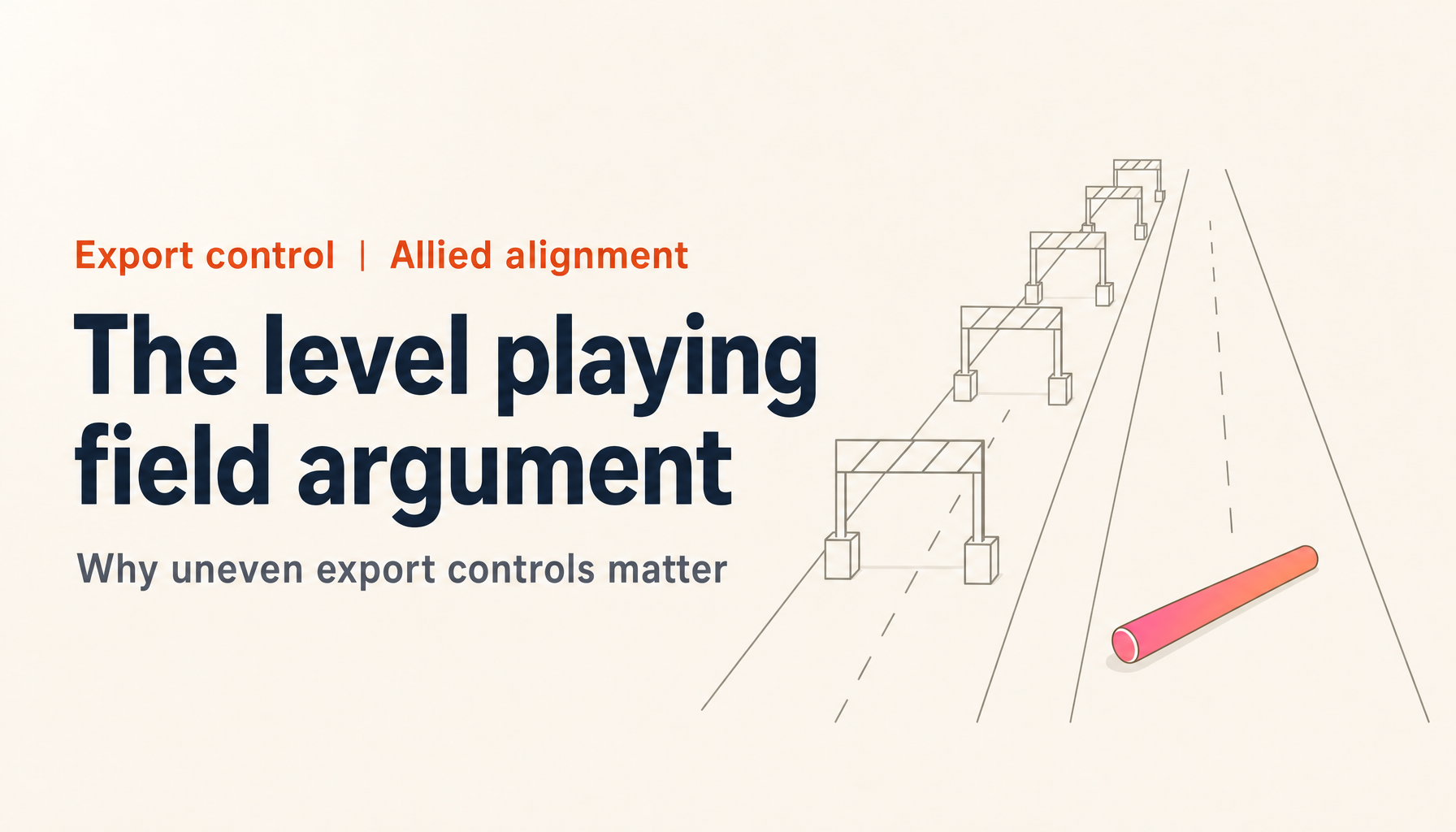
Start with an analogy. Ten drivers race on the same road, but only three obey the speed limit and stop at every stop sign. The other seven do not. Two problems follow.
The first is unfairness. The three rule-followers finish late, and the seven who ignore the rules arrive first. At the next race, fewer people may follow the rules. That is the fairness problem. The second problem is that the rule fails at its job. A stop sign at a blind intersection exists to prevent crashes, but if seven drivers roll through, the intersection stays dangerous. That is the effectiveness problem.
Translate this to export controls. The first problem is the competitive position of companies. Suppose one country's firms need a license to sell a tool that another country's firms can sell without one. If customers move to the second group, only the firms that follow the stricter rule lose revenue. The second problem is the security purpose. Even if a control is meant to prevent a worrying end use, the purpose is not met if the same equipment is available from a country without that control.
I think separating these two is the single most useful habit when reading this debate. The same phrase sometimes protects corporate interests and sometimes closes a gap in a control. When you hear it, ask yourself whether the speaker is talking about fairness or about effectiveness.
One more point. An argument about fairness is separate from the question of whether a control is right in the first place. People who think a control is justified and people who think it is too heavy can still agree that the rules should apply equally. In theory, equality can be reached either by raising the lighter side or by lowering the heavier side. In practice, every source I read below talks about raising the lighter side.
Replace siloed classification work with AI.
METI's FY2024 data shows 52% of foreign exchange law violations stem from classification errors. Download the TRAFEED product catalog covering features and rollout.
How U.S. congressional documents use the phrase
The phrase is most visible in the MATCH Act (Multilateral Alignment of Technology Controls on Hardware Act), introduced in April 2026. I have covered the bill's history and mechanics in a separate explainer on the MATCH Act, so here I focus on wording.
In the introduced House bill, H.R. 8170, Section 2 is a "Sense of Congress." Its eighth item says the U.S. government should work closely with allies and partners to align export controls on semiconductor manufacturing equipment and components in order to prevent gaps, reduce the risk of circumvention and "ensure a level global playing field."1 The Senate bill, S. 4281, has the same item and adds a ninth: a diplomatic agreement, including through positive incentives, is the best and most sustainable path to alignment.2
Note where the phrase sits. A sense of Congress clause states the view of Congress. It does not impose a legal obligation on agencies or other countries. The operative rules are in Section 3. In the introduced text, the agencies first press allied supplier countries diplomatically to adopt matching controls. If they cannot certify within 150 days that those countries have done so, the United States extends its own jurisdiction to equipment exported from them.1 There is also a provision that lets the United States end or modify its controls once an allied country has put matching controls in place, so the US side steps back when alignment is reached. The 150-day deadline was later changed in the House Foreign Affairs Committee. See the explainer above for the latest text.
Lawmakers use the phrase in their statements too. In an April 2, 2026 press release from Representative Baumgartner, Senator Ricketts is quoted as saying that U.S. restrictions on this equipment are stronger than those of close allies and partners, that this puts American companies last, and that the bill "creates a level playing field for U.S. companies."3 In the same release, Select Committee Chairman Moolenaar speaks of a level playing field "for U.S. and allied toolmakers," Representative Lawler of a level playing field "with our allies," and Representative Golden of one "for American manufacturing."3 The title of the Senate Foreign Relations Committee's press release also includes the line "Level the Global Playing Field for U.S. Tech."4
A report from the House Select Committee on the Strategic Competition Between the United States and the Chinese Communist Party, published on October 7, 2025, is also worth reading. It examined five leading equipment makers based in the United States, Japan and the Netherlands. By its tally, their sales to China came to about $38 billion in 2024, 39 percent of their combined worldwide revenue and 66 percent more than in 2022.5 From the gap between what non-U.S. and U.S. makers sold to entities that were restricted at the time of sale, the committee concluded that U.S. export controls have created "an unlevel playing field."5 The report says this is suggested by the sales disparity. It is the committee's inference, not a measured causal result, and that is worth keeping in mind. Its recommendations include using incentives and leverage so that the Netherlands and Japan come fully into line with U.S. policy, and it says the short-term pain should be borne equally by makers from all allied producing countries. It adds that harmonized controls would give makers "market certainty and predictability."5
Other material frames the same problem as one of effectiveness. In testimony to a House Foreign Affairs subcommittee on November 20, 2025, Chris McGuire of the Council on Foreign Relations argued that allied controls must be raised to match U.S. controls. His main reasoning was that Japan and the Netherlands had not fully matched U.S. controls on advanced fabs, so those fabs keep access to allied tools, components and servicing. He also said this shifts market share away from American firms, but the weight of the testimony is on the gap in the control itself.6
| Source | Date | How the idea is expressed | Emphasis |
|---|---|---|---|
| MATCH Act (sense of Congress) | April 2026 | Ensure a level global playing field | Gaps and circumvention, fairness |
| Lawmakers' press release | April 2026 | A level playing field for U.S. companies, or for U.S. and allied toolmakers | Competitive position of firms |
| House Select Committee report | October 2025 | U.S. controls have created an unlevel playing field | Competitive position, gaps in controls |
| Council on Foreign Relations testimony | November 2025 | Allied controls must be raised to match U.S. controls | Effectiveness |
Each of these is a claim by the person or body that made it. None of them is the position of the Japanese or Dutch governments. The next section looks at materials from the side being asked to align.
The view from Japan, the Netherlands, the EU and Wassenaar
Looking at the countries being asked to align changes the picture. The starting point is the design of the Wassenaar Arrangement, the main international framework for export controls.
According to its official website, the Arrangement has 42 participating states, all decisions are taken by consensus, and the Plenary normally meets once a year, in December.7 The decision to transfer or deny the transfer of any item is the sole responsibility of each participating state, and all measures are taken under national legislation and policies on the basis of national discretion.7 The site's FAQ adds that the scope of controls is set by the Arrangement's lists, but practical implementation varies from country to country under national procedures, and it states that the Arrangement is not directed against any state or group of states.7 In short, divergence in implementation is built into the design. The limits of the framework and what individual countries are doing are covered in our article on the Wassenaar Arrangement's dysfunction.
Japan's system works along these lines. A METI summary dated May 23, 2023 explains why 23 items of advanced chipmaking equipment were added to export controls: amid a harsher security environment, to prevent military diversion, complementing the Wassenaar Arrangement while also taking into account the latest export control developments in the countries concerned.8 The legal basis is Article 25, paragraph 1 and Article 48, paragraph 1 of the Foreign Exchange and Foreign Trade Act, and the measure took effect on July 23, 2023.8 The document shows Japan watching other countries' moves while deciding on its own legal footing.
How does a Japanese advisory council talk about this problem? The Subcommittee on Security Export Control of the Industrial Structure Council issued an interim report on April 24, 2024.9 A METI deck summarizing it gives as one direction that Japan should secure both effectiveness and fairness through layered cooperation with allies and like-minded countries.9 It also says that if countries rely heavily on unilateral measures, effectiveness and predictability decline, so the aim is to coordinate systems and operations through international cooperation.9 Fairness and effectiveness appear together.
In the summary I could read, the loanword "level playing field" does not appear. The word used is "fairness" in Japanese. The same deck also has the phrase "while paying attention to fairness among companies" in the context of reviewing supplementary controls.9 That refers to fairness among Japanese companies, not between countries, so the same word points to a different party. I could not obtain the full text of the report or the council's minutes, and checking them remains to be done.
The Dutch government's official announcement shows another angle. On January 15, 2025, it said that from April 1, 2025 it would modify its national export control measure for advanced semiconductor manufacturing equipment, a measure first introduced on September 1, 2023.10 The minister said it is important to maintain control over who gains possession of what technology, and also that the semiconductor industry is international and that the government had worked with the utmost care so as not to disrupt it unnecessarily.10 It reads as an effort to balance a security judgment and care for industry within the country's own framework.
The phrase turns up in European rules too. The preamble of the EU dual-use Regulation (EU) 2021/821 refers to "the level-playing field between exporters" and to "a multilateral level playing field."11 The first is used in explaining guidelines for internal compliance programs, and the second in explaining contributions to international regimes on cyber-surveillance items.11 The European Commission's 2016 proposal that led to this regulation aimed, among other things, to create a more level playing field among EU Member States.12 The same words, but the competing parties are exporters, Member States or countries, depending on the context.
Finally, one Japanese researcher's view. In a June 2026 paper, Yoshiaki Takayama of the Japan Institute of International Affairs lists challenges the MATCH Act raises for Japan: moving from following U.S. tightening step by step to helping shape alignment, building a system to cover company losses when caught between two sides, and preparing for measures such as China's blocking rules.13 Which path to take is a decision for governments, and I do not evaluate it here. It is still worth remembering that for Japanese firms, the alignment debate is also a matter of standing between U.S. and Chinese requirements.
Tools for alignment, and where the foreign direct product rule fits
There are broadly three ways to bring controls into line. Countries can agree through diplomacy, each country can add rules under its own law, or a country such as the United States can extend the reach of its own rules. The third is what people call extraterritorial application.
The U.S. Export Administration Regulations (EAR) have two mechanisms that reach foreign-made products. One is the de minimis threshold, based on the share of U.S.-origin content. The other is the foreign direct product rule (FDPR), which covers foreign products made with U.S. technology or software. Both are explained in detail in our article on the FDPR. What I want to look at here is how this mechanism has treated allies.
A rule published by the Bureau of Industry and Security on December 5, 2024 created a new foreign direct product rule for semiconductor manufacturing equipment.14 The text explains that the rule does not generally apply to the destinations listed in Supplement No. 4 to Part 742, because the governments of those destinations belong to multilateral export control regimes and have the authority to control key equipment of concern.14 The list contains 33 countries, including Japan and the Netherlands as well as European countries, the United Kingdom, Canada, Australia and New Zealand.14 Taiwan and South Korea are not on it. For this particular rule, then, the United States left the listed countries to their own controls.
The MATCH Act, and the Council on Foreign Relations testimony we saw earlier, point toward revisiting that arrangement. The testimony recommends suspending the exemption until allies adopt matching restrictions.6 The bill says that if allied supplier countries cannot be certified as having put the required controls in place by the deadline, the United States would extend its jurisdiction to equipment exported from them and to its servicing.1 The bill's definition of "applicable item" also covers foreign-produced items with more than zero percent controlled U.S.-origin content.1 That is drafted more strictly than an ordinary de minimis threshold, which sets a percentage cutoff. How this overlaps with current rules is set out in the explainer above. For how it relates to Japanese rules, read our article on Japan's 21-item semiconductor and quantum controls alongside it.
But this is only a bill. As far as I can confirm, it had not been enacted as of November 6, 2026, the date of writing. Its amendments and status are updated in the explainer. Please avoid treating a bill that has not passed as if it were an established rule.
Gaps in controls, and how to read this debate
"Loophole" is a word that often travels with this phrase. It helps to list the kinds of gap that appear when controls are not aligned.
The first is a difference in items. If national lists differ, a tool that needs a license in one country may not need one in another. The second is a difference in destinations or users. One country may put a destination under a blanket license requirement while another screens transactions case by case. The third is servicing of installed equipment. Stopping exports of new tools does little if servicing and parts supply continue and the installed tools keep running. The MATCH Act defines servicing in detail, from installation and calibration to repair, software updates and technical assistance, which I read as a response to exactly this issue.1 The CFR testimony likewise treats continued access to allied tools, components and servicing as a problem.6 The fourth is circumvention through third countries or other companies, a topic for a separate article.
Seen this way, a shift of business toward countries with lighter rules is a natural result of differences between countries. If customers of a heavily regulated country move to suppliers in a lightly regulated one, the purpose of the control is diluted on both fairness and effectiveness grounds. That is why the alignment debate arises.
There are several cautions in reading it. First, most of these documents are claims from the author's own position. U.S. congressional documents speak from the U.S. perspective, and Dutch and Japanese materials from theirs. Second, a conclusion drawn from a sales gap, like the House committee's, is an inference rather than a demonstration of causation. Third, as controls are aligned, the governments of countries on the receiving end may object or respond with countermeasures. Takayama's paper names preparation for China's blocking rules as a challenge.13 I have covered this in our article on China's extraterritorial application. Fourth, as the Wassenaar design shows, national discretion is the premise of export control. Asking another country to match a standard touches that country's sovereign judgment. That is probably why the bill puts diplomacy first and stresses incentives.
My own way of reading this debate is to reduce it to two questions: fairness between whom, and measured by what. Between whom could mean U.S. firms and allied firms, exporters in general, or Member States. The measure could be items, destinations or servicing. When someone says "we should align" without being clear on those two points, it is worth reading with care.
Five steps for Japanese companies
Now to practice. There is plenty you can check without waiting for the outcome of any bill. The steps below are my own arrangement, not a procedure set by law.
- Check whether your products and technology fall under Japan's list controls. For semiconductor manufacturing equipment, the controlled items are specified down to technical parameters in the METI ministerial ordinance, Article 6, item 17 and following.8 A starting point is our guide to Appended Table 1.
- Check whether your products contain U.S.-origin parts, software or technology. If they do, you need to find out whether U.S. rules apply. Our guide to extraterritorial application of the EAR is a good reference for how to think about it.
- Record customers, installation sites, end uses and servicing partners. Servicing of installed equipment is one of the focal points of this debate, so be ready to explain who services what, and where.
- Write down in contracts and internal rules what happens when the law changes. Review whether you have agreed with counterparties on stopping shipments if a license becomes necessary, restrictions on re-export and the handling of servicing.
- Decide how you will gather information. Treat METI's amendment notices, the U.S. Federal Register and the official congressional bill pages as primary sources, and use press reports as support. Keep the date and source of what you confirmed together with your decision record.
Take a made-up example. A company with 50 employees makes parts for chipmaking equipment. This is a hypothetical case. It has no dedicated export control officer, and a sales manager handles it as a side duty. Every time a bill appears in the news, the staff worry. If they complete steps 1 to 3, they can put on one sheet which parts fall under which rule, to whom they are delivered and where, and who services them. With that sheet, when rules change they can identify affected transactions in a few hours. Without it, every news item sends them hunting through all their transactions.
The final classification decision is made by your own export control officer. Think of the steps above as groundwork so that the decision can be made quickly and on solid evidence.
Common misunderstandings, and what comes next
Here are the misunderstandings I see most often in this debate.
| Misunderstanding | What the sources show |
|---|---|
| "Level playing field" is a legal term | In the introduced bill it sits in a sense of Congress clause that imposes no duty. The binding mechanism is in a different section |
| Controls are uneven because Japan and the Netherlands do not regulate | Japan put 23 items under license requirements for all destinations from July 23, 2023, and the Netherlands introduced a national measure in September 2023. What U.S. lawmakers point to are differences in scope and coverage |
| Fairness arguments are only an American thing | EU regulation recitals and Japanese council materials also contain fairness-minded language, though the parties compared differ by context |
| If the bill passes, Japanese companies immediately need a U.S. license | The bill has not been enacted. Its text has been amended, and its application depends on what allies do |
| Aligned rules mean fully equal competition | The weight of regulation is separate from other conditions such as customer location, technology level and exchange rates. Regulatory differences are only one factor in competitive conditions |
What stayed with me most in this research is how differently the same phrase works from one context to the next. In the U.S. Congress it points to the competitive position of firms. In a Japanese advisory council it points to a framework for international cooperation. In the EU it refers to exporters and Member States. Do not be pulled along by how the words sound. Ask each time: fair for whom, and about what? That is where I would start when reading the news from here.
The most realistic move for Japanese companies is not to try to predict policy, but to keep their own transactions explainable. If you retain customers, installation sites, end uses, servicing partners and the basis for your decisions, you can adjust calmly however alignment changes.
If you want to keep counterparty screening and classification records in one place, TRAFEED may help. For your specific situation, we are happy to talk through a consultation.
References
Footnotes
-
H.R. 8170 "Multilateral Alignment of Technology Controls on Hardware Act" (as introduced), U.S. Government Publishing Office (GovInfo), April 2, 2026, accessed November 6, 2026. https://www.govinfo.gov/content/pkg/BILLS-119hr8170ih/html/BILLS-119hr8170ih.htm ↩ ↩2 ↩3 ↩4 ↩5
-
S. 4281 "Multilateral Alignment of Technology Controls on Hardware Act" (as introduced; Section 2, items 8 and 9), GovInfo, April 2026, accessed November 6, 2026. https://www.govinfo.gov/content/pkg/BILLS-119s4281is/html/BILLS-119s4281is.htm ↩
-
Representative Michael Baumgartner, "Baumgartner Introduces Bipartisan Bill to Tighten Controls on Sensitive Chipmaking Equipment," April 2, 2026, accessed November 6, 2026. https://baumgartner.house.gov/2026/04/02/baumgartner-introduces-bipartisan-bill-to-tighten-controls-on-sensitive-chipmaking-equipment ↩ ↩2
-
U.S. Senate Committee on Foreign Relations, "Risch, Ricketts, Kim Introduce MATCH Act; Level the Global Playing Field for U.S. Tech," April 8, 2026, accessed November 6, 2026 (the page body could not be retrieved; only the title was confirmed through search results). https://www.foreign.senate.gov/press/rep/release/risch-ricketts-kim-introduce-match-act-level-the-global-playing-field-for-us-tech ↩
-
House Select Committee on the CCP, "Selling the Forges of the Future" (report), October 7, 2025, accessed November 6, 2026. https://chinaselectcommittee.house.gov/media/reports/selling-the-forges-of-the-future ↩ ↩2 ↩3
-
Chris McGuire (Council on Foreign Relations), "Protecting the Foundation: Strengthening Export Controls on Semiconductor Manufacturing Equipment" (testimony to a House Foreign Affairs subcommittee), November 20, 2025, accessed November 6, 2026. https://www.cfr.org/report/protecting-foundation-strengthening-export-controls-semiconductor-manufacturing-equipment ↩ ↩2 ↩3
-
The Wassenaar Arrangement, "About Us" (participating states, consensus, national discretion), Wassenaar Arrangement Secretariat, accessed November 6, 2026. https://www.wassenaar.org/about-us/ ↩ ↩2 ↩3
-
Ministry of Economy, Trade and Industry (METI), "Outline of the amendment of the ministerial ordinance specifying goods and technologies under Appended Table 1 of the Export Trade Control Order and the Appended Table of the Foreign Exchange Order," May 23, 2023 (Japanese), accessed November 6, 2026. https://www.meti.go.jp/policy/anpo/law_document/shourei/20230523_gaiyo.pdf ↩ ↩2 ↩3
-
METI, "Recent Trends in Security Export Control" (includes a summary of the interim report of the Security Export Control Subcommittee, Industrial Structure Council; Japanese), December 2024, accessed November 6, 2026. https://www.meti.go.jp/policy/anpo/daigaku/seminer/r6/meti4.pdf. The interim report's release page (April 24, 2024) is https://www.meti.go.jp/press/2024/04/20240424004/20240424004.html. The full report could not be retrieved; only the summary deck was checked. ↩ ↩2 ↩3 ↩4
-
Government of the Netherlands, "Klever: export controls on advanced semiconductor manufacturing equipment to be tightened," January 15, 2025, accessed November 6, 2026. https://www.government.nl/latest/news/2025/01/15/klever-export-controls-on-advanced-semiconductor-manufacturing-equipment-to-be-tightened ↩ ↩2
-
Regulation (EU) 2021/821 of the European Parliament and of the Council of 20 May 2021 (recitals 18 and 39; Article 9), EUR-Lex, published in the Official Journal June 11, 2021, accessed November 6, 2026. https://eur-lex.europa.eu/eli/reg/2021/821/oj ↩ ↩2
-
European Parliament Legislative Train, "File review of dual-use export controls" (describes the Commission proposal of September 28, 2016), accessed November 6, 2026. https://www.europarl.europa.eu/legislative-train/theme-international-trade-inta/file-review-of-dual-use-export-controls ↩
-
Yoshiaki Takayama, Japan Institute of International Affairs, "JIIA Strategic Comment 2026-17: The MATCH Act and the 'Pincer' on Economic Security" (Japanese), June 24, 2026, accessed November 6, 2026. https://www.jiia.or.jp/jpn/report/2026/06/strategic_comment_2026-17.html ↩ ↩2
-
Federal Register, "Foreign-Produced Direct Product Rule Additions, and Refinements to Controls for Advanced Computing and Semiconductor Manufacturing Items" (89 FR 96790; Supplement No. 4 to Part 742), December 5, 2024, accessed November 6, 2026. https://www.federalregister.gov/d/2024-28270 ↩ ↩2 ↩3