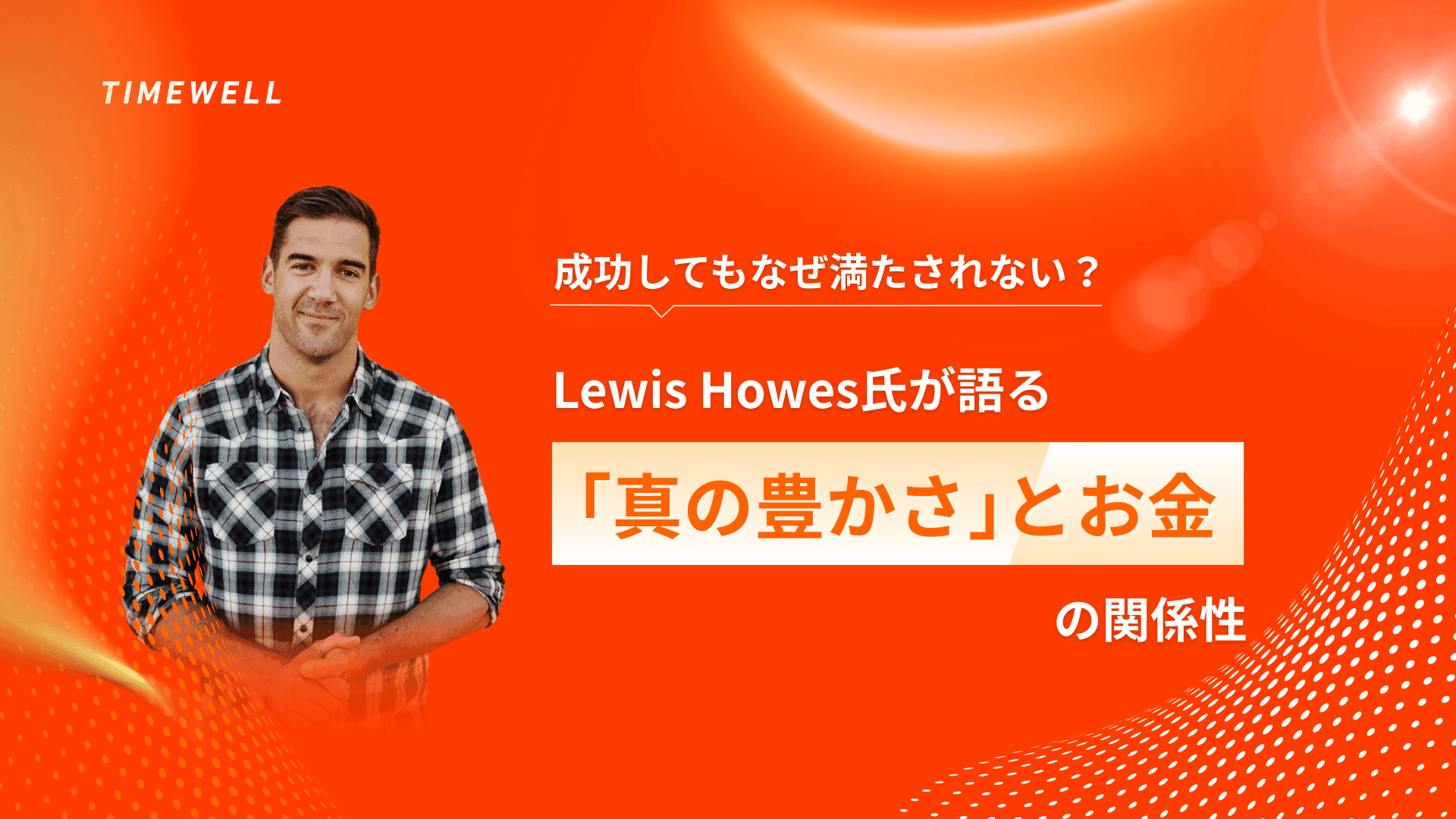
Money Is Central to Modern Life — But Is It Enough for a Truly Rich Life?
In modern society, "money" is an essential element inseparable from our lives. Many people chase financial success, striving to earn more and build larger fortunes. But does financial prosperity alone bring a truly "rich life"?
Today we look at Lewis Howes, who answers that question with a resounding "no." He is a former professional football player, host of one of the world's top podcasts, "The School of Greatness," and a New York Times bestselling author. Behind his impressive résumé lies a turbulent past: childhood bullying and sexual abuse, a career-ending injury that cut short his time as a professional athlete, and days spent broke and sleeping on his sister's couch. He overcame all of this to achieve remarkable success in the media world.
His new book, Make Money Easy: Create Financial Freedom and Live a Richer Life, is not a conventional self-help guide on budgeting or investing. Drawing on his own experience and insights from the financial experts and psychology researchers he has interviewed on his podcast, the book explores our deep psychological relationship with money and the critical importance of "emotional abundance."
In this article, we explore Lewis Howes's insights to uncover what true abundance really means — and the concrete steps to attain it.
Is Financial Success Alone Not Enough? The Four Levels of Your Relationship with Money Releasing the "Money Story" That Holds You Back: How Past Experiences Shape Your Present Finding a "Meaningful Mission" and Attracting Abundance: The Role of Gratitude and Generosity Conclusion
Looking for AI training and consulting?
Learn about WARP training programs and consulting services in our materials.
Is Financial Success Alone Not Enough? The Four Levels of Your Relationship with Money
Many people treat financial prosperity as one of life's ultimate goals. Yet Lewis Howes argues that there are deeper levels to our relationship with money beyond simply "having it" or "not having it" — and that these levels have a profound effect on our sense of well-being.
Drawing on his own experience, he identified four distinct levels that describe how people can relate to money. Understanding these levels is the first step toward grasping where you currently stand, and toward attaining true abundance — a state where financial freedom and inner fulfillment coexist.
Level 1: Financially Broke and Emotionally Broke
This is the state of literally having no money — chasing debts and credit card payments, constantly stressed about finances. But crucially, at this level, financial hardship is intertwined with an emotional sense of deprivation: a lack of self-worth, a feeling of powerlessness, and a loss of hope for the future. Feelings of helplessness and despair dominate the mind: "I have no value," "I can't do anything," "I see no hope."
Lewis Howes himself admitted to being in exactly this state when a career-ending injury forced him to live broke on his sister's couch. Weighed down by student loans and credit card debt, unable to support himself, his self-esteem shattered and his spirit crushed. People at this level are often suffering not just from financial problems, but from deep emotional wounds and a profound sense of worthlessness.
Level 2: Financially Broke but Beginning to Feel Emotional Abundance
The financial situation remains difficult, but inner change begins to take hold. Through actions like facing fears, learning new skills, and finding mentors, a person starts to recognize their own value and potential. A feeling emerges that "there's something I can do" — an inner sense of abundance, an "abundance" energy, begins to stir. Lewis Howes also moved toward this level while still living on his sister's couch, as he threw himself into self-improvement and networking. Financially still a struggle, but with a glimmer of hope that "something can change" — this is an important turning point. Even so, if the financial situation doesn't improve, frustration remains.
Level 3: Financially Successful but Emotionally Broke
This is a state that many successful people — especially driven business professionals — tend to fall into.
Drawing on the inner energy, confidence, and skills cultivated at Level 2, a person begins to achieve real financial success. They launch a business, income grows, savings accumulate. Lewis Howes himself, through relentless work, eventually reached a point where his bank account held a million dollars. Yet remarkably, he describes feeling "the most deprived I had ever felt" at that moment. With success in hand, he had become more irritable, suspicious of people, and constantly felt that someone was taking advantage of him. Old classmates reaching out to ask for money strained relationships.
Why does financial success breed emotional poverty? Lewis Howes points to "comparison," "envy," and "self-doubt." Think of people working at top companies like Google — they are highly capable, worked hard to earn their positions, and are well compensated. Yet looking around, they may see only colleagues who seem more talented than themselves. "I'm not enough," "I have to work harder" — anxiety and inferiority keep them from truly enjoying the success and wealth they have worked for. Lewis Howes himself reflects that because his motivation for success was driven by wanting to look good to others and wanting to prove them wrong, reaching his goals never brought genuine peace.
Level 4: True Abundance — Financially and Emotionally Free
This is the ultimate goal Lewis Howes holds up: a state of being both financially and emotionally free.
It is not simply about becoming wealthy. Of course financial stability matters, but beyond that, it refers to a state of inner peace, calm, and harmony with oneself. Whether money increases or decreases, whether you get promoted or not, whether your boss praises you or not — you are not excessively swayed by others' actions or external circumstances, and you feel a stable sense of happiness and abundance from within. It is a disposition so grounded that you can even pay California's high state taxes with a sense of gratitude rather than anger.
Not being tossed about by daily events — building a stable inner sense of happiness — does not mean suppressing your emotions or turning away from reality. It means not being driven by whatever emotion arises, while continuing to cultivate positive energies like gratitude and generosity from within. This inner abundance becomes a magnet that draws in more financial opportunities and the reality you desire.
Reaching this level requires facing yourself, healing past wounds, setting healthy boundaries, and having the courage to express your own views. It cannot be achieved overnight — it is the journey of self-exploration and healing itself. Lewis Howes's message teaches us the importance of honestly recognizing which level we are at, and if we are not satisfied with where we are, taking concrete steps toward a higher level.
Releasing the "Money Story" That Holds You Back: How Past Experiences Shape Your Present
The emotions, beliefs, and behavioral patterns we hold toward money are not formed by chance. They are deeply shaped by our experiences from childhood and the "meaning" we have assigned to those experiences.
Lewis Howes calls this collection of personal experience the "money story," and argues that it exerts a powerful influence on our current financial situation and sense of happiness. He emphasizes that to improve our relationship with money and attain true abundance, we must first understand our own "money story" — and if necessary, rewrite it.
Take, for example, the "two-dollar bill" episode from his childhood — a case of a positive money story.
His father was by no means wealthy, but whenever he left a tip, he always used two-dollar bills. While the monetary value is the same as two one-dollar bills, the recipient of the rare two-dollar bill would invariably smile, and remember it as a special event of the day. This gave Lewis Howes a positive lesson: even without much, with a little creativity you can bring joy and value to others — and feel your own sense of abundance in doing so. This experience became one of the origins of the emphasis on "gratitude and generosity" that would define his later life.
On the other hand, negative "money stories" limit our actions and keep us distant from abundance. Lewis Howes speaks candidly about how several traumatic events in his life planted negative beliefs about money in him.
At age five, he was sexually abused by a stranger — planting deep seeds of self-denial: "I have no value," "I don't deserve to be loved," "It's okay to be used." At age eight, his brother was arrested for drug possession, the family struggled with enormous legal bills, and the household was permeated by stress and anxiety. For young Lewis Howes, home was not a safe place — it felt as though money problems were the source of his family's suffering. This planted a vague dread and fear around money.
Also around age eight, he experienced the humiliation of feeling he had to pay for friends. Because his brother was in prison, the parents of neighborhood children forbade them from playing with Lewis Howes. He was isolated and felt "I am someone who cannot be accepted." To join a club the children had formed, one either had to answer a quiz correctly or pay five dollars. Unable to answer the quiz, he cried to his mother, who dug coins from the sofa cushions to scrape together five dollars — but even after paying, the children refused to let him in, and he sat alone in the corner. This experience planted a powerful sense of worthlessness: "I'm not smart enough, even paying doesn't get me accepted — I'm a person of no value."
These personal memories — his "money story" — formed a specific "belief system" within him. What is crucial is not the events themselves, but the "meaning" he assigned to them. Someone else might have found strength in overcoming the same experiences. But the young Lewis Howes interpreted them with negative meanings — "I am unloved," "I have no value," "I am not enough" — and this belief system came to unconsciously govern his actions, reactions, and thinking patterns. We all carry a belief system shaped to varying degrees by past experiences, and that belief system shapes our behavior and the results in our lives.
So how do we free ourselves from a negative "money story" and start attracting abundance?
Lewis Howes says the first step is to consciously excavate your own "money story" and understand how it is affecting you today. This requires honestly reflecting on past memories, especially emotionally charged events involving money. His book Make Money Easy includes concrete exercises and assessments to help readers understand their money story and their relationship with money. The process involves exploring past memories and uncovering what emotions and beliefs are attached to them.
The next critical step is to assign "new meaning" to past events. For example, rather than concluding "I am worthless" from the experience of paying to make friends, you can adopt a more affirming interpretation: "Even in a difficult situation, I took action to try to change things" or "Because of that experience, I learned how precious human connection is, and developed a deep desire to contribute to others." You cannot change past events themselves, but you can change the meaning those events hold for you.
This is a process that might be called "money therapy" — the patient work of healing past wounds and rewriting negative beliefs. But by going through this process, we can free ourselves from the chains of the past, act based on healthier beliefs, and as a result, create an increasingly rich and fulfilling life.
Lewis Howes himself has rebuilt his self-worth through this process and transformed past experiences into sources of strength. He wrote this book because he himself is still on that journey, and wants to grow together with his readers.
Finding a "Meaningful Mission" and Attracting Abundance: The Role of Gratitude and Generosity
Pursuing financial success alone will never bring true abundance. This is what Lewis Howes emphasizes again and again. So what is needed to attain both financial and inner abundance?
At the heart of the answer is finding a "Meaningful Mission" and practicing "Gratitude" and "Generosity" in daily actions.
From the most important principle he learned through his own experience, Lewis Howes offers this:
Gratitude and generosity are the keys that open the door to abundance.
He returns to this point repeatedly — because he himself found, when he was at rock bottom, that understanding and practicing this principle was what turned his life around dramatically.
Many people tend to think that to become abundant, "getting" must come first — acquiring money or material things. Especially when financially struggling, a sense of scarcity — "I have nothing," "I need help" — leads to thinking more about receiving than giving. But Lewis Howes insists, paradoxically, that the only way out of that scarcity is to "give" — and to "be grateful" for what you already have.
When he was living on his sister's couch, he had almost no money or possessions. But he had "time" and "genuine interest in people." He thought deeply about what he could do, and realized that even without material things, he could give others his time, curiosity, passion, and joy. He made it a practice to ask the people around him: "What can I do for you today?" — proactively offering support.
Lewis Howes thought he had nothing to offer, but discovered that simply listening attentively to people and asking questions with genuine curiosity was, in fact, enormously valuable. He says he had the experience, many times, of asking someone a few questions and being told: "You are the most interesting person I have ever met." Not because he said anything special — but because he showed genuine interest and listened deeply.
This "listening skill" — which he once thought had no value — went on to sustain his business for more than twelve years. The discovery that "people love being listened to" became the foundation for the success of his podcast, "The School of Greatness."
From this experience, Lewis Howes speaks to the importance of finding a "meaningful mission." It does not have to be a grand vision from the very start. His initial mission was simply "to be grateful and generous to the person in front of me" and "to serve." By continuing to act on this simple principle, he gradually honed his skills, built his confidence, and moved toward larger goals.
Lewis Howes's current mission is "to help people overcome life's difficulties and improve their quality of life," with the podcast as the mechanism for doing that. The mechanism may change with the times and circumstances, but the underlying sense of purpose is what drives his actions.
We too, by listening to our inner voice and asking ourselves "Through what do I want to contribute to the world?" can find the seeds of a "meaningful mission." And by consciously practicing "gratitude" and "generosity" in daily life — even in small ways — we can chart a course toward attaining both financial abundance and inner richness, realizing a truly "wealthy life" in the fullest sense.
Conclusion
Lewis Howes's message goes beyond mere financial success strategies — it asks us to reexamine what "true abundance" means in our lives. Through his own turbulent experiences, he powerfully conveys the importance of "inner abundance" that so many people lose sight of in the pursuit of financial success.
In this article, we explored the four levels of our relationship with money that Lewis Howes describes, and examined the trap of "financially successful but emotionally deprived" that many people fall into. We also revealed how the "money stories" formed from past experiences are holding us back today. His own harrowing past — sexual abuse, family troubles, bullying — gives us the courage to face our own emotional wounds and unconscious limiting beliefs.
Equally important is that a concrete path was shown for overcoming these challenges and attaining true abundance: finding your own "meaningful mission," and practicing "gratitude" and "generosity" in daily actions. The principle that gratitude and generosity are the keys that open the door to abundance has the power not only to change his life, but ours as well.
Even if you are currently in financial difficulty, it is possible to give to others — in the form of time, curiosity, or attentive listening. That small first step cultivates self-worth and becomes a magnet that draws in new opportunities. Lewis Howes's book Make Money Easy and podcast "The School of Greatness" are valuable resources for exploring this journey more deeply.
The most important thing, however, is to take what you have learned today and apply it to your own life — to act. By honestly facing your own money story and consciously beginning to practice gratitude and generosity, you too can take a sure step toward creating a future that is truly rich and fulfilling in every dimension of life.
Reference: https://www.youtube.com/watch?v=qoYNyDU0gso
Streamline Event Management with AI | TIMEWELL Base
Struggling with the complexity of managing large-scale events?
TIMEWELL Base is an AI-powered event management platform.
Track Record
- Adventure World: Managed Dream Day with 4,272 attendees
- TechGALA 2026: Centralized management of 110 side events
Key Features
| Feature | Impact |
|---|---|
| AI Page Generation | Event page ready in 30 seconds |
| Low-Cost Payments | 4.8% fee (among the lowest in the industry) |
| Community Features | 65% of attendees stay engaged after the event |
Feel free to reach out for a consultation on streamlining your event operations.