Hello, this is Ryuta Hamamoto from TIMEWELL.
On November 23, 2026 (U.S. time), NVIDIA's board announced that Jensen Huang was back as President, CEO and a member of the board, eleven days after he resigned. The vote was unanimous1. If you followed the story in fragments, it was hard to see the thread: the founder who had led the company for 33 years was suddenly gone, and then, in under two weeks, he wasn't.
I'm covering this in an export control publication for one reason. Between the resignation and the return, the board set up a standing National Security and Export Control Oversight Committee. When reports say your own chief executive was targeted by a foreign intelligence effort, how do you rebuild oversight? That question isn't only NVIDIA's. Export control managers in Japan should be asking it too.
Below I keep what I could confirm in official announcements and government documents apart from what remains press reporting. No finding of wrongdoing has been made against Huang or NVIDIA. The board's independent investigation continues, and the board says it will run to conclusion1.
The short version
- The official record says "resigned." The November 12 announcement gives no reason. Press reports said the board had been preparing to oust him, so many outlets called it a de facto ouster23.
- The board gave two reasons for bringing him back. After discussions with him, it was satisfied with his "candor" and ability to lead, and after input from senior levels of the U.S. government it concluded his return poses no national security risk1. President Trump says he convinced the board. That is his claim; the board's statement doesn't mention him4.
- What's worth copying for export control is the design: a standing committee of independent directors directly under the board, two compliance teams that report straight to it, outside experts on call, and a newly created Chief Compliance Officer role51.
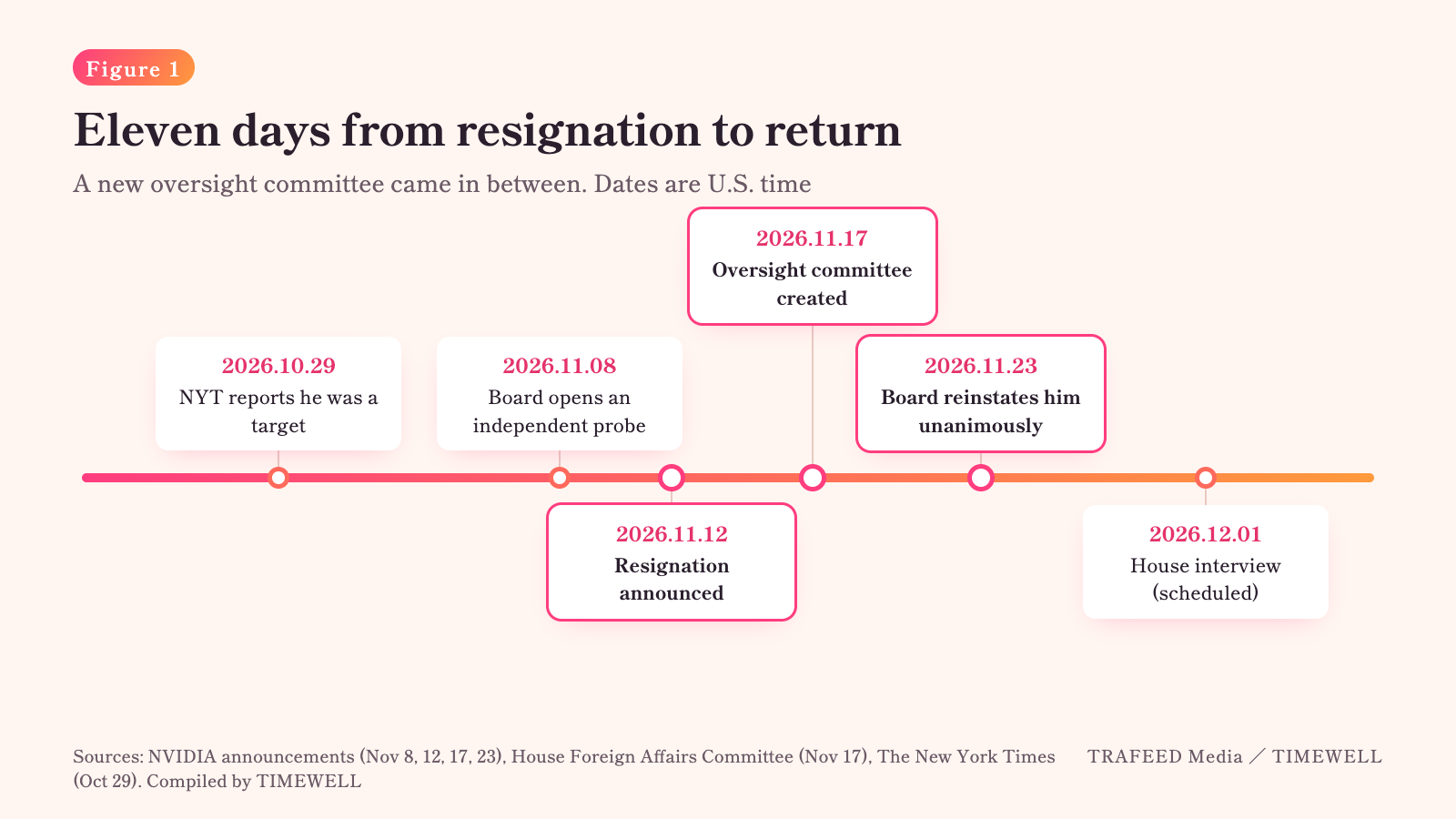
Figure 1. Key events from the first report to the return (U.S. dates). Sources: NVIDIA announcements (November 8, 12, 17 and 23, 2026), House Foreign Affairs Committee (November 17), The New York Times (October 29). Compiled by TIMEWELL.
Why he left: the record says "resigned," with no reason given
The story starts with a New York Times report on October 29, 2026. U.S. officials, it said, had concluded that a person who was an executive at Megaspeed, a Singapore data center company, was an asset of Chinese intelligence6. Megaspeed was an NVIDIA customer, and that person had interactions with Huang. The sources spoke anonymously because the findings came from classified intelligence. The same article said Huang had not received a defensive briefing, the warning officials sometimes give Americans targeted by foreign intelligence services. NVIDIA responded at the time that meetings with customers are part of a CEO's job and that the interactions were "not unusual or unexpected."
China rejects the allegation outright. A Chinese Embassy spokesperson in Washington called it "groundless smears and slanders," and foreign ministry spokesperson Guo Jiakun said on November 9 that the "Chinese spy" allegation was "purely unsubstantiated and directed at smearing China"67. The U.S. Attorney General told reporters that the Justice Department had not reached a conclusion on whether the person was a Chinese spy, according to AP8. Keep one thing straight: Huang is the person reported to have been targeted.
On November 5, the Republican chairs of three House committees (Foreign Affairs, the Select Committee on China, and Intelligence) wrote to Huang asking for a closed-door briefing9. On Sunday, November 8, NVIDIA's board announced an independent investigation "in light of recent reporting" that Huang had been the target of a foreign intelligence effort. The same statement said the board had "no reason to believe that either national security or NVIDIA secrets were compromised"10. Two days later, the independent directors retained Joon H. Kim, a former acting U.S. Attorney for the Southern District of New York, and his firm Wachtell, Lipton, Rosen & Katz11.
Then, on Thursday, November 12, NVIDIA announced that Huang had resigned as President, CEO and director, effective immediately2. CFO Colette Kress became interim CEO while keeping the CFO job, and Harvey C. Jones became the company's first-ever board chair. The announcement does not contain a single line on why. Here is how the official record and the reporting line up.
| Question | Official announcements (primary) | Press reports |
|---|---|---|
| How he left | "has resigned"; no reason given | The board had been preparing to oust him (first reported by WSJ, confirmed by CBS with two sources) |
| What was at issue | At reinstatement, the board said it was satisfied with his candor | In October he told the general counsel and others the dealings were standard business with customers (Reuters) |
| National security impact | No reason to believe national security or company secrets were compromised (Nov 8) | The Attorney General said no conclusion had been reached on espionage (AP) |
According to the reports, by the night of November 11 the board was preparing to ask Huang to step down. The Wall Street Journal broke that, and CBS News confirmed it with two people familiar with the matter3. That's why the departure is widely described as a de facto ouster. At a U.S. company, the board picks and replaces the CEO. When a board signals it wants a CEO out and the CEO steps aside first, the record shows a resignation.
So what did the board object to? It hasn't said. There are two clues. One is a Reuters report that in October, Huang told NVIDIA leaders, including the general counsel and the chief marketing officer, that his interactions with that person and Megaspeed reflected standard business dealings with customers. Reuters cited two people and internal correspondence it reviewed, and it says it saw only the October messages12. The other clue is the wording of the reinstatement. The board said that after a series of discussions and meetings with Huang, it "was satisfied with respect to Mr. Huang's candor and ability to lead NVIDIA"1.
My reading is that the question at the resignation was less whether any intelligence operation succeeded and more whether the CEO had been fully candid with the board and his own executives. That's an inference from the statements and the reporting. The board has not published its reasons.
Replace siloed classification work with AI.
METI's FY2024 data shows 52% of foreign exchange law violations stem from classification errors. Download the TRAFEED product catalog covering features and rollout.
Why he came back after eleven days: the board's account and the President's claim
At the start of the November 17 earnings call, Chair Harvey Jones said the board had "unanimously accepted his resignation and does not intend to reinstate Jensen as CEO." AP reported that NVIDIA had rejected Huang's offer to return13. Six days later, on Monday, November 23, the board reversed course unanimously. Jones stays on as chair, and Kress returns to her role as CFO18.
The board gave two reasons. First, after a series of discussions and meetings with Huang, it was satisfied with his candor and ability to lead. Second, during the process it "received input from senior levels of the United States government," and based on that input it is "confident that Mr. Huang's reinstatement poses no national security risk"1. The statement doesn't say who those senior officials were.
| Whose account | What they said | Status |
|---|---|---|
| NVIDIA board (Nov 23) | Satisfied with his candor and ability to lead; after input from senior U.S. officials, no national security risk | Primary (company announcement) |
| President Trump (CNBC, Nov 23) | Spoke to the board and convinced them; "I made the deal" | The President's claim; the board's statement doesn't mention him |
| President Trump (social media, Nov 23) | The Attorney General confirmed the government has no evidence of unlawful conduct; NVIDIA should continue its internal export control compliance review | Post as quoted by CBS; original not verified |
| Treasury Secretary Bessent (Nov 15 and 22) | Called for a "dramatic shake-up" and an outside successor; on Nov 22, "Jensen is on the outside now" | Press reports (AP, CBS) |
In a phone interview with CNBC, Trump said, "I spoke to them ... And I convinced them," and "I made the deal." He said the board had asked for assurances on national security and the administration gave them4. On the narrow point that government input fed into the decision, the board and the President agree. The claim that the President convinced the board is his own account, and nothing from the board backs it up. In a social media post the same day, he also wrote that NVIDIA should continue its internal investigation of its compliance with U.S. export controls14.
The administration didn't speak with one voice, either. On November 15, Treasury Secretary Scott Bessent called for a "dramatic shake-up" of NVIDIA's leadership and said the next CEO should come from outside15. On November 22, the day before the reinstatement, he was still saying, "Jensen is on the outside now"14.
Markets were moving too. NVIDIA closed at $166.19 on November 12, down 4.3%3. A stock data site reports a close of $125.53 on November 20, but the Nasdaq Composite fell 5.28% that day as well, so not all of it can be pinned on this story16. Right after the reinstatement was announced, the stock opened 33% higher at $165.57 on November 238. How much the share price weighed on the board, the announcement doesn't say. In Congress, Senate Democratic Leader Chuck Schumer said the administration's rush to reinstate Huang "underscores the need for Congress to act"8.
The "Stand with Jensen" petition and the shareholder letter
The loudest call for his return came from an open-letter site called Stand with Jensen. It describes itself as "an independent campaign of current and former NVIDIA employees and shareholders" and says plainly, "Not affiliated with NVIDIA"17. Its demand: bring Huang back as CEO while the announced outside investigation proceeds, disclose the investigation's scope and timeline, give him a meaningful chance to respond, and provide a clear, evidence-based explanation showing that any removal is in NVIDIA's best interests. It also states that it "does not treat espionage allegations as proven facts or presume the inquiry's findings."
| Signers by category (self-reported) | Count |
|---|---|
| Current NVIDIA employees | 10,348 |
| Former employees | 1,841 |
| Shareholders | 108,079 |
| Supporters | 86,160 |
| Total (November 23, when signing closed) | 206,428 |
Read these numbers with care. Every affiliation is self-reported, and the site itself says they are not verified17. The site compares the current-employee count with NVIDIA's roughly 42,000 employees (as of January 25, 2026, per the annual report) and puts it at about 24.6%, which is also an unverified approximation. TNW reported more than 175,000 names on November 16 and noted that Elon Musk was listed first among the public signers18.
Two large shareholders also weighed in. Brad Gerstner of Altimeter Capital and Gavin Baker of Atreides Management posted a letter to the board on X on November 13. They asked for "a slow, measured, and deliberate process regarding the future leadership of Nvidia," with "the potential return of Jensen Huang" kept as an option. They did not ask for an immediate reinstatement, and they said the company would be "capably led" by interim CEO Kress19.
Honestly, the signature count interests me less than the list of demands. Disclose the scope and timeline of the investigation, give the accused a chance to respond, explain the decision with evidence. That is a due-process checklist for when a company's top executive is under suspicion, and you can read it apart from the emotion around it.
Why this is an export control story: the Megaspeed probe and a new BIS rule
This is more than a CEO drama because Megaspeed is under a U.S. export control investigation. On November 16, the Justice Department and the Commerce Department said that while they don't typically comment on ongoing investigations, they were issuing a joint statement to "address inaccurate information circulating in public reporting"20. Here's the sequence it laid out.
| When | What the joint statement says |
|---|---|
| 2024 | Commerce, after spotting suspicious activity through monitoring for possible diversion of sensitive semiconductors, opened an investigation into Megaspeed for potential export control violations |
| May 2025 | Commerce investigators requested records from NVIDIA on direct or indirect sales to Megaspeed |
| June 2025 | NVIDIA placed Megaspeed on its "no sell" list; BIS agents, with Singaporean officials, did an on-site end-use check at Megaspeed |
| Afterward | The Justice Department took the lead on the criminal investigation |
The statement doesn't accuse NVIDIA of anything, and no charges have been announced. Megaspeed says it "conducts legitimate and lawful business" and has hired outside counsel for an internal investigation21. From a compliance practitioner's point of view, one detail stands out: the month after the records request, NVIDIA put Megaspeed on its no-sell list. Action was taken after the authorities asked. What the board faced, as I see it, wasn't a hole in customer screening. It was a governance question: who oversees a matter when the CEO is personally involved?
The same day, the Commerce Department's Bureau of Industry and Security (BIS) announced an interim final rule on remote access to advanced computing through overseas data centers22. It was published in the Federal Register and took effect on November 19 (91 FR 74970; comments due January 19, 2027)23. It puts new restrictions on exports to overseas data centers that remotely supply significant compute to companies headquartered in Country Group D:5 or Macau, and it requires data centers and exporters to check customers' direct and indirect ownership and control. It also generally requires a license to export advanced chips to Indonesia, Malaysia, Singapore, Thailand and Brazil, with an exception, subject to reporting, for companies headquartered in the United States. BIS says the rule was "written by and at the direction of the Department of Treasury and the National Security Council."
The rule text doesn't name NVIDIA or Megaspeed. I searched the full text to check. Framing it as a response to the NVIDIA affair is the media's reading, NPR's among them21. I go through what the rule does and what it means for operators in Japan in GPU cloud and export controls: sorting facts on the new BIS rule.
China's foreign ministry pushed back. Spokesperson Mao Ning said on November 12 that the U.S. "should stop fabricating the 'Chinese spy' narratives as a pretext for imposing technology restrictions," and Guo Jiakun criticized the BIS rule on November 17 as "overstretching the concept of national security"2425. The three House chairs announced that Huang would sit for a transcribed interview on December 1 and NVIDIA's general counsel on December 2. They said Americans need answers on "Nvidia's role in allowing dangerous PRC actors to access our most advanced chips." That is the lawmakers' view; the Justice and Commerce statement assigns no such role to NVIDIA26. In its November 17 results, NVIDIA said its outlook assumes no data center compute revenue from China27. For the allegations around Megaspeed and the warning signs to look for in counterparties, see what the AI chip diversion reports teach us about thin counterparties.
The National Security and Export Control Oversight Committee, directly under the board
On November 17, the board announced the National Security and Export Control Oversight Committee5. It's a standing committee "responsible for board-level oversight of the company's national security policies, export control compliance and global trade risk management." Suzanne Nora Johnson chairs it, with Stephen C. Neal and John O. Dabiri as members, and the November 23 announcement says it is made up solely of independent directors1.
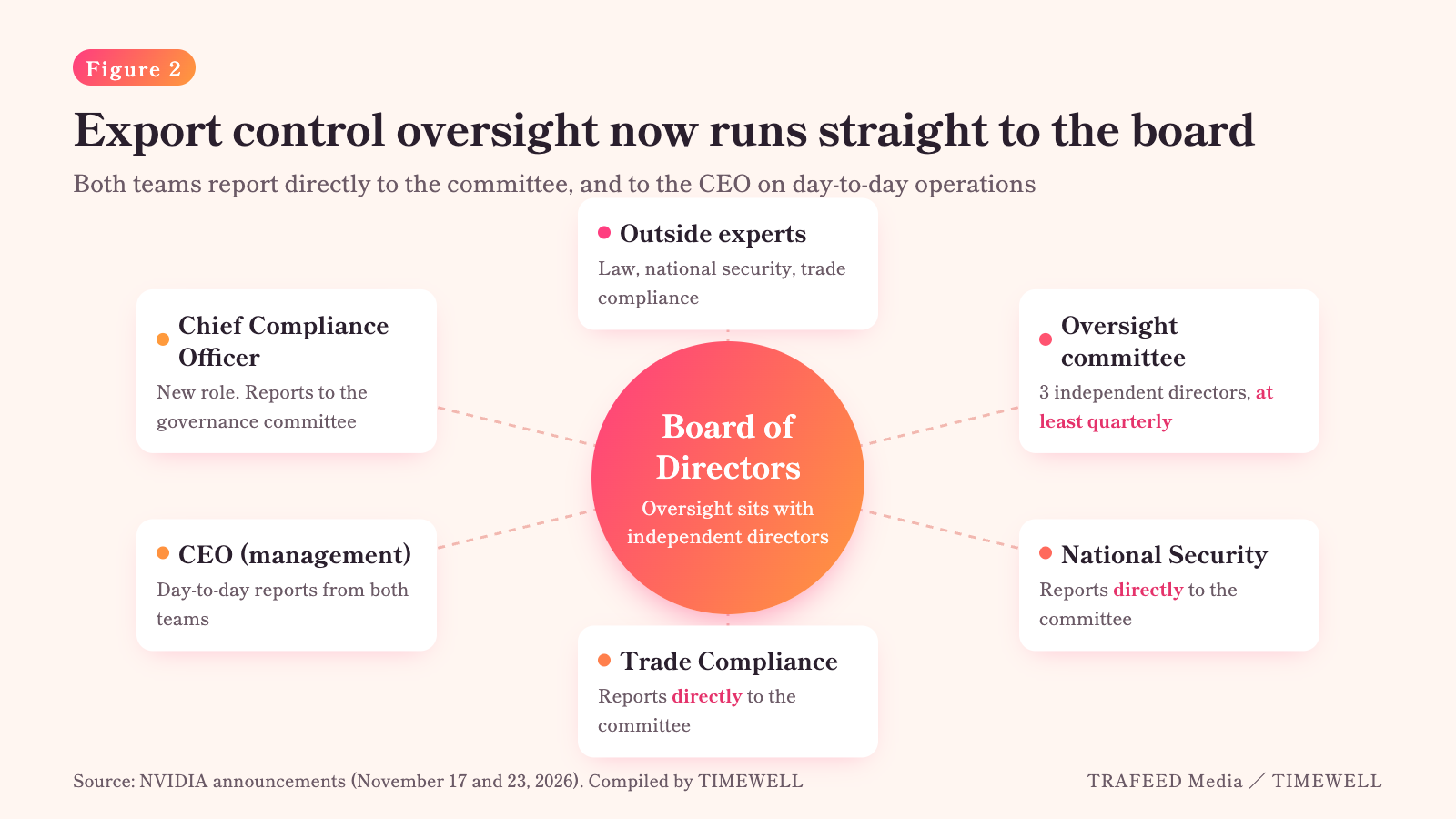
Figure 2. The oversight structure NVIDIA announced in November 2026. Source: NVIDIA announcements (November 17 and 23, 2026). Compiled by TIMEWELL.
Here's what the announcements actually say. The existing National Security Team and Global Trade Compliance Team report directly to the committee, and to the CEO on day-to-day operations. The committee meets at least quarterly, both with management and in executive session, meaning without management in the room. It works closely with independent outside experts in law, national security and global trade compliance, and the November 23 statement adds that it is engaging counsel experienced in national security, who will in turn retain specialist advisors. NVIDIA is also creating a Chief Compliance Officer role to oversee compliance across the company. That person will report not to the CEO but to the board's Nominating and Corporate Governance Committee51. When the committee was announced, Jones said that advanced silicon and the emergence of artificial and superintelligence "present unprecedented challenges for national security."
A board-level security committee isn't new in itself. U.S. defense contractors have them. Lockheed Martin's Classified Business and Security Committee is made up of three or more independent directors with appropriate security clearances, and its purpose is oversight of the company's classified business and "the security of personnel, data, and facilities" (charter revised October 9, 2026)28. The Defense Department's industrial security rules also require contractors under certain foreign ownership mitigation agreements, such as voting trusts, to set up a permanent board committee called the Government Security Committee29. NVIDIA's committee isn't required by any such rule. It chose to create one.
What makes it a possible model, in my view, isn't the name. It's how it's put together.
- Oversight (independent directors) is separated from execution (the CEO)
- The national security and trade compliance teams have a reporting line that doesn't run through the CEO
- Sessions without management are built into the regular schedule
- Outside experts are involved as a matter of course, not just in emergencies
- The Chief Compliance Officer reports to a board committee, not to the CEO
- The independent investigation continues even though the CEO is back
When the person at the top is at the center of a question, organizations where everything reports to that person tend to stop passing bad news upward. These six points read as fixes for exactly that weakness. The committee is brand new, though. Budget, headcount and what it reports to the full board are not in the announcements. Whether it works will show in how it runs.
Applying this to a Japanese company
Japan's export control regime does set standards for a company's internal setup. Article 55-10 of the Foreign Exchange and Foreign Trade Act (FEFTA) has the Minister of Economy, Trade and Industry set "exporter compliance standards," and paragraph 4 says exporters must carry out exports in accordance with them30. The content is in Article 1 of the Ministerial Ordinance on Exporter Compliance Standards31.
The governance parts are in Article 1, item 2, which applies to what the ordinance calls exporters of specified important goods (those who export or provide specified important goods or technology as a business). Item 2(a) requires appointing, from among the company's representatives, a chief export control officer who oversees export operations. Item 2(b) requires defining the authority and responsibility of the departments that handle exports. Item 2(f) asks companies to set up an audit system and audit regularly, 2(g) to train the chief officer and staff, and 2(h) to guide subsidiaries. Item 2(j) requires reporting promptly to the Minister of Economy, Trade and Industry when laws have been, or may have been, violated, and taking steps to prevent recurrence. Items (f), (g) and (h) are written as best-effort duties; (a), (b) and (j) are obligations. Putting these into an internal compliance program (CP) document makes them easier to run and to check.
By requiring the chief officer to be a company representative, Japan puts export control responsibility at the top of management. That's sound design. It keeps export control from being left to the shop floor. Viewed through the NVIDIA case, though, it has a blind spot: when the issue involves the top executive personally, the reporting line ends at that same person. That's my own view, not something the ordinance says. NVIDIA's fix was to leave execution with the CEO while handing oversight to a committee of independent directors.
I don't think Japanese companies need to copy the committee itself. Company size and board structure differ too much for that. A company with few outside directors can still bring in the idea by writing a reporting line to its statutory auditors or audit committee into its rules, or by putting an outside adviser on retainer. Figure 3 sets out the checks.
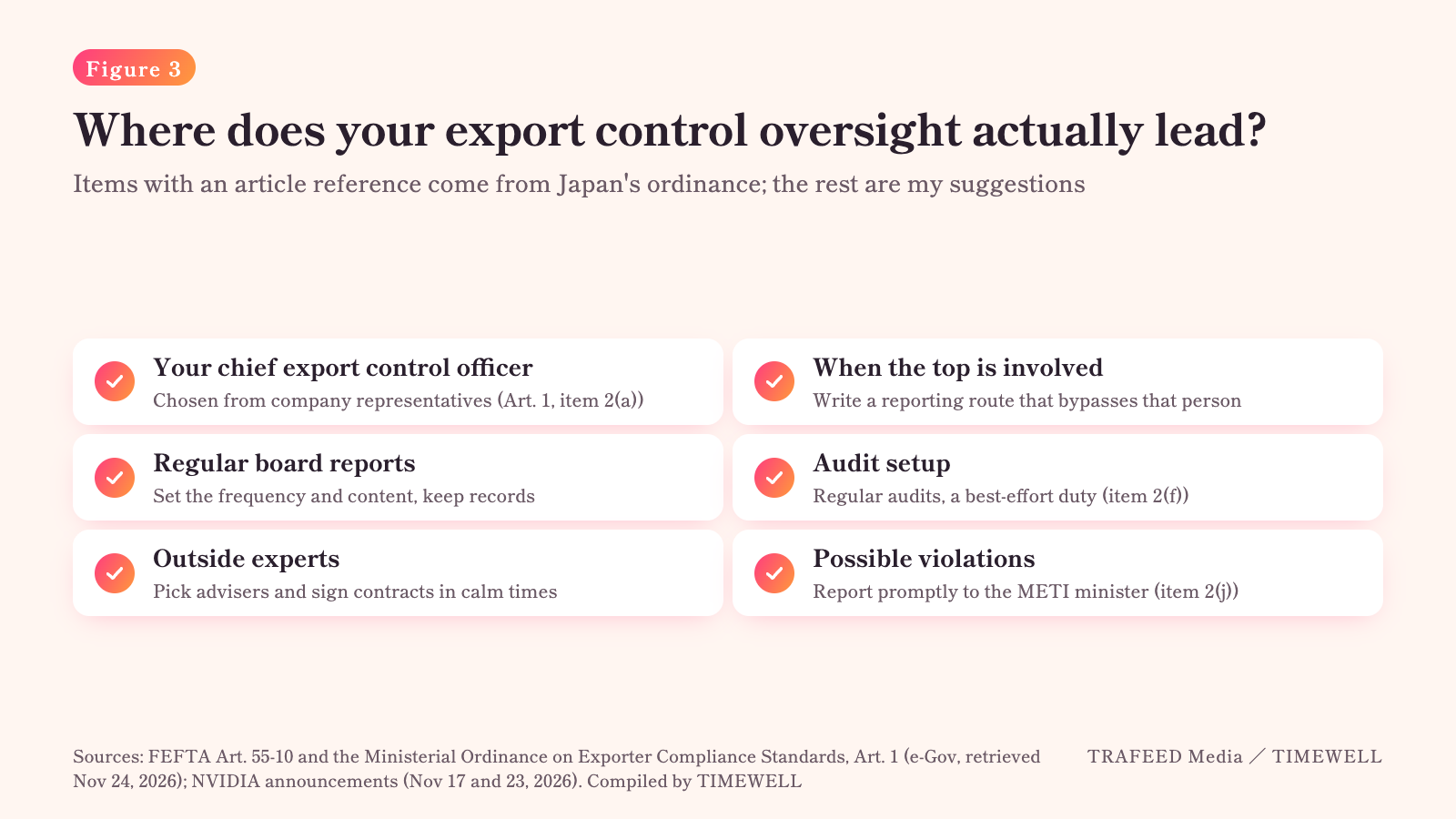
Figure 3. Checks for your own export control oversight. Sources: FEFTA Article 55-10 and the Ministerial Ordinance on Exporter Compliance Standards, Article 1 (e-Gov, retrieved November 24, 2026), and NVIDIA announcements (November 17 and 23, 2026). Compiled by TIMEWELL. Items without an article reference are my suggestions.
Of the six, three rest directly on the ordinance: the chief officer (item 2(a)), audits (item 2(f)) and reporting possible violations (item 2(j)). The reporting route for cases involving top management, regular board reports and how you use outside experts aren't legal requirements. They're my suggestions, drawn from how NVIDIA set things up. Look hardest at the second one. If an issue could involve the CEO or another director, who does it go to, and by what route? I suspect plenty of companies haven't written that down. Building the assumption that directors can be targets of foreign intelligence efforts into your training and scenarios is another takeaway from this case.
If you want to run the check and take the result to your board, our twenty-item self-assessment and executive one-pager (Excel, in Japanese) sorts twenty items into obligations, best-effort duties and practical checks, and turns your scores into a one-page board report. For the full picture of the standards and how they differ from a CP, see what Japan's exporter compliance standards are.
What to watch next, and what I couldn't confirm
The reinstatement doesn't close the story. Huang's transcribed interview with the three House committees is set for December 1, and NVIDIA's general counsel for December 226. The independent directors' investigation will run to conclusion, and how much of the result will be made public hasn't been decided. The search for a Chief Compliance Officer, the Justice Department's Megaspeed investigation and the comment period on the BIS rule (through January 19, 2027) all continue2023.
Some things I couldn't confirm. I didn't obtain the 8-K filings made at the resignation and the reinstatement, any original statement of the board's reasons for seeking his departure, the earnings call transcript, or the original social media posts by Huang and the President. I've relied on press quotations for those. I also haven't seen the original announcement from the Singapore authorities. I'll update this piece as new primary sources appear.
What export control teams can take from these eleven days isn't a verdict on who did wrong. It's a question: when the person at the top becomes a party to an issue, where does your export control oversight actually lead? Open your compliance program to the page that names your chief export control officer and take a fresh look.
If you'd like to talk through how to build counterparty checks, record-keeping and regulatory change tracking into a system, you can reach us for a one-on-one consultation. Final classification and transaction decisions remain with your company's export control officer.
Footnotes
-
NVIDIA, "NVIDIA Board Reinstates Jensen Huang as President, CEO and Board Director," November 23, 2026. https://nvidianews.nvidia.com/news/nvidia-board-reinstates-jensen-huang-as-president-ceo-and-board-director (retrieved November 24, 2026) ↩ ↩2 ↩3 ↩4 ↩5 ↩6 ↩7 ↩8 ↩9
-
NVIDIA, "NVIDIA Announces CEO Transition," November 12, 2026. https://nvidianews.nvidia.com/news/nvidia-announces-ceo-transition (retrieved November 24, 2026) ↩ ↩2
-
CBS News, November 12, 2026. Reports that the board had been preparing to oust Huang (first reported by WSJ, confirmed by CBS with two sources) and the day's closing price. https://www.cbsnews.com/news/nvidia-ceo-jensen-huang-resigns/ ↩ ↩2 ↩3
-
CNBC, "Trump tells CNBC 'I made the deal' to reinstate Nvidia's Jensen Huang," November 23, 2026. https://www.cnbc.com/2026/11/23/trump-nvidia-jensen-huang.html (checked November 24, 2026) ↩ ↩2
-
NVIDIA, "NVIDIA Board of Directors Establishes National Security and Export Control Oversight Committee," November 17, 2026. https://nvidianews.nvidia.com/news/nvidia-board-of-directors-establishes-national-security-and-export-control-oversight-committee (retrieved November 24, 2026) ↩ ↩2 ↩3
-
The New York Times, "Nvidia Chief Seen as Target of Chinese Spy Plot," October 29, 2026 (read via the GV Wire reprint). https://gvwire.com/2026/10/29/nvidia-chief-seen-as-target-of-chinese-spy-plot/ ↩ ↩2
-
Ministry of Foreign Affairs of the People's Republic of China, regular press conference of November 9, 2026 (spokesperson Guo Jiakun), English transcript. https://www.fmprc.gov.cn/eng/xw/fyrbt/lxjzh/202611/t20261109_12056171.html (retrieved November 24, 2026) ↩
-
AP via PBS News, November 23, 2026. The reinstatement, the opening share price, and remarks by the Attorney General and Senator Schumer. https://www.pbs.org/newshour/nation/nvidia-board-unanimously-reinstates-jensen-huang-as-ceo-and-chairman (the headline's "chairman" is wrong; Jones remains chair) ↩ ↩2 ↩3 ↩4
-
House Foreign Affairs Committee (Republicans), "Chairmen Mast, Moolenaar, and Crawford Request Jensen Huang Brief Congress," November 5, 2026. https://foreignaffairs.house.gov/news/press-releases/chairmen-mast-moolenaar-and-crawford-request-jensen-huang-brief-congress-on-link-to-chinese-intelligence-asset (retrieved November 24, 2026) ↩
-
NVIDIA, "Statement From NVIDIA Board of Directors," November 8, 2026. https://nvidianews.nvidia.com/news/statement-from-nvidia-board-of-directors (retrieved November 24, 2026) ↩
-
NVIDIA, "Statement From the Independent Members of the NVIDIA Board," November 10, 2026. https://nvidianews.nvidia.com/news/statement-from-the-independent-members-of-the-nvidia-board (retrieved November 24, 2026) ↩
-
Reuters report of November 13, 2026. We could not read the Reuters original and confirmed its content through a reprint by another outlet. The board has not made any statement on this point. ↩
-
AP via BNN Bloomberg, November 17, 2026. https://www.bnnbloomberg.ca/business/2026/11/17/nvidia-chairman-says-board-does-not-intend-to-reinstate-jensen-huang-as-ceo/ ↩
-
CBS News, November 23, 2026. Quotes the President's social media post and Treasury Secretary Bessent's remarks of November 22. https://www.cbsnews.com/news/nvidia-jensen-huang-trump-comment-national-security-risk/ ↩ ↩2
-
AP via PBS News, "Trump backs campaign to reinstate Huang as CEO of Nvidia," November 16, 2026. https://www.pbs.org/newshour/politics/trump-backs-campaign-to-reinstate-huang-as-ceo-of-nvidia ↩
-
Gotrade News (stock data roundup), November 23, 2026. November 20 close and the Nasdaq Composite's decline. https://www.heygotrade.com/en/news/nvidia-nvda-stock-news-november-23-2026/ (secondary aggregation; exchange data not checked) ↩
-
Stand with Jensen, "An Open Letter to The NVIDIA Board." https://standwithjensen.com/ Final counts from the site's public data (updated 2026-11-23T17:56:10Z), retrieved November 24, 2026. The site states that affiliations are self-reported and not verified. ↩ ↩2
-
TNW, "More than 175,000 names back a call to reinstate Jensen Huang at Nvidia," November 16, 2026. https://thenextweb.com/news/stand-with-jensen-letter-nvidia-board-huang-return ↩
-
CNBC, "Nvidia board urged to consider 'potential return of Jensen Huang' by two major investors," November 14, 2026. https://www.cnbc.com/2026/11/14/nvidia-investors-jensen-huang-return-board-letter.html (checked November 24, 2026) ↩
-
U.S. Department of Justice and Department of Commerce, "Joint Statement from Department of Commerce and Department of Justice on Megaspeed Investigation," November 16, 2026. https://www.justice.gov/opa/media/1472536/dl (retrieved November 24, 2026) ↩ ↩2
-
NPR, "U.S. tightens controls on remote access to AI technology amid Nvidia fallout," updated November 17, 2026. Includes Megaspeed's statement. https://www.npr.org/nx-s1-6042883 ↩ ↩2
-
U.S. Department of Commerce, Bureau of Industry and Security, "BIS Issues Rule Addressing Remote Access to American Super Intelligence Technology," November 16, 2026. https://www.bis.gov/press-release/bis-issues-rule-addressing-remote-access-american-super-intelligence-technology (retrieved November 24, 2026) ↩
-
Federal Register, "Addressing Remote Access to Advanced Semiconductors" (91 FR 74970, FR Doc. 2026-23529, published and effective November 19, 2026). https://www.federalregister.gov/documents/2026/11/19/2026-23529/addressing-remote-access-to-advanced-semiconductors (full text retrieved November 24, 2026; it does not name NVIDIA or Megaspeed) ↩ ↩2
-
Ministry of Foreign Affairs of the People's Republic of China, regular press conference of November 12, 2026 (spokesperson Mao Ning), English transcript. https://www.fmprc.gov.cn/eng/xw/fyrbt/lxjzh/202611/t20261112_12058413.html (retrieved November 24, 2026) ↩
-
Ministry of Foreign Affairs of the People's Republic of China, regular press conference of November 17, 2026 (spokesperson Guo Jiakun), English transcript. https://www.fmprc.gov.cn/eng/xw/fyrbt/lxjzh/202611/t20261117_12061159.html (retrieved November 24, 2026) ↩
-
House Foreign Affairs Committee (Republicans), "Jensen Huang and NVIDIA Agree to Appear Before Congress," November 17, 2026. https://foreignaffairs.house.gov/news/press-releases/jensen-huang-and-nvidia-agree-to-appear-before-congress (retrieved November 24, 2026) ↩ ↩2
-
NVIDIA, "NVIDIA Announces Financial Results for Third Quarter Fiscal 2027," November 17, 2026. https://nvidianews.nvidia.com/news/nvidia-announces-financial-results-for-third-quarter-fiscal-2027 (retrieved November 24, 2026) ↩
-
Lockheed Martin, "Classified Business and Security Committee Charter" (revised October 9, 2026). https://www.lockheedmartin.com/en-us/who-we-are/leadership-governance/board-of-directors/classified-business-security-committee-charter.html (retrieved November 24, 2026) ↩
-
32 CFR 117.11(g) (National Industrial Security Program Operating Manual; foreign ownership, control or influence). https://www.ecfr.gov/current/title-32/section-117.11 (retrieved November 24, 2026) ↩
-
Foreign Exchange and Foreign Trade Act (Act No. 228 of 1949), Article 55-10, in Japanese, via e-Gov. https://laws.e-gov.go.jp/law/324AC0000000228 (retrieved through the e-Gov law API on November 24, 2026) ↩
-
Ministerial Ordinance on Exporter Compliance Standards (METI Ordinance No. 60 of 2009), Article 1, in Japanese, via e-Gov. https://laws.e-gov.go.jp/law/421M60000400060 (version reflecting the amendment effective October 9, 2025, retrieved through the e-Gov law API on November 24, 2026) ↩