Hello, this is Ryuta Hamamoto from TIMEWELL.
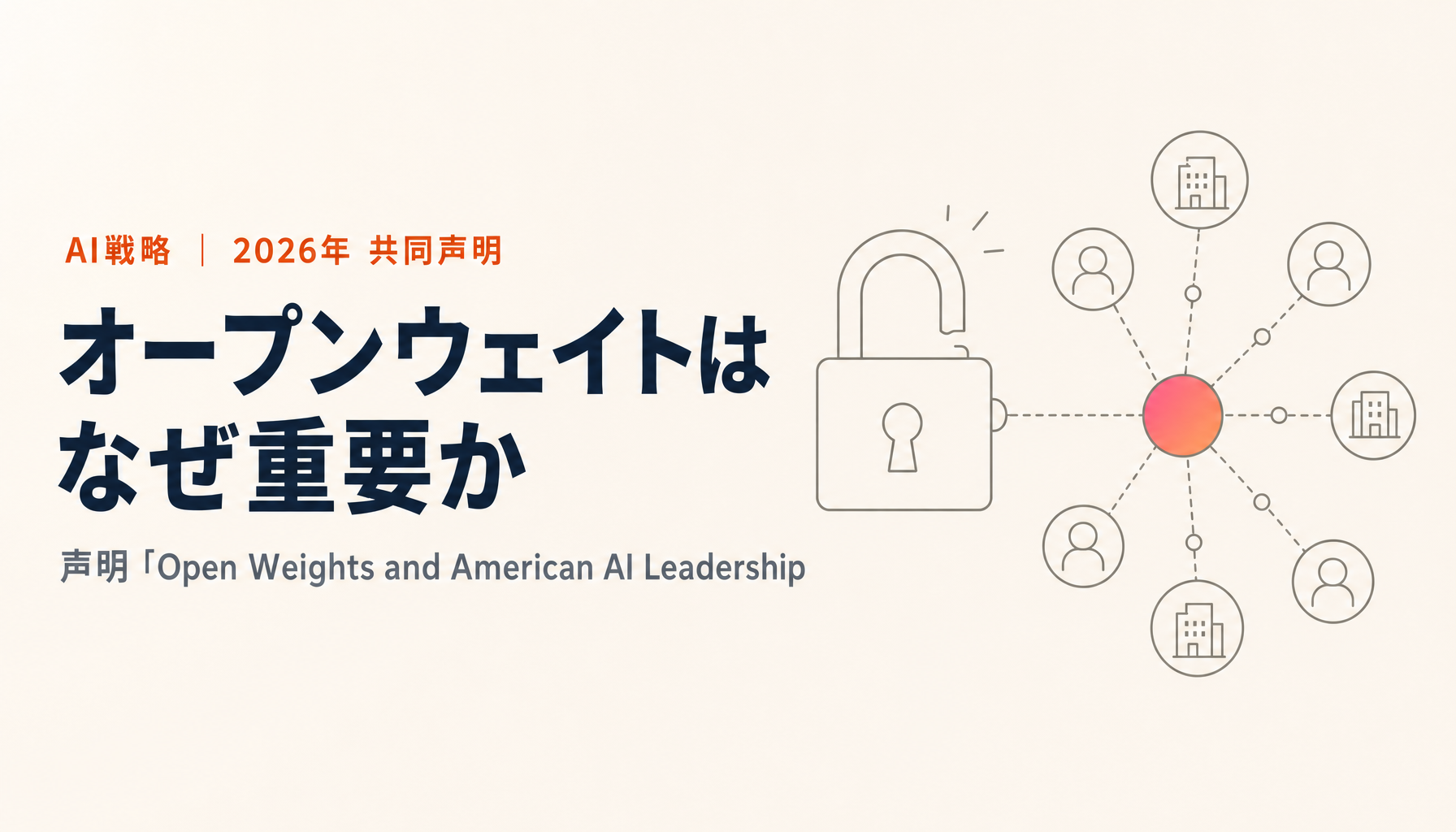
On 24 July 2026, Jensen Huang, the CEO of NVIDIA, shared a joint statement on X, formerly Twitter. Its title was "Open Weights and American AI Leadership"1. It was a fairly heavyweight document: the head of a leading semiconductor company waved the flag, and the names attached to it included Andreessen Horowitz, Hugging Face, IBM, The Linux Foundation, Meta, Microsoft, Mistral AI, Mozilla, Palantir, Perplexity and Y Combinator.
At first glance the statement looks like a matter of AI policy inside the United States. But read it closely and the points it raises drive straight into a practical question that Japanese companies now face, which is how they will choose their own AI going forward. In this article I break the statement down gently, putting each technical term into everyday language as it appears. Then I write, as my own view, how I think Japanese companies should take it.
Let me say one thing up front. I lean toward the open side by default. That said, I do not think openness alone solves everything, and the statement itself does not reject closed models outright. I want to look at that balance carefully too. If you are curious about where your own company stands on AI, it helps to first check your footing with our free AI literacy self-check. The discussion in the second half will feel more like your own concern once you have.
The "shared foundation of knowledge" that open source built
Let me start with the history that the statement uses as its starting point. Once this part clicks, the rest of the argument slides into place easily.
The statement invokes the open-source pioneers of the 1980s1. Open source is the idea of publishing source code, the blueprint of software, meaning the inner workings of a program, so that anyone can read it, fix it and redistribute it. At the time, the conventional wisdom ran the other way. Software kept its quality and made progress precisely because companies guarded it tightly. In an era when that was the belief, there were people who deliberately opened the inner workings.
What happened as a result? Most of today's internet runs on open-source software. The systems of the largest tech companies, and much of the scientific research and cybersecurity infrastructure of government agencies, rest on open source too. What the statement stresses is that open source delivered more than mere cost cutting. Because a "shared foundation of knowledge" was created that anyone could reference and build on, a store of technology emerged that outlives any one company's rise and fall and carries across generations. The core claim at the heart of the statement is that we should now repeat this lesson of history with AI.
This is not some old tale. The base software on the smartphone in your hand, and the operating systems that support corporate servers, trace their roots back to the open-source idea2. Opening things up, rather than closing them, ended up making society as a whole stronger. That track record is the spine of the argument for open weights.
What "open weights" actually means
Now let me explain the phrase at the centre of it all, "open weights." Miss this and the whole picture falls apart, so I will take it slowly.
An AI model, say one that generates text, holds inside it a vast collection of numbers as the result of learning from enormous amounts of data. This mass of numbers is called the "weights," also known as parameters. Whether a model is clever comes down, in the end, to what is inside these weights. Perhaps the closest analogy is the intuition and knack a person picks up through experience.
Open weights refers to a state where these weights are published so that anyone can download them. Once you can download them, four things become possible: inspecting what is inside, adapting the model for your own use, running it on your own infrastructure such as your own servers or your own cloud, and continuing to use it without asking anyone's permission each time.
The paired concept is the closed model. Here the weights are not public, and users can only reach the model through an API, meaning a window that sends a query to an outside provider's servers. The model itself sits in the provider's hands, and the user receives only the result.
Let me sort out one point that is easy to confuse. Open weights and open source are similar but not the same. Open source is a state in which the source code is opened as well. Open weights, by contrast, means you can obtain the weights of a finished model, but the data and the code used to train it are not necessarily all published. In other words, it helps to see open weights as an idea that places the emphasis on "being able to run a finished product in your own hands." The statement positions open weights as an important part of an open AI ecosystem1.
Looking for AI training and consulting?
Learn about WARP training programs and consulting services in our materials.
Access widens, competition emerges, costs fall
What is good about open weights? The statement raises three broad benefits: access, competition and cost.
Take access first. With open weights, startups, established firms, universities and public institutions do not have to train a model from scratch on their own. Training takes an enormous amount of computing resources and money, so this matters a great deal. What is more, they can build their own refinements on top of a model they already hold, instead of paying a high fee every time they use a frontier model. The statement expresses this as being able to assign "the right model to the right job at the right cost"1. Factories, hospitals, farms, classrooms and neighbourhood shops can all bring AI, sized to fit, into their daily work. That, the statement reckons, is where the winning path lies.
Take competition next. When many organisations can build, adapt and deploy models, rivalry emerges across a wide range of layers, not only among the companies that make models but also in cloud, chips, apps and services. Where competition arises, innovation advances, prices fall, and the benefits of AI reach broadly across the whole economy. Conversely, when power concentrates in a few hands, the opposite tends to happen. That is the argument.
Cost, the third, follows naturally as a consequence of the two above. When options grow and competition works, downward pressure comes to bear on the price users pay. There is a world of difference in the long-run burden between having no choice but to keep using at one company's asking price, and being able to choose from several options.
The customer holds the initiative, and avoids vendor lock-in
This is the part of the statement that I felt bears most on practice.
When a company invests in AI, there is a state that, in truth, everyone wants to avoid: being bound tightly to a single company's service, unable to operate anywhere else. This is called "vendor lock-in." Once you have embedded something deeply, the cost of switching becomes so large that you cannot move, even if the price rises or the specification changes.
The statement argues that open weights are a countermeasure to this lock-in1. First, you can keep your own data under your own control. You can evaluate and adapt the model to fit your own needs. And you can freely choose where to run it according to your requirements, whether on the cloud or on your own servers, wherever the requirement calls for. More important still, you can hold the model you have honed this way, along with the specialised capability and the accumulated knowledge tied to it, as your own asset rather than the contractor's.
I rate highly this idea of leaving the initiative on the customer's side. AI will work its way into the core of business operations from here. To hand that core over entirely to an outside company that might raise prices at any time, or change the spec at any time, is, I believe, an act that narrows your management options. Of course, it is not the simple story that holding everything in house is the answer. The point is to keep the state of being able to switch if it comes to that, in other words to leave yourself room to control things on your own side. That, I believe, is where the value of open weights lies.
I have also prepared a separate article that organises this theme from the angle of export control and economic security. If you are interested in whom you entrust your data to, and what risks that leads to, I hope you will also look at my article on AI security and data sovereignty strategy.
Facing the risk head-on, and still choosing "openness, not prohibition, as the path to safety"
Here, precisely because I lean toward the open side, there is a point I want to address without dodging: the question of risk. The statement acknowledges this point with surprising candour.
Open weights carry a real risk. Once a model is released, it leaves the developer's control. Even if a version altered for misuse spreads, chasing it down to recall it, or making it as if it never happened, is hard. The statement does not paper over this difficulty1.
On that basis, the answer the statement offers is the idea that "openness, not prohibition, is the path to safety." This is worth following carefully. In a world where the attacking side gets hold of advanced AI, the defending side cannot protect itself unless it can access equal capability. Open models spread the capacity to defend to many people. And because many teams can verify the same model, weaknesses, meaning vulnerabilities, can be found and fixed sooner. As transparency rises, hidden failures also become easier to notice from the outside.
Conversely, what happens when capability is concentrated in a few closed models alone? The statement uses the phrase "single point of failure"1. It refers to a structure in which, when one place is breached or fails in a way that cannot be detected from outside, the impact spreads all at once. Just as open source once showed that "opening something for many eyes to see can be safer than hiding what is inside," the safety of AI can also be supported by "more people trying it and toughening it up." This is the consistent claim of the statement.
Let me note this in fairness. The statement does not reject closed models outright. What it asks for is not to exclude closed models but to keep a pluralistic ecosystem that includes open ones too. It does not conclude that closed means safe. Nor does it conclude that open means dangerous. Rigorous benchmarks, red-teaming, meaning attack testing by specialist teams, and protections tied to harms that have actually been confirmed. It settles on a realistic line: that we should build up fact-based responses like these. This restrained way of writing struck me, for my part, as honest.
Proposals to policymakers, and the distinction between "distillation" and "illicit extraction"
The second half of the statement is a set of proposals to policymakers. A strongly open AI ecosystem does not form on its own if left alone. From the position that policy should therefore give it a push, several concrete measures are raised1.
The first is widening access to computing resources: making the computing power to develop AI available to startups and researchers. The second is investment in shared training assets: putting in place datasets, tools and evaluation frameworks for measuring performance that anyone can use. The third is avoiding hasty restrictions on open models. Tighten regulation in a rush and competition weakens, while the people who develop the technology flee overseas. So the claim is that the frontier, meaning the leading edge of technology, should be kept in a pluralistic state rather than in the hands of a few.
And there is one more point, technical but important: the warning not to confuse "distillation" with "illicit extraction." Distillation is a technique that uses one model's output to help train, improve or evaluate another model. This way of learning from and building on a preceding model is a legitimate and widely used method that inherits a long tradition running back to the open-source movement. Extracting value illicitly from a closed model, on the other hand, is a separate problem. The statement argues that rather than lumping the two together in a blanket prohibition, we should deal only with illicit extraction through a targeted legal and commercial framework1. I too see this as an important line to draw, one that keeps the legitimate advance of technology from being caught up in the crossfire.
That covers the content of the statement. If you are wrestling with the practical question of how to use AI, I encourage you to bring this idea of "holding things pluralistically" and "leaving yourself the initiative" home to your own company. In WARP, the AI consulting service we run, the design of which model to bring in, to where, and in what form is always the first fork in the road.
Implications for Japanese companies, but do not import the American context wholesale
Finally, let me write about how to take this statement as a story for Japanese companies.
First, as a premise: this is a document written in a domestic American policy context, under the banner of American AI leadership. The scale of computing resources, the way government is involved, and the size of the funding all differ from Japan's circumstances. So I think it is crude to apply the policy proposals it contains to Japan as they are. Japan has its own current state of computing resources and data infrastructure, and a separate discussion grounded in that is needed. Let me add this point honestly.
On that basis, there are universal points here that apply fully to Japanese companies too. They are three ideas: leave the initiative on your own side, do not narrow your dependence to a single company, and keep your data under your own control. These hold across borders.
Depending on one company also means tying your entire business to whatever circumstances that one company sits in. If you depend deeply on a specific overseas vendor alone, that country's export controls and geopolitical shifts feed straight through to the tools you can use. The situation of a familiar model becoming unusable one day is not a fantasy. That is exactly why a multi-vendor design that holds several model suppliers, a readiness that lets you choose where to run things, and a clear judgment about where to place your data come to carry weight as risk management.
This way of thinking overlaps directly with the philosophy we have valued in ZEROCK, our enterprise AI. ZEROCK runs on servers inside Japan and places importance on controlling a company's own knowledge, meaning its internal knowledge and information, under its own management. You could restate it as giving concrete form, for Japanese companies, to the idea the statement speaks of: the customer holding the initiative over its AI investment and keeping its data sovereignty. Whether or not you use open weights themselves depends on each set of requirements. But the posture at its root, of "keeping things open, keeping yourself able to choose, keeping things on your own side," is, I believe, worth adopting for any company in Japan.
Which model, run where, and how, for your own AI. How far to accept vendor dependence, and from where to take back the initiative. If you are hesitating at the entrance to this design, please talk to the WARP team. Specialists who led DX and data strategy at major companies walk alongside you month by month, helping you bring AI down into your management. Let us start by translating the large question the statement poses into the one step in front of you.
To sum up
It ran long, so let me organise the key points.
- "Open Weights and American AI Leadership" is a joint statement by many companies and organisations, shared on X by NVIDIA's Jensen Huang on 24 July 2026. OpenAI is reported to have joined later, in addition to the original coalition
- Open weights are models whose trained weights are published, so that anyone can download, inspect and adapt them and run them on their own infrastructure. The scope differs from open source, which also opens the source code
- The statement argues that open weights widen access, drive competition and lower costs. Its claim is that the "shared foundation of knowledge" open source built historically should be reproduced with AI too
- For companies, the great value lies in the customer holding the initiative, avoiding vendor lock-in, and keeping data sovereignty
- It acknowledges the risk candidly, yet argues that "openness, not prohibition, is the path to safety." The thinking is that concentration in a few closed models increases single points of failure
- The policy proposals raise opening up computing resources, investing in shared training assets, avoiding hasty restrictions, and distinguishing distillation from illicit extraction
- For Japanese companies, I believe the value lies in not importing the American policy context wholesale, yet still adopting the universal idea of "keep it open, keep yourself able to choose, keep it on your own side." It overlaps with the philosophy of ZEROCK, which runs on servers inside Japan
What the statement poses, in the end, is the question of "who holds the initiative over AI." Do we entrust it to a few hands, or share it among many players? For each company in Japan, too, this is not someone else's business. Start by taking stock of which AI your own company depends on, and how deeply.
References and primary sources
Footnotes
-
Joint statement "Open Weights and American AI Leadership," 24 July 2026. A joint statement by a signing coalition, published and shared on X, formerly Twitter, by NVIDIA's Jensen Huang. The original signatories were American Innovators Network, Andreessen Horowitz (a16z), Arcee AI, Arena, Black Forest Labs, Box, CrowdStrike, Dell Technologies, Emergence Capital, Hugging Face, IBM, The Linux Foundation, Mariana Minerals, Meta, Microsoft, Mistral AI, Mozilla, NVIDIA, Palantir, Perplexity, Reflection, Replit, ServiceNow, Telnyx and Y Combinator. OpenAI is reported to have joined later, in addition to the original signing coalition (this is reporting-based information as of the time of writing, and official confirmation has not been obtained). This article is based on the logic of the text of the statement that Mr Huang published and shared on X. The statement itself is public in his X post, and this article is a summary and explanation of its content. NVIDIA, one of the signatory companies, maintains an official newsroom at https://nvidianews.nvidia.com/ (note: the top page of this newsroom does not itself carry the statement). ↩ ↩2 ↩3 ↩4 ↩5 ↩6 ↩7 ↩8 ↩9
-
The Linux Foundation (a reference for the background in which open source supports social infrastructure; one of the signatory organisations of the statement). https://www.linuxfoundation.org/ ↩