This is Hamamoto from TIMEWELL.
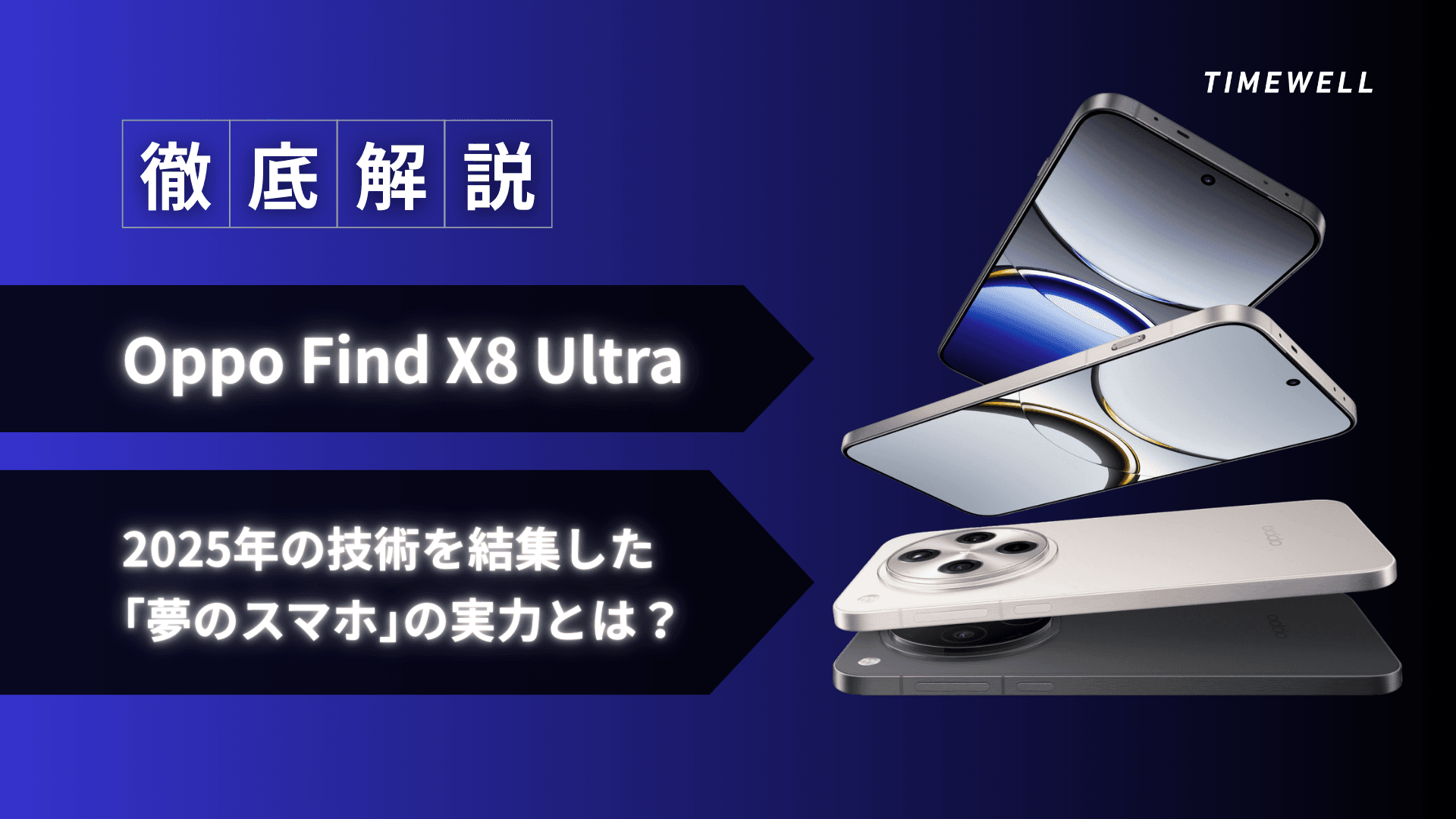
Tech enthusiasts and business professionals alike have long chased the idea of the "perfect smartphone." As one prominent reviewer put it, the answer has always been a Frankenstein device — the best display from one phone, the best camera from another, and the biggest battery and fastest chip from yet another. Fitting all of that into a single device has been dismissed as fantasy, constrained by physics and cost. That fantasy, however, may finally have a name: the Oppo Find X8 Ultra.
This article takes a comprehensive look at the Find X8 Ultra — its specifications, design, camera system, software, and market positioning — including its potential as a business tool.
A Spec Sheet Without Compromises
The Find X8 Ultra's specifications read like someone with an unlimited budget sat down to design the ideal phone. At its heart is the Snapdragon 8 Elite, the current undisputed king of mobile processors. Paired with 16GB of RAM and up to 1TB of UFS 4.1 storage, the device handles heavy multitasking, demanding applications, and AI-intensive features without breaking a sweat.
The display is a 1440p AMOLED panel with LTPO technology, supporting up to 120Hz adaptive refresh. Peak brightness hits an extraordinary 2500 nits under HDR conditions, making it perfectly legible in direct sunlight. High-frequency 2160Hz PWM dimming reduces flicker at low brightness settings, protecting eyes during extended use. The under-display ultrasonic fingerprint sensor is fast and accurate.
Battery life is where this phone truly sets itself apart. The 6100mAh silicon-carbon battery is not just large — the silicon-carbon chemistry yields higher energy density than conventional lithium-ion, meaning Oppo has achieved this extraordinary capacity without making the phone unwieldy. Wired charging tops out at 100W (full charge in roughly 40 minutes), while wireless charging reaches 50W. Reverse wireless charging is included for accessories.
Rounding out the specifications: Wi-Fi 7, NFC, dual-SIM, IP68 and IP69 dust and water resistance, and an infrared emitter — a feature becoming increasingly rare in flagships.
Looking for AI training and consulting?
Learn about WARP training programs and consulting services in our materials.
A Camera System That Rewrites the Rules
If any single aspect of the Find X8 Ultra demands attention, it is the camera array. The rear system carries five sensors, and unlike virtually every other smartphone on the market, it refuses to cut corners on any of them.
The main wide-angle camera uses a 1-inch-type 50MP sensor with an f/1.8 lens and optical image stabilization. This sensor is reportedly 63% larger than the primary sensor in Apple's iPhone 16 Pro Max and 69% larger than Samsung's Galaxy S25 Ultra's main sensor. The physical advantages are profound: more light captured means faster shutter speeds, less noise in low light, and dramatically shallower depth of field for natural subject separation.
What truly distinguishes the Find X8 Ultra, however, is what Oppo has done with the telephoto cameras. The 3x telephoto also uses a 50MP sensor — reportedly 300% larger than the Galaxy S25 Ultra's equivalent telephoto sensor, comparable in size to the main cameras found on Oppo's standard Find X8 and the ROG Phone gaming flagship. The 6x telephoto likewise carries a large 50MP sensor, reportedly 30% larger than the Galaxy S25 Ultra's secondary telephoto and 36% larger than the iPhone 16 Pro Max's telephoto.
The ultrawide camera completes the quad-camera setup with another large 50MP sensor, while a fifth element — a dedicated Chroma Sensor — continuously samples ambient color temperature to deliver accurate white balance even under complex mixed lighting conditions.
In practice, these massive sensors enable fast-moving subjects to be frozen with minimal blur, rich bokeh that rivals dedicated cameras, and low-light performance well beyond what standard smartphone sensors can produce. Macro photography is handled by the 3x telephoto rather than the ultrawide, reducing distortion and allowing natural working distances. AI-powered digital zoom extends reach to 120x, and while results vary by subject, it handles distant text with impressive clarity.
Video capabilities match the stills: both the 1x and 3x cameras support 4K 120fps Dolby Vision HDR recording, meeting professional production standards.
| Camera | Specification |
|---|---|
| Main (1x) | 1-inch 50MP, f/1.8, OIS |
| Ultrawide | Large 50MP |
| Telephoto 1 (3x) | Extra-large 50MP, macro-capable |
| Telephoto 2 (6x) | Large 50MP |
| Chroma Sensor | Color temperature measurement |
| Front | 32MP, autofocus |
| Video | 4K 120fps Dolby Vision HDR (1x, 3x) |
Design, Software, and Market Strategy
Visually, the Find X8 Ultra has settled into mainstream flagship conventions — flat sides, a large square camera module — in contrast to the adventurous sliding-camera designs of earlier Find X models. The form factor is unremarkable by today's standards, which makes the internal engineering all the more impressive: fitting a 6100mAh silicon-carbon battery and four oversized camera sensors into a phone that feels normal in the hand is a genuine feat.
Two additional physical controls deserve attention, and both reveal Oppo's competitive strategy clearly. The left side carries a customizable shortcut button assignable to eight preset actions — camera launch, flashlight, voice memo, and so on. It mirrors Apple's Action Button from the iPhone 15 Pro series almost exactly, though full app-launch customization is absent. On the right side, a touch-sensitive "Quick Button" controls camera zoom with left-right swipes, launches the camera with a double-tap, and triggers burst shooting with a long press — an unmistakable echo of Apple's Camera Control on the iPhone 16 lineup.
ColorOS 15 runs Android with a heavily customized interface that draws clear inspiration from iOS: the Settings layout, the split notification center and quick settings panel, lock screen customization options, and a Dynamic Island-style notification animation all bear the influence. Oppo even promotes the ability to "AirDrop directly from an Oppo device to an iPhone" — which in practice requires installing a third-party app on the iPhone side, making the comparison more aspirational than functional.
This strategy makes sense in context. In markets where Android dominates — across Asia and much of Europe — device selection tends to be driven by hardware capability and feature comparison rather than platform lock-in. Oppo is targeting users who want the best possible hardware, wrapped in an interface that minimizes the learning curve for those familiar with iOS. The result is something like a thought experiment made real: what if Apple competed seriously in the specification arms race?
Summary
The Oppo Find X8 Ultra is a showcase for where smartphone technology stands in 2025. Snapdragon 8 Elite, 16GB RAM, 1TB storage, an extraordinary AMOLED display, a 6100mAh silicon-carbon battery with 100W charging, and a camera system with four large-sensor cameras — no single component has been compromised.
The camera array is the device's signature achievement. The 1-inch main sensor, the oversized telephoto sensors, the Chroma Sensor for accurate color rendition, and 4K 120fps Dolby Vision video capability collectively define a new standard for smartphone photography.
The design language borrows freely from established trends, and ColorOS 15 wears its iOS influences without much subtlety. But this is a deliberate market strategy, not carelessness. In the hardware-centric markets where Oppo competes, delivering the best possible specifications — combined with a familiar interface — is how the company builds competitive advantage.
Pricing at launch was unconfirmed at time of writing, but based on prior Find X series pricing, a range around ¥140,000 seems likely. For a device with these specifications, many buyers will find that justified.
Reference: https://www.youtube.com/watch?v=p24qhUFIe68
Related Articles
- The Reality of a Part-Time Employee Who Worked Full-Time, Took Two Maternity Leaves, and Changed Her View of Work | TIMEWELL
- Before Paternity Leave — What You Absolutely Must Do to Take Leave Even During a Busy Period
- Pursuing a Hands-On Architecture Firm: Finding My Own Way as the 5th Generation of a Construction Company | Fujita Construction