Hello, this is Ryuta Hamamoto from TIMEWELL.
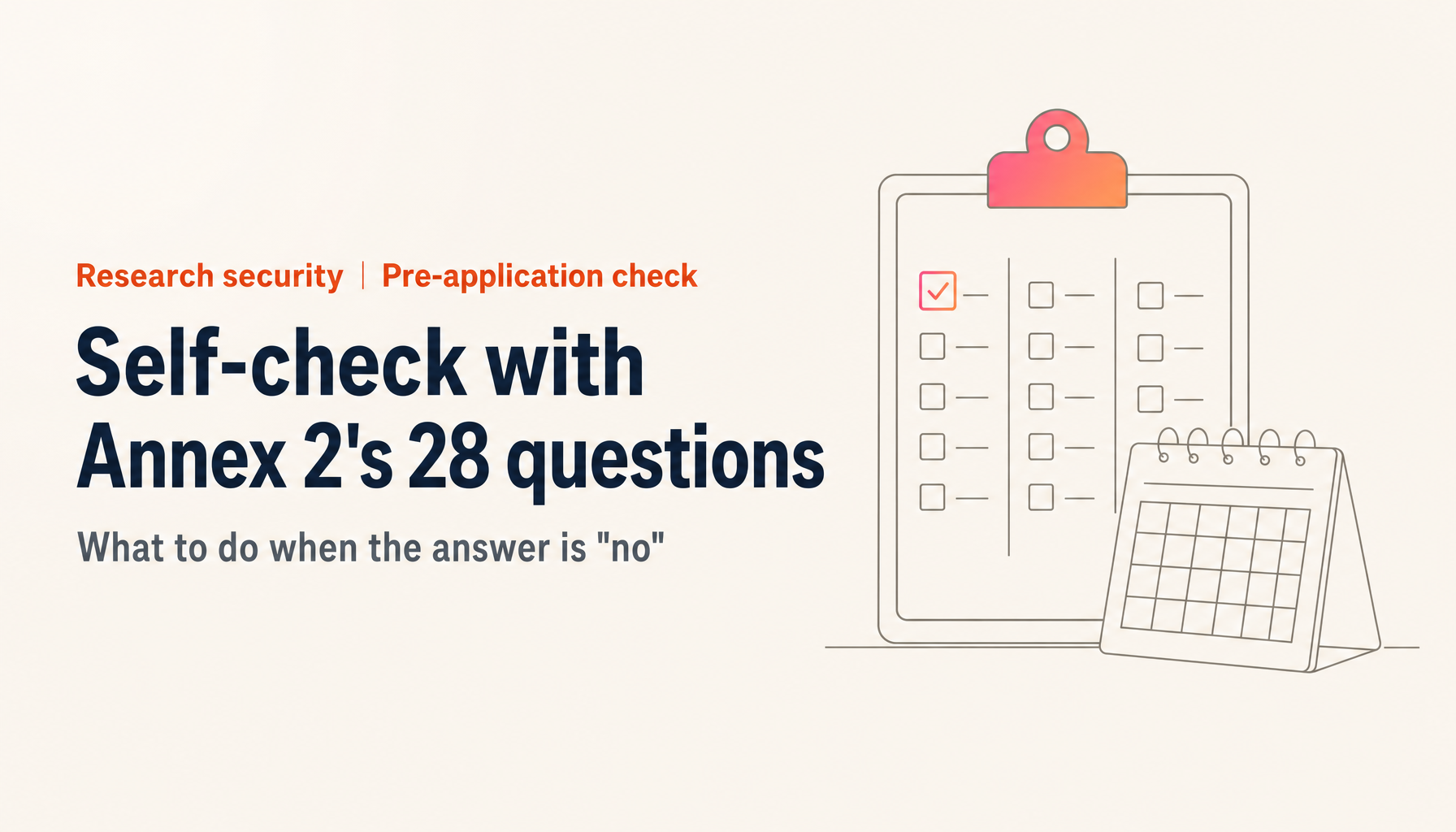
"One of our faculty members is applying to a Specified Research and Development Program next year. Who fills in the Annex 2 checklist from the manual, when, and how far do they have to go?" I hear some version of this from research administration offices fairly often. The short answer: Annex 2 is not something you send to the funding agency. It is a checklist for confirming, before you apply, whether you can carry out the manual's measures by the funding agency's deadline. You answer 28 questions and turn every "no" into a to-do list to clear before the questionnaire arrives. That, to me, is the most practical way to use it.
The short version
- Annex 2 has three checklists with 28 questions in total: 9 for the lead institution, 8 for collaborating institutions and 11 for researchers. Of the researcher questions, the PI answers six and the Co-PI five. The manual calls this self-check "desirable", and says nothing about submitting it.
- The check itself is only desirable, but what it asks about are measures the manual describes as "necessary" or as something institutions "shall" do (our mapping). Treat a "no" as work to finish before the questionnaire is due, not as a sign to give up on the application.
- ATLA's questionnaire (Annex 5) points in a different direction. Annex 2 asks "can you?", Annex 5 asks "did you?". Deciding in advance which Annex 5 question each Annex 2 answer feeds into shortens the preparation.
This article does not evaluate any country, institution or person. Being on METI's End User List or the U.S. Consolidated Screening List is a regulatory designation, not a judgment of the listed institution or person. The manual itself says that, in deciding whether a counterpart is a trustworthy partner, "it goes without question that there must be no discriminatory treatment on the grounds of nationality, race, religion, culture or the like"1. Everything below assumes you work from the manual's verification items (affiliations, funding, contracts, track record of collaboration), not from nationality or origin.
I checked the facts against the Cabinet Office's Procedures Manual for Ensuring Research Security (December 2025), its Q&A (last updated 26 August 2026) and the Cabinet Office page for the one-stop desk for the manual, all as retrieved on 22 November 2026123. For ATLA's questionnaire I read a copy of the FY2026 call for the Innovative Science and Technology Initiative for Security (commissioned research), retrieved on 20 November 20264. All of these are in Japanese; quotations are our translations. How to gather the 13 verification items and how to answer the questionnaire template (Annex 3) question by question are covered in our guide to the research security questionnaire. Here I stay with the Annex 2 check that comes before it.
Fill in Annex 2 using the same numbering as this article: an Excel workbook that lists the three Annex 2 checklists word for word, one question per row, and moves every row marked "partly" or "cannot" onto a 90-day plan. The question numbers used here ("Lead 1(1)", "Researcher 2-4" and so on) match the IDs on the kit's Annex 2 self-check sheet. Research security self-check and due diligence kit (Excel, in Japanese)
What Annex 2 is: who uses it, when, and which one
Annex 2 is the "research security checklist" at the back of the manual (pages 29 to 38). Section 2-5(2) says it was prepared "for each research institution and each researcher to refer to when applying to a Specified Research and Development Program"1. A Specified Research and Development Program is a competitive research funding program, premised on publishing results, that the competent ministry designates in consultation with the funding agency because, from an economic security standpoint, preventing technology leakage is particularly important (section 2-2). In the FY2026 calls I read, JST's CREST program (five research areas) and ATLA's Innovative Science and Technology Initiative for Security both state that they are designated45. The Cabinet Office desk page says there are no plans to publish a list of designated programs, and that designation will be made clear in each call for proposals3.
The three checklists and who answers them
Annex 2 is split into three checklists by role. Each opens with the same "0. Definitions", which fix what PI (the person responsible for the whole project), Co-PI (the researcher who will take part as the representative of a collaborating institution) and research participant (a researcher who will take part, including students, excluding the PI and Co-PIs) mean1.
| Checklist | Who answers | Questions | Answer format | Pages |
|---|---|---|---|---|
| For the lead institution | The lead institution (where the PI belongs) | 9 | Two options, such as "can carry out" and "cannot carry out" | 29 to 31 |
| For collaborating institutions | The collaborating institution | 8 | Two options | 32 to 34 |
| For researchers | The PI (6) and the Co-PI (5) | 11 | Two options such as "submitted" and "not submitted". Only 1(2) has a third option, "there is no collaborating institution" | 35 to 38 |
The researcher checklist has a line that is easy to miss. The note at the top says it is for checking whether the researcher, "as PI or Co-PI", has done what is needed, and tells the PI to answer the questions beginning "For the PI" and the Co-PI to answer those beginning "For the Co-PI"1. The title says "for researchers who will take part", but only the PI and Co-PI answer. Research participants, students included, do not fill it in themselves. They sit on the side the PI and Co-PI check: has their information been submitted?
How strong "desirable" is
Section 2-5(2) reads: "researchers who intend to apply to a Specified Research and Development Program, and their institutions, should desirably use the research security checklist to self-check whether they can carry out the measures under this manual"1. On the researcher side, section 4-1 likewise calls it desirable to self-check with the checklist when declaring information1.
Section 1-2(2) defines the weight of "desirable". Where the text says "necessary", it describes the minimum measures to be taken. Where it says "desirable", it describes measures "that are desirable to implement but whose implementation is not required at present"1. The Cabinet Office desk page confirms this: asked whether everything not marked "desirable" is mandatory, it answers "that is correct". Asked whether leaving a "desirable" item undone could lead to rejection, it says each funding agency sets its own review criteria, so the Cabinet Office cannot answer3.
So running the Annex 2 check is not itself required. The content is another matter. Each of the nine lead-institution questions corresponds to a measure the manual calls "necessary" or something institutions "shall" do (see the basis column in the next section; the mapping is ours). The check is optional; the measures it checks are what you will be asked to carry out once you apply.
I also looked at submission. In the body of the manual, "research security checklist" appears in three places: 2-5(2), section 1-5 of Part II chapter 1 (the Cabinet Office will review the checklist as needed) and 4-1. None of them requires submitting it to a funding agency1. Neither JST's FY2026 call nor ATLA's FY2026 call (commissioned research) asks for Annex 2 to be submitted, as far as I could find45. What you answer to the funding agency is the questionnaire each agency builds from Annex 3. On whether the self-check can partly rely on public information or a university's own researcher directory, and whether information can be collected with an electronic form such as Google Forms, Q&A I-4 says: "Please check the call for proposals and proceed in consultation with the funding agency in charge of the program"2.
When to run the check
The note at the top of Annex 2 says it is for checking, "when applying to a Specified Research and Development Program, whether the measures under the manual can be carried out by the deadline the funding agency sets in its call"1. Q&A II-10 says the checklist is for self-checking when you apply or may apply, and adds that it "is also desirable to do routinely"2.
I recommend splitting the check into two rounds. The first is a stocktake before the call opens. A "cannot" caused by missing rules or forms takes months, not days, to fix. The second comes once you decide to apply, when you re-answer against that call's deadlines. ATLA's FY2026 call ran from 13 March to noon on 20 May 2026, and the call says the lead institution of a project selected for interview submits the questionnaire by around mid-July4. JST sends its questionnaire separately to the principal investigators of those shortlisted projects that become subject to risk management, with a deadline JST sets separately5. On ATLA's timetable, that leaves about two months between the application deadline and the questionnaire (our calculation). Whatever is still "cannot" after the second round has to be cleared in that window.
Before you start, check that your copy of Annex 2 is current. The manual says the Cabinet Office is to "review [the checklist] as needed"1. Watch out for a name clash as well. ATLA's call has its own Annex 2, which is the guide to preparing application documents and has nothing to do with Annex 2 of the manual4. Writing "Annex 2 of the manual" in internal emails avoids mix-ups.
The nine questions for the lead institution: what they mean, and which records and offices to check
The lead-institution checklist has nine questions in which the PI's institution checks whether it can carry out the manual's measures for its own researchers and the Co-PIs by the deadline. The "records to check" and "main offices" columns are our examples; substitute your own. On which office should handle risk management, Q&A II-9 expects that offices already handling security export control or research integrity will usually take the lead, and says that where no suitable office exists, the institution needs to designate one, reorganising if necessary2.
| No. | What it asks | Basis in the manual | Records to check (our examples) | Main offices (our examples) |
|---|---|---|---|---|
| Lead 1(1) | Can you have the PI, your own research participants and the Co-PIs self-declare items 1 to 13 by the deadline, verify them and carry out due diligence? | 3-3(1)(i), "necessary" | Research integrity declarations, HR records, declaration form, due diligence record form | Research promotion and support, HR, export control |
| Lead 1(2) | Will you check the four points of joint research and other agreements? | 3-3(1)(v), "necessary" | Agreement templates, contract review checklist | Industry partnerships, IP, legal |
| Lead 1(3) | Can you give the funding agency the financial position, capital structure and list status of your institution and collaborating institutions (excluding Japanese universities and similar)? | Part II chapter 2, 2-2(1) (the funding agency's due diligence), "necessary" | Financial statements, shareholder information, list screening records | Finance and accounting, industry partnerships |
| Lead 1(4) | Will you notify the collaborating institution's office of the names of its Co-PI and research participants? | Note to the figure in 2-4, "necessary" | Contact details for the collaborating institution's office | Research promotion and support |
| Lead 2 | Will you ask your researchers and the Co-PIs for a consent form (purpose and third-party provision) and a declaration? | 3-3 (Reference), "shall" | Consent and declaration forms, personal data rules | Research promotion, personal data officer |
| Lead 3 | Can you carry out reasonable risk mitigation measures based on the risk assessment? | 3-4, "necessary" | Procedures for building entry and access rights, employment contract template, training records | Facilities, IT infrastructure, HR |
| Lead 4(1) | After the project starts, can you check how mitigation is going and act on it? | 3-5, "necessary" | Timing and record form for follow-up checks | Research promotion and support |
| Lead 4(2) | If you add a research participant after the start, can you carry out due diligence on them? | 3-5, "necessary" | Form for adding lab members | Research promotion, HR |
| Lead 4(3) | If declared information turns out to be wrong, can you report it promptly to the funding agency and redo due diligence on the corrected information? | 3-5, "necessary" | Reporting procedure and contacts | Research promotion and support |
1(1): can you collect and verify the 13 items in time?
Of the nine, 1(1) carries the most work. It asks whether, for the PI, your own research participants (students included) and the Co-PIs, you can have everyone self-declare items 1 (education from high school onward) through 13 (anything else the funding agency deems necessary), verify them and carry out due diligence, meaning the process of confirming that participating institutions and researchers are appropriate. Items 3 to 8, 10 and 11 cover the past three years, including the fiscal year in which the application date falls1. Q&A II-4 explains this as "three years in total": the fiscal year of the application date plus the two before it2.
In my view you can tick "can" when four things are settled: the form, how you collect, how you verify, and where the records live. For collection you can use HR records. Q&A II-19 says using information the institution already holds is fine, but you must confirm with the researcher that it is current and accurate, and ask them to self-declare anything missing, such as work at other institutions2. For verification, Q&A II-17 describes the flow: receive the self-declaration with a declaration that it is true, then use open sources and similar to check for inconsistencies2. If only one item lacks a procedure, say item 11 (relationships with researchers at listed institutions), choose "partly" in the kit and write the missing step on that row. How to gather each of the 13 items is covered in the questionnaire guide and in our article on research security due diligence.
1(2) to 1(4): contracts, partner institutions and names
1(2) is the only one of the nine whose wording itself says "it is necessary to confirm the appropriateness"1. The points to confirm, for joint research and other agreements with collaborating institutions and other persons or bodies, are the scope of cooperation, access to research data, the handling of inventions, patents and other IP, and confidentiality obligations. Look at your contract review checklist: if it has a line for each of the four, you can answer straight away. How to build those lines, with sample clauses, is in our article on checking joint research agreements. For a starting template, the joint and commissioned research checklist with sample clauses (Excel, in Japanese) has the ten pre-contract checks, a screening record for the partner institution and seven sample clauses (to be reviewed by your legal team).
For 1(3), the bracketed limitation decides the answer. It covers your own institution and collaborating institutions "limited to institutions other than" Japanese universities, inter-university research institutes, colleges of technology, national research and development agencies and public research institutes1. If a Japanese university is the lead institution and every collaborating institution is also a Japanese university, the question applies to no one. The original offers only "can submit" and "cannot submit", so in the kit we added "not applicable" as our own option. If a company or a foreign institution is a collaborating institution, the question is whether you can provide its financial position, its capital structure (for a company) and whether it is on a list. On which institutions fall in scope, Q&A II-20 lists all foreign institutions, private companies in Japan and abroad, and non-profit bodies, foundations, voluntary groups and the like (in its answer about due diligence on collaborating institutions)2. The Cabinet Office desk page adds that an institution may count as a collaborating institution even if no funding flows to it, as long as it does research with you under the program3.
1(4) rests on the note to the figure in section 2-4. Using the example of University A as lead institution and University B as collaborating institution, the note says University A's responsible office must notify University B's office of the names of the Co-PI and research participants belonging to University B, and share them, calling this "necessary"1. Check, before you apply, whether you can write down in one line which office at the partner handles research security and how to reach it.
2 to 4(3): consent forms, mitigation measures and post-start procedures
Question 2 asks whether you will require a consent form and a declaration when your researchers and the Co-PIs declare personal information. In the lead-institution version, the third parties named in the consent form are "the funding agency and the relevant administrative bodies"1. The reference box in 3-3 says the consent form covers declaring the information for risk management, with the institution using it only for that purpose, and providing it to third parties for that purpose; the declaration covers the statement that, to the best of the signatory's knowledge, the information is current at the time of declaration and contains nothing false and nothing omitted1. We provide a sample set as self-declaration, consent and declaration forms (Word, in Japanese).
Question 3 asks whether you can carry out reasonable risk mitigation. Section 3-4 says measures "suffice if they are reasonable in proportion to the level of risk", then lists examples: managing access to facilities and equipment, securing off-campus research space, choosing meeting attendees according to the sensitivity of the information, strengthening governance through employment contracts (for students and similar cases), training, managing access to research data, and stronger cyber defences1. To tick "can", I think it is enough to know which of these your institution can actually put in motion and which office owns each one. How far to implement the seven is covered in our article on risk mitigation measures.
Questions 4(1) to 4(3) are about what happens after the project starts. Section 3-5 makes three things "necessary": checking how mitigation is going after the start, carrying out due diligence on any research participant added later, and, if declared information proves wrong, reporting it promptly to the funding agency and redoing due diligence on the corrected information1. These are easy to overlook before selection, but people join labs mid-year. Check whether the form for adding a lab member includes a line requesting due diligence.
Replace siloed classification work with AI.
METI's FY2024 data shows 52% of foreign exchange law violations stem from classification errors. Download the TRAFEED product catalog covering features and rollout.
The eight questions for collaborating institutions and the 11 for researchers
The collaborating-institution and researcher checklists share the lead institution's skeleton, with differences in the detail. If you run the lead institution's side, knowing what the partner and the PI and Co-PI will be asked makes it easier to word your requests and set internal deadlines.
How the collaborating institution checklist differs
The eight questions are 1(1) to 1(3), 2(1), 3(1) and 4(1) to 4(3). There are four differences.
The first is who is covered by due diligence. Collaborating 1(1) asks whether you can have your own Co-PI and research participants self-declare items 1 to 13, verify them and carry out due diligence (section 3-3(2)(i))1. The Co-PI is therefore covered by both the lead and the collaborating institution. Q&A II-18 says that because the lead institution compiles information for the whole team and is accountable to the funding agency, it is expected to obtain the Co-PI's self-declaration, consent form and declaration, usually through the collaborating institution's administrative office2.
The second is where the information goes. Collaborating 1(3) asks whether you can "submit to the PI" your institution's financial position, capital structure and list status (excluding Japanese universities and similar)1. It goes to the lead institution through the PI, not straight to the funding agency.
The third is the scope of third parties in the consent form. In collaborating 2(1), the third parties are "the lead institution, the funding agency and the relevant administrative bodies"1. Reuse the lead institution's form unchanged and the lead institution drops out.
The fourth is the reporting route for errors. Collaborating 4(3) asks whether you can report errors to the funding agency "through the lead institution"1. There is no equivalent of lead 1(4) (sharing names), because notifying is the lead institution's job.
Where a confidentiality agreement makes it hard to disclose the Co-PI's details to the lead institution, the Cabinet Office desk page suggests that the collaborating institution first carry out due diligence and risk assessment internally, then report its conclusion, for example "no risk identified", to the lead institution3. If you are on the collaborating side, agree with the lead institution early whether you will use this route. It saves an argument just before the deadline.
The researcher checklist: six questions for the PI, five for the Co-PI
All 11 researcher questions are in the past tense: "did you submit?", "did you confirm?". They are easiest to read as a submission tracker: have you handed in your own information and forms by the deadline your institution set, and is everyone else's in?
| No. | Who answers | What it asks | Options in the original |
|---|---|---|---|
| Researcher 1(1)-1 | PI | Did you submit your own items 1 to 13 to the lead institution's office by the deadline? | Submitted, not submitted |
| Researcher 1(1)-2 | PI | Did you prompt the Co-PIs and the lead institution's research participants and confirm everyone's information is in? | Confirmed, not confirmed |
| Researcher 1(1)-3 | Co-PI | Did you submit your own items 1 to 13 to the offices of the lead institution and your own collaborating institution? | Submitted, not submitted |
| Researcher 1(1)-4 | Co-PI | Did you prompt your institution's research participants and confirm everyone's information is in? | Confirmed, not confirmed |
| Researcher 1(2) | PI | Did you submit the financial position and other details of collaborating institutions (excluding Japanese universities and similar) to the lead institution's office? | Submitted, not submitted, no collaborating institution |
| Researcher 1(3)-1 | PI | Are you prepared to carry out the agreed mitigation measures in cooperation with the institutions involved? | Yes, no |
| Researcher 1(3)-2 | Co-PI | The same question | Yes, no |
| Researcher 2-1 | PI | Did you submit your own consent form and declaration, in the specified format, to the lead institution's office? | Submitted, not submitted |
| Researcher 2-2 | PI | Did you confirm the Co-PIs' and the lead institution's research participants' consent forms and declarations are in? | Confirmed, not confirmed |
| Researcher 2-3 | Co-PI | Did you submit your own consent form and declaration to the offices of the lead and collaborating institutions? | Submitted, not submitted |
| Researcher 2-4 | Co-PI | Did you confirm your institution's research participants' consent forms and declarations are in? | Confirmed, not confirmed |
The two that matter most in practice are 1(1)-2 and 2-2, where the PI confirms that everyone's paperwork is complete. Rather than having the PI chase every form personally, I think it works better if the PI confirms against the office's intake status. Research participants include students, so the numbers add up quickly. Note 9 to section 2-4 says that if participants have not been decided at the time of application, each must be added to the scope of risk management as soon as they are decided1. If the office sets the internal deadline first and sends the PI a "what is still missing" view of this table, the 11 researcher questions become your reminder list. Contracts and pledges for students and RAs are covered in our article on hosting students and research assistants.
What to do when you answer "no"
When you get a "cannot" or a "not submitted" on Annex 2, the first question is usually whether it means you cannot apply. The manual says nothing to suggest Annex 2 answers decide eligibility1. The point of the check is whether you can carry out the measures by the funding agency's deadline. So treat each "no" as work to finish by then.
First, set the deadline and the record
Two things come first. One is the deadline. Work back from the questionnaire deadline, not the application deadline; on ATLA's FY2026 timetable, that was around mid-July4. Subtract the time needed for internal checks and for exchanges with collaborating institutions, and that is the deadline for each row. The other is to write, next to each row, who will fix what and by when. In the research security self-check and due diligence kit (Excel, in Japanese), rows marked "partly" or "cannot" appear automatically in the 90-day plan at the bottom of the sheet. Fill in the basis, owner, deadline and action columns and you have your internal work list.
Next steps, question by question
Here are common reasons for a "no" and what to do next. The next steps are our own suggestions, not something the manual prescribes.
| Question | Common reason for "no" | Next step (our suggestion) |
|---|---|---|
| Lead 1(1), Collaborating 1(1) | No form for declaring the 13 items and no due diligence record form | If the funding agency specifies a form, follow it; otherwise settle an internal one. Fill the items HR records already cover first (Q&A II-19) |
| Item 11 under Lead 1(1) | No procedure for checking co-authors' and collaborators' affiliations against the lists | Decide how to check the affiliations of everyone you did joint or commissioned research with, co-authored with, or co-presented with at conferences over the past three years against METI's End User List and the Consolidated Screening List, and try it on one researcher |
| Lead 1(2), Collaborating 1(2) | The contract review checklist has no lines for the four points | Add lines for scope of cooperation, access to research data, IP handling and confidentiality |
| Lead 1(3), Collaborating 1(3), Researcher 1(2) | A company or foreign institution has not sent financial documents | Ask as soon as you decide to apply. If they may not arrive, consult the funding agency |
| Lead 1(4) | You do not know the collaborating institution's responsible office | Ask the partner's research administration office which office handles research security and how to contact it |
| Lead 2, Collaborating 2(1), Researcher 2-1 to 2-4 | No consent or declaration form | Draft forms covering what the reference box in 3-3 requires. At a collaborating institution, include the lead institution as a third party |
| Lead 3, Collaborating 3(1), Researcher 1(3) | No agreed means or owner for mitigation | From the seven examples, pick the ones your institution can actually run (building access, IT access rights, employment contracts, training and so on) and assign an office to each |
| Lead 4(1) to 4(3), Collaborating 4(1) to 4(3) | No post-start follow-up process | Write one page covering when to check, how new members are registered and screened, and how errors get reported |
| Researcher 1(1)-1 to 1(1)-4 | Some people have not submitted | The office sends intake status to the PI and Co-PI, names who is missing and chases them |
The rows that take time are the ones where you need a new form or procedure. Lead 1(1) and lead 2 block everything else: until the forms exist you cannot send requests to researchers. I suggest clearing those two in the first month. Building the 13-item form and the due diligence record lines up with the 90-day plan in our guide to setting up research security governance.
What to check separately even when Annex 2 is all "yes"
Annex 2 does not cover every measure in the manual. Some things the manual calls "necessary" have no Annex 2 question at all. If you run the lead institution's side, check this table alongside Annex 2.
| Section | Wording | What it covers | Annex 2 question |
|---|---|---|---|
| 3-1(1) | Necessary | Collecting the information researchers declare under the research integrity checklist | None |
| 3-1(2) | Necessary | A system for managing the information needed for risk management when researchers apply or plan to apply | None |
| 3-1(4) | Necessary | Reviewing the research integrity checklist in light of how it is working | None |
| 2-6 | Necessary | A system that keeps critical technology from leaking, a contact and response system for emergencies, and verification if a leak happens | None |
| 3-3(1)(ii) | Desirable | Checking the appropriateness of the project's data management plan (DMP), samples, IT systems and facilities | None |
| 3-3(1)(iii) | Desirable | Due diligence on collaborating institutions (excluding Japanese universities and similar): purpose of the collaboration, track record in the field over three years, financial position and list status | Partly (Lead 1(3) asks whether you can give the funding agency the financial position and list status) |
| 3-3(1)(iv) | Desirable | Due diligence on persons or bodies supporting the research through grants, donations, provision of goods and so on (excluding public bodies) | None |
| 3-2 | Desirable | Preparing the risk management setup at application (designating those involved in running the program, confidentiality, emergency contacts) | None |
The four "desirable" rows are not required at present, per the definition in 1-2(2)1. Even so, data management under 3-3(1)(ii) is also listed as desirable for researchers in 4-2, which mentions preparing an appropriate DMP for the PI and Co-PI1. The more "yes" answers an institution has on Annex 2, the more I would point it at the top four rows of this table next. For national research and development agencies, the 90-day research security plan for national R&D agencies (Excel, in Japanese) lays out the additional procedures in the manual, data management included, over 90 days with owners, deadlines and evidence. On supporters, the Cabinet Office desk page says ordinary trading partners for buying goods or services unrelated to the research content can be treated as not being "supporters"3.
Why an honest "cannot" is better
Annex 2 is an internal checklist, so ticking "can" will not be checked by anyone outside. I still recommend answering as things are, and the reason is section 2-6. The manual says that even when its measures are properly carried out, a leak may still happen, and in that case "research institutions and researchers do not bear responsibility". It also says that where there is intentional false declaration or concealment, the government needs to respond1. Find your "cannot" rows on Annex 2 and clear them before the questionnaire, and you can answer the questionnaire truthfully.
Rows you do not expect to clear in time should go to consultation early. Questions about how a call works go to the funding agency you are applying to; questions about reading the manual go to the Cabinet Office one-stop desk for the manual3. Section 1-2(2) of Part II chapter 1 says the desk that handles risk management consultations from institutions advises, and "does not make decisions on the enquirer's behalf"1. The decision stays with your institution. Write down, in one line, which Annex 2 row is "cannot" and why before you call; the answer will be easier to use.
How Annex 2 differs from ATLA's questionnaire (Annex 5)
After the Annex 2 check comes the funding agency's questionnaire. Here I compare Annex 2 with ATLA's Annex 5, "Questionnaire on Research Security", because its form can be read in the call itself. Annex 5 follows the same order as Annex 3 of the manual (the questionnaire template)14. JST sends its questionnaire separately to the principal investigators of the shortlisted projects concerned, and I have not seen that form5.
Status and direction of the questions
| Aspect | Annex 2 (the manual's checklist) | Annex 5 (ATLA's questionnaire) |
|---|---|---|
| Status | A checklist that is "desirable" to use for self-checking | "To be selected for this Specified Research and Development Program, you must answer this questionnaire" |
| Who answers | The lead institution, the collaborating institution, and the PI and Co-PI separately | The lead institution, for the whole team |
| Timing | At application, checking whether you can carry out the measures by the deadline | Projects selected for interview submit by around mid-July |
| Direction | "Can you?", "Will you?" (the researcher checklist asks "did you?") | "Did you carry out?", "Have you confirmed?" |
| Who due diligence covers | By institution (the lead institution covers the PI, its own research participants and the Co-PIs; the collaborating institution covers its own Co-PI and research participants) | "All members of the research team (PI, Co-PIs and research participants)" |
| Options for due diligence in 3(1) | "Can carry out", "cannot carry out" | "Carried out", "not carried out", "carried out but some information could not be obtained" |
| Item 13 | Anything else the funding agency deems necessary for due diligence | Nationality |
| Final boxes | None | Consent of the PI, Co-PIs and research participants, and confirmation by the offices of the lead and collaborating institutions. Both must be ticked before research can start |
The biggest difference is direction. Annex 2 asks, before the information is in, whether you can do it by the deadline. Annex 5 asks, once collection is done, whether you did it, and has you list any items you could not obtain4. The other is scope. In Annex 5's 3(1), the lead institution answers for everyone on the team, which means it also gathers and reports the results of the due diligence the collaborating institution ran on its own Co-PI and research participants. Annex 3 of the manual tells the lead institution to obtain what it needs from the PI, Co-PIs, research participants and collaborating institutions to answer1.
Where each Annex 2 answer feeds into Annex 5
This table shows which Annex 5 question each part of the Annex 2 check prepares you for. The mapping is ours.
| Annex 2 question | Corresponding Annex 5 question |
|---|---|
| Lead 1(1), Collaborating 1(1), Researcher 1(1)-1 to 1(1)-4 | 3(1) (due diligence on all members), and from its results 3(2) (whether anyone needs mitigation) |
| Lead 1(2), Collaborating 1(2) | 3(4) (the lead institution's four contract points) and 3(5) (the collaborating institution's) |
| Lead 1(3), Collaborating 1(3), Researcher 1(2) | 1(1) (when the lead institution is not a Japanese university or similar) and 2(1) (when a collaborating institution is not) |
| Lead 3, Collaborating 3(1), Researcher 1(3)-1 and 1(3)-2 | 4(1) (which mitigation measures, multiple answers allowed) and 4(2) (confirming they are feasible) |
| Lead 4(2), Collaborating 4(2) | 3(3) (before adding members, carry out due diligence and consult the funding agency) |
| Lead 1(4), Lead 2, Collaborating 2(1), Researcher 2-1 to 2-4, Lead 4(1) and 4(3), Collaborating 4(1) and 4(3) | No corresponding question |
The last row does not mean you can skip those steps because Annex 5 does not ask about them. Sharing names, consent forms and declarations, post-start checks and error reporting are all things the manual calls "necessary" or says institutions "shall" do1. When I searched the text of Annex 5, the words for "consent form", "declaration" and "follow-up" did not appear at all4. That is where Annex 2 earns its keep: it checks procedures the questionnaire never mentions.
Item 13 and how the periods are written
Annex 5 sets item 13 as "nationality", both in the questionnaire and in the attached self-declaration form4. In Annex 2 and Annex 3 of the manual, item 13 is "anything else the funding agency deems necessary for due diligence", a field each funding agency defines1. Filling in a nationality field is one thing; making decisions based on nationality is another. The manual says there must be no discriminatory treatment on the grounds of nationality, race, religion, culture or the like1. Inside the institution, I recommend deciding who may see the nationality information you collect and what it may be used for, within the purposes stated in the consent form. Our kit has no nationality column. When answering Annex 5, enter it in item 13 of the attached form.
The periods are written differently too. The body of Annex 5's 3(1) uses the manual's wording, "the past three years including the fiscal year in which the application date falls", but the fields for items 3 to 8, 10 and 11 say "FY2023 (Reiwa 5) to the present"4. The call ran from 13 March to 20 May 2026. An application in March falls in FY2025, so the body text gives FY2023 to FY2025, matching the fields. An application from April onward falls in FY2026, and the fields then reach one fiscal year further back than the body text (our calculation; Japan's fiscal year runs April to March). Where a field states a period, collect for that period. The questionnaire guide covers this as well.
Summary, and what we have not confirmed
Annex 2 is not paperwork to hand in. It is a checklist for finding the gaps in your own procedures before you apply. Answer the 28 questions; for each "no", write a deadline worked back from the questionnaire due date and an owner, and start with the rows that need a new form or procedure. Then check the "necessary" measures Annex 2 does not ask about: the information management system, research integrity declarations and their review, and emergency arrangements. If you want one thing to do this week, pick a lab likely to apply next year and have your office answer the nine lead-institution questions. If three or more come back "cannot", that is roughly your workload between now and spring.
Some things were not confirmed as of 22 November 2026, when I wrote this. I have not seen JST's questionnaire form or its contents. The timing of ATLA's and JST's FY2027 calls, and which programs will be designated, have not been announced. On revisions to the manual and the checklist, Q&A I-1 says only that the Cabinet Office "would like to consider reviews as necessary", with no timing2. Q&A II-1 says an English version of the manual "is planned first", but I have not confirmed whether it has been published2. The "records to check", "main offices" and "next step" columns are our own suggestions, not official standards. The funding agency's call and questionnaire take precedence over this article.
What to read next
- The research security questionnaire guide: gathering the 13 verification items and answering the questionnaire template (Annex 3) question by question.
- Setting up research security governance: owners, rules and forms for clearing your "cannot" rows in 90 days.
- Research security due diligence: which sources to use for the 13 items in Lead 1(1).
- Risk mitigation measures: how far to implement the seven example measures behind Lead 3.
- Checking joint research agreements: the four contract points in Lead 1(2), with sample clauses.
- How research security became a funding requirement: reading the JST and ATLA designations from the calls.
You can use TRAFEED for screening against the lists and keeping a record of what you checked. To talk it through with us, get in touch here.
Footnotes
-
Expert Panel on Ensuring Research Security and Research Integrity, "Procedures Manual for Ensuring Research Security" (our translation of the Japanese title), December 2025 (Cabinet Office), in Japanese. https://www8.cao.go.jp/cstp/kokusaiteki/integrity/yushikisha/guidelines_v1.pdf . Introduction; Part I chapter 1, 1-1(2) and 1-2(2); chapter 2, 2-2, 2-4 (note 9 and the note to the figure), 2-5 and 2-6; Part II chapter 1, 1-2 and 1-5; chapter 2, 2-2 (the funding agency's measures after a call opens); chapter 3, 3-1 to 3-5 (including the reference box on personal data in 3-3); chapter 4, 4-1 and 4-2; Annex 2 (pages 29 to 38) and Annex 3 (pages 39 to 43). Checked against a copy retrieved on 22 November 2026. ↩ ↩2 ↩3 ↩4 ↩5 ↩6 ↩7 ↩8 ↩9 ↩10 ↩11 ↩12 ↩13 ↩14 ↩15 ↩16 ↩17 ↩18 ↩19 ↩20 ↩21 ↩22 ↩23 ↩24 ↩25 ↩26 ↩27 ↩28 ↩29 ↩30 ↩31 ↩32 ↩33 ↩34
-
Cabinet Office, "Q&A on the Procedures Manual for Ensuring Research Security" (in Japanese), last updated 26 August 2026. https://www8.cao.go.jp/cstp/kokusaiteki/integrity/security_qa_v1.pdf . I-1, I-4, II-1, II-4, II-9, II-10, II-17, II-18, II-19 and II-20. Checked against a copy retrieved on 22 November 2026. ↩ ↩2 ↩3 ↩4 ↩5 ↩6 ↩7 ↩8 ↩9 ↩10 ↩11
-
Cabinet Office, "Q&A on the manual and the one-stop desk for the manual" (in Japanese). https://www8.cao.go.jp/cstp/kokusaiteki/effort/contact.html . The FAQ entries on items not marked "desirable", unfinished "desirable" items and review, the list of designated programs, the scope of collaborating institutions, the scope of supporters, and cases with confidentiality agreements, plus the desk information. Checked against a copy retrieved on 22 November 2026. ↩ ↩2 ↩3 ↩4 ↩5 ↩6 ↩7
-
Acquisition, Technology and Logistics Agency (ATLA), "FY2026 Innovative Science and Technology Initiative for Security (Commissioned Research) Call for Proposals", March 2026, in Japanese. https://www.mod.go.jp/atla/funding/koubo/r08/r08koubo_full_itaku.pdf . List of annexes (Annex 2 is the guide to preparing application documents), 4.3.2 (application period), 5.13 (research security; 5.13.3 sets the submission deadline), Annex 5 "Questionnaire on Research Security" and its attached form. Checked against a copy retrieved on 20 November 2026. ↩ ↩2 ↩3 ↩4 ↩5 ↩6 ↩7 ↩8 ↩9 ↩10 ↩11
-
Japan Science and Technology Agency (JST), "FY2026 Strategic Basic Research Programs (CREST, PRESTO, ACT-X) Call for Proposals", 7 April 2026 (updated 17 April), chapter 6, section 6.5, in Japanese. https://www.jst.go.jp/kisoken/boshuu/teian/koubo/2026youkou.pdf . Designation as a Specified Research and Development Program (five CREST research areas, applying to projects newly selected from FY2026), and the provisions on sending the questionnaire and its deadline. Checked against a copy retrieved on 20 November 2026. ↩ ↩2 ↩3 ↩4