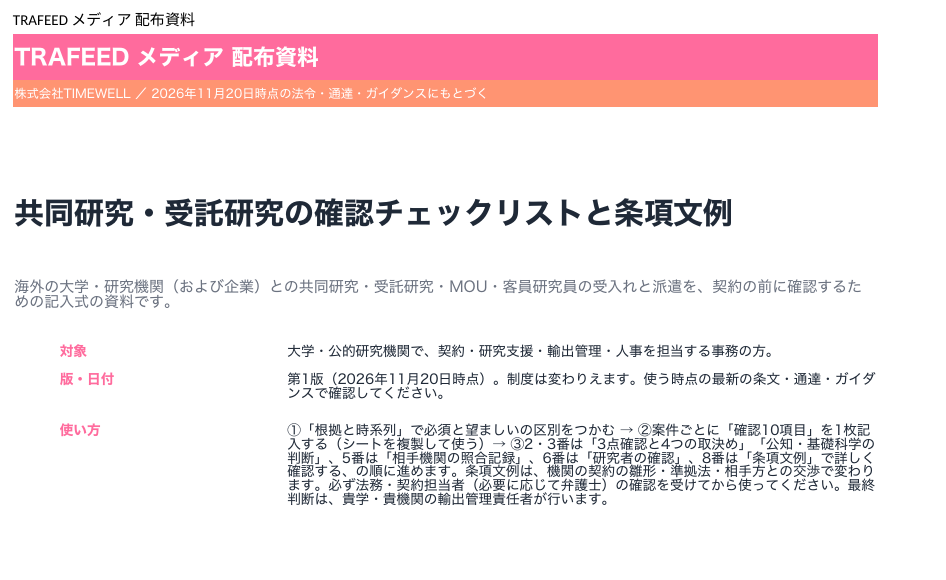
Joint-Research Contract Checklist and Clause Templates (editable Excel)
A ten-item pre-contract checklist, counterparty screening log, questionnaire and seven clause templates, plus four scenarios with domestic partners and a shipment log with six MTA clauses for samples, equipment and data (Japanese only; legal review required).
Get the fileYou can download it after a short form (Japanese).
Hello, this is Ryuta Hamamoto from TIMEWELL.
Picture this. A professor walks into the research support office with a draft agreement for joint research with an overseas university. The partner is a lab they have worked with for years, and they want to start joint experiments next month. The draft is almost entirely the partner's own template. It has confidentiality and ownership-of-results clauses, but nothing on export control. The staff member is not in contracts or legal, and there is nobody to ask what they should be looking at.
Joint and sponsored research contracts are where academic freedom and technology control run into each other. What goes into the contract decides most of what happens later. Notice an export control or research security problem only after the contract is signed, and what you can still change is no longer the clauses but the way the research is run.
The subject here is how to check joint research, sponsored research, MOUs, and the hosting and sending of visiting researchers with overseas universities and research institutions (and companies) before anything is signed, laid out in the order the work actually happens. It is written for administrative staff at universities and public research institutions who handle contracts, research support, export control or HR. The 10-item checklist, the partner screening steps, sample contract clauses and the points of care for researchers are all here in one place.
The conclusion first
- Before signing, check whether the technology you will provide is controlled, whether there is any concern about the partner, and how the results can be published.
- For Specified Research and Development Programs, the Cabinet Office procedures manual says it is necessary to check four points: the content of the collaboration, access to data, intellectual property and confidentiality.
- Check researchers by where they live and what relationships they have, not by nationality. Use the same procedure for everyone who handles the technology, and pair every explanation with consent.
- Checks remain even when the partner is a Japanese company or university: whether any of their participants are non-residents or fall under a specific category, whether they will move results or samples abroad, whether you host their researchers, and whether samples or equipment go abroad through them (see below).
- When you send samples, equipment or data, decide whether it is an export of goods or a provision of technology by what is being sent, not by the name of the agreement (an MTA or otherwise) (see below).
How FEFTA and the procedures manual fit together, and the timeline from first enquiry to close-out
Before any checking starts, settle the sources and the order. If you cannot say which steps are legal obligations and which are only desirable, you cannot explain them to the partner or to colleagues on campus. I first sort out the different nature of the sources, the penalty figures and how technology controls relate to joint research, and then set out the timeline from first enquiry to close-out as a table.
Keep the three sources separate
The grounds for reviewing a contract come in three kinds, and they are different in nature. Mix them up and nobody can tell whether something is "required" or merely "desirable," and the people doing the work stall.
The first is the Foreign Exchange and Foreign Trade Act (FEFTA, 外為法). It is a legal obligation, and violations carry penalties. Transactions that provide controlled technology (特定技術) in a foreign country, or to a non-resident, require a license from the Minister of Economy, Trade and Industry (FEFTA Article 25(1)). Paragraph 3 of the same article states that a license obligation may also apply to taking storage media out of the country and to sending technology by telecommunications1.
The second is the Cabinet Office's "Procedures for Measures to Ensure Research Security" (December 2025), which I will call the procedures manual. It separates the minimum measures research institutions must take, written as "necessary," from measures it would be "desirable" to take. Its scope, however, is limited to applying for or taking part in "Specified Research and Development Programs" designated by the competent ministries2. Not every joint research project running in a lab is in scope.
The third is the institution's own rules. Whatever level the law or the manual demands, an institution can decide for itself that "contracts with overseas institutions go through this check first." Many institutions run day-to-day practice on this third basis.
FEFTA penalties, in numbers
I checked the penalties and will write them out in figures. Providing controlled technology without a license is punishable under Article 69-7(1) of FEFTA by imprisonment of up to seven years, a fine of up to ¥20 million, or both. For technology related to the development of nuclear weapons and the like that is specified by Cabinet Order, paragraph 2 of the same article raises this to imprisonment of up to ten years, a fine of up to ¥30 million, or both. Article 72 applies to corporations, with fines of up to ¥700 million for a violation of Article 69-7(1) and up to ¥1 billion for a violation of paragraph 2 (in both cases, where five times the value of the subject matter exceeds that ceiling, the fine can be up to five times the value)1.
Older materials sometimes give the penalty provision as "Article 69-6." In the current text, which we checked on e-Gov on 20 November 2026, Article 69-6 is a provision on transitional measures, and the penalties are in Article 69-7. The numbers have moved down by one, so when you cite them in internal rules or notices, use the current numbering.
How FEFTA's technology controls apply to joint research
First, what does "research collaboration" mean in FEFTA's terms? When your institution gives drawings, data, programs, experimental procedures or technical guidance to researchers at an overseas partner in joint research, that is provision of technology. If the recipient is abroad or is a non-resident, a license is required when the technology falls under list controls. How this connects with the Services Circular (役務通達, formally "Regarding Transactions or Acts Providing Technology That Require a License under Article 25(1) of the Foreign Exchange and Foreign Trade Act and Article 17(2) to (4) of the Foreign Exchange Order") is explained in our guide to service transactions and the Services Circular3.
Three points are worth holding on to.
First, email, shared cloud folders and screen sharing in web meetings all count as provision if the content is controlled technology. Even if you never hand it to the contracting party directly, putting it where the partner's researchers can reach it is likely to be treated as provision.
Second, even when the recipient is a resident, provision to someone who falls under a specific category (a person under strong influence from a foreign government or the like, or from a foreign corporation) is subject to deemed export controls. This matters when you think about visiting researchers and joint research participants. I come back to it later.
Third, exporting samples and equipment is regulated separately from providing technology (as an export of goods under FEFTA Article 48). When joint research involves sending samples or equipment, check the classification of the goods as well as the technology. Carrying out or shipping storage media that hold controlled technology, such as programs or data, or sending it electronically, is regulated on the technology side instead (FEFTA Article 25(3); see the first point above)1.
The whole picture, as a timeline
Put the checks before the contract. Once it is signed, very little can still be moved. The table below shows a standard timeline from first enquiry to close-out. The durations are our own guide, not something set by law or by the manual.
| Stage | Guide | Who | What to do | Record to keep |
|---|---|---|---|---|
| Enquiry | Within a week of receiving the draft contract | Researcher, research support | Summarize on one page the purpose of the research, what will be provided, the partner and the participants. Decide the type of contract | Enquiry memo (case summary) |
| Pre-contract | Weeks 2 to 4 | Export control, research support, contracts, legal | The 10-item check. Partner screening. Drafting clause amendments. Participant checks | Classification record, screening record, clause checklist, consent forms and pledges |
| During the contract | Contract term | Researcher, IT | Access control, checks when participants change, notice before results are published, half-yearly review | Access rights register, change log |
| Close-out | Around the end date | Researcher, contracts | Confirm return and destruction, remove access rights, check published outputs | Close-out checklist, certificate of destruction |
Notice that the checks cluster in weeks 2 to 4, before signing. Negotiations with the partner go more smoothly when the checks are done first, because you go in with your reasons for any clause changes already in hand: "the procedures manual requires us to check this," or "we cannot provide this until a license is granted."
The 10-item checklist
The table below is the core of this article. Fill in one sheet per case before the contract. The "Who" column is written by role so a two-person office can use it. If one person covers several roles, have someone else handle at least classification and approval, so the decision does not rest on a single view. A version of these ten items you can fill in per case, together with a partner screening log, a questionnaire and the seven sample clauses, is in our joint-research contract checklist and clause templates (Excel, in Japanese).
| No. | Item | Who | When | What to check | Record |
|---|---|---|---|---|---|
| 1 | Type of contract and what will be provided | Researcher, research support | At enquiry | Joint research, sponsored research, MOU, hosting or sending. A diagram of how technology, data, samples and people flow | Enquiry memo |
| 2 | Classification of the technology to be provided | Export control, researcher | Pre-contract | Whether the technology, programs, data and samples fall under list controls in the Appended Table to the Foreign Exchange Order | Classification record |
| 3 | Where the publicly-available and basic-science exceptions apply | Export control | Pre-contract | If the technology is controlled, how far Article 9(2)(ix) and (x) of the Non-Trade Transactions Ordinance can explain the provision | Decision memo |
| 4 | End use and end user | Export control | Pre-contract | Whether there is any concern that the partner's use involves developing weapons of mass destruction or conventional weapons. Plans for re-transfer | Questionnaire response |
| 5 | Partner institution check | Research support, export control | Pre-contract | Screening against the End User List and the US Consolidated Screening List. Control relationships, finances, track record | Screening record |
| 6 | Participating researcher check | Research support, HR | From before the contract until the person joins the project | Residency, specific categories, declared information, consent forms and sworn statements | Consent forms, sworn statements, pledges |
| 7 | Funding, supporters and conflicts of interest | Research support, COI office | Pre-contract | Source of funds, conditions attached, overlap with other funding or affiliations | Disclosure forms, COI check form |
| 8 | Contract clauses | Contracts, legal | Pre-contract | Seven clauses: publication of results, confidentiality, data, intellectual property, export control, subcontracting, suspension | Clause checklist |
| 9 | Access control for data, samples and facilities | Researcher, IT | Before the research starts | Who can get in, from where, and to what. How things are shared | Access rights register |
| 10 | Return, destruction and follow-up at close-out | Researcher, contracts | At close-out | Return and destruction, removal of access rights, checks on published results | Close-out checklist |
Decide what you are handing over first (items 1 to 4)
Item 1 looks unglamorous, but it does the most work, because technology flows differently depending on the type of contract.
In joint research, both sides contribute technology and data. In sponsored research, your institution takes funding or a research question from the partner, does the research and delivers the results. There, reporting the results is itself provision of technology to the partner. An MOU is usually a document confirming an intention to cooperate, and is often only weakly binding or not binding at all. But if the MOU says "the parties will exchange data," actual technology transfer happens under the MOU's name. When technology or data is actually going to change hands, the safer practice is to conclude a separate, specific contract alongside the MOU. Hosting and sending visiting researchers is provision through people. The flow of people is covered later in this article, in the section on checking the researchers you host and send.
List what you will hand over at this point. Experimental data that has not yet become a paper, design drawings for equipment, analysis source code, experimental protocols, samples. Write down where it will be shared, too. By email attachment, through a shared drive, or by going to the partner's lab and explaining it in person?
Item 2, classification, is done for each piece of technology to be provided. You cannot make one blanket call "because it is joint research." For the list-control classification itself, the institution's export control staff, or the researcher, explains what the technology is, and the researcher and staff compare it against the Appended Table to the Foreign Exchange Order together. If in doubt, consult METI's help desk or a specialist the institution has engaged.
Item 3, where to draw the line, is the point where research institution administrators get stuck most often, so I will spend a little longer on it.
Drawing the line on the publicly-available and basic-science exceptions
Article 9(2) of the Non-Trade Transactions Ordinance lists service transactions that do not require a license. Item (ix) concerns publicly available technology, and item (x) concerns research activities in basic science4.
Item (ix) covers transactions that provide publicly available technology, or that provide technology in order to make it publicly available. It lists, among others: providing technology already made available to an unspecified large number of people through newspapers, books, magazines, files on telecommunications networks and so on; providing technology that an unspecified large number of people can obtain, such as academic journals and published patent information; providing technology at venues such as lectures that an unspecified large number of people can attend; and transactions aimed at making technology obtainable or viewable by an unspecified large number of people, such as manuscripts for conference presentations or submissions to journals. The key point is a parenthetical that excludes transactions that make technology publicly available for the purpose of providing it to specific persons.
Now apply that to joint research contracts. METI's Q&A for universities and research institutes (February 2021; I will call it the Q&A for universities) says that making technology obtainable or viewable by an unspecified large number of people through papers or conference presentations is provision in order to make technology publicly available, and that no license to provide technology is needed even for list-controlled technology. It also says, however, that where conference participants are bound by confidentiality, for example, the provision is not necessarily all aimed at making technology publicly available, and that a license is required where the exception does not apply (Q&A for universities, Q12)5. Our explainer on METI's Q&A is technology provision at universities and research institutes and the publicly-available exception (in Japanese).
In joint research practice, it helps to read it three ways. In joint research premised on publishing the results in papers or at conferences, if you share data and manuscripts to the extent needed for publication, much of it can be explained under item (ix). But sharing before publication means that, until publication, only the partner's researchers have it. Whether it can be treated under the exception depends on whether what you share actually stays within what will be published.
What will not be published, such as equipment designs, unpublished manufacturing conditions or how samples are made, cannot be explained under item (ix), even in research premised on publication. If it falls under list controls, check whether a license is needed. And in sponsored research where the results are delivered only to the sponsor and not published, the item (ix) exception cannot be used, because the purpose is to provide technology to a specific party.
On item (x), research activities in basic science, METI's Q&A describes them as research activities whose main purpose is to elucidate the principles of phenomena in the natural sciences and that are not aimed at designing or manufacturing a specific product. This definition uses the same wording as Services Circular 1(3)(ku)6. METI also answers that transactions providing technology on the use of equipment needed as part of research activities in basic science, to the minimum extent necessary, are understood not to require a license (METI "Technology-related" Q&A, Q2-5, Q2-7 and Q2-15; we checked the original on 21 November 2026; these Q numbers are not from the Q&A for universities)7. Our explainer is the article on exceptions that do not require a license (in Japanese).
The basic-science exception is not decided by calling something "research." It is decided by purpose. Sponsored research funded by a company and aimed at developing a specific product may not count as research activities in basic science, even when a university carries it out. A researcher's own sense that "this is basic research" does not settle whether the exception applies, and the answer to Q6 of the Q&A for universities is built the same way. Q6 says that where work cannot be called research activities in basic science, a license application is needed if the research content and the technology provided fall under list controls or catch-all controls.
In practice, decide in this order and keep a decision memo.
- Does the technology to be provided fall under list controls? If not, you can stop here (the end use and end user checks continue under item 4).
- If it does, is the provision aimed at publication? If so, check how much can be explained under item (ix).
- If the provision is not aimed at publication, can it be explained as research activities in basic science, kept to the minimum necessary extent (item (x))? Does the purpose include designing or manufacturing a specific product?
- For anything that fits neither, check whether a license is needed, apply if it is, and do not provide it until the license is granted.
Item 4, end use and end user, is checked even for technology outside list controls, because the objective requirements of catch-all controls (the end-use requirement and the end-user requirement) come into play. Is it evident that the partner's research will be used for developing weapons of mass destruction or conventional weapons? Is the partner on the End User List? This links to the explainer on the objective requirements (in Japanese) and to the screening steps in the next section.
Confirm who you are working with (items 5 to 7)
Item 5, the partner check, is covered in detail in the next section. For now, just note where the manual stands. For partner institutions other than Japanese universities, inter-university research institutes, colleges of technology, national research and development agencies and public testing and research institutes, the manual says it is "desirable" for the lead research institution to check the purpose of the joint research, the partner's track record in the field (the past three years, including the fiscal year in which the application is made), its financial position (capital structure, for companies) and whether it appears on lists, and to carry out due diligence2. In other words, the manual too expects joint research with overseas universities and companies to be checked. But this is at the "desirable" level.
Item 6, participant checks, involves care for people, so it gets its own section.
Item 7, funding and conflicts of interest, matters especially in sponsored research and in joint research funded by overseas companies or institutions. For individuals and organizations that provide grants, donations, goods or the like for the research (supporters), the manual says it is "desirable" to check the content of the support, its purpose and conditions, the supporter's financial position and whether it appears on lists. The purpose-and-conditions item carries a note that checking whether anything is asked for in return is one possible approach2. Declaring sources of research funding and affiliations is covered in detail in our articles on undisclosed foreign funding and affiliations and COI and COC disclosure in practice.
Settle the contract and how it will run (items 8 to 10)
Item 8, the clauses, is covered with templates in the section after next. Item 9, access control, cannot be settled by the contract alone. The contract says "only persons listed in the research plan may have access," and the actual permissions are set through shared drive settings and the accounts you issue. If the two do not match, you are protected on paper but not in reality.
Item 10, close-out, is decided before you start. Put return and destruction obligations in the contract, actually ask for them at the end, get proof of destruction, and remove access rights. Decide at contract time, too, that after the end you will check the partner's patent filings and publications every six months to a year.
Replace siloed classification work with AI.
METI's FY2024 data shows 52% of foreign exchange law violations stem from classification errors. Download the TRAFEED product catalog covering features and rollout.
Checking the partner institution: steps and records
Item 5 of the checklist, checking the partner institution, is covered in three parts: the screening steps, how to read the results, and a questionnaire for the partner. A clean result against the lists does not end the check. Recording the name variants you searched and the date is part of the procedure.
Screening steps
The approach to partner screening is the same as in our guide to customer due diligence (end-user screening) in practice. I have reordered the steps to suit research institutions.
As information sources usable for due diligence, the manual lists self-declared information, open-source information, academic literature databases (such as Web of Science and Scopus), portals such as Google Scholar, research databases such as e-Rad, the KAKEN database (Grants-in-Aid for Scientific Research) and researchmap, intellectual property databases such as J-PlatPat, METI's End User List and the US Consolidated Screening List2.
| Step | What to do | Where to look | What to record |
|---|---|---|---|
| 1 | Pin down the partner's official name, address, English name and local-language name | Draft contract, the partner's official website, the signatory's title | Name as written, address, date checked |
| 2 | Screen against the End User List | The list published on METI's website | Date screened, version of the list (publication date), result |
| 3 | Screen against the US Consolidated Screening List | The US government's published site | Date screened, result, spellings searched |
| 4 | Check for spelling variants | Abbreviations, former names, local-language names, affiliated organizations | List of spellings searched |
| 5 | Check control relationships | Official website, published ownership, press reports | What was checked, and what could not be checked |
| 6 | Check the purpose of the joint research and the partner's track record | Literature databases, researcher databases | Co-authorship over the past three years, whether research themes are consistent |
| 7 | Decide on the result and have the approver sign | Internal form | Decision (no issue, further checks, put on hold) and reasons |
Watch for spelling variants when screening. Universities and research institutions turn up under abbreviations, former names, several language versions and the names of affiliated institutes. Do not search only the English name on the official website and conclude "no match." Search the local-language name, former names and affiliated institutes too, and record the spellings you used.
The other point that needs care is control relationships. A note in the manual says, about the US Consolidated Screening List, that institutions not on the list may be subject to the same restrictions as listed ones if they are owned by listed institutions or individuals, so it is desirable to check this as well2. At research institutions, this check comes up less for the university itself than for its links with affiliated companies, companies set up to commercialize research results, foundations that provide funding, and so on.
Reading the results
Read screening results consistently with our other articles. Appearing on the End User List is an export control classification. It is not a finding that the institution or its researchers have done anything wrong. Nor does the check end just because there is no listing. METI's Q&A for universities (Q23) asks you to check whether brochures, catalogues, contracts and other documents obtained from the counterparty state that it develops (or has developed) nuclear weapons and the like, and treats the End User List as one useful source of information for that. A counterparty that is not on the list can still meet the end-user requirement because of what the documents you have obtained say. Our explainer is how to read the End User List (in Japanese).
Where there is a listing, work out the response case by case, along these lines. Providing technology to a listed institution may already require a license if the technology is list-controlled. Even for technology outside list controls, a license application may be needed under catch-all controls unless it is clear, from the use and the terms of the transaction, that there is no concern. Here, consult your institution's export control officer and METI's help desk. Do not decide mechanically that "listed means we stop," or that "a listing has nothing to do with research." Set the technology, the use and the counterparty side by side, decide, and record your reasons. That comes closer to what the manual calls "reasonable measures proportionate to the level of risk."
Sample partner questionnaire
Below is a sample questionnaire for the partner institution. Adapt it to your institution's circumstances, on the assumption that legal and export control staff will review it. It does not ask about individual researchers' careers in detail; it asks the institution to answer as an institution.
Template (questions for the partner institution; based on the Japanese system, to be reviewed by your legal team)
Before concluding this joint research agreement, we would be grateful if you could tell us the following about your institution's operations and research management. We will use your answers only to review this agreement and will not disclose them to third parties except as required by law.
- Your institution's official name (English name, local-language name, former names) and address
- Your institution's form of establishment (national, public, private, corporate research laboratory, etc.) and main sources of funding
- If your institution receives investment from, or is controlled by, another organization, the name of that organization
- The names, affiliations and roles of the researchers expected to take part in this joint research (for names, the extent listed in the annex to the joint research agreement is sufficient)
- Whether your institution plans to provide the results of this joint research to third parties (government bodies, companies, etc.)
- Whether your institution is listed on, or has received an enquiry about listing on, any regulatory list relating to export control in Japan, the United States or elsewhere
- Where the technology, data and samples received in this joint research will be stored, and who will have access to them
- Whether you plan to subcontract any part of this joint research
- Whether your institution has rules on research data management and information security
- Confirmation that the results of this joint research will not be used for developing weapons of mass destruction or conventional weapons
So that item 10 does not cause offence, it helps to add a line presenting it as standard practice: "We ask all of our joint research partners to confirm the same points." That line, which shows you are not singling out any particular country or institution, also serves as evidence that the process is neutral.
What goes where in the contract: sample clauses
Item 8, the contract clauses, starts with a table matching the manual's four points to clauses, then moves on to seven sample clauses. The samples turn the points to check into clause form. Read them on the understanding that you will adapt them to your institution's templates and the negotiation with the partner, and have them reviewed by legal and contracts staff.
How the clauses map to the manual's four points
The four points the manual asks you to check in contracts are the content of the collaboration, access to research data and the like, the handling of intellectual property such as inventions and patents, and the content of confidentiality obligations. It says checking that these are appropriate is "necessary" both for the lead research institution and for partner institutions2. The table below maps the seven clauses in this article to those four points.
| What the manual asks you to check | Corresponding clauses | What to check |
|---|---|---|
| Content of the collaboration | Purpose and scope (at the start of the contract), subcontracting, suspension | Scope of the research, division of roles, participants, whether work may be subcontracted to third parties |
| Access to research data and the like | Data handling, export control | Who can see what, and from where. Taking data out and storing it in third countries |
| Handling of intellectual property such as inventions and patents | Intellectual property, publication of results | Ownership, joint filing, coordination with publication, third-party rights |
| Content of confidentiality obligations | Confidentiality, publication of results | Scope, duration, exceptions, return and destruction |
| (A perspective outside the manual) | Export control, suspension | Holding back provision where a license is needed, prohibition of re-transfer, grounds for termination |
Note that the manual's four points do not prescribe what the contract must say. What they require is that you "check" whether the content is appropriate. Clause wording will vary with each institution's contract templates, the negotiation with the partner and the governing law. The templates below simply put the review points into the shape of clauses.
Everything that follows is a template based on the Japanese system. Have it reviewed by your legal and contracts staff, and by a lawyer if needed, and do not adopt it as it stands. Set the numbers and day counts in brackets to suit your institution.
Publication of results
Template (publication of results; based on the Japanese system, to be reviewed by your legal team)
Article [X] (Publication of Results)
1. Each party may publish the results of the Research in academic papers, at conferences or by other means.
2. A party intending to publish (the "Publishing Party") shall notify the other party in writing (including by email; the same applies below) of the content to be published no later than [X] days before the scheduled date of publication.
3. Within [X] days of receiving the notice under the preceding paragraph, the other party may request in writing, with reasons, that publication be postponed (for no more than [X] days) or that the relevant part be deleted, but only where either of the following applies:
(1) the content to be published includes the other party's Confidential Information; or
(2) publication may cause an opportunity to file a patent application to be lost.
4. Where a request under the preceding paragraph is made, the parties shall consult in good faith. The other party may not stop publication for any reason other than those listed in the items of the preceding paragraph.
5. Before publication, the Publishing Party shall confirm that the content to be published does not include any technology that requires a license under applicable laws and regulations.
There are three points here. First, the restrictions on publication are kept to the minimum. Academic freedom and the publication of results are at the heart of universities and research institutions, and restrictions that are too broad erode the value of the research itself. Second, a prior-notice requirement lets you check, before anything is published, that no confidential information has slipped in and that patent filing opportunities are protected. Third, paragraph 5 makes each party responsible for checking whether anything that needs a license has found its way into the published material. Research premised on publication does not mean the unpublished parts also fall under the publicly-available exception.
Confidentiality
Template (confidentiality; based on the Japanese system, to be reviewed by your legal team)
Article [X] (Confidentiality)
1. Neither party shall use information disclosed by the other party that is marked as confidential in writing or by electronic means, or that is disclosed orally and notified in writing as confidential within [X] days of disclosure ("Confidential Information"), for any purpose other than the Research, nor disclose it to any third party without the other party's prior written consent.
2. Notwithstanding the preceding paragraph, each party may disclose Confidential Information, to the extent necessary, only to persons listed in the annex as participants in the Research. In that case, the disclosing party shall impose obligations equivalent to those in this Article on the recipients and shall be responsible for their compliance.
3. Confidential Information does not include information that falls under any of the following:
(1) information that was already publicly known at the time of disclosure, or that becomes publicly known after disclosure through no fault of the recipient;
(2) information already held by the recipient at the time of disclosure;
(3) information lawfully obtained from a third party without any obligation of confidentiality; or
(4) information developed independently without use of Confidential Information.
4. A party required by law or by an order of a court or administrative authority to disclose Confidential Information shall notify the other party in advance, to the extent permitted by law.
5. The obligations in this Article shall survive for [X] years after the termination of this Agreement, provided that, for information that constitutes a trade secret, they shall survive until that information becomes publicly known.
Paragraph 2 limits who may receive disclosures to the participants listed in the annex. If you list the names of lab students and cooperating staff in the contract annex and have changes notified, this lines up with how the manual manages "research participants." University students are often not covered by work rules, so the options are to ask them for a pledge covering confidentiality and ownership of results, or to give them an employment contract. This is covered in our article on student participation and employment contracts.
Data handling
Template (handling of research data; based on the Japanese system, to be reviewed by your legal team)
Article [X] (Handling of Research Data, etc.)
1. Each party shall store and manage the research data, programs, samples and other information shared in the Research ("Research Data, etc.") by the methods and at the locations specified in the research plan.
2. Access to Research Data, etc. shall be permitted, to the extent necessary, only to participants whose names are listed in the research plan. The granting and changing of access rights shall be recorded in writing.
3. Neither party shall copy, store or take Research Data, etc. to any location other than those specified in the research plan without the other party's prior written consent. The extent necessary for publication in papers or at conferences is governed by Article [X] (Publication of Results).
4. On learning of a leak, loss or other incident involving Research Data, etc., or of a risk of one, each party shall notify the other party without delay (and in any event within [X] business days) and take the measures necessary to prevent further harm.
5. On the expiry or termination of this Agreement, each party shall, at the other party's request, return or erase the Research Data, etc. and certify the erasure in writing.
If access and storage locations are written into the research plan, the contract itself stays stable, and when the research moves on and sharing methods change, updating the research plan is enough. Record each update to the research plan in writing. When you set the number of days for notice in paragraph 4, align it with the incident reporting deadline in your institution's information security rules.
Intellectual property
Template (intellectual property; based on the Japanese system, to be reviewed by your legal team)
Article [X] (Intellectual Property)
1. Intellectual property held by each party before the conclusion of this Agreement, or acquired independently of the Research ("Background IP"), belongs to that party. This Agreement does not grant any license to use Background IP.
2. Of the inventions and the like relating to the results of the Research, those made solely by the participants of one party belong to that party. Those made jointly by participants of both parties are jointly owned, with shares determined through consultation according to contribution.
3. Filing, maintaining and licensing to third parties the right to obtain a patent for jointly owned inventions and the like shall be done after prior consultation with, and with the written consent of, the other party.
4. Neither party shall grant or promise to any third party rights in the results of the Research that conflict with this Agreement.
5. Coordination between publication in papers or at conferences and patent filing is governed by Article [X] (Publication of Results).
Paragraph 4 is there to prevent what is sometimes called double contracting. If, through other funding or other joint research, the results end up promised to more than one party, the contract stops working. The clause is not written with any particular country or institution in mind. It applies to all joint research alike.
Export control
Template (export control; based on the Japanese system, to be reviewed by your legal team)
Article [X] (Export Control)
1. Each party shall comply with the laws and regulations on export control that apply to the Research (including Japan's Foreign Exchange and Foreign Trade Act and the orders made under it).
2. Before providing the other party with technology, data, samples or other items that require a license or other procedure under law ("Controlled Items"), a party shall carry out the necessary checks on its own responsibility. It may withhold Controlled Items until any necessary license is obtained, and shall not be liable for any delay to the research caused by withholding them.
3. The receiving party shall not re-transfer Research Data, etc., samples or other items it receives to a third country, or use them for any purpose other than the Research, without the prior written consent of the providing party.
4. Neither party shall use, or allow others to use, Research Data, etc. provided to it for developing weapons of mass destruction or conventional weapons.
5. Each party shall notify the other party without delay of any fact that affects the continuation of the Research, such as the listing of itself or its participants on a regulatory list relating to export control, or a material change in its organizational control.
6. Each party may suspend provision of Research Data, etc., to the extent necessary, where it receives a notice under the preceding paragraph or reasonably determines that there is a risk of a breach of this Article.
7. If either party becomes aware of a suspected violation of the Foreign Exchange and Foreign Trade Act or other export control laws in connection with the Research, it shall promptly notify the other party and report to the relevant authorities in accordance with law.
This clause is mapped to the four measures that METI's university guidance (5th edition) asks for when conducting joint research: (1) an agreement or pledge prohibiting unlicensed re-provision to third parties of technology that could be used to develop weapons of mass destruction or conventional weapons; (2) treating non-compliance as a breach of contract and stopping further transactions; (3) providing technology that needs a government license only after the license is obtained; and (4) promptly reporting any suspected FEFTA violation to the relevant authorities (pp. 83–84)8. Paragraphs 3 and 4 correspond to (1), paragraph 6 and the termination clause below to (2), paragraph 2 to (3), and paragraph 7 to (4).
Paragraph 2 is the most useful one in practice. If the contract says provision can be held back until a license is granted, with no liability for the resulting delay, it protects you contractually against researchers who, under schedule pressure, would otherwise hand the technology over before the license comes through. Paragraph 4 is worded so as not to offend the partner. If the partner is a civilian university, there is normally no objection. If there is one, asking why is itself part of the check.
Subcontracting
Template (subcontracting; based on the Japanese system, to be reviewed by your legal team)
Article [X] (Subcontracting)
1. Neither party shall subcontract all or part of the Research to a third party without the other party's prior written consent.
2. A party seeking consent under the preceding paragraph shall notify the other party in writing of the subcontractor's name and address, the work to be subcontracted and the scope of Research Data, etc. the subcontractor will handle.
3. Where work is subcontracted to a third party with consent, the subcontracting party shall impose on the subcontractor obligations equivalent to those in this Agreement on confidentiality, data handling, intellectual property and export control, and shall be responsible for the subcontractor's acts.
4. The other party may carry out the necessary checks on the subcontractor and may refuse consent only where it has reasonable grounds.
Checking "the content of the collaboration" under the manual also means looking at whether there is subcontracting. Once third parties who actually carry out the research are added beyond the contracting parties, the scope of access, intellectual property and export control checks all widen.
Suspension and termination
Template (suspension and termination; based on the Japanese system, to be reviewed by your legal team)
Article [X] (Suspension and Termination)
1. Either party may suspend all or part of the Research by notifying the other party in writing where any of the following applies:
(1) the other party breaches, or there is a risk that it will breach, the provisions of this Agreement on confidentiality, data handling or export control;
(2) a license or other procedure necessary to carry out the Research cannot be obtained;
(3) the other party is placed on a regulatory list relating to export control, and continuing the Research may violate the law;
(4) there is a material change in the other party's control that may hinder the continuation of the Research; or
(5) a person not listed in the annex accesses Research Data, etc. without authorization.
2. Where the Research is suspended under the preceding paragraph, the parties shall promptly consult and consider the measures needed to resolve the cause of the suspension.
3. If the cause is not resolved within [X] days of the date of suspension, either party may terminate this Agreement.
4. After the expiry or termination of this Agreement, Article [X] (Confidentiality), Article [X] (Intellectual Property) and the provisions on return and erasure in Article [X] (Handling of Research Data, etc.) shall remain in effect.
This template keeps suspension and termination apart. Rather than terminating straight away, you suspend first, then consult, then terminate if the problem cannot be resolved. Two steps like this make it easier to keep the partner's trust, and they lighten the load on researchers. Part 2 of our explainer on METI's technology leakage guidance, which covers Chapter 4, also lists grounds for termination, audits, and return and destruction as matters for the contract stage.
Researchers, domestic partners and shipments
Even with the contract clauses in order, technology moves through people and things. Researchers you host and send, flows that pass through Japanese companies or universities, and shipments of samples, equipment and data all happen outside the contract. In the ten-item checklist, item 6 (participants), item 9 (access control) and item 10 (close-out) come in here. Checking people needs the most care, so it comes first, followed by domestic partners and then shipments.
Checking researchers you host and researchers you send
Checking visiting researchers, hosted researchers and researchers you send abroad is the part that calls for the most care for the people involved. Let me set out the premise first.
Look at residence and relationships, not nationality
The manual states that, in judging whether a counterparty is a trustworthy partner, there must of course be no discriminatory treatment on grounds such as nationality, race, religion or culture2. FEFTA's deemed export controls are not built on nationality either. Whether someone is a resident or a non-resident depends on where they live or where their office is, not on their nationality. METI's university Q&A (February 2021) treats international students who have been in Japan for less than six months as non-residents (Q18), and says they are treated as residents once more than six months have passed since they entered the country (Q19)5. Our explainer is the Q&A on residency and catch-all controls (in Japanese).
Even for residents, providing technology to someone who falls under a specific category is a deemed export. The specific categories are defined as three types in Services Circular 1(3)(sa): (1) persons who, under a contract with a foreign corporation or the like or a foreign government or the like, are subject to its direction and supervision or owe it a duty of care (excluding, for example, cases where it has been agreed that the direction of a Japanese corporation takes priority); (2) persons who receive, or have agreed to receive, money or other benefits from a foreign government or the like amounting to 25 percent or more of their annual income; and (3) persons who receive instructions or requests from a foreign government or the like regarding their conduct in Japan6. Among the items to be checked in due diligence (whether a person is a non-resident or falls under a specific category), the manual gives as examples a professor at a Japanese university who has an employment contract with a foreign university and holds a concurrent professorship there, an international student whose study is funded by a foreign government, and a researcher who takes part in a foreign talent recruitment program and receives large amounts of research funding or living expenses2. What is described here is not "foreign nationals." It is "people under strong influence through a relationship with a foreign organization." Japanese researchers can fall under a specific category too. A professor or similar who holds a post at a foreign university, has come to Japan on sabbatical and has become a resident falls under Category 1, whether or not they have an employment relationship with the Japanese university (Deemed Export Q&A, Q64)9.
In "Clarifying the Operation of Deemed Export Controls," METI writes that the specific categories are only a typology of cases that need to be checked individually in screening, and that falling under a specific category does not mean the person is regarded as a security concern (we checked this against page 3 of the original on 21 November 2026. A related statement is Q59 of METI's Deemed Export Q&A (revised 8 August 2023): METI does not envisage refusing a license across the board merely because a person falls under the specific categories). When you ask researchers to go through the check, open your explanation with this sentence.
Steps, and who does what
Splitting hosting checks among three parties, HR, research support and the host lab, keeps the load from landing in one place.
| Stage | Who | What to do | Points of care |
|---|---|---|---|
| Before the invitation is decided | Host lab, research support | Decide the research theme and the scope of technology the person will handle | Decide whether a check is needed by the scope of technology, not by nationality |
| After hosting is decided | Research support, HR | Work out residency (when they will arrive and how long they will stay) | If you ask the person about their circumstances, explain why you are asking |
| Before they handle technology | Research support, the researcher | Check the specific categories. Ask for a pledge | Ask everyone who handles technology, Japanese nationals included, using the same form |
| During the stay | Host lab | Limit access to the scope in the research plan | Do not treat people differently because their affiliation is different |
| At the end | Research support, host lab | Remove access rights, collect loaned items | Use the same exit procedure as for other staff |
On checks at the job-offer stage, Q24 of METI's Deemed Export Q&A (revised 8 August 2023) answers that checking, before hiring, whether a prospective hire falls under a specific category is acceptable if done with the person's voluntary cooperation, and that a pledge must then be obtained again after hiring. A pledge can be obtained without paper or a seal (Q33, Q35), and evidence that the person made the pledge or confirmation is normally enough to keep to its intent. A sample pledge form appears in Annex 1-4 of the Services Circular and may be modified as long as its intent is preserved (Q32)9. The detailed flow and templates for hiring are in what HR checks when hiring foreign faculty and researchers. Our explainer on METI's Q&A is the Q&A on deemed export checks and pledges (in Japanese), and an overview of the risks is in deemed export risks and countermeasures.
Template explanation for researchers
When asking for a pledge, the most common mistake is to hand over the paperwork and nothing else. The host lab's contact person can use the explanation below, either spoken or as a cover note. It is a template; adapt it to your institution and to your legal team's review.
Template (explanation for researchers; based on the Japanese system, to be reviewed by your legal team)
When we collaborate with overseas institutions or host researchers, [University/Institution name] asks everyone who will handle technology to go through the same check. Who is asked is not decided by nationality or origin, and we ask Japanese nationals exactly the same.
Japan's Foreign Exchange and Foreign Trade Act includes a mechanism for checking, when technology is provided, the recipient's residency and their relationships with foreign institutions. Even if the check shows that you fall under a specific category, that is a legal classification. It is not an assessment of you, and it does not mean you are regarded as a security concern. You can continue your research once the necessary procedures are in place.
We only ask you to confirm the items set out in the attached pledge. We will not use the information you provide for any purpose other than this check. If anything is unclear or hard to fill in, please contact the research support office ([contact details]). Please complete it before you start handling technology.
The last paragraph of this template matches the intent of the "consent form" in the manual. The manual says that when an institution receives a declaration of personal information from a researcher, it asks for a consent form covering the purpose of use and provision to third parties, and a sworn statement that the declared information is, to the best of the signer's knowledge, current and contains no falsehood or omission2. These, however, are procedures for risk checks under Specified Research and Development Programs. They are not meant to be applied mechanically to every researcher. Before you obtain any consent form or pledge, you explain to the person what it is for, what information is involved and who will receive it. The whole system runs on that premise. Sample forms that set out the manual's 13 check items (section 3-3) and the required content of the consent form and sworn statement as in the original are in our research security self-declaration, consent and sworn statement forms (Word, in Japanese).
Checking researchers you send abroad
When you send your own researchers to an overseas joint research partner, look at "what they take with them" and "what they will talk about there." METI's Q&A for universities (Q4) says that if drawings or technical data are taken on a business trip for one's own use, not given to anyone and brought back, this is not regarded as a transaction with a foreign party and is basically not a problem. If they are taken out in order to give to someone, a license to provide technology is needed if the technical data is list-controlled technology. Make "Will you give any data you take to anyone there?" an item on the travel application form, and the check becomes a natural part of the process.
When the partner is a Japanese company or university
A domestic partner does not remove the need for export control checks. There are fewer points than with an overseas institution, but these four remain.
| Situation | What to check |
|---|---|
| The partner's participants include non-residents or people in a specified category | Providing technology to them can be subject to deemed-export control even with a domestic partner. Check the participant list, regardless of nationality, for residency and the specified categories |
| The partner moves results or samples to its overseas sites or customers | Make re-transfer by the partner subject to prior written consent in the contract (paragraph 3 of the export control clause above) |
| You host commissioned researchers from the partner | Check each person for residency and the specified categories. The procedure is the same as in hiring foreign faculty and researchers; nationality is not the test |
| Samples or equipment are sent overseas through the partner | If the destination is abroad, check classification and the need for a license as an export of goods |
In commissioned research where you receive technology or samples from the partner, also plan ahead for the check you will need when the university later provides or exports what it received (for example, to an overseas institution, or to a non-resident or a person in a specified category). Article 10(2)(ii) of the model rules in the fifth edition of the guidance (the centralized-management example) provides that "faculty and staff who intend to provide technology or export goods obtained from outside the university/institution shall obtain a classification statement or similar from the source and carry out classification appropriately, as in the preceding item." A proviso says the university may skip obtaining it from the source if it can classify the item itself through the procedure in the preceding item (p. 108; in the decentralized-department, central-oversight example it is Article 11(2)(ii), p. 113). The guidance also asks universities to check the content of a classification statement on their own responsibility, even when it was obtained from outside (p. 57)10. Adding a sentence to the contract or the transmittal documents so that you can ask the partner for a classification statement when you receive the material saves work when you pass it on later (our proposal).
For a contract with a domestic partner, paragraphs 1–3 and 7 of the export control clause above cover most situations. Fields for these four situations are on the "domestic partner" sheet of our joint-research contract checklist (Excel, in Japanese), added in the second edition of 21 November 2026.
Sending samples, equipment or data (MTAs, international post and courier)
Joint research often involves sending samples, equipment or data to the partner. Samples are often covered by a Material Transfer Agreement (MTA), sometimes separate from the joint research agreement. The export control check turns on what is being sent, not on the name of the agreement.
| What is sent | Type of control | What to check |
|---|---|---|
| Samples (microorganisms, toxins, genes and so on), materials, equipment | Export of goods (FEFTA Article 48) | Which row of Appended Table 1 to the Export Trade Control Order applies. Row 3-2 (1), for example, covers organisms, toxins or their subunits, or genes used as raw materials for military bacteriological agents, as specified by ministerial ordinance11. Items outside list control can still be caught by catch-all controls. Even home-made measuring equipment needs an export license, even if it will be brought back, if it meets list-control specifications (Q&A for universities, Q3)5 |
| Data, programs, drawings (taken out on storage media, or sent by email or cloud) | Provision of technology (FEFTA Article 25; taking out storage media and sending by telecommunications fall under Article 25(3))1 | Whether it falls under the Appended Table to the Foreign Exchange Order, and whether the publicly available technology or basic science exceptions apply |
Clauses worth putting in an MTA (our suggestion; have your legal team review them). Where they overlap with the export control clause above, you can simply refer to it.
- Identification of the material (name, quantity, specifications; attach the classification result)
- Limiting use to the stated purpose, and not using it for developing weapons of mass destruction or conventional weapons
- No re-transfer to third parties or third countries without the provider's prior written consent
- The right to hold back provision until any required license or other procedure is complete
- Return or disposal at the end of the research, and a report on it
- Method of transport, and allocation of responsibility in transit
When sending by international post or courier, complete the export control procedure before dispatch. METI's self-assessment checklist for universities asks whether the institution follows export control procedures using its own forms when sending international post or courier items, and whether items cannot be dispatched until those procedures are complete (3-7, 3-7-1, 3-7-2)12. Couriers may explain the necessary procedures, but METI's Q&A for universities says classifying complex items such as test equipment is difficult for a courier, and is best done by someone who knows the item's specifications (Q5)5. Link the shipping record and the classification record in your case ledger. The "MTA and shipping" sheet of the same checklist has a shipping log with one line per item sent, and fields for the six MTA clauses.
Common misconceptions, and the limits of this article
To finish, here are the misconceptions that keep coming up in practice, and the range of what this article was able to confirm. Each of the six misconceptions comes from trying to settle the question on a single cue: an MOU, a plan to publish, the label "basic research," a listing, nationality, or the contract itself. And many failures come from missing records. Knowing what was confirmed tells you what you need to check again yourself in your own rules and case records.
Common misconceptions and mistakes
Here are six misconceptions that come up often in practice.
The first is "once we sign an MOU, we can exchange things freely." An MOU is often a document confirming an intention to cooperate. Even if it mentions exchanging technology or data, it does not let you skip the classification and license checks when you actually provide something. Conclude a specific contract at the point where technology or data actually changes hands.
The second is "we will publish it, so the publicly-available exception covers everything." Separate what will be published from what will not. Equipment drawings, how samples are made and unpublished measurement conditions shared during joint research cannot be explained under item (ix), even in research premised on publication.
The third is "it is basic research, so it is out of scope." Research activities in basic science are an exception under Article 9(2)(x) of the Non-Trade Transactions Ordinance, but the condition is that the purpose is not the design or manufacture of a specific product. For sponsored research with companies, check the purpose even if the research itself is fundamental.
The fourth is "if they are not on the list, we are safe." The End User List is one of the information sources used for checks (Q&A for universities, Q23). Institutions that are not listed can still meet the end-user or end-use requirement because of what the documents you obtain say, or because of the use. Screening is where the check starts, not where it ends.
The fifth is the practice of running "especially strict checks on foreign researchers." Neither the manual nor METI's framework contemplates distinctions by nationality. Treating people differently by nationality risks being discriminatory, and it does not fit the purpose of the system either. Use the same procedure for everyone who handles the technology.
The sixth is "it is in the contract, so we are covered." METI's guidance (the technology leakage guidance) itself says that contractual measures alone make it hard to reduce the risk of leakage through a partner taking samples out or misusing information. Run the contract together with the actual access settings, the sharing method and the close-out checks.
And many failures come from missing records. The manual states that where sufficient measures were taken and technology leakage still could not be prevented, the research institution or researcher does not bear responsibility. It also says that where there has been intentional false declaration or concealment, the government will need to respond2. Records are what let you show that you took those measures. Put the date, what was checked, who decided and why into a form, and keep it.
What we have not confirmed, and the limits of this article
This article is based on the following primary sources, checked as of 20 November 2026: the text of FEFTA Articles 25, 55-10, 69-7 and 72 (current version checked on e-Gov Law Search); Article 9(2)(ix) to (xi) of the Non-Trade Transactions Ordinance (checked on e-Gov); and the original of the Cabinet Office's "Procedures for Measures to Ensure Research Security" (December 2025) (checked by converting the PDF to text).
Here is what we have not confirmed, and what this article does not cover, source by source.
On 20 November 2026 we obtained from METI's website the originals of METI's Q&A for universities (February 2021), the Deemed Export Q&A (revised 8 August 2023) and the Services Circular (last amended by a notice promulgated on 14 November 2025, in force from 14 February 2026), and checked the Q numbers, the wording of the answers and the definitions. On 21 November 2026 we also checked in the original the "Technology-related" Q&A (Q2-5, Q2-7, Q2-15; last updated 23 April 2026) and page 3 of "Clarifying the Operation of Deemed Export Controls."
METI's technology leakage guidance mentioned in the text (Chapter 4, and the statement to the effect that contractual measures alone make it hard to reduce the risk of leakage through taking items out or misusing information) was checked in the original on 21 November 2026: Chapter 4, section 3 (pp. 144–150), and on p. 144, "contractual measures alone make it difficult to reduce the risk of technology leakage through the counterparty taking out samples provided or using information inappropriately." According to METI's page, the second edition was revised in April 2026. https://www.meti.go.jp/policy/economy/tech_leakage_prevention/pdf/guidance2.0.pdf.
The manual came into operation in April 2026. The Cabinet Office set April 2026 as the start of operation. The Acquisition, Technology and Logistics Agency's (ATLA) Innovative Science and Technology Initiative for Security has applied it from the FY2026 call, and the Japan Science and Technology Agency's (JST) Strategic Basic Research Programs apply it to projects newly selected in FY2026 in five CREST research areas. Details are in our article on building a research security function. As of 21 November 2026, we had not checked the Cabinet Office's page for any revisions to the manual since it came into operation. The manual covers Specified Research and Development Programs designated by the competent ministries. Check the call guidelines for what an individual call requires.
The sample clauses show a general approach. We have not checked them against any particular institution's templates, or their validity under any governing law. Always have them reviewed by legal and contracts staff.
The substance of FEFTA's Export Compliance Standards (appointing responsible officers and so on) sits not in the Act itself but in a METI ordinance. The text of the ordinance is checked against e-Gov in our two-person team article (Article 1(i)(a)–(b) and (ii)(a)–(j)). Whether your institution counts as an entity that exports or provides technology "as a business" under item (ii) is not covered in this article.
How the other country's laws (US re-export controls, for example) apply to technology received in joint research, or to technology provided from Japan, is outside the scope of this article. Handle it through checks with the partner and advice from specialists.
Record retention is a best-efforts obligation under the Export Compliance Standards ordinance (Article 1, item 2 (ri)). METI's guidance for universities (fifth edition, p. 71) says it is desirable to keep records relating to rows 1 to 4 of Appended Table 1 of the Export Trade Control Order and of the Appended Table to the Foreign Exchange Order for at least seven years, and those relating to rows 5 to 16 for at least five years. Set specific periods in your institution's document management rules with this in mind.
This article cannot decide classification, or whether a license is needed, in any individual case. Consult your institution's export control officer, METI's help desk or a specialist.
Regulations change. Writing the date of each check into the case record will help when you look back later.
What to read next
- What HR checks when hiring foreign faculty and researchers: checks on incoming researchers, in order from job posting to departure
- Building a research security function in 90 days: the whole process, from the responsible officer and rules to forms and emergency contacts
- METI's technology leakage guidance (Part 2): what to address at each stage of joint research, from planning and contracts to execution and close-out
- Students, RAs and employment contracts: pledges from students, and stronger governance through employment contracts
- Technology provision at universities and research institutes and the publicly-available exception (in Japanese): an explainer on METI's Q&A about the publicly-available exception
- Undisclosed foreign funding and affiliations: how to think about declaring funding and affiliations
- COI and COC disclosure in practice: running the process from declaration to verification
- Customer due diligence (end-user screening) in practice: the original model for list screening steps
If you want to put partner screening records and per-case checklists on a firmer footing, please contact us about TRAFEED.
Footnotes
-
Foreign Exchange and Foreign Trade Act (Act No. 228 of 1949), Articles 25, 55-10, 69-7 and 72. Current text on e-Gov Law Search (Digital Agency) (in Japanese). Checked 20 November 2026. https://laws.e-gov.go.jp/law/324AC0000000228 ↩ ↩2 ↩3 ↩4
-
Expert Panel on Ensuring Research Security and Research Integrity, "Procedures for Measures to Ensure Research Security" (in Japanese), December 2025 (Cabinet Office). The four contract items are in 3-3(1)(v) and (2)(iii); due diligence on partner institutions and supporters is in 3-3(1)(iii) and (iv); consent forms and sworn statements are in the "(Reference)" part of 3-3; the allocation of responsibility is in 2-6; and the prohibition of discrimination is in Part I, Chapter 1, "Basic Policy." Checked 20 November 2026. https://www8.cao.go.jp/cstp/kokusaiteki/integrity/yushikisha/guidelines_v1.pdf ↩ ↩2 ↩3 ↩4 ↩5 ↩6 ↩7 ↩8 ↩9 ↩10
-
The formal title of the Services Circular (4-Bōkyoku No. 492) is "Regarding Transactions or Acts Providing Technology That Require a License under Article 25(1) of the Foreign Exchange and Foreign Trade Act and Article 17(2) to (4) of the Foreign Exchange Order" (in Japanese). Last amended by Export Notice 2025 No. 27 (promulgated 14 November 2025, in force 14 February 2026). We checked the original obtained from METI's website (20 November 2026). https://www.meti.go.jp/policy/anpo/law_document/tutatu/t10kaisei/ekimu_tutatu.pdf ↩
-
Ministerial Ordinance on Trade-Related Non-Trade Transactions (Ordinance of the Ministry of International Trade and Industry No. 8 of 1998), Article 9(2)(ix) to (xi). Current text on e-Gov Law Search (law ID 410M50000400008) (in Japanese). Checked 20 November 2026. https://laws.e-gov.go.jp/law/410M50000400008 ↩
-
METI, "Q&A (for Universities and Research Institutions)" (in Japanese), February 2021 (13 pages). Original checked (20 November 2026). https://www.meti.go.jp/policy/anpo/daigakuqanda/daigakuqanda.pdf "Q&A for universities" in this article refers to this document. The publicly-available exception is covered in Q9 to Q14, residency in Q15 to Q21, taking items on business trips in Q4, and research activities in basic science in Q6 and Q7. ↩ ↩2 ↩3 ↩4
-
Services Circular 1(3)(ku) (definition of research activities in basic science) and 1(3)(sa) (definition of the specific categories). Original checked (20 November 2026). Same source as note 3. ↩ ↩2
-
METI, "Technology-related" Q&A (last updated 23 April 2026) (in Japanese), section 2, "When no license is required (exceptions, etc.)," Q2-5, Q2-7 and Q2-15. Original checked on 21 November 2026. https://www.meti.go.jp/policy/anpo/qanda25.html ↩
-
METI, "Guidance on Sensitive Technology Control for Security Export Control (for Universities and Research Institutions)," 5th edition (September 2025), pp. 83–84 (in Japanese): the four measures for joint research. Original checked 20 November 2026. ↩
-
METI, "Q&A on Clarifying Deemed Export Controls" (in Japanese), revised 8 August 2023 (29 pages). Original checked (20 November 2026). See Q24 (offer recipients), Q32 (modifying the form), Q33 (seals and signatures), Q35 (collecting electronically) and Q64 (professors and others on sabbatical). https://www.meti.go.jp/policy/anpo/law_document/minashi/minashiqa3.pdf ↩ ↩2
-
METI, "Guidance on Sensitive Technology Control for Security Export Control (for Universities and Research Institutions)," 5th edition (September 2025) (in Japanese): Article 10(2)(ii) of the model security export control rules (centralized-management example, p. 108) and Article 11(2)(ii) (decentralized-department, central-oversight example, p. 113), and the caution on classification statements obtained from outside (p. 57). Page numbers are the printed page numbers of the PDF. Checked against our copy of the original (obtained 20 November 2026). https://www.meti.go.jp/policy/anpo/daigaku/guidance5.pdf ↩
-
Export Trade Control Order (Cabinet Order No. 378 of 1949), Appended Table 1, row 3-2 (1) and (2) (in Japanese). Current text checked via the e-Gov Laws API, 21 November 2026. https://laws.e-gov.go.jp/law/324CO0000000378 ↩
-
METI, "Self-Assessment Checklist on Security Export Control for Universities" (in Japanese), 31 March 2020: summary version 3-7 and detailed version 3-7-1 and 3-7-2 (international post and courier). https://www.meti.go.jp/policy/anpo/daigaku/checklist.pdf (checked against a copy obtained on 20 November 2026) ↩