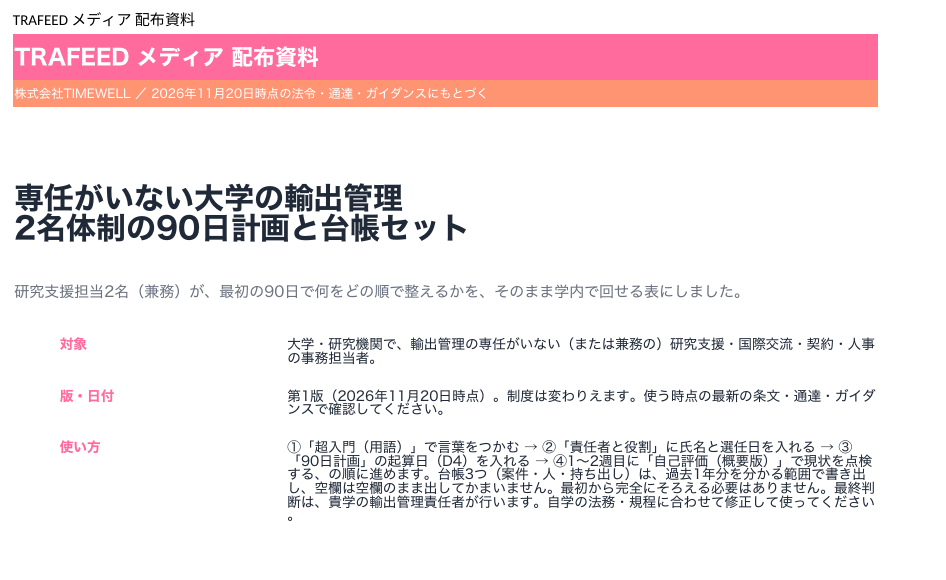
90-Day Plan and Ledger Set for a Two-Person Team (editable Excel)
An editable Excel set for university export-control staff: a 13-week plan, roles, project / people / carry-out ledgers, a contract-review field, a self-assessment record, a classification request and record form, and the fields of the guidance’s pre-screening sheets and review sheets with fictional examples (Japanese only).
Get the fileYou can download it after a short form (Japanese).
(November 21, 2026) We corrected the list of standards in Article 1, item 2 of the ordinance, which had left out the check that what is shipped matches the documents (ho).
Hello, this is Ryuta Hamamoto from TIMEWELL.
Picture this. At a private university in regional Japan, two people in the Research Support Office have been told to take on export control on top of their existing jobs. One handles contracts for joint and sponsored research. The other looks after international student admissions and international exchange. The president asks them, "I hear other universities are getting their systems in order. Are we all right?" Neither has an answer. There is no dedicated staff member and no budget. And if they ask faculty to "please keep export control in mind," they can already hear the reply: "So you want to get in the way of our research?"
With no dedicated staff and two administrators covering it alongside other work, what should they put in place in the first 90 days, and in what order, to end up with something that works? Who owns what? What goes in the ledgers? How do you explain it to faculty? Where is it fine to bring in outside help? I have written the answers as tables and templates you can circulate on campus as they are.
The conclusion first
- Dedicated staff are not a legal requirement. If, in the first 30 days, you appoint the responsible officers in writing, inform the people involved and set up ledgers, you have a foundation.
- Article 55-10(4) of the Foreign Exchange and Foreign Trade Act is a "duty to follow the compliance standards." What the responsible officers must do is set out in a ministerial ordinance. Cite the ordinance in your internal rules.
- Hard classification cases and your first license application can go to outside help. Only the appointment of the responsible officers and the final decisions have to stay in house.
For research institutes (national research and development agencies and similar bodies) This article uses a university as the example. At a research institute, read "president" as the chair of the board (the person who represents the organization and serves as the overall officer; Guidance, p. 94) and "university rules" as the institute's own rules. Decide first where export control sits within the "system for ensuring the proper conduct of operations" that the statement of operating procedures must describe (Article 28(2) of the Act on General Rules for Incorporated Administrative Agencies), in other words within the institute's internal control. That way you do not need a new committee. The section "For national research and development agencies: start from the add-ons" in Building a research security program covers how to combine this with research security.
For private universities (school corporations) The chair of the board (rijicho) represents a school corporation (Private Schools Act, Article 37(6)). If the act of endowment so provides, a representative executive director also represents it (Article 37(7)). The ordinance requires the overall officer to be chosen from among those who represent the organization (Article 1(ii)(a)), so where the president is neither the chair nor a representative executive director, one approach is to make the chair (or a representative executive director) the overall officer and place the president as the working head (the "export control overall manager" in the model regulations). Check the act of endowment and internal rules for whose name goes on the appointment notice and which body (such as the board) adopts the regulations. The Guidance also says the chief officer should be someone who represents the organization, such as the president or the chair (p. 94).1
Cite the law correctly, then decide who is responsible
The first job is checking the legal text. Get it wrong and the article your internal rules cite as their basis will be off, and you will have to go back and fix it.
Here is how Article 55-10 of the Foreign Exchange and Foreign Trade Act (FEFTA, 外為法) is structured. We checked the original text in e-Gov, the Japanese government's law database2.
| Paragraph | Content |
|---|---|
| (1) | The Minister of Economy, Trade and Industry sets the "Export Compliance Standards" (輸出者等遵守基準) by ordinance of the Ministry of Economy, Trade and Industry (METI) |
| (2) | Matters the standards cover (such as matters relating to classification) |
| (3) | Definition of "specified critical goods, etc." (specified technologies and the like that are prescribed by METI ordinance as particularly likely to impede the maintenance of international peace and security) |
| (4) | Exporters must carry out exports in accordance with the compliance standards |
In other words, paragraph 4 is a duty to follow the standards. Appointing responsible officers, informing staff, setting procedures: none of that appears in paragraph 4, or in any other paragraph of Article 55-10. It sits in Article 1 of the Ministerial Ordinance on Export Compliance Standards (輸出者等遵守基準を定める省令, METI Ordinance No. 60 of 2009)3. Our own earlier article, Export Control for Universities, used to say that "Article 55-10(4) requires a responsible officer." The accurate statement is that "paragraph 4 imposes the duty to follow the compliance standards, and the ordinance sets out the substance, including the responsible officers." Keep that distinction whenever you cite articles in internal rules or approval requests.
Article 1 of the ordinance has two items.
Item 1 sets the standards that apply to every exporter. There are two: appoint an officer responsible for classification (determining whether an item or technology falls under the control lists, 該非判定) (sub-item i), and give the people who do export work guidance, including briefing them on current law (sub-item ro).
Item 2 adds the standards for exporters who handle specified critical goods. Appoint, from among those who represent the organization, an officer who oversees the work as a whole (the "overall officer") (i); define each department's authority and responsibilities (ro); set classification procedures (ha); set and carry out procedures for checking end use and end users (ni); when shipping or providing, confirm that the goods or technology described in the documents and records are the same as what is actually going out (ho); and, where there has been a violation or a risk of one, report promptly to the Minister of Economy, Trade and Industry and take steps to prevent it happening again (nu). Audits (he), training (to), guidance to subsidiaries (chi) and record retention (ri) are written as things to "endeavor to" do. In other words, they are best-efforts obligations.
Article 2 of the ordinance also allows the classification officer and the overall officer to be the same person. For a university with a team of two, that is a helpful provision.
METI's guidance (fifth edition, September 2025) takes the same view. It says that universities and research institutions need to appoint an officer to confirm classification, and to brief people on current law and give them the necessary guidance, even if they do not handle list-controlled technology or goods (guidance pp. 88 and 92)4. So both requirements in item 1 apply to every university.
The guidance makes three further points about who fills these roles. First, there are no requirements for who can be the classification officer. It does not have to be someone with technical expertise; someone versed in the law is fine, and appointing several people is not a problem. Some institutions make the organizational decision through a board or a committee (p. 93 and note 105). The overall officer, on the other hand, must be someone who represents the organization, such as the president or the chair of the board of trustees (p. 94).
The third point is about titles. The guidance's model rules use "chief officer" (最高責任者) for what the ordinance calls the overall officer (統括責任者), and "export control overall officer" (輸出管理統括責任者) for the person in charge in practice. Because the Japanese titles are so alike, the guidance adds a note warning readers not to mix them up (p. 94, note 107). METI's self-assessment checklist uses the same split.
Much of the technology universities handle spans fields that may fall under the control lists. Our position, therefore, is that a university should build its system as if it were on the item 2 side. Which side a particular university is actually on should be confirmed against METI's guidance and by the responsible officers' judgment. The ordinance has also been amended, with changes in force from 9 October 2025 (see the supplementary provisions). When you cite it in internal rules, open the current text in e-Gov and check it at that point.
Table of responsible officers and roles
Here is what the law requires, translated into a two-person setup. The role names are our own arrangement, matched to the wording of the law.
| Role | Who | Owns | Basis |
|---|---|---|---|
| Overall officer (the "chief officer" in the guidance's model rules) | Someone who represents the organization, such as the president or the chair of the board | Approving the system; the final decision on reporting to METI when there is a risk of a violation | Ordinance Art. 1, item 2 (i) and (nu); guidance p. 94 |
| Classification officer (close to the "export control overall officer" in the guidance's model rules) | A section-manager-level person in research support (may be the same person as the overall officer; there are no qualification requirements, and there may be more than one) | Reviewing classification results and approving the records | Ordinance Art. 1, item 1 (i), and Art. 2; guidance p. 93 |
| Staff member A (administration) | Contracts desk for joint and sponsored research | Project ledger, the contract review fields, checks on outside institutions, keeping records | Ordinance Art. 1, item 2 (ha) and (ni) |
| Staff member B (administration) | Desk for international students and international exchange | People ledger, collecting pledges, guidance at entry and exit, briefing faculty | Ordinance Art. 1, item 1 (ro) |
| Faculty member who knows the technology (one per faculty) | Nominated by the dean | Explaining what technology is being provided; first-pass classification | Classification is best done by someone who knows the specifications (METI Q&A, Q5; item 2-2-2 of the detailed self-assessment checklist also asks whether people with technical knowledge carry out classification) |
| Outside specialists | Lawyers, export control advisers | Checking the wording of internal rules; advice on hard cases | See below (the guidance suggests, as one option, hiring an export control adviser or making use of university research administrators (URAs); p. 93, note 106) |
Decide how the appointments will be approved, too. The ordinance does not specify the form an appointment takes, but we recommend doing it in writing, not verbally. Send a notice in the name of the person who represents the organization (the president at a national university corporation; at a private university where the president does not represent the school corporation, the chair of the board or another representative) to the whole university saying who the overall officer is, who the classification officer is, and that the Research Support Office is the contact point. A setup in which faculty do not know who is responsible can hardly be called a system. Here is a short template for the appointment notice.
Template (notice appointing responsible officers; based on the Japanese system, to be reviewed by your legal team) Subject: Appointment of officers responsible for security export control In accordance with the Export Compliance Standards under the Foreign Exchange and Foreign Trade Act (the Ministerial Ordinance on Export Compliance Standards), the University appoints the following officers responsible for security export control. Overall officer: [name] ([title]) Classification officer: [name] ([title]) Contact point: Research Support Office (phone / email) Please consult the contact point about providing technology on campus, joint or sponsored research with foreign institutions, and taking items or data abroad. [date] President [name] (at a private university where the president does not represent the corporation, the chair of the board or another representative)
The 90-day plan
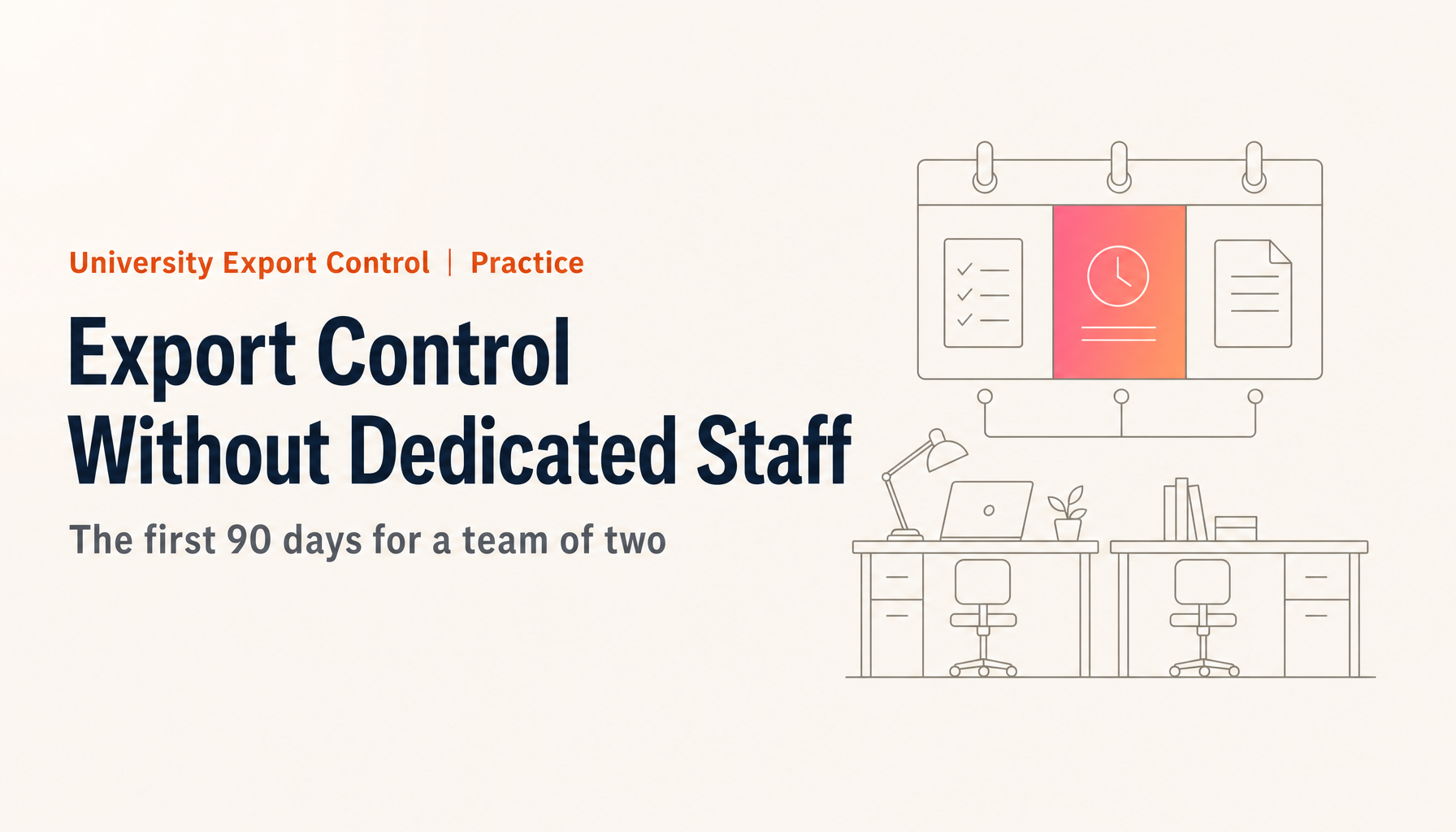
With two people doing this on top of other work, time is short. Our estimate (an assumption for this article, not something we measured) is that the first 90 days can be run if the two of them can find 5 to 6 hours a week between them. Rather than 30 minutes every day, a more realistic pattern is one 90-minute meeting a week for the two of them, with the rest of the time spent on individual tasks. The only agenda item for the weekly meeting is "that week's deliverable" in the table below.
Day one is the day the notice appointing the overall officer goes out.
The plan follows the order of Chapter VI of the guidance (pp. 88 to 100). The guidance breaks system-building into three stages: (1) preliminary review (understanding the current situation, getting leadership on board, deciding the responsible department and staff); (2) building the organizational structure (responsible officers and contact points, plus rules and other procedures); and (3) preparing to run the system (messaging from leadership, pamphlets and manuals, building checks into existing administrative procedures, and communication between staff and faculty). Weeks 1 to 2 correspond to stage 1, weeks 3 to 8 to stage 2, and weeks 9 to 13 to stage 3.
| Period | Who | What | Deliverable |
|---|---|---|---|
| Weeks 1–2 | Classification officer | Get the overall officer's approval and send out the appointment notice | Appointment notice (university-wide) |
| Weeks 1–2 | A and B | Check where you stand using METI's self-assessment checklist for universities | Check results (list of items not yet in place) |
| Weeks 3–4 | A | List all joint research, sponsored research and contracts with foreign institutions from the past year | Project ledger (first version) |
| Weeks 3–4 | B | List international students, researchers with posts at foreign institutions, and the status of side-job declarations | People ledger (first version) |
| Weeks 3–4 | A | Ask each faculty member whether they handle list-controlled technology or goods (the guidance's survey items are: (1) do you handle list-controlled goods or technology; (2) do you hold any of the goods given as examples in the export cautions; (3) do you accept international students or research students from institutions on the End User List; p. 91) | List of where controlled technology sits (first version) |
| Weeks 3–4 | A and B | Put the faculty notice on one page and send it university-wide | Faculty notice (one page) |
| Weeks 5–6 | B | Create the pledge form (for people the university employs) | Pledge form and where it is stored |
| Weeks 5–6 | A | Add export control check fields to contract review for joint and sponsored research | Contract review check fields |
| Weeks 7–8 | A and B | Write up the entry process (admission, hiring, contracts) | Entry procedure (1 to 2 pages) |
| Weeks 7–8 | Outside specialists | Have the draft internal rules reviewed (the model rules in Chapter IX of the guidance are the starting point; the guidance says the sample forms can be downloaded from METI's page https://www.meti.go.jp/policy/anpo/law08.html#jishukanri ; as of November 22, 2026 that page no longer exists, and the Word version is on https://www.meti.go.jp/policy/anpo/daigaku.html ) | Comments on the draft rules |
| Weeks 9–10 | A | Adapt the classification request form and record sheet in the ledger set for your university, and trial them with a faculty member who knows the technology | Request form and record sheet adapted for your university; one trial case |
| Weeks 11–12 | B | Create procedures for the interim stage (during enrollment or employment) and the exit stage (graduation, departure, taking items abroad) | Interim and exit procedures |
| Week 13 | Everyone | Hold one briefing session for faculty (the guidance says the message lands best when leaders such as the president or the chair of the board deliver it themselves; p. 97). Re-run the self-assessment checklist and report to the overall officer | Report (what got done, what is left, the next 90 days) |
The request form and record sheet for weeks 9–10 are in the "classification request form and record sheet" sheet of the 90-day plan and ledger set for a two-person team (Excel, in Japanese) (the record sheet links to the case ledger by case ID). The set also has "pre-acceptance check sheet (sample)" and "review sheet (sample)" sheets that lay out the fields of the sample forms in the fifth edition of the guidance as in the original. For a field-by-field reading of the three pre-check sheets and two review sheets, including what to write and where people tend to slip, see how to fill in a university's pre-check sheets and review sheets.
A weekly meeting has a precedent in METI's casebook. University J (a medical university) had its export control and international departments meet every week to coordinate (casebook, case 10, p. 67)5.
A word on internal rules. Internal export control rules are something the guidance strongly recommends as a way to manage in line with the compliance standards (p. 96). The ordinance does not require rules directly. As examples of what to include, the guidance lists: (1) purpose, definitions, scope and basic policy; (2) the chief officer, the export control overall officer, export control officers and committees; (3) prior checks, classification, end-use checks, end-user checks, transaction screening, license applications, control of technology provision and control of goods shipments; and (4) audits, training, document management, reporting and discipline. It then asks for rules that are workable and fit the reality of the university's size and division of duties. With two people, rules you can actually run matter more than rules that spell out every detail.
How the model rules are structured (Chapter IX of the guidance)
Chapter IX of the guidance, "Examples of rules and forms" (from p. 105), contains two examples of a "Security Export Control Rules of XX University / Research Institution": one for "centralized management at headquarters" and one for "decentralized management by departments, coordinated by headquarters"4. For a two-person team, the centralized example is the natural starting point. Its articles are as follows (headings as in the original; the right-hand column is our summary).
| Articles | Headings | What they set out (our summary) |
|---|---|---|
| 1–4 | Purpose, definitions, scope, basic policy | Export control carried out with due regard to the sound development of academic research; terms, and the people and transactions covered |
| 5–8 | Chief officer, export control general manager, export control manager, export control committee | Who makes the final call, who runs the work, and how the committee is made up |
| 9 | Prior check | Staff use the "prior check sheet" to check concerns about the other party, whether anyone is a non-resident or in a specified category, and whether the public-domain or basic-science exceptions apply, and get the manager's approval on whether a transaction review is needed |
| 10–14 | Classification, end-use check, end-user check, transaction review, license application | The procedure for cases that need a transaction review. For technology or goods obtained from outside, obtain the supplier's classification document |
| 15–16 | Control of technology transfers, control of shipments | Confirm the prior check, the review and any license before providing or shipping; if you cannot confirm, do not provide |
| 17 | Checking persons in the specified categories | Newly hired staff submit a pledge on whether they fall under the specified categories, and resubmit it if anything changes |
| 18 | Document control and retention of media | Keep records for at least seven years from the date of transfer or export (the model's wording; METI's introductory guidance sets benchmarks of at least 7 years for rows 1–4 and at least 5 years for rows 5–16, so the model uses the longer period) |
| 19–22 | Audit, survey, guidance, training | Regular audits, an annual survey of listed technology held, guidance and planned training for staff |
| 23–24 | Guidance to subsidiaries, reporting | Regular guidance to related subsidiaries; reporting a violation or suspected violation, and the route to the authorities |
| 25–27 | Discipline, administration, miscellaneous | Discipline under the work rules, the office in charge, delegation to detailed rules |
The decentralized example adds an article for a "department export control manager," which shifts the numbering back by one. The original notes that the examples are "one reference example" and that how they are used is left to each university or institution. METI's "Model Security Export Control Rules Manual for Universities and Research Institutions" (May 2019) explains the purpose of each article. As of November 2026, however, METI's site refuses retrieval, so we have not been able to re-check the original. The manual predates the fifth edition; its prior-check article, for example, does not include checking whether the person is a non-resident or falls under a specific category. Check current wording against the fifth edition's model rules.
If your university already has old internal rules, the procedure for checking them article by article against the fifth edition's model is in Revising old university export control rules.
When a two-person team adapts the model, the first job is to cut the roles in Articles 5–8 down to the people you actually have. You can start without a committee (Article 8) and run on the general manager's approval. On the other hand, we recommend keeping the prior check (Article 9) and the pledge (Article 17) even with two people: the prior check quickly takes out cases that need no review, which frees up both of you, and the pledge is the foundation for deemed-export checks.
The most important part of the table is the inventory in weeks 3 to 4. The first version of each ledger does not have to be perfect. A common failure is trying to capture every case from the start and stalling. Decide on "the past year, as far as we can tell," and leave blanks as blanks.
Nor does everything have to be finished by day 90. The week 13 report covers three things: what got done, what is left, and what comes in the next 90 days. Being honest about what is left earns you more trust from the overall officer.
Replace siloed classification work with AI.
METI's FY2024 data shows 52% of foreign exchange law violations stem from classification errors. Download the TRAFEED product catalog covering features and rollout.
The three ledgers to set up first
Ledgers are at the center of export control work. Here, a ledger means a list of the things on campus that export control touches. Limit it to three.
- Project ledger. Joint research, sponsored research, technical guidance, and shipments of samples or equipment involving foreign institutions or companies
- People ledger. Keeping track of people who may be non-residents, people not under the university's direction, people with contractual relationships with foreign institutions, and so on
- Outbound ledger. Technical data, samples and equipment taken abroad on overseas trips or when international students go home
I chose these three because they are the situations METI's Q&A comes back to again and again. Providing technology covers a lot of ground, from supervision in the lab to overseas trips. But working through METI's Q&A for our explainer series (in Japanese), we found that the three situations that actually cause trouble at universities are "contracts with foreign institutions," "determining residency" and "taking items abroad." METI's self-assessment checklist lists seven situations by transaction type: general technology provision, management of international students and researchers, overseas business trips, international joint research, visits by researchers from abroad, lectures with foreign participants, and international mail and courier. These three ledgers overlap with the first four. Add visits, lectures and mail after the first 90 days.
Example columns for the project ledger
| Column | Example content |
|---|---|
| Project ID | Joint research contract number, etc. |
| Counterpart institution | Name, country or region, type of institution (university, company, public body) |
| Faculty member in charge | Name, faculty |
| Outline of technology or items provided | "What, and in what form" (data, samples, equipment, verbal guidance) |
| Review of the publicly-available and basic-science exceptions | Whether considered, who decided, date (decided through organizational procedure, not by individual faculty) |
| Classification | Done / not done, checked by, basis (manufacturer's classification certificate, own classification) |
| End-use and end-user check | Documents checked (the counterpart's explanation, public information), date screened against the End User List |
| License needed? | No / yes / under consultation |
| Where records are kept | Paper, or shared folder path |
How to carry out end-use and end-user checks is covered in our explainers on the objective requirements (in Japanese) and the End User List (in Japanese). Appearing on the list is a regulatory classification, not a judgment about whether the institution is good or bad. This column exists to record the date and result of each screening.
Example columns for the people ledger
The people ledger needs careful handling. Do not include a nationality column. Residency is determined by where a person lives or has their office, not by nationality (METI Q&A, Q15)6.
| Column | Example content |
|---|---|
| Category | Employed faculty, staff, TAs and RAs; non-employed students, research students and visiting faculty |
| Date of entry into Japan (where relevant) | Used to count the six months from arrival. This applies to international students, research students and foreign researchers who are not employed by a Japanese university or similar institution (under six months, they are non-residents; METI Q&A, Q18 and Q19; guidance p. 77). A foreign national employed by the university is a resident from the moment of employment if they live in Japan and their university salary is their main source of income (Q&A, Q16; guidance p. 39, note 36). Someone who has not entered Japan and works remotely from their home country is a non-resident (guidance p. 39, note 36) |
| Affiliation and residence category | On campus; came to Japan while keeping a post at a foreign institution; etc. |
| Pledge (people under direction) | Date obtained, form version |
| Check against documents such as application forms (people not under direction) | Date checked, type of document checked |
| Declarations of side jobs and contracts with foreign institutions | Yes or no, date declared, date it reached the export control desk (even if the university has approved the side job, a separate specific-category check is required; Deemed Export Q&A, Q47) |
| Result | Not applicable / needs checking / under consultation |
Are the side-job and conflict-of-interest declarations that HR collects actually reaching the export control desk? Of all the columns in the ledgers, this one makes the most difference. The guidance's position is that it is not enough for HR simply to receive declarations; the information gathered there has to be used in export control checks (p. 46, note 42)4. It also recommends that the department hosting a person and the export control department work together to check information on the specific categories (特定類型), and that this information be gathered in one place in the export control department (p. 51).
On who to include in the ledger, the guidance says the following. Japanese nationals can also fall under a specific category, so the checks apply regardless of nationality (Deemed Export Q&A, Q3). On the other hand, a university may decide, as a matter of policy, not to check administrative staff and students who have nothing to do with technology transactions. But if technology is in fact provided to such a person and that person falls under a specific category, the question of intent or negligence could arise (p. 51, note 48; Deemed Export Q&A, Q22 makes the same point). If you narrow the scope, record your reasons.
How to identify the specific categories is set out in Annex 1-3 of the Services Circular (役務通達, the METI circular on technology transactions that require a license). The key point is that the method of checking depends on whether the recipient is under the university's direction and supervision (an employment relationship or something equivalent). Faculty and staff under the university's direction are checked through a self-declaration (a pledge) at hiring. Students and others not under its direction are treated as falling under a category only when that is evident from documents normally obtained in the course of dealings, such as application forms (Deemed Export Q&A, Q17, Q18 and Q61). Note also that "substantial" in specific category 2 means 25% or more of the individual's annual income. Research funding that a university or laboratory receives from a foreign government or similar body does not, in principle, fall under specific category 2. It does, however, if the money goes to the university or lab in form only, to get around the rules, while in substance the individual is the recipient (guidance p. 43).
Example columns for the outbound ledger
| Column | Example content |
|---|---|
| Type of trip or departure | Overseas business trip; an international student or researcher going home; international conference; joining a closed meeting run by an overseas institution online (even without travel, providing controlled technology requires a license; guidance p. 82) |
| What is taken | Data, samples, equipment, laptops |
| Will it be provided to anyone? | Own use only / will be provided on site |
| Classification | Check equipment against its specifications (older or home-built equipment may need a license depending on its specs) |
| Protection against loss or theft | Whether encrypted and password-protected (measures the guidance recommends; p. 83; Q&A, Q30 and Q31) |
| Who checked beforehand, and when | Record of the contact point's check |
According to METI's Q&A, taking technical data abroad on a trip purely for your own use and bringing it back is basically not a problem. If you are going to provide it to someone and it is list-controlled technology, you need a license to provide technology (Q4). Older imaging equipment or home-built measuring instruments sometimes have specs that put them on the control list, and in that case an export license may be needed even if you bring them back (Q3)6. Loss or theft is not in itself a FEFTA violation unless there was an intention or purpose to provide controlled technology abroad. But staging a loss or theft in order to provide technology could be a violation. It is advisable to keep a record of the facts so that you can explain them if something does go wrong (Q&A, Q30 and Q31; guidance p. 83). You can build this table by adding three lines to the pre-trip application form.
How long to keep records
Ledgers and pledges need to be kept in a state that lets you explain them later. The ordinance asks exporters to endeavor to keep documents for an appropriate period (Art. 1, item 2 (ri), a best-efforts obligation). As a guide, the guidance indicates at least seven years for transactions in the rows of greatest concern for weapons of mass destruction and the like (rows 1 to 4 of the Appended Table to the Foreign Exchange Order), and at least five years for the rest (rows 5 to 16) (p. 71). Even where no list-controlled technology or goods are handled, it recommends keeping documents and records as evidence of how the case was handled whenever concerns could not be cleared, a review sheet was completed, and the technology was provided after a final decision to proceed (pp. 71–72). Records of specific-category checks, such as pledges, should ideally be kept for as long as technology is expected to be provided to that person (for faculty and staff, the period of employment) (Deemed Export Q&A, Q36; guidance p. 45, note 41). Where technology has been provided, the record of that provision should ideally be kept for the periods above (Deemed Export Q&A, Q36).
Briefing faculty, and running entry, interim and exit
Once the ledgers exist, the next job is getting people to act. What you tell faculty and where you check people between arriving and leaving are two sides of the same coin. Most of the five situations in which you ask faculty to get in touch overlap with the contract review and admissions at entry, the outside-appointment declarations in the interim, and the checks on taking things out at exit. If the pledge and the contract review fields are in place at entry, I think the load on faculty gets lighter as well. So I take the two together.
Explaining it to faculty: a notice template and how to win them over
At a university without dedicated staff, the hardest part is, in fact, getting faculty on board. Legal provisions and procedures can be put in writing, but if faculty do not act, the ledgers stay empty.
Three things to say first
Explain it to faculty in this order.
First, this system does not exist to stop research. The guidance says the law does not prohibit supervising or teaching international students, and that doing so with a license is fine4. What is needed is checking whether the technology you are passing on is controlled and, if it is, getting a license in advance.
Second, limit the situations in which you ask faculty to get in touch to five: (1) joint or sponsored research, technical guidance or sending samples with partners abroad; (2) taking data, samples or equipment out on trips or when going home; (3) giving new technology to someone who has been in Japan for less than six months or who has a contract with a foreign institution (of any nationality); (4) their own contracts with foreign institutions or funding from foreign governments or similar bodies; and (5) presentations under confidentiality. The list is in the same order as the one-page outline, notice and script in our article on explaining export control to faculty. Ask for more than that at the start and nobody will read it.
Third, falling under a category is a procedural classification. METI explains that the specific categories group together cases that need individual checking during screening, and that falling under one does not mean the person is regarded as a security concern. ("Clarifying the Operation of Deemed Export Controls," p. 3: "the specific categories are a typological grouping of cases that need individual checking in screening, and falling under a specific category does not mean the person is regarded as a security concern.")7 There is also a related statement: METI says it does not expect to refuse licenses across the board simply because someone falls under a specific category (Deemed Export Q&A, Q59). If you apply for a license and there is no concern from the standpoint of international peace and security, it will be granted. If the people handing out pledge forms do not understand this, the paperwork arrives reading like a letter that says "we suspect you."
Notice template
Template (notice to faculty; based on the Japanese system, to be reviewed by your legal team and specialists) Subject: A request regarding international research collaboration (security export control) Dear colleagues, The University is putting in place a security export control system under the Foreign Exchange and Foreign Trade Act. This system is not meant to stop research or the supervision of international students. Only where the technology you pass on is subject to control do you need a license in advance, and with that license, research and supervision can go ahead. In the five situations below, please contact the Research Support Office beforehand. The check takes about five minutes.
- When you carry out joint research, sponsored research or technical guidance with a foreign university, company or public body, or send them samples or equipment
- When you take technical data, samples or equipment out on an overseas trip or when going home (data you only use yourself, give to no one and bring back is normally not a problem; always contact us about equipment and samples)
- When you give new technology to someone who has been in Japan for less than six months, or who has an employment or similar contract with a foreign institution (of any nationality)
- When you yourself sign an employment or similar contract with a foreign institution, or personally receive funding from a foreign government or similar body (please contact us in addition to declaring your side job)
- When you present research results at a closed workshop or similar event where participants are bound by confidentiality Note: Even if the intellectual property in the technology belongs to you personally, the procedure still applies. Content you publish in papers or at conferences usually does not need a license. How it is treated depends on whether it is before or after publication, so if in doubt, please get in touch. Falling under a specific category is a procedural classification, not an assessment of you. Contact: Research Support Office ([name], [name]) Ext. [ ] Email [ ]
A one-page outline, a university-wide notice, answer notes for the seven common faculty reactions, a five-minute script and a short quiz, all built around the same five situations as this notice, are in our one-page faculty briefing and notice templates (Word, in Japanese).
Common reactions and how to answer them
Faculty reactions are fairly predictable. Prepare your answers in advance and the briefing session becomes much easier.
| Faculty reaction | Example answer | Basis |
|---|---|---|
| "Ours is basic research, so this doesn't apply to us." | The basic-science exception is limited to "research whose main purpose is to elucidate the principles of natural phenomena and that is not aimed at designing or manufacturing a specific product." Whether it applies is decided technology by technology, through an organizational procedure. Industry-academia research aimed at a specific product often does not qualify | Services Circular 1(3)(ku); guidance pp. 61–63 (including note 73)48 |
| "We'll publish the results in a paper, so I can talk about them freely." | Published technology is exempt. But unpublished data before publication does not qualify, even if you plan to publish it later. Technology that only specific people can know is not treated as publicly available, whether or not there is a confidentiality obligation. Presentations given under confidentiality are a different matter as well | METI Q&A, Q11 and Q12; guidance pp. 62 and 6494 |
| "The IP belongs to me personally." | Even if it belongs to you, the procedure still applies | Guidance p. 394 |
| "So you suspect international students?" | We don't look at nationality. We check where people live and what relationships they have. Japanese faculty, staff and students go through the same checks. Falling under a category is a classification, not an assessment | METI Q&A, Q15; Deemed Export Q&A, Q3; guidance pp. 40–416104 |
| "I'm too busy." | Once you contact us, the desk does the checking. All we ask of you is to explain what technology you are passing on | The operating design in this article |
Rather than trying to win over faculty who push back, in our view the faster route is to find two or three faculty members who seem willing to help and start by putting their labs' projects into the ledger. "Professor so-and-so's lab goes through the procedure too" carries more weight than any notice.
A 30-minute briefing is enough
The briefing session at the end of the 90 days needs only 30 minutes. As a guide, the university-wide explanation (at a faculty meeting or alongside the notice) takes five minutes, and this day-90 briefing takes 30 minutes (the five-minute script plus questions). It covers four things.
- Why universities are covered (providing technology is part of daily life)
- The five situations in which to get in touch
- How long a check takes, and how to reach the contact point
- Questions
Detailed explanations of residents and non-residents, or of the three specific categories, should be given individually to those who need them. Say too much to everyone and the five situations get buried. The thinking behind deemed exports is laid out in our explainer on the basics of METI's deemed export Q&A (in Japanese) and in Export Control for Universities.
Entry, interim and exit
Operations are easier to organize when you split them into three stages over time. The guidance for universities takes the same three-stage view4.
| Stage | Situations | What administration does | Forms and ledgers used |
|---|---|---|---|
| Entry | Admitting international students and researchers; hiring faculty and staff; joint and sponsored research contracts | Check against documents such as application forms. Obtain pledges from people the university employs. In contract review, check end use, end user and the technology to be provided | People ledger, project ledger, pledges |
| Interim | During enrollment or employment | Regular re-screening in line with End User List updates (at least once a year). Keeping track of declarations of side jobs and contracts with foreign institutions. Checking changes to projects | People ledger, project ledger |
| Exit | Graduation, leaving the university, going home, overseas trips | Reminders about providing technology and taking items abroad after going home. Considering whether to obtain a fresh pledge, as at admission or hiring. Prior checks on items taken abroad | Outbound ledger, pledges |
At entry
At entry, you check two things: "to whom" and "what."
"To whom" depends on whether the person is employed. Professors, lecturers, TAs, RAs, part-time staff and others employed by the university are under its direction, so obtain a pledge at hiring. Students, research students, visiting faculty, emeritus professors and others who are not employed are checked against documents normally obtained in the course of dealings, such as application forms or CVs. There is no obligation to look further into anything that is not evident from those documents (Deemed Export Q&A; Services Circular, Annex 1-3)10.
The timing for obtaining pledges can also be confirmed in the original. Even if your work rules prohibit side jobs and conflicts of interest or require them to be reported, a pledge still has to be obtained separately at the point the person comes under the university's direction (Deemed Export Q&A, Q20). The form of employment does not matter (Q21). Even for someone assigned on joining to a department that does not handle technology controlled under FEFTA, the pledge must be obtained at the latest before that person is given any controlled technology (Q23). Obtaining it at the job-offer stage is acceptable if the person cooperates voluntarily, but it then has to be obtained again after hiring (Q24).
Pledges can be on paper or electronic. METI's answer is that even without a seal or a signature, evidence that the person made the pledge (an electronic approval record, an email saying they have confirmed it) would normally not undermine the pledge's purpose (Q33 and Q35)10. Tools like Google Forms are acceptable too. The form may be modified as long as its purpose is not undermined. However, deleting the field (the fourth checkbox) through which people who do not fall under any category pledge that they do not is treated as undermining its purpose (Q32). By contrast, changing the word "pledge" to "declaration" or "confirmation," deleting the address field where no one else has the same name, and adding a commitment to report any future change are given as examples of changes that do not undermine its purpose (Q32). For details, see our explainer on METI's Q&A on pledges (in Japanese).
How to approach checks when admitting international students is covered in Admitting International Students: What Universities Should Verify. What to do when someone refuses to submit a pledge is also framed not as a question of how to treat the person but as a matter of managing "which technology to provide" (Q37). The point is not to disadvantage people who do not submit one. Nor do we recommend using pledges for HR decisions. Take care that no one is disadvantaged because of nationality or origin.
METI's casebook also has a real example of what to put in the request letter when handing out pledges. University G stated the following five points in its letter asking for pledges (casebook, case 7, reference material 2, p. 49)5.
- Pledges are not collected in order to treat people who fall under a specific category in a discriminatory way, or to unfairly refuse to admit them
- Personal information in the pledge will not be disclosed to anyone other than specific people involved, such as export control staff
- People who fall under a specific category may face restrictions on the research activities they wish to pursue
- If anything in a submitted pledge changes, it must be submitted again
- If false information is given in a pledge, disciplinary or other action may be taken under university rules
Items 3 and 5 involve each university's own judgment. We are not recommending any particular practice; decide them after review by your legal team. Items 1 and 2 are worth including at any university, so that faculty and staff feel comfortable submitting.
"What" is checked in contract review for joint and sponsored research. For applications to "specified research and development programs" (calls that require research security measures), the Japanese government's procedures manual for research security requires checking that four things are appropriate in contracts: the content of the collaboration, access to research data and the like, the handling of intellectual property, and confidentiality obligations11. Even outside those programs, the list is a useful starting point for contract review. Add three more, namely the classification of the technology to be provided, the end use and end user, and a review of the publicly-available and basic-science exceptions, and you have an export control check. The bigger picture on research security is set out in research security governance.
The contract review fields can be built like this. The guidance asks universities doing joint research with foreign universities, research institutions, companies and others to check three things in advance (p. 83). It also lists four arrangements to put in place so as not to break the law inadvertently (p. 84)4.
Template (fields to add to contract review for joint and sponsored research; based on the Japanese system, to be reviewed by your legal team) Export control check (completed by the Research Support Office)
- Does the technology to be provided include any list-controlled technology? (classification: done / not done / not required; basis; checked by; date)
- Is the counterpart institution on the End User List? (date screened; result)
- Is there a risk that the technology will be used to develop weapons of mass destruction or conventional weapons? (end-use and end-user check: documents checked)
- Will the publicly-available or basic-science exception be applied to the technology? (if so: basis and approver; applied technology by technology, through organizational procedure)
- Does the contract include the following four arrangements? (if not, why not) (1) Technology that could be used to develop weapons of mass destruction or conventional weapons will not be passed on to third parties without a license (2) If the arrangements are not observed, this will be treated as a breach of contract and further dealings will stop (3) Technology that requires a government license will be provided only after the license has been obtained (4) If a FEFTA violation is suspected, it will be reported promptly to the relevant authorities
- If, partway through the joint research, new technology that is not publicly available is to be provided, classification will be checked again (contact for changes: Research Support Office)
Item 6 reflects the guidance's requirement that, even if the early stages of joint research involve only publicly available technology, classification must be done again once the research moves on to providing new technology that is not publicly available (p. 83). METI's self-assessment checklist also has an item (detailed version 3-4-2) asking whether joint research contracts include security export control clauses. The ten pre-contract checks and sample clauses on publication, confidentiality, export control and more are in our joint-research contract checklist and clause templates (Excel, in Japanese).
During enrollment or employment
The interim stage is about keeping the ledgers moving. You can narrow it down to three tasks.
- Once a year, re-screen the counterpart institutions in the project ledger against the End User List
- Check that declarations of side jobs and contracts with foreign institutions are reaching the people ledger
- When the content of joint research changes (when more technology is being provided), update the "Classification" column in the project ledger
The guidance adds a note on re-screening against the End User List. The list is revised at least once a year. If the institution a person came from is newly added to the list after you have admitted them, that alone is not a violation. Any further provision of technology should, however, be considered carefully, with a license obtained first if needed (p. 81). It also says that at points where a person's research becomes more advanced during enrollment, the technology to be provided should be checked again, and if concerns cannot be dispelled, revising the technology provided or changing the person's assignment may be options (p. 81).
The third task is the one most often overlooked. What was basic work when the contract was signed turns, as the project goes on, into an exchange of design data. Include notice of changes in content, not just contract renewals, in the first of the five situations in which you ask faculty to get in touch (joint research and similar with partners abroad).
At exit
Exit means graduation, leaving the university and going home. METI's Q&A says that someone who has been in Japan for more than six months is treated as a resident, but that a license application is needed if, on going home, they take controlled technical information with them in order to provide it abroad. It also says that it is not realistic for universities to monitor international students or inspect their belongings, and that thorough reminders are what matter (Q19)6.
So exit operations come down to "a reminder notice, plus prior checks through the outbound ledger." Hand out one page at graduation and completion briefings. Add a field to the paperwork for leaving the university confirming whether technical data or samples are being taken out. That is enough to give it shape. There is no need to run it on suspicion.
How far to rely on outside help, and checking the system
A two-person system stalls if it tries to do everything in-house, and loses track of who is responsible if it hands too much over. Once you have decided how far to rely on outside help, you need a yardstick for what is done and what is not. METI's self-assessment checklist serves as that yardstick, used twice: in weeks 1 to 2 and in week 13. I end with the misconceptions that tend to take hold in teams with no dedicated staff.
Where to draw the line on outside help
With a team of two, you do not need to do everything in house. But some things can go outside and some cannot.
Legal responsibility stays with the university. METI's Q&A says that even if a manufacturer's classification turns out to be wrong, the university or research institution that carried out the export basically bears the responsibility. Even if you ask a customs broker to handle the paperwork, the applicant for an export license is, in principle, the party seeking to export, such as the university or the researcher (Q26 and Q27)6. Responsibility cannot be moved outside. So what you ask for stops at "having someone prepare material or drafts for the decision."
| Task | In house (two administrators) | Outside help | Reason / guide |
|---|---|---|---|
| Appointing responsible officers, approving the system | In house (overall officer) | Cannot be outsourced | Legally a decision for the organization's representative |
| Running the ledgers, briefing faculty | In house | Do not outsource | Day-to-day operations that will not work if handed outside |
| Collecting and storing pledges | In house | Do not outsource | Personal information, managed on campus |
| Deciding on the publicly-available and basic-science exceptions | In house (through organizational procedure) | Ask for advice on hard cases | The guidance says leaving it to individual faculty can lead to violations4 |
| Classification (equipment, technology) | Faculty member who knows the technology + classification officer | Specialists for reading manufacturers' classification certificates and for complex equipment | Best done by someone who knows the specs (Q5). Complex equipment is hard |
| End-use and end-user checks | In house (with a checklist) | Consult METI if concerns cannot be dispelled | Q&A, Q22, Q24 and Q29 |
| Preparing license applications | In house from the second one on | For the first, a specialist or a prior consultation with METI's help desk | Takes experience with the format |
| Drafting internal rules | Draft in house | Have a lawyer check it | Prevents errors in article numbers and wording |
| When there is a violation or a risk of one | The responsible officer decides | Consult specialists at the same time | The ordinance requires prompt reporting to the Minister of Economy, Trade and Industry3 |
METI's contact points are listed by purpose at the end of the fifth edition of the guidance (pp. 149 to 150). Questions on deemed exports (the procedure for checking the specific categories) go to the Security Export Control Policy Division. Prior consultations on license applications under list controls (including license applications for deemed exports) and questions on catch-all controls go to the Security Export Licensing Division. Reports of FEFTA violations and questions about internal export control rules go to the Security Export Inspection Office, and questions about the guidance itself go to the university guidance team. Email addresses are given in the guidance. The phone numbers in METI's Q&A (February 2021) (Q25) are as of that date. Contact details can change, so check METI's website for the latest before you use them46.
The guidance also points to support beyond the university. Each region has a network through which universities working on security export control exchange information and hold study sessions (p. 100, as of July 2025). The practicalities of building a system are also covered in the "Guidelines for Building and Operating Voluntary Management Systems for Security Trade," published by Japan's academic society for industry-academia collaboration (産学連携学会) (p. 88, note 102). The guidance further states that its text and figures may be quoted in training materials and similar documents at universities and research institutions, as long as the source is cited (p. 149). That is a convenient condition when you are putting together materials for faculty.
One caution when you go outside: do not give advisers information that identifies individuals. Do not send the contents of the people ledger out as they are. You can ask for advice in anonymized form, such as "one international student who is a non-resident."
How to use METI's self-assessment checklist
METI published the "Security Export Control Self-Assessment Checklist for Universities" on 31 March 2020. Its purpose is for universities to check, voluntarily and on their own, how well they have set up and are running their internal control systems, and to use the results to improve. It does not require regular or mandatory filings with METI. It does note, however, that METI may in future ask individual universities to submit it voluntarily so that it can understand their situations. It also states that it may be revised12.
Structure and item headings
The checklist comes in two parts, a summary version and a detailed version. The idea is to use the summary version for an overview of how the system is set up and run, and the detailed version for the specifics of each item.
The summary version has fields for the person filling it in and for basic information, followed by 16 self-assessment items. Each is answered with one of three options: "sufficient," "partly insufficient" or "insufficient." The headings are as follows.
| Section | Item | Heading |
|---|---|---|
| 1 Rules and forms (3 items) | 1-1 | Whether rules and detailed regulations exist |
| 1-2 | Content of rules and regulations (whether they meet the requirements of the Export Compliance Standards) | |
| 1-3 | Whether forms and templates exist (prior checks, transaction screening, admission screening) | |
| 2 Operations: procedures (6 items) | 2-1 | Prior checks |
| 2-2 | Classification | |
| 2-3 | Transaction screening | |
| 2-4 | Control of technology provision / control of goods shipments | |
| 2-5 | Audits | |
| 2-6 | Training and awareness | |
| 3 Operations: by transaction type (7 items) | 3-1 | General technology provision / export of goods |
| 3-2 | Management of international students and researchers | |
| 3-3 | Overseas business trips | |
| 3-4 | International joint research | |
| 3-5 | Visits by researchers and others from abroad | |
| 3-6 | Lectures and similar events with foreign participants | |
| 3-7 | International mail and courier |
The basic information section of the summary version has fields for the number of faculty, the number of international students, the titles and names of the chief export control officer and the export control overall officer, and the numbers of prior checks, transaction screenings and license applications to the Minister of Economy, Trade and Industry (each with subtotals for those relating to admitting international students and researchers and those relating to overseas trips). A note says it is also useful to track these numbers by faculty or department. For a two-person team, filling in this section is itself the work of building the first version of the ledgers.
The detailed version breaks the same three sections down into sub-numbered items. There are 57 sub-numbered items (counting 2-1-4 as two, since it is split into (1) and (2); 56 if you count it as one). By section, that is 13 for rules and forms, 20 for operations (procedures) and 24 for operations (by transaction type). Each item is answered with checkboxes and has a remarks field for writing in things like the relevant article number in your rules or the name of a form. Here are the items a two-person university would do well to look at first.
- 1-2-1 and 1-2-2 (whether the organization's representative is designated as chief officer; whether an overall officer, export control officers and others are designated) and 1-2-3 (whether the division of duties and the scope of responsibility are clear). These correspond to the table of responsible officers in this article
- 2-1-2 (whether decisions are made as an organization, with a responsible manager's approval, using a prior-check sheet or similar, and whether there is any item saying "no need to submit to the export control department") and 2-1-4 (whether, when the publicly-available or basic-science exception is applied, the decision is made as an organization with the responsible officer's approval, and whether the basis is checked). These correspond to "don't leave it to individual faculty" in this article
- 2-6-1 to 2-6-3 (who receives training and the training record; communicating current law on campus; setting up and publicizing a help desk). These correspond to the faculty notice and the briefing session in this article
- 3-2-1 to 3-2-7 (basic information on prospective admits, concern information, the mechanism for final admission decisions, checks at temporary return home, graduation and departure, pledges), 3-3-1 to 3-3-3 (whether procedures for overseas trips are built into the existing travel application), and 3-4-2 (whether joint research contracts include security export control clauses). These correspond to the three ledgers and the contract review fields in this article
Appended Table 1 (concern information on counterparts) and Appended Table 2 (concern information on prospective admits) at the end of the checklist list the angles to check. Table 1 covers listing on the End User List; whether the country or region is a country of concern or under a UN arms embargo; suspected involvement in weapons development based on public information; nuclear-related research; research on chemicals of concern; and other concerns. Table 2 covers the End User List; countries of concern and arms-embargoed countries or regions; concerns about weapons development; financial support of concern from the government or an organization of the person's home country; plans to work in a military-related department after going home; past research; and other concerns. This is a description of the checkpoints METI has set out, not a judgment about whether any individual or institution is good or bad. Being on the list is a regulatory classification. Do not read the result of a check as an assessment of the person. We are not suggesting any practice that sorts people by nationality or origin, or one that mechanically decides admissions using these tables.
Points to watch
First, bear in mind that the checklist is dated. It was built on the third edition of the guidance (October 2017). The current guidance is the fifth edition (September 2025), and checks on the specific categories (applied from May 2022) do not appear among the checklist items. Cover them by adding the people-ledger items from this article to the checklist.
The checklist's answer options are "sufficient," "partly insufficient" and "insufficient." There is no "none" or "don't know" option. Run the check twice: in weeks 1 to 2 and in week 13. List the items marked "partly insufficient" or "insufficient" in the first check, turn them into your list of things to fix in the next 90 days, and carry them into the plan.
The checklist items are based on the guidance, and the checklist notes that some of them are things to be done voluntarily. Not every "insufficient" item is a legal obligation. The minimum the ordinance requires is appointing the responsible officer, briefing and guiding staff, and, for those handling specified critical goods, appointing an overall officer and so on. The guidance, too, treats audits and training as best-efforts obligations. The introduction to the checklist also says it can be used as part of internal audits.
Common misconceptions and mistakes
Here are seven beliefs that tend to take hold in teams with no dedicated staff.
"Not having dedicated staff is a violation." It is not. What the ordinance requires is appointing a responsible officer and briefing and guiding the people involved (Art. 1, item 1). It does not require dedicated staff. Even with people covering this alongside other work, appointing a responsible officer (doing it in writing is our recommendation) meets the entry-level requirement. That said, when the people doing this also have other jobs, the lack of time does wear down the quality of the work. Put the weekly meeting from the 90-day plan in the calendar, every week, without fail.
"Article 55-10(4) says to appoint a responsible officer." As explained above, it does not. Paragraph 4 is the duty to follow the compliance standards, and the substance is in the ordinance. In your internal rules, cite the Act and the ordinance side by side as the legal basis.
"We'll start once the ledgers are complete." If you wait for them to be complete, you will never start. The first version can be incomplete. Put it out, then fix it as you go.
"We have to explain everything to faculty." Tell them the five situations and the contact point first. Save the three specific categories and the definition of a resident for the people who need them, one by one.
"We can't deal with institutions on the list." Being on the list is a regulatory classification, not a judgment on the institution. Whether it is listed does not settle the matter on its own; what follows is a check of the technology to be provided, the end use and the end user (Q22)6.
"A pledge makes us safe." A pledge is one way of checking. You are not obliged to verify that what it says is true, but our reading is that if information reaches you by other routes, you need to take that into account too. And even if you obtain a pledge, without a record in the ledger you will not be able to explain it later.
"METI's Q&A is too old to use." The Q&A for universities dates from February 2021, and some parts have changed with later amendments. For example, the Q&A cites the penalty provisions as "Articles 69-6 and 69-7," but in the current e-Gov text, the penalties for violating the export and technology license requirements are in Article 69-7 (paragraph 1: imprisonment of up to seven years, a fine of up to ¥20 million, or both; paragraph 2: up to ten years and ¥30 million), and Article 72 sets fines of up to ¥700 million for corporations (in the case of Article 69-7(1))2. Article numbers move, so check the current text when you cite them in internal rules. That is how to work with older materials. The thinking behind them is still a sound foundation for practice.
What we could not confirm, and the limits of this article
Here is what we could not confirm, and what this article does not decide, source by source.
On 20 November 2026 we obtained and checked the originals of METI's guidance for universities and research institutions, fifth edition (September 2025, 150 pages), the self-assessment checklist (31 March 2020, summary and detailed versions), the Q&A for universities (February 2021), the Q&A on clarifying deemed export controls (revised 8 August 2023), the casebook for universities (August 2023) and the Services Circular (last amended by a notice promulgated on 14 November 2025, in force from 14 February 2026). We were unable to obtain the separate document described as the guidance's "latest changes (November and December)," or the Word versions of the model rules and forms. Further changes made from November 2025 onward may therefore not be reflected in this article.
We have not checked the contents of METI's "Model Security Export Control Rules Manual," its near-miss casebook, its materials for explaining the rules to faculty and staff, or its e-learning (the manual because METI's site refused retrieval as of 21 November 2026). We only state that the guidance refers to them.
We have not checked the notice from the Ministry of Education, Culture, Sports, Science and Technology (MEXT) on help desks (reportedly dated 10 April 2025). This article refers only to METI's contact points (as given in the fifth edition of the guidance).
This article does not determine which side of the ordinance any individual university falls on, including with respect to the scope of "specified critical goods" (as prescribed by METI ordinance) after the amendment in force from October 2025. Each university's responsible officers and specialists should confirm this.
The time needed for the 90 days is our estimate, not a measurement. It varies widely with the size of the university and the number of cases.
Rules can change. Check the latest versions of laws, circulars and guidance at the time you use them.
This article does not make judgments on individual cases (whether a license is needed, whether an exception applies). Please consult your university's responsible officers and, where needed, METI or specialists.
All the templates are examples of how such documents can be written; have your legal team or specialists review them before use. On practices that touch HR and employment, we are not recommending any particular treatment, and the starting point is taking care that no one is disadvantaged because of nationality or origin.
Further reading
- Export Control for Universities: the overall picture of deemed exports and the specific categories
- Export Control Rules for a Small Private University in Japan: how much of METI's model to keep, the chair and the president, and what the board decides
- Research security governance and a 90-day roadmap: how to move forward on the research security side
- METI Q&A: research, technology provision and exceptions (in Japanese): the publicly-available and basic-science exceptions
- METI Q&A: residency and catch-all controls (in Japanese): determining residency and how violations are viewed
- METI Q&A: pledges and specific-category checks (in Japanese): how to obtain pledges
- Guide to our METI Q&A series (in Japanese): a reading order by purpose
- How to build an export control system: system-building for companies (useful as a reference when adapting it for a university)
If you are interested in ways to lighten the work of building ledgers and screening joint research partners, please talk to the TRAFEED team.
References and primary sources
Footnotes
-
e-Gov Law Search, Private Schools Act (Act No. 270 of 1949), Article 37(6) and (7) (version in force from May 21, 2026, retrieved through the Laws API v2; checked November 21, 2026). https://laws.e-gov.go.jp/law/324AC0000000270 (in Japanese) ↩
-
Foreign Exchange and Foreign Trade Act (Act No. 228 of 1949) (in Japanese), Articles 25, 55-10, 69-7 and 72. e-Gov Laws https://laws.e-gov.go.jp/ (checked 20 November 2026; article text retrieved via the API) ↩ ↩2
-
Ministerial Ordinance on Export Compliance Standards (METI Ordinance No. 60 of 2009) (in Japanese), Articles 1 and 2 and the supplementary provisions. e-Gov Laws (checked 20 November 2026) ↩ ↩2
-
METI Trade Control Department, "Guidance on Sensitive Technology Management for Security Trade (for Universities and Research Institutions), Fifth Edition" (in Japanese), September 2025, 150 pages. https://www.meti.go.jp/policy/anpo/daigaku/guidance5.pdf . We obtained and checked the original (checked 20 November 2026). Page numbers cited are the printed page numbers in the PDF. See also our explainer Export Control for Universities ↩ ↩2 ↩3 ↩4 ↩5 ↩6 ↩7 ↩8 ↩9 ↩10 ↩11 ↩12
-
METI, "Casebook on Security Trade Control at Universities and Research Institutions: Responding to the Clarified Operation of Deemed Export Controls" (in Japanese), August 2023, 71 pages. https://www.meti.go.jp/policy/anpo/daigaku/minashi.pdf . Initiatives at ten universities. We obtained and checked the original (checked 20 November 2026). The casebook states that its content is as of August 2023 and may change ↩ ↩2
-
METI, "Q&A (for Universities and Research Institutions)" (in Japanese), February 2021. https://www.meti.go.jp/policy/anpo/daigakuqanda/daigakuqanda.pdf . We obtained the original and checked the question numbers and answers (checked 20 November 2026). Chapter VIII of the fifth edition of the guidance also contains example questions and answers, but its numbering differs from this Q&A (for example, conference presentations are Q11 in this Q&A and Q12 in the guidance). The Q numbers in this article are this Q&A's numbers. See also our explainers on research, residency, catch-all controls and violations (in Japanese) and technology provision and exceptions (in Japanese); each explains its own question numbering ↩ ↩2 ↩3 ↩4 ↩5 ↩6 ↩7
-
METI Trade Control Department, Security Export Control Policy Division, "Clarifying the Operation of Deemed Export Controls" (in Japanese), p. 3, "Examples of persons falling under the specific categories expected at universities and research institutions." https://www.meti.go.jp/policy/anpo/law_document/minashi/meikakukanitsuite2.pdf . We checked the original on 21 November 2026. The same caveat also appears in the reference sheet "What is the specific-category approach" (May 2022) posted by Tokyo Metropolitan University (https://bunnkei-kanribu.jim.tmu.ac.jp/site/wp-content/uploads/2023/08/%E3%80%90%E5%8F%82%E8%80%83%E8%B3%87%E6%96%991%E3%80%91%E2%91%A4%E7%89%B9%E5%AE%9A%E9%A1%9E%E5%9E%8B%E3%82%A2%E3%83%97%E3%83%AD%E3%83%BC%E3%83%81%E3%81%A8%E3%81%AF-2022.5%EF%BC%88%E6%97%A5%E3%83%BB%E8%8B%B1%EF%BC%89.pdf). A related statement we could check in the original is Q59 of METI's Deemed Export Q&A (revised 8 August 2023): METI does not envisage refusing a license across the board merely because a person falls under the specific categories. ↩
-
"On Transactions or Acts of Providing Technology That Require a License under Article 25(1) of the Foreign Exchange and Foreign Trade Act and Article 17(2) to (4) of the Foreign Exchange Order" (the Services Circular, ref. 4-Bōkyoku No. 492) (in Japanese), 1(3)(ku) (definition of research activities in basic science). Last amended by a notice promulgated on 14 November 2025, in force from 14 February 2026. https://www.meti.go.jp/policy/anpo/law_document/tutatu/t10kaisei/ekimu_tutatu.pdf . We obtained and checked the original (checked 20 November 2026) ↩
-
Same as above. Q11 and Q12 in our explainer on technology provision and exceptions (in Japanese) ↩
-
METI, "Q&A on Clarifying Deemed Export Controls" (in Japanese), revised 8 August 2023, 65 questions. https://www.meti.go.jp/policy/anpo/law_document/minashi/minashiqa3.pdf . We obtained the original and checked the question numbers and answers (checked 20 November 2026). Q numbers from this Q&A are written as "Deemed Export Q&A, Q__." See also Annexes 1-3 and 1-4 of the Services Circular (ref. 4-Bōkyoku No. 492; last amended by a notice promulgated on 14 November 2025, in force from 14 February 2026). Our explainer: pledges and specific-category checks (in Japanese) ↩ ↩2 ↩3
-
Expert Panel on Ensuring Research Security and Research Integrity, "Procedures for Measures to Ensure Research Security" (in Japanese), December 2025 (Cabinet Office). The four contract items (the content of the collaboration, access to research data, handling of inventions, patents and other intellectual property, and confidentiality) are in Part II, Chapter 3, 3-3(1)(v) and (2)(iii) (page 19). Checked against our copy of the original (21 November 2026). See also our explainer on research security governance ↩
-
METI Trade and Economic Cooperation Bureau, Security Export Control Policy Division, "On the Security Export Control Self-Assessment Checklist for Universities" and "Security Export Control Self-Assessment Checklist for Universities (Summary Version / Detailed Version)" (in Japanese), 31 March 2020, 17 pages. https://www.meti.go.jp/policy/anpo/daigaku/checklist.pdf . We obtained the original and checked its structure and items (checked 20 November 2026). The page where it is posted (https://www.meti.go.jp/policy/anpo/daigaku.html) also carries information such as briefing sessions for fiscal 2026 ↩