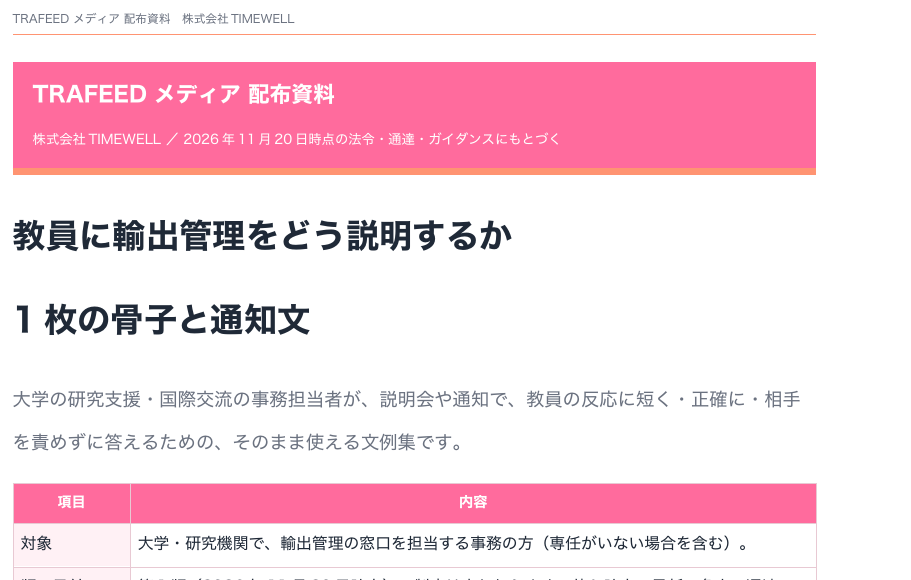
One-Page Faculty Briefing and Notice Templates (Word)
A one-page faculty briefing, a university-wide notice template, answer notes for seven common faculty reactions, a five-minute script and quiz (Japanese only).
Get the fileYou can download it after a short form (Japanese).
Hello, this is Ryuta Hamamoto from TIMEWELL.
Say the Research Support Office at a private university in regional Japan has two staff members. Neither works on export control full time. At a briefing on campus, one professor told them, "Our research is basic research." Another asked, "I'm only presenting at a conference. Why do I need to check with the office?" They could not give a good answer to either. That is the kind of situation I have in mind.
Faculty do not push back only because they don't know the system. My sense is that there is often a feeling behind it: "my research is under suspicion," or "more paperwork will stall my work." What administrators need, then, is less the ability to recite the law than material that lets them answer the usual reactions briefly, accurately and without putting anyone on the defensive.
The core of that material is a set of answers to seven common faculty reactions, grounded in METI's Q&A and the legal provisions. After those come a 5-minute script, the outline of a one-page handout for faculty, a template for a campus notice, and sample questions for briefing sessions, all in a form you can use as it is. The article answers one question only: how to explain export control to faculty. Building the system and reviewing contracts are left to other articles.
The conclusion first
- Most faculty reactions come not from misreading the law but from not knowing which situations are covered. Prepare an answer for each situation and you can explain it briefly.
- Both the publicly-available exception and the basic-science exception can be used. But whether they apply is decided through a university procedure, not by individual faculty members.
- The basic message is not "don't" but "check with us before it goes out." Don't sort people by nationality or origin, and say at the outset that a check is not an evaluation of anyone's research.
Four principles to settle before you start explaining
Before lining up answers to the reactions, settle four principles for the people doing the explaining. Even if the content is correct, the wrong stance makes faculty hear "we suspect you."
Principle 1: Say first that checks are about procedure, not about judging research
Page 3 of METI's explanatory material "On the Clarification of Deemed Export Management" says: "the specific categories are a typological grouping of cases that need individual checking in screening, and falling under a specific category does not mean the person is regarded as a security concern" (we checked the original on 21 November 2026)1. A related statement is METI's Deemed Export Q&A, Q59: it does not envisage refusing licenses across the board merely because someone falls under a specific category2. Control lists and categories are procedural classifications. They are not an evaluation of a faculty member's research or of their character.
Put this sentence at the start of your explanation. In the script, it sits in the first 30 seconds. Putting it first is enough on its own to change how the rest is received. The same goes for handing out pledges. Paperwork can arrive reading like a letter that says "we suspect you."
Principle 2: Don't sort people by nationality or origin
What the system looks at is the substance of a person's relationships: where they live or have their office, contractual relationships such as employment, and economic benefits from foreign governments and similar bodies. METI's guidance states clearly that the specific categories (特定類型) apply regardless of a resident's nationality, and that Japanese nationals can fall under them too (guidance p. 41; the Deemed Export Q&A, Q3, says the same)2. Checking people because they are foreign, or not checking them because they are Japanese, does not fit the intent of the system.
If someone asks at a briefing, "Are our international students all right?", answer: "We don't look at nationality. We look at how long someone has lived in Japan and who they have contracts with." Avoid naming particular countries or universities as a way of urging caution.
Principle 3: Make it "check with us first," not "don't"
The law does not prohibit supervising or teaching international students and others. METI's guidance says that supervising and teaching after obtaining a license is fine (pp. 77 and 79)2. What is required is checking whether something is controlled and, if it is, getting a license in advance.
So the request to faculty is not "please stop" but "please give us a heads-up before you send technology abroad, or before you give new technology to a non-resident." It is not about stopping research. It is about checking before something goes out.
Principle 4: Don't leave individual faculty to decide what is publicly available
METI's guidance says that leaving the application of exceptions to individual faculty and researchers can lead to violations of the law, and asks institutions to decide carefully through an organizational decision-making procedure (p. 61)2. As a concrete example, it describes a flow in which a responsible manager checks, case by case, whether an exception can be applied, cases that need close scrutiny are discussed by a body such as the university's export control committee, and the overall officer makes the decision. It also says that whether an exception applies must be decided for each technology to be provided, not in broad units such as a whole laboratory (p. 61, note 73). This is the heart of the explanation.
If faculty decide for themselves that "this is publicly available" or "this is basic research," they will get it wrong, however good their intentions. What you ask of faculty is not a decision but the material for one, handed to the office. The decision is made through the university's procedure. Drawing the line this way also takes weight off faculty, because the message changes from "you will be responsible" to "we will decide this together as an institution."
Seven faculty reactions and how to answer each
From here, I answer seven reactions that come up often. For each, I set out what a faculty member is likely to say, the background, the answer, the basis, and cautions against overstating things.
The basis is METI's "Q&A (for Universities and Research Institutions)" (February 2021 edition), the "Guidance on Sensitive Technology Management for Security Trade (for Universities and Research Institutions)," fifth edition (September 2025), the "Q&A on Clarifying Deemed Export Controls" (revised 8 August 2023), the Services Circular (役務通達, the METI circular on technology transactions that require a license), and the legal provisions themselves. We checked the legal provisions in e-Gov, the Japanese government's law database345. For METI's materials, we obtained and checked the originals62. The Q&A is the February 2021 edition and may not reflect later revisions. When the text says "Q__," it means the question number in the February 2021 Q&A unless stated otherwise. Chapter VIII of the fifth edition of the guidance also has example questions and answers, but they are numbered differently. "Deemed Export Q&A, Q__" refers to the numbering in the August 2023 edition.
Reaction 1: "Our research has nothing to do with the military, so it's out of scope."
Behind this is the impression that export control is about people who make weapons. That impression is half right and half wrong.
The answer: "Control depends on what the technology is, not on what the research is for. A lot of research isn't covered, but you can't know whether yours is until you check."
Here is the basis. Article 25(1) of the Foreign Exchange and Foreign Trade Act (FEFTA, 外為法) requires a license for transactions that provide technology relating to the design, manufacture or use of certain types of goods abroad, or to non-residents. The scope of that technology is set in Article 17(1) of the Foreign Exchange Order as the technology listed in the middle column of its Appended Table35. In other words, the first question is whether the technology relates to the design, manufacture or use of goods on the list. Even if a researcher's aims are entirely peaceful, list controls may apply if the technology relates to goods whose performance puts them on the list.
There are also catch-all controls. Even technology that is not on the list can need a license depending on its end use or end user. METI's Q&A sorts this out in terms of the objective requirements and the inform requirements. For details, see our explainer on the objective requirements under catch-all controls (in Japanese).
But insisting that "it does apply to you" is also wrong. Most commercially available laptops and mobile phones are not controlled, with some exceptions (METI Q&A, Q3). Knowledge found in textbooks is publicly available technology. In most labs, I expect the bulk of day-to-day work will turn out not to be covered once it is checked. Finish your answer with "so let's put together a way to check, together," and faculty will listen without getting defensive.
Two cautions against overstating. First, administrators should not decide for themselves that "our field isn't covered." The fields involved range widely: nuclear, precision machining, automated control, chemistry, biotechnology, materials, aerospace, navigation and more2. Second, don't scare people by saying "everything is covered." Whether something is actually covered depends on the field and the content.
Reaction 2: "It's basic research, so we're fine, right?"
This is the reaction you hear most. And half of it has legal backing.
Article 9(2)(x) of the Ministerial Ordinance on Trade-Related Non-Trade Transactions (the Non-Trade Transactions Ordinance) treats "transactions providing technology in research activities in the field of basic science" as transactions that do not require a license4. So the phrase "basic research" does have a basis in law. A faculty member who says "basic research is fine" is not wrong.
The problem is assuming that calling your work basic research makes it qualify. METI's Q&A, Q6, says that for research that cannot be called research activities in basic science, a license application is needed if the research content and the technology provided fall under list controls or catch-all controls. The answer runs in this order: first, see whether it is research activity in basic science; if it is not, look at the content.
The test for whether research qualifies is in the definition in the Services Circular. "Research activities in the field of basic science" means research activities whose main purpose is to elucidate the principles of phenomena in the field of natural science, conducted by theoretical or experimental methods, and not aimed at designing or manufacturing a specific product (Services Circular 1(3)(ku))7. So there are two conditions: "the main purpose is elucidating the principles of phenomena," and "it is not aimed at designing or manufacturing a specific product." The guidance gives research on how the universe formed and research on elementary particle theory as examples that qualify. Research aimed at designing or manufacturing a specific product does not qualify, even if elucidating principles is its main purpose. Conversely, research that is not aimed at a specific product still does not qualify if elucidating principles is not its main purpose. Research aimed at application in a specific product, such as joint research with industry, often does not qualify (guidance pp. 62–63)2. Even within one faculty member's work, basic parts can sit alongside parts that are close to a company's product development.
There is one more thing to tell faculty. This exception applies to providing technology. It does not apply to exporting goods in the course of basic-science research, and if the goods are controlled, a license is needed (guidance p. 63). Taking equipment or samples abroad on a trip falls outside this exception.
The answer: "There is indeed a basic-research exception. But whether it applies depends not on what the research is called, but on whether its main purpose is elucidating principles and it isn't aimed at designing or manufacturing a specific product. That decision isn't yours alone; it goes through the university's procedure."
A caution: as METI's Q&A, Q7, shows, even answers such as "teaching how to operate something is not thought to count as 'necessary technology'" are framed as inferences. Nowhere does it say "anything goes if it's basic research." The same Q7 also points out that some things are broadly controlled, such as technology for using items designed exclusively for nuclear use, and that even where an instruction manual's content is the same as for uncontrolled goods, the manufacturer may have classified it as technology for using controlled goods. Take care not to state things as certainties when you explain.
Reaction 3: "Surely we're free to present at conferences."
This one has legal backing too. And it is the exception administrators will find easiest to use.
Article 9(2)(ix) of the Non-Trade Transactions Ordinance exempts from licensing both transactions that provide publicly available technology and transactions that provide technology in order to make it publicly available. As examples, it lists academic journals, published patent information, minutes of open symposiums, and "transactions whose purpose is to make the technology obtainable or viewable by an unspecified large number of people, such as sending manuscripts for conference presentations or materials for distribution at exhibitions, or submitting to journals"4. METI's Q&A, Q12, also says that even for list-controlled technology, no license is needed to provide technology through papers or conference presentations intended to be obtainable or viewable by an unspecified large number of people.
So the first half of the answer is: "That's right. Conference presentations and paper submissions intended for publication don't need a license." Turn the faculty member's worry into reassurance first.
Then add two conditions.
The first is the proviso "excluding transactions that make technology publicly available for the purpose of providing it to specific persons"4. Q&A, Q12, also states clearly that cases such as presenting at a conference while imposing confidentiality on the participants cannot always be called provision to make technology publicly available, and that a license is needed if the exception does not apply. Closed workshops and presentations under confidentiality need to be thought about separately.
The second is the scope of the Q&A after a talk. Q&A, Q11, says that questions and answers are thought to be covered by the exception as long as they stay within the scope of the technology presented to make it publicly available. Going into details that were not presented could raise a separate issue for that part.
There is one more thing faculty tend to confuse in connection with conference presentations: unpublished data before submission. The guidance's position is that even if you ultimately aim to make it public, the publicly-available exception does not apply if the technology is not publicly available at the time it is provided2. Peer review is covered only to a limited extent. The guidance says that sending a paper to a society or to reviewers for peer review that is a required step in presenting at a conference or publishing in a journal is treated as part of the process of making it public. Optional peer review that is independent of that process is excluded (guidance p. 62). In the same way, even if you are aiming to publish a paper, showing the technology to two or three people before filing for a patent does not qualify, because an unspecified large number of people cannot know it (p. 64). And "publicly available" does not include a state in which only specific people can know the technology, whether or not there is a confidentiality obligation (p. 64). Treat submissions intended for publication and non-public sharing as different things.
Published patent information counts as publicly available technology and needs no license (Q&A, Q13). Lectures and practical classes based on commercially available textbooks or published information are also covered by the exception. You do, however, need to check in advance that their content does not include information or technology that has not been published (Q&A, Q9).
Q&A, Q12, goes on to make a request, while noting that it is not a legal obligation: think carefully about whether it is appropriate to make something public, bearing in mind the social side of preventing the proliferation of weapons of mass destruction and the side of scientific ethics. This is a request, not an obligation. When you pass it on to faculty, the accurate way is to present it not as a duty but as "something METI asks people to bear in mind."
Online courses work the same way. Q&A, Q10, says the exception is thought to be available for courses anyone can join, while courses only for enrolled students are generally courses with specific enrollment requirements, to which the exception is thought not to apply. It also says, however, that if the content itself is technology that is already public, the exception is thought to apply even to an audience that has to meet enrollment requirements.
Reaction 4: "International students are in Japan, so they're out of scope, aren't they?"
This reaction splits into misunderstandings in two directions: "international students are in Japan, so it isn't an export," and "international students are foreign, so they are all covered." You can prepare the same answer for both.
The answer: "We look at residency, not nationality. But even once someone becomes a resident, some situations still need checking."
The residency criteria are in METI's Q&A, Q15. Residency is judged by where a person lives, has their residence or has their principal office, and nationality is not a criterion. Q&A, Q18 and Q19, show that international students who have been in Japan for less than six months are treated as non-residents, and that after more than six months from entry they are treated as residents (the Q&A notes that the criteria for determining residency are in a Ministry of Finance circular dated 29 November 1980, Zōkoku No. 4672). This six-month treatment applies to people who are not employed by a Japanese university or similar institution. The guidance's position is that a foreign national working at an office in Japan is a resident; for example, a foreign national employed by a Japanese university for just two months is a resident if they live in Japan for those two months and their university salary is their main source of income (Q&A, Q16; guidance p. 39, note 36). Someone who has not entered Japan and works remotely from their home country is a non-resident (same note 36).
There are three points to get across to faculty here.
The first is checking before giving new technology to non-residents. When you provide technology that may fall under list controls or catch-all controls to international students who have only recently arrived, or to researchers on a short stay in Japan (of any nationality), a license may be needed. Q&A, Q18, as a caution for cases where such people might be brought into joint research, asks that the technology to be provided be classified.
The second is the checks that remain after someone becomes a resident. Q&A, Q19, says that no license application is needed to provide technology to international students who have been in Japan for more than six months. However, a license application is needed in cases such as taking controlled technical information home in order to provide it abroad. The answer says it is not realistic for universities to monitor international students or inspect their belongings, and that what matters is thorough reminders that providing technology abroad or to non-residents, or taking it out of the country, requires a license.
The third is the specific categories. Since May 2022, providing technology to people under the strong influence of a foreign corporation or government has been brought under licensing, even if they are residents. The three categories are: a relationship based on a contract with a foreign corporation or foreign government (a person who, under an employment contract or a contract equivalent to employment, is subject to that party's direction or owes it a duty of care as a prudent manager); economic benefits received personally from a foreign government or similar body (25% or more of the individual's annual income); and instructions or requests from a foreign government or similar body regarding conduct in Japan (guidance pp. 41–43)2. An international student who is still enrolled at an overseas university does not fall under category 1 unless they have an employment or mandate contract with that university2. The point that simply being enrolled does not trigger a category can be passed on to faculty exactly as it is. Economic benefits also mean money received as personal income. When a university professor receives research funding from a foreign government or similar body as a university or a lab, that does not, in principle, fall under category 2 (guidance p. 43). Holding an honorary professorship from a foreign university does not, by itself, fall under category 2 (Deemed Export Q&A, Q63). On the other hand, a professor who also holds a professorship at a foreign university and is subject to that university's direction would normally fall under category 1 (Q46). Even if the university has approved the side job, a license application is still needed as long as category 1 applies (Q47).
End your answer with consideration for the people involved: "This check isn't about suspecting international students. A Japanese professor who also holds a professorship at a foreign university goes through the same check." METI's Q&A also says that Japanese employees, researchers and students are subject to checks (Deemed Export Q&A, Q3; see also our explainer on the basics of deemed exports, in Japanese). Note too that falling under a specific category does not automatically mean a license will be refused. If there is no concern from the standpoint of international peace and security, the license will be granted (Deemed Export Q&A, Q59).
In practice, how the six-month rule applies can vary with individual circumstances, such as the expected length of stay and whether the person is employed. Don't let the office carry hard cases involving international students alone; bring them to the campus consultation point described later.
Reaction 5: "I'm just taking my laptop and data on a business trip."
Business trips are part of everyday life for faculty. That is exactly why this is where export control feels closest to home.
METI's Q&A, Q4, answers in two parts. The first half: if you take something for your own use, provide it to no one and bring it back, this is not regarded as an external transaction and is basically not a problem. The second half: if you take it out in order to provide it to someone, and the technical data or design drawings are list-controlled technology, you need to apply for a license to provide technology. Even technology that is not list-controlled may fall under catch-all controls.
The dividing line is whether you provide it to someone. The same data is treated differently depending on whether you take it to use yourself or to hand to someone at your destination. The answer to faculty: "If you're only using it yourself, that's basically fine. If you plan to give data to someone there, let us know before you leave."
Some background on the basis. Article 25(3) of FEFTA provides that, in relation to the transactions in paragraph 1, a license requirement can be imposed on exporting storage media on which information containing specified technology is recorded, and on sending such information by telecommunication3. Article 17(3) of the Foreign Exchange Order sets the scope5. What this shows is that not only physically carrying it out, but also emailing it or sending it through the cloud to the destination, can need a license. When faculty consult you about a trip, ask about transmissions to the destination as well as about taking a computer along.
The guidance puts it this way. Taking a USB drive or documents containing controlled technology abroad to provide to someone there, or sending it abroad over the internet or by phone, requires a license under paragraph 3. Even after taking technology abroad under a paragraph 3 license, a separate paragraph 1 license is needed before that technology is provided. So if you plan to provide it to a third party, it makes more sense to obtain the paragraph 1 license from the outset (p. 82). And even without traveling abroad, providing controlled technology by joining a closed lecture or meeting held online by a foreign university or research institution requires a paragraph 1 license, just as traveling would (p. 82). This is how you answer the reaction "I'm not going anywhere, so it doesn't concern me."
The guidance also lists measures for managing USB drives and computers that hold data on controlled technology: setting login passwords and changing them regularly, encryption, and theft prevention (wire locks and the like). It notes that computers have been stolen on overseas trips, so care is needed (pp. 72–73).
Equipment needs a different caution. Q&A, Q3, says most commercially available laptops and mobile phones are not controlled, but that some older imaging equipment or home-built measuring instruments used in joint research have specs that put them among list-controlled items, in which case an export license application is needed even if they will be brought back. Don't lump everything together as "trip equipment is fine." Treat instruments and devices as something to consult the office about.
On loss and theft, Q&A, Q30 and Q31, give the answer. If there is no intention or purpose of an external transaction, loss or theft in itself is not a FEFTA violation. However, to keep problems to a minimum should something happen, encrypting files and setting passwords is advisable. It is an advisable measure, not an obligation. When you tell faculty, keep the same distinction: "It isn't required, but it's reassuring to have it in place."
Reaction 6: "Our partners in joint and sponsored research are Japanese companies and universities."
Plenty of faculty probably assume export control has nothing to do with domestic partners. The answer: "Having a partner in Japan doesn't mean it has nothing to do with you. But all we need to check is a few points before the contract."
Let me sort this out. Providing technology between domestic corporations is outside the scope of FEFTA. METI's Q&A also says that provision by a corporation to its own employees is normally outside the scope, except in special cases such as where the aim is to get around the rules or where the contract specifies provision to employees (Deemed Export Q&A, Q11; see also our explainer on the basics of deemed exports, in Japanese).
Even so, there are six situations where checks are still needed.
The first is when non-residents or people falling under a specific category take part in the partner's lab. In joint research with another university's lab, if the partner's participants are faculty or staff, you move on to sorting out the employment relationship; if they are students, to the specific-category check. Students may be treated as not falling under a category unless the documents normally obtained for the joint research make it clear that they do (Deemed Export Q&A, Q14).
Checks are also needed when the partner is in Japan but plans to pass results or technology on to a foreign institution further down the line, and in international joint research where the partner is a foreign institution. For that case, Q&A, Q24, suggests, as one option, listening carefully to the partner's explanation of the end use and obtaining an agreement or pledge that the technology will not be diverted to weapons of mass destruction and the like.
When sponsored or joint research aims to develop a specific product, the point that the basic-science exception often cannot be used comes into play2. And when confidentiality obligations are imposed on publishing the results, the premise of the publicly-available exception falls away (Q&A, Q12).
The last is when non-residents or people falling under a specific category (Japanese nationals included) attend closed research presentations or thesis presentations on campus. If the presentation is not open to an unspecified large number of people, the exception cannot be applied, so procedures are needed (guidance pp. 41 and 85; Deemed Export Q&A, Q65). Attendees from within the university will normally have been through the university's specific-category checks already, so there is no need to repeat them for each presentation. External attendees may, in principle, be treated as not falling under a category unless documents normally obtained, such as registration forms, clearly state that they do (Q65).
How to check these points in contract review is set out in our export control checklist for joint and sponsored research contracts. The one thing to tell faculty in this article is: "Before you sign a contract, please show the office the draft."
For employment contracts and consent forms when international students take part in research as RAs, research security and student RA contracts goes into detail. Here I will only note that the research security procedures and the export control specific categories meet in the same questionnaire.
Reaction 7: "If something goes wrong, who takes responsibility?"
My sense is that this reaction usually comes from anxiety: what if I break the rules in the course of my research without knowing it? Answer with both the facts of the system and the institution's stance.
Here are the facts. The penalties are in Article 69-7 of FEFTA. Conducting a transaction without a license, among other things, is punishable by imprisonment of up to seven years, a fine of up to ¥20 million, or both. Where five times the value of the subject matter exceeds ¥20 million, the fine is up to five times that value. For technology prescribed by Cabinet Order, such as technology relating to the development of nuclear weapons, the penalty is imprisonment of up to ten years, a fine of up to ¥30 million, or both. For corporations, Article 72 provides for fines of up to ¥700 million or ¥1 billion respectively3.
METI's Q&A says that where the party doing the exporting is a university or research institution, the university or research institution basically bears the responsibility (Q26). It also says that, depending on the nature of the violation, both individuals and the corporation may face penalties (Q28).
Do not use these numbers as a threat. The point of telling faculty is not to frighten them, but to give a reason behind the request "so please consult us before it goes out." Note also that METI's Q&A gives the penalty provisions as "Articles 69-6 and 69-7." In the current legal database, the penalties are in Article 69-7, and Article 69-6 is a transitional provision. When you put article numbers in materials for faculty, use the numbers you have confirmed in the current legal database.
The fact that reassures faculty most is that following the check procedure protects them. For the specific categories, carrying out checks in line with the guideline in Annex 1-3 of the Services Circular means you have exercised the duty of care ordinarily required. As a result, even if it later turns out that the person did fall under a specific category, you are treated as not negligent in failing to obtain a license beforehand, and you are not subject to criminal penalties or administrative sanctions (guidance p. 44; Deemed Export Q&A, Q16)2. The same applies if faculty or staff under the university's direction wrote something false in their pledge: as long as the provider had no other information, there is no criminal penalty or administrative sanction (guidance pp. 45–46; Deemed Export Q&A, Q38). Conversely, if someone refuses to submit a pledge, the possibility that they fall under a specific category has not been ruled out, so providing controlled technology to them cannot be regarded as fulfilling the duty of care. In that case, consider managing what technology is provided, for example by limiting it to publicly available technology or technology from basic-science research (Deemed Export Q&A, Q37). For catch-all controls on weapons of mass destruction, too, Q&A, Q29, says that if you have not received a notice from the Minister of Economy, Trade and Industry telling you to apply for a license, and after properly looking into the end use and end user you find "no risk," it is not a violation even if the technology is misused after it is provided.
In other words, as long as the institution has a check procedure and keeps records, the system is not designed for an individual to bear responsibility for the outcome alone. The answer can be summed up like this: "Setting a check procedure and keeping records is how we protect you. That's why the office acts as the contact point."
Here too, take care not to overstate. How responsibility plays out in a particular case depends on the facts. Rather than having the office promise "it'll be fine," stop at saying "having a record of the check will help if you ever need to explain."
Replace siloed classification work with AI.
METI's FY2024 data shows 52% of foreign exchange law violations stem from classification errors. Download the TRAFEED product catalog covering features and rollout.
The script for the briefing, and the documents to hand out
What follows is what you use on the day of a briefing and just before and after it. You talk through the five-minute script, hand out the one-page outline at the end, and let the whole university know where to go through a notice. When someone actually comes to you, you hand over the request form. I have laid out the script and the three documents in that order. All of them are templates, so change the university name, the contact point and the names of the rules to fit your situation.
The order and script for a 5-minute explanation
At a briefing or a faculty meeting, five minutes is often all you get. In our templates, the university-wide explanation (at a faculty meeting or alongside the notice) takes five minutes, and the briefing held on day 90 of setting up the system takes 30 minutes (this five-minute script plus questions). You can't say everything in five minutes. Narrow it down to two things: the situations that are covered, and your requests.
Time allocation
| Time | Content | Purpose |
|---|---|---|
| 0:00 to 0:30 | Opening. Say that checks are not evaluations | Lower defenses |
| 0:30 to 1:30 | What is covered: not "things" but "passing on technology" | Make it personal |
| 1:30 to 3:30 | Five situations: joint research and similar with partners abroad, taking things out on trips or when going home, providing technology to recent arrivals or people with contracts with foreign institutions, your own contracts with foreign institutions or funding from foreign governments, presentations under confidentiality | Answer situation by situation |
| 3:30 to 4:30 | Three requests: check with us first, records, don't carry decisions alone | Agree on what to do |
| 4:30 to 5:00 | Contact point and next step | Hand over contact details |
Script (template)
The following is a template based on the Japanese system. Adjust the university's name, the contact point and the names of rules to fit your situation. It is written to be close to spoken language.
[0:00] I'll take just five minutes to talk about export control. One thing first. What I'm about to say isn't about evaluating anyone's research, or doubting it. It's about procedures under a law called the Foreign Exchange and Foreign Trade Act.
[0:30] People tend to think export control means sending things abroad. In fact, passing on technology is covered too. Emailing a drawing, teaching a method in your lab to someone who arrived from abroad recently or who belongs to an institution overseas, handing over data on a trip. Situations like these can count as providing technology. That said, when we check, it often turns out they aren't covered.
[1:30] There are five situations where we'd like you to talk to us. The first is joint or sponsored research, technical guidance or sending samples with a university or company abroad. Please show the office the draft contract before you sign. The second is taking things out on overseas trips or when going home. If you only use data yourself, give it to no one and bring it back, that's basically fine. If you're going to hand data to someone there, talk to us before you leave, and always talk to us about instruments and samples.
[2:30] The third is giving new technology to someone who has been in Japan for less than six months, or who has an employment or similar contract with a foreign institution. What we look at isn't nationality: a Japanese professor or student with an employment contract at a foreign university is checked too. The fourth is when you yourself sign a contract with a foreign institution or receive funding from a foreign government or similar body. Please let us know in addition to the outside-work declaration. The fifth is presenting at closed sessions where participants are bound by confidentiality. Presenting to anyone at conferences or in papers basically needs no license.
[3:30] I have three requests. One: in those five situations, give the office a heads-up before you send or give technology. Two: please don't decide on your own that something is fine because it's basic research or already public. We'll decide together as an institution. Three: the office will keep the records of our checks.
[4:30] The contact point is the export control desk in the Research Support Office. The extension is [number], and the email is [address]. I'll hand out a one-page summary at the end. If in doubt, ask us first. Thank you.
How to use the script
The script leaves out the finer exceptions, because they would go beyond what you can get across in five minutes. When questions come up, pull the relevant answer from the seven in the previous section.
The script deliberately puts a "you don't need a license" situation first. Telling faculty up front that public conference presentations need no license gives them the sense that "this explanation isn't about stopping research." This order is our recommendation. METI's materials do not prescribe an order.
Two documents to hand out
Here are templates for a handout to give out after the briefing and a notice to send university-wide. Have both reviewed by your legal team or specialists before use. The one-page outline, the university-wide notice, answer notes for the seven reactions, the five-minute script and a short quiz are also available as a Word file: one-page faculty briefing and notice templates (Word, in Japanese).
Outline of a one-page handout for faculty (template)
This is in a form you can paste into Word, and it fits on one A4 page. Adjust the parts in [ ] to your university. It is based on the Japanese system.
Export control: a guide for researchers
[University name] Research Support Office  [Date of issue]

1. Purpose of this guide
 To explain how to check things so that you can carry on your research with confidence, not to stop it.
 A check is not an evaluation of your research or of you. It is a procedure under the Foreign Exchange and Foreign Trade Act.

2. Passing on technology is covered too
 Sending drawings or data, teaching methods in the lab, handing over materials on a trip.
 Acts like these can count as "providing technology."
 That said, when we check, it often turns out they are not covered.

3. Please consult us beforehand when:
 (1) You carry out joint or sponsored research, technical guidance, or sending of samples or equipment with a foreign university, company or public body
 (2) You take technical data, samples or equipment out on an overseas trip or when going home
     (data you only use yourself, give to no one and bring back is normally not a problem;
      always consult us about equipment and samples)
 (3) You give new technology to someone who has been in Japan for less than six months, or who
     has an employment or similar contract with a foreign institution (of any nationality)
 (4) You yourself sign an employment or similar contract with a foreign institution, or receive
     funding personally from a foreign government or similar body (please tell us in addition to
     your outside-work declaration)
 (5) You present research results at a closed workshop or similar event where participants are
     bound by confidentiality

4. Main situations where no license is needed (but decide together with the office)
 (1) Papers, conference presentations and public lectures in a form anyone can obtain
 (2) Lectures and practical classes based on commercial textbooks or published information (we check in advance that no unpublished content is mixed in)
 (3) Research activities in basic science (main purpose is elucidating the principles of phenomena; not aimed at designing or manufacturing a specific product)
 * Please do not decide on your own that something is fine "because it's basic research" or "because it's public."
 * Joint or sponsored research aimed at developing a specific product often does not fall under (3).
 * Unpublished data before submission, and technology shown to a few people before a patent filing, do not fall under (1).

5. We look at relationships, not nationality
 Checks are based not on whether someone is an international student or foreign researcher, but on where they live,
 contractual relationships such as employment, and economic benefits from foreign governments and similar bodies.
 Japanese nationals may also be covered.

6. Our requests
 (1) Please check with us before technology goes out
 (2) Don't carry decisions alone; make them together with the office
 (3) The office will keep records of checks

7. Contact
 [University name] Research Support Office, Export Control Desk  Ext. [ ]  Email [ ]
 Hours [ ]
 This guide is an explanatory template based on METI's "Q&A (for Universities and Research Institutions)"
 and other sources. For individual decisions, please consult the university's responsible officers and specialists.
Here is what the page is designed to do. Item (5) in section 3 describes the situations where the exceptions fall away, in words from the faculty member's side. Section 4 shows the "no license needed" situations first, while saying twice that the decision is made together with the office. Section 5 states plainly that nationality is not the yardstick.
Law names and article numbers are left off the page. Faculty only need the procedure and the contact point. Keep the legal text at hand in the office for answering questions.
Template for a campus notice
This is a template for a notice to all faculty. Adjust the format, approval procedure and names of rules to your university's own. It is based on the Japanese system.
[Document number]
[Date]
To all faculty, staff and students

[University name] Research Support Office

Export control in research activities (notice)

Under the Foreign Exchange and Foreign Trade Act (FEFTA), not only exports of goods
but also the provision of technology may require a license, depending on what it is and who receives it.
In university research too, checks may be needed in situations such as overseas trips,
providing technology to recent arrivals or to people with contracts with foreign institutions, and joint research with overseas institutions.

To help your research proceed smoothly, the University is setting up a contact point for these checks, as follows.

1. Situations in which we ask you to consult us in advance
 (1) You carry out joint or sponsored research, technical guidance, or sending of samples or equipment with a foreign university, company or public body
 (2) You take technical data, samples or equipment out on an overseas trip or when going home
     (data you only use yourself, give to no one and bring back is normally not a problem;
      always consult us about equipment and samples)
 (3) You give new technology to someone who has been in Japan for less than six months, or who
     has an employment or similar contract with a foreign institution (of any nationality)
 (4) You yourself sign an employment or similar contract with a foreign institution, or receive
     funding personally from a foreign government or similar body (please tell us in addition to
     your outside-work declaration)
 (5) You present research results at a closed workshop or similar event where participants are
     bound by confidentiality

2. Situations in which checks are in principle not needed
 Papers, conference presentations and similar in a form anyone can obtain.
 If you are unsure, however, please consult us.

3. Purpose of the checks
 These checks do not evaluate research or researchers.
 No distinction is made on the basis of nationality or origin.

4. Contact point
 Research Support Office, Export Control Desk  Ext. [ ]  Email [ ]

5. Briefing session
 [Date and time] [Venue] [Online] (about 30 minutes: roughly five minutes of explanation, then questions)

For details, please see the campus website [URL].
The point of this notice is "setting up a contact point," not "stopping things." Section 3 puts the purpose of the checks, and the fact that no distinction is made by nationality, in the body of the notice itself. That is so faculty reading it do not come away thinking "they suspect something."
Grounding this notice in internal rules is a separate task. Article 55-10(4) of FEFTA requires exporters to carry out exports in accordance with the Export Compliance Standards3. The substance of those standards includes appointing responsible officers, and briefing and guiding staff. The minimum way to set up the system is covered in a 90-day plan for two administrators.
When someone comes to you: hand over Part A of the request form
Once the one-page outline and the notice have asked faculty to "check with us before it goes out," you also need something to give them when they actually do. That is the "classification request form and record sheet" in the 90-day plan and ledger set for a two-person team (Excel, in Japanese). Print only "A. Request form" for the faculty member, who fills in the yellow fields (what the provision is for, the counterparty, what is being provided, how the counterparty will use it, whether it is limited to published content or is basic science research, and the grounds for thinking so, among others) and hands it to the research support office. The fields were drawn from the sample form "Pre-check sheet for providing technology and exporting goods" (pp. 117–119) and Articles 9 to 11 of the model rules (p. 108) in the fifth edition of the guidance, narrowed to what only the faculty member can know (our framing)2. The office fills in "B. Record sheet." Screening against the End User List, checking residency and the specific categories when the counterparty is a person in Japan, and deciding whether the public-domain or basic science exceptions apply are done by the office and the responsible officers, not left to the faculty member (Principle 4). Set the deadline for submitting the request form through your own procedures, as the sample form leaves it as "[x] days before (to be set according to each university's procedures)." If you want to read the underlying sample forms (three pre-check sheets and two review sheets) field by field, with fictional entries showing where people tend to go wrong, see how to fill in a university's pre-check sheets and review sheets.
Material to keep the explanation going, and checking that it landed
An explanation is not finished once you have given it. To make the second and later ones shorter and more accurate, I think you need to borrow material from outside, check whether the message landed, and cut down on the mistakes the office side makes. METI's guidance and casebook show what other universities have done. A few short questions after a briefing tell you how to fix the next one. And the office's usual mistakes are easy to avoid once you know them.
Using METI's materials and other universities' examples
You don't have to build your explanation from scratch. METI's guidance and casebook contain material you can use and real examples from other universities.
On informing faculty and staff, the guidance makes several recommendations (pp. 97–100)2. The message lands best, it says, when leaders such as the president or the chair of the board speak directly to faculty and staff, at university-wide briefings or faculty meetings, about why the system is needed, the procedures and where to ask questions. It also recommends creating pamphlets and manuals that are easy to understand and fit the university's situation, and making them readily available, together with the forms for each procedure, on the website or campus intranet to the people who need them.
Building export control check fields and the collection of pledges into existing administrative procedures also works well, according to the guidance: the procedures for admitting international students, researchers, faculty and staff, for overseas trips, for joint research and for concluding research cooperation agreements, for example. It cites Tohoku University's approach (adding check fields, attaching notes on points to watch, collecting pledges) as an example. And in the early stages, it says, each side needs to understand the other's position: faculty and staff understanding the procedures, and the staff in charge understanding each faculty member's research. Building trust through day-to-day communication means people will come to the staff in charge when they are unsure.
METI also points to materials that can be used for these explanations. According to the guidance's notes, there is the "Near-Miss Casebook on Security Trade Control at Universities and Research Institutions," which introduces scenarios that could lead to violations of the law and how to deal with them, as well as explanatory materials for faculty, staff and students (guidance p. 77, note 94, and p. 97). E-learning for faculty and staff is listed on METI's page for universities and research institutions (https://www.meti.go.jp/policy/anpo/daigaku.html , checked 21 November 2026). The guidance states that its text and figures may be quoted in training materials and similar documents as long as the source is cited (p. 149). At the time of writing, we have not been able to check the contents of these materials.
METI's casebook (August 2023) contains initiatives from ten universities. Here are the ones that help when explaining things to faculty8.
| University (case number, page) | How they explained and spread the word | Where it fits in this article |
|---|---|---|
| University C (case 3, p. 20) | At a university-wide briefing, explained the response to the clarified deemed export rules in connection with research integrity, including the background to why it was needed. Before that briefing, explained the specific requests to the HR and academic affairs units in each department that would carry the extra work, sounded them out and got their agreement | Talk to related administrative units, such as HR and academic affairs, before explaining to faculty |
| University D (case 4, p. 27) | Created online training materials that set out the system clearly and made everyone at the university, including part-time staff (about 29,000 people), eligible to take them | How to reach people who can't attend briefings |
| University E (case 5, p. 32) | Prepared materials for the admissions and HR units that explained the basics carefully. Posted the revised rules, forms and handbook on the intranet, reported at the deans' council and asked that the information be shared at each faculty meeting | The order for spreading the word through campus committees |
| University F (case 6, p. 36) | Compiled its own material with concrete examples of when the specific categories apply, posted it on the intranet and held campus briefings | Creating concrete, campus-facing examples of who falls under a category |
| University G (case 7, p. 45) | Spread the word about the system through video, and held separate briefings for units expected to deal with overseas institutions (such as the international exchange committee) to deepen their understanding. During internal audits, asked faculty and staff questions to gauge how well they understood the system | How to think about post-briefing surveys and comprehension questions |
| University H (case 8, p. 51) | Created its own manual and a Q&A built from questions raised in exchanges with departments, and posted them on the intranet. Held around ten focused meetings, starting around October 2021, with the leaders of departments with many export control cases, such as engineering and science | Build up answers to reactions as a Q&A. Visit high-volume departments first |
| University J (case 10, p. 67) | The export control and international departments held a regular meeting every week, and held occasional meetings with HR and student admissions units to explain and coordinate actual operations | A weekly meeting for a two-person team |
The page numbers in this table are the printed page numbers in the casebook. The casebook states that the content of the cases is as of August 2023 and may change.
If you post this article's seven reactions and answers on campus as a Q&A and keep adding questions that actually come up, as University H did, the contact point's answers will also become more consistent.
A post-briefing survey and sample comprehension questions
Whether your explanation got through cannot be judged by how it felt to the person giving it. Ask three or four short questions at the end of the briefing and you will have material for improving the next one.
Check to run after the briefing (template)
The following is a template. It works on paper or as a web form. It is fine to make it anonymous.
| Question | Format | What you want to learn |
|---|---|---|
| 1. In today's explanation, were there situations that seem relevant to your own research? (multiple choice: joint or sponsored research and sending samples with partners abroad; taking things out on trips or when going home; providing technology to recent arrivals or people with contracts with foreign institutions; your own contracts with foreign institutions or funding from foreign governments; presentations under confidentiality; none in particular) | Choice | Which situations hit home |
| 2. Do you think you will be able to consult the office before sending or giving technology in those five situations? (yes / probably / difficult) | Choice | Whether the request is workable |
| 3. If you answered "difficult": what makes it difficult? (free text) | Free text | Obstacles in practice |
| 4. Which parts of the explanation were hard to understand? (free text) | Free text | Where to improve the explanation |
| 5. Do you have any overseas trips or joint research planned in the near future? (yes / no / prefer not to say) | Choice | When consultations are likely to pick up |
Question 2 includes "difficult" as an option so that you hear what people really think. With a question where "yes" is the only realistic choice, faculty give the expected answer and that is the end of it.
Questions to check understanding (template)
You can also ask about three questions out loud right after the explanation. Turning them into a quiz shows how well faculty have understood. The aim is not to get the right answers out of them, but to find the gaps in your explanation.
- You give a public presentation at a conference, with no confidentiality imposed on participants. Do you need a license? (Answer: basically not. A presentation aimed at making something public is treated as provision to make technology publicly available.)
- You take a commercially available laptop with your research data on it on an overseas trip. You don't show the data to anyone there. Do you need a license? (Answer: if it's for your own use, not provided to anyone and brought back, it is basically not a problem.)
- You teach your lab's own experimental method to an international student who arrived in Japan two months ago and is not employed by the university. Is a check needed? (Answer: people who have been in Japan for less than six months are treated as non-residents. Consult the office in advance about whether the technology is controlled. Someone employed by the university who lives in Japan and whose main income is the university salary is a resident from the time of employment.)
- A professor of Japanese nationality has an employment contract with a foreign university. Is a check needed before giving this professor your lab's technology? (Answer: they may fall under a specific category; nationality is irrelevant.)
The answers are worded with phrases like "basically" and "may," because they can change with individual circumstances. If a quiz sets "always" or "never" as the right answer, faculty will come to expect the office to have an answer that is right every time.
Where the people explaining tend to go wrong
The mistakes the office side tends to make fall into five groups.
The first is explaining by listing article numbers. Faculty don't come to memorize article numbers. What they need is the situation and the next step. Keep the legal text at hand for answering questions.
The second is presenting the exceptions as "everything is OK." Both the publicly-available and basic-science exceptions can be used. But whether they apply is decided by looking at the content. If you flatly say "no license needed" in your explanation, faculty will start deciding for themselves.
The third is naming foreign countries to urge caution. Do not name particular countries, universities or companies in explanatory materials or notices. Being on a control list is a regulatory classification, not a judgment on whether that country or institution is good or bad. Sorting people by nationality does not fit the intent of the system and can amount to discrimination against researchers.
The fourth is handing out pledges without explanation. Pledges for the specific categories are easily read as "we suspect you." Before handing them out, add one sentence: "This is a procedure, not an evaluation." How to handle pledges is set out in our explainer on specific-category checks and pledges (in Japanese).
The fifth is explaining once and leaving it there. Faculty will not remember the briefing by the time of their next trip or contract. Putting the contact point into the forms for business trips and contract review gives them a built-in reminder. The guidance also recommends building checks into existing administrative procedures and getting the message across persistently, again and again (pp. 97 and 98).
One more worry we often hear from administrators: "No matter how many times I explain, faculty don't listen." Two likely causes are that the explanation is too long, or that it comes across as getting in the way of research. Keep it to five minutes, tell people first where no license is needed, and give them the assurance that a word with the contact point will settle things. In our view, those three work in that order.
What we could not confirm, and the limits of this article
This article is based on information we could confirm as of 20 November 2026. Here is what we could not confirm, and what may change, source by source.
METI's "Q&A (for Universities and Research Institutions)" is the February 2021 edition. We obtained the original and checked the question numbers and answers. Please check METI's page for any later revisions and the latest treatment. We also obtained and checked the originals of the fifth edition of the guidance (September 2025), the Deemed Export Q&A (revised 8 August 2023), the casebook (August 2023) and the Services Circular (last amended by a notice promulgated on 14 November 2025, in force from 14 February 2026). We were unable to obtain the separate document described as the guidance's "latest changes (November and December)".
We have not checked the original of the residency circular (Ministry of Finance, Zōkoku No. 4672 of 1980). The six-month treatment of residency relies on the explanation on p. 39 of the guidance and on METI's Q&A. The method of checking the specific categories was confirmed both through the summary quoted on p. 44 of the guidance and against the original Annex 1-3 of the Services Circular (1(1): people not under the provider's direction are checked with contracts and other documents; 1(2): people under its direction by self-declaration and reporting; 2: category 3) on 21 November 2026.
METI's explanation to the effect that "the specific categories group together cases that need individual checking during screening, and falling under one does not mean the person is regarded as a security concern" was checked against page 3 of the original "Clarifying the Operation of Deemed Export Controls" on 21 November 2026. The related statements in the text were also checked in the originals: that falling under a specific category does not lead to refusal across the board (Deemed Export Q&A, Q59), and the casebook example of a request letter stating that pledges are not collected for discriminatory purposes.
We have not checked the contents of METI's near-miss casebook, or of its e-learning and explanatory materials for faculty and staff.
We checked the legal provisions in e-Gov's law database: FEFTA as in force from 12 August 2026, the Foreign Exchange Order as in force from 16 September 2026, and the Non-Trade Transactions Ordinance as in force from 15 November 2025. Later amendments may not be reflected.
We checked the definition of "research activities in the field of basic science" in Services Circular 1(3)(ku) and on pp. 62–63 of the guidance. This article cannot judge whether any particular piece of research qualifies.
The templates (script, one-page outline, notice, sample questions) show a general form. Depending on a university's rules, approval procedures and employment circumstances, the wording may need to change. Have them reviewed by your legal team or specialists before use.
This article does not single out any particular country, nationality, university or researcher as a problem. We have no intention of treating foreign researchers or international students as a risk.
Individual decisions should be made by your university's export control officers and, where necessary, in consultation with METI.
Keeping it going
Explaining things to faculty is never a one-off. If you record the questions asked and the answers given each time, the next explanation gets easier and the contact point's answers become more consistent. As a first step, ask for five minutes at the next faculty meeting and open with the line the script starts with: this is not about evaluating anyone's research, it is about a legal procedure. Add each new question to the answers for the seven reactions, and over time you end up with a Q&A written in your own university's words.
TIMEWELL's TRAFEED is a tool that uses AI to make managing classification records and checking counterparties more efficient. The final decisions rest with your university's export control officer. If you want to get your checks on joint research partners and your record-keeping in order, please get in touch.
Further reading
- Export Control for Universities: deemed exports and the specific categories: the overall picture administrators should have before explaining things to faculty
- Export Control Rules for a Small Private University in Japan: for a private university that has no rules yet and needs to decide how much of the model to keep
- A 90-day plan for two administrators: the minimum system and operations
- Revising old university export control rules: checking the internal rules behind the notice, article by article, against the fifth edition's model
- Technology provision at universities and the publicly-available exception (METI Q&A) (in Japanese): Q1 to Q14, the basis for this article
- Residency and catch-all controls at universities (METI Q&A) (in Japanese): Q15 to Q31 of the same Q&A
- The basics of deemed exports (METI Q&A) (in Japanese)
- Specific-category checks and pledges (METI Q&A) (in Japanese)
- Research security and student RA contracts
- Export control checklist for joint and sponsored research contracts
Sources for this article
We checked the legal provisions in e-Gov's law database (all on 20 November 2026). As shown in the footnotes, we obtained and checked the originals of METI's materials.
Footnotes
-
METI, Trade Control Department, Security Export Control Policy Division, "On the Clarification of Deemed Export Management" (in Japanese) https://www.meti.go.jp/policy/anpo/law_document/minashi/meikakukanitsuite2.pdf . Page 3, "Examples of persons falling under the specific categories expected at universities and research institutions"; we checked the original on 21 November 2026. The same caveat also appears in a reference sheet on the specific-category approach posted by Tokyo Metropolitan University (May 2022): https://bunnkei-kanribu.jim.tmu.ac.jp/site/wp-content/uploads/2023/08/%E3%80%90%E5%8F%82%E8%80%83%E8%B3%87%E6%96%991%E3%80%91%E2%91%A4%E7%89%B9%E5%AE%9A%E9%A1%9E%E5%9E%8B%E3%82%A2%E3%83%97%E3%83%AD%E3%83%BC%E3%83%81%E3%81%A8%E3%81%AF-2022.5%EF%BC%88%E6%97%A5%E3%83%BB%E8%8B%B1%EF%BC%89.pdf ↩
-
METI Trade Control Department, "Guidance on Sensitive Technology Management for Security Trade (for Universities and Research Institutions), Fifth Edition" (in Japanese), September 2025, 150 pages. https://www.meti.go.jp/policy/anpo/daigaku/guidance5.pdf . We obtained and checked the original (20 November 2026). Page numbers are the printed page numbers in the PDF. We also obtained and checked the original of METI's "Q&A on Clarifying Deemed Export Controls" (in Japanese) (revised 8 August 2023, 65 questions) https://www.meti.go.jp/policy/anpo/law_document/minashi/minashiqa3.pdf ("Deemed Export Q&A, Q__" in the text). Annex 1-3 of the Services Circular (METI Trade Bureau No. 492 of 1992, last amended by the notice promulgated 14 November 2025, effective 14 February 2026) was checked against the original (https://www.meti.go.jp/policy/anpo/law_document/tutatu/t10kaisei/ekimu_tutatu.pdf , our copy obtained 20 November 2026). We also referred to our explainers Export Control for Universities and specific-category checks and pledges (in Japanese). ↩ ↩2 ↩3 ↩4 ↩5 ↩6 ↩7 ↩8 ↩9 ↩10 ↩11 ↩12 ↩13 ↩14
-
Foreign Exchange and Foreign Trade Act (Act No. 228 of 1949) (in Japanese), Articles 25, 55-10, 69-7 and 72. e-Gov Laws, version in force from 12 August 2026. https://laws.e-gov.go.jp/ (accessed 20 November 2026) ↩ ↩2 ↩3 ↩4 ↩5
-
Ministerial Ordinance on Trade-Related Non-Trade Transactions (MITI Ordinance No. 8 of 1998) (in Japanese), Article 9(2)(ix) (provision of publicly available technology, and provision to make technology publicly available) and (x) (provision of technology in research activities in basic science). e-Gov Laws, version in force from 15 November 2025. https://laws.e-gov.go.jp/ (accessed 20 November 2026) ↩ ↩2 ↩3 ↩4
-
Foreign Exchange Order (Cabinet Order No. 260 of 1980) (in Japanese), Article 17(1) to (3) and (8). e-Gov Laws, version in force from 16 September 2026. https://laws.e-gov.go.jp/ (accessed 20 November 2026) ↩ ↩2 ↩3
-
METI, "Q&A (for Universities and Research Institutions)" (in Japanese), February 2021, 13 pages. https://www.meti.go.jp/policy/anpo/daigakuqanda/daigakuqanda.pdf . We obtained the original and checked the question numbers and answers (20 November 2026). Q numbers in the text are this document's numbers. The questions in Chapter VIII of the fifth edition of the guidance are numbered differently. We also referred to our explainers on technology provision and the publicly-available exception (in Japanese), residency and catch-all controls (in Japanese) and the basics of deemed exports (in Japanese). ↩
-
"On Transactions or Acts of Providing Technology That Require a License under Article 25(1) of the Foreign Exchange and Foreign Trade Act and Article 17(2) to (4) of the Foreign Exchange Order" (the Services Circular, ref. 4-Bōkyoku No. 492) (in Japanese), 1(3)(ku). Last amended by a notice promulgated on 14 November 2025, in force from 14 February 2026. https://www.meti.go.jp/policy/anpo/law_document/tutatu/t10kaisei/ekimu_tutatu.pdf . We obtained and checked the original (20 November 2026). ↩
-
METI, "Casebook on Security Trade Control at Universities and Research Institutions: Responding to the Clarified Operation of Deemed Export Controls" (in Japanese), August 2023, 71 pages. https://www.meti.go.jp/policy/anpo/daigaku/minashi.pdf . We obtained and checked the original (20 November 2026). Page numbers are the printed page numbers. ↩