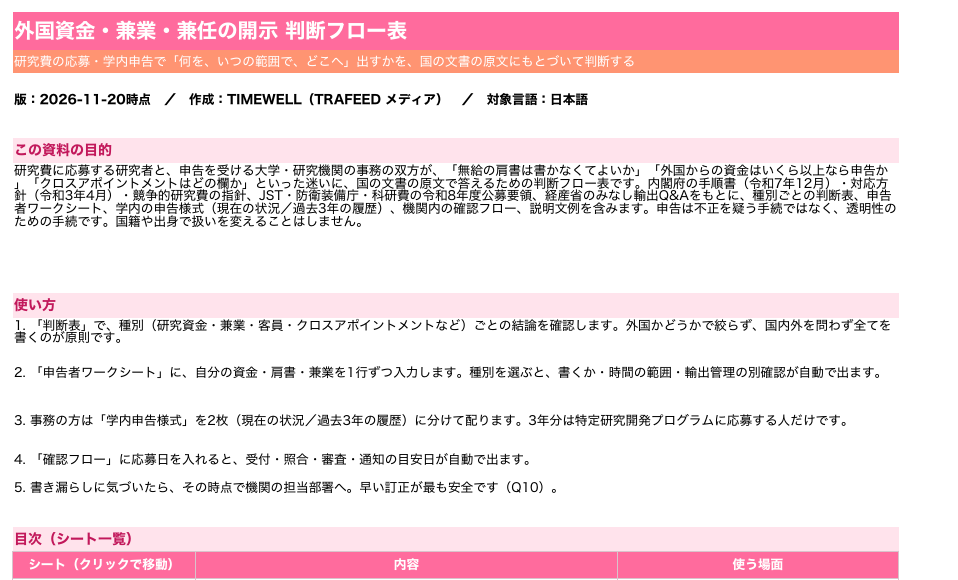
Disclosure Decision Flow for Foreign Funding and Outside Appointments (editable Excel)
A decision table, researcher worksheet and internal disclosure form for research-security disclosures, based on the Cabinet Office procedures (Japanese only).
Get the fileYou can download it after a short form (Japanese).
(November 21, 2026) We corrected the section references for the KAKENHI call for proposals in footnote 6 to match the original's structure (I-5 (1) ② and ③, III-1 (2), IV-3 (2)).
Hello, this is Ryuta Hamamoto from TIMEWELL.
Picture a question landing on the desk of a university's research promotion office. An associate professor is getting ready to apply for national research funding. They hold a visiting title at a foreign university, are invited to give a lecture there once a year, and receive travel costs and a speaking fee. Faced with the "affiliations and positions" field on the application form, they stop. "It's an unpaid title, so surely I don't need to list it?" "How much money from abroad does it take before I have to disclose it?"
The administrative side has its doubts too. There is a researcher on a cross-appointment (クロスアポイントメント, an arrangement in which a researcher holds employment contracts with more than one institution), but the word never appears in the calls for proposals. What should the university's internal disclosure form ask about foreign talent programs? Ask the wrong way and it can read as though you suspect the researcher.
This article answers those doubts from the original text of the national documents. On 20 November 2026 we obtained and read the Cabinet Office's "Procedures for Measures to Ensure Research Security" (研究セキュリティの確保に関する取組のための手順書, December 2025), the "Policy on Ensuring Research Integrity Against New Risks Accompanying the Internationalization and Opening of Research Activities" (April 2021), the Guidelines on competitive research funding, and the FY2026 calls for proposals from JST, ATLA (the Acquisition, Technology and Logistics Agency) and KAKENHI123456. For the big picture, see our complete guide to research integrity and research security. For how disclosure works in general, see COI and COC disclosure in practice. Here I narrow things down to the ten situations where people get stuck.
The conclusion first
- As a rule, do not filter disclosure by asking "is it foreign?" Disclose all current affiliations and positions, and all research funding and support.
- Three years of history are asked for only in some items of the questionnaire for Specified Research and Development Programs. The fields on the application form ask for "current" information.
- Disclosure is a transparency procedure, not a procedure for suspecting misconduct. If you notice a gap, telling your institution early is the best course.
Getting the basics straight: "foreign funding" is not a term in the national documents
First, three distinctions. Mix them up and neither researchers nor administrators can see the answers.
There is not just one document that requires disclosure. They differ in whom they ask, how far they reach and when they apply.
| Document | When it applies | What it asks for |
|---|---|---|
| The Policy (April 2021) and the Guidelines on competitive research funding | Applications for competitive research funding in general (KAKENHI, JST, ATLA's program and so on) | Current status of applications for and receipt of research funding, all current affiliations and positions, and a pledge that support such as donations and equipment has been reported to the institution23 |
| The manual (December 2025) and its questionnaire | Only programs designated as "Specified Research and Development Programs" (特定研究開発プログラム) | 13 check items, some covering the past three years, plus a consent form and a sworn statement1 |
| The institutional checklist (template) | Day-to-day operation (whether or not you are applying) | Reporting and updating career history, affiliations and positions, and support received from outside organizations7 |
Specified Research and Development Programs are competitive research funding programs, premised on publishing their results, that the responsible ministry designates as needing particular protection against technology leakage from an economic security standpoint1. In FY2026 they include, for example, five research areas of JST's CREST4. ATLA's Innovative Science and Technology Initiative for Security is also designated as a Specified Research and Development Program5. The KAKENHI call for proposals we read for this article says nothing about KAKENHI being a Specified Research and Development Program. KAKENHI does, however, have both the affiliations-and-positions disclosure and the pledge in e-Rad (the cross-ministerial R&D management system)6.
Next, the wording. "Foreign funding" (外国資金) is not a defined term in the manual. The Policy says funding agencies should ask for the information needed for transparency, "including the status of acceptance of research funding from abroad," and describes all current research funding as "not only domestic competitive research funding but, including funding from abroad, subsidies, grants, joint research funding, sponsored research funding and so on"2. In other words, it draws no line between domestic and foreign. Foreign funding is in there, along with everything else.
One more term. The phrase 外国人材採用プログラム, which you sometimes see in Japanese headlines and which reads as "a program for hiring foreign nationals," does not appear in the national documents either. The manual's term is 外国の人材採用プログラム ("foreign talent recruitment programs"), and the term in the Guidelines and the calls for proposals is 外国の人材登用プログラム (literally "foreign talent appointment programs")13. Neither means a program for hiring foreigners. Both refer to schemes in which a foreign party recruits and invites researchers. Note that this is not a question of nationality. The manual contains no sentence defining the term. Footnote 22 gives an example: as programs whose participation would be checked, it points to those on the list based on Section 1286 of the US National Defense Authorization Act for Fiscal Year 20191. The Cabinet Office Q&A (II-15), asked whether a specific definition or list of programs will be provided, answers that "the manual has in mind the list based on the US National Defense Authorization Act"8.
Finally, the purpose of disclosure. The manual states that, in judging whether a counterparty is a trustworthy partner, there must, "as a matter of course," be no discriminatory treatment on grounds such as nationality, race, religion or culture1. A note in the Cabinet Office's checklist template also points to the risk that a researcher who fails to disclose may be suspected of a false statement or a conflict of interest and lose trust as a result7. Disclosure is not there to cast suspicion on researchers. It is also a procedure that protects researchers themselves.
What to disclose and when: read "current" and "past three years" separately
The biggest source of confusion is the time range. The application form works in "current," part of the questionnaire works in "past three years," and the two are different yardsticks. The table below lines them up by situation.
| Situation | What is disclosed | Where it goes | Time range | Basis |
|---|---|---|---|---|
| Day to day (whether or not you are applying) | Career history, all current affiliations and positions, support received from outside organizations | The responsible office at your institution | Report updates whenever something changes | Policy 2(2), checklist27 |
| At application (competitive research funding in general) | Status of applications for and receipt of other research funding; all current affiliations and positions (including outside appointments, participation in foreign talent appointment programs, and roles such as emeritus professorships with no employment contract) | Application form, e-Rad | Current | Guidelines, each call for proposals3456 |
| At application (same) | A pledge that all information on research activities, including support such as donations and free use of facilities and equipment, has been reported to the institution | e-Rad | That it has been reported | Guidelines, each call for proposals36 |
| From application to award (Specified Research and Development Programs only) | The 13 questionnaire items. Research funding history, history of support other than research funding, participation in foreign talent recruitment programs and some others cover the past three years | From the institution to the funding agency | Past three years, counting the fiscal year that contains the application date | Manual 3-31 |
| Same | Consent form on the purposes for which personal information is used; sworn statement that the content is up to date and complete | To the institution (signed by the researcher) | As of submission | Manual 3-31 |
| After award, during the research period | Changes to what was stated, checks when research participants are added, corrections of errors | From the institution to the funding agency | Each time something changes | Manual 3-5, JST call 6.314 |
One point on how to read "past three years." The manual says that information on items ③ to ⑧, ⑩ and ⑪ covers "the past three years, including the fiscal year that contains the application date"1. For an application in FY2026, that reads as three fiscal years including FY2026, i.e. FY2024 to FY2026 (Japanese fiscal years run from April to March). The Cabinet Office Q&A (II-4) confirms this: the fiscal year containing the application (or appointment) date plus the two before it. A funding agency's questionnaire can ask for a longer period, though. The FY2026 questionnaire for the Innovative Science and Technology Initiative for Security (commissioned research, Annex 5 of the call guidelines) covers items 3 to 8, 10 and 11 from "FY2023 to the present." Where the questionnaire you receive states a period, collect for that period.
A quick table for counting the three fiscal years from the application date is in our research security declaration, consent and pledge templates (Word, in Japanese). The templates set out the 13 items in Manual 3-3 and the required content of the consent and pledge forms as worded in the original, with the answers from the Q&A updated in August 2026 built into the filling notes.
Be clear, too, about which items fall within the three years and which do not. Education (①), research and employment history (②), listing on lists (⑨), status as a non-resident or under the specific categories (⑫) and other matters the funding agency considers necessary (⑬) are not in the three-year group1. Administrators designing the disclosure form can reduce researchers' uncertainty by building this difference into the field labels.
Submission timing differs by program. JST says it will separately send the questionnaire to the principal investigators of candidate projects selected for risk management4. ATLA says the lead research institution of a project selected for interview review submits it by around mid-July5. What they have in common is that not everyone necessarily submits it at the time of application. The questionnaire flow is set out in our guide to answering the questionnaire.
Replace siloed classification work with AI.
METI's FY2024 data shows 52% of foreign exchange law violations stem from classification errors. Download the TRAFEED product catalog covering features and rollout.
Answering the ten hard questions from the original texts
Each question is answered in the same order: answer, basis, how to proceed, whom to ask. "How to proceed" is our proposal. For the final decision, follow the call for proposals you are applying under and your institution's rules.
Q1. What exactly does "foreign funding" cover?
Answer. Do not narrow it down by whether it is foreign. Think in terms of all research funding and all support other than money.
Basis. The Policy treats as information needed for transparency all current research funding (subsidies, grants, joint research funding, sponsored research funding and so on), plus donations and the free provision of goods such as research facilities, equipment and instruments, and of services2. The manual's questionnaire describes "history of support other than research funding" as the status of remuneration and salaries, scholarships, donations, the conferral of honorary titles and the like, and concurrent posts1. A note in the checklist template gives the scope of remuneration as incentive payments, salaries for concurrent posts, prize money, gifts, donations, travel expenses, speaking fees, writing fees and so on7.
How to proceed. The internal form should not ask "Do you have any funding from abroad?" It should ask "Please list all research funding and support, whether domestic or foreign." Why phrase it that way? So that researchers are not the ones left carrying the burden of deciding what counts as foreign.
Whom to ask. The contact point at the funding agency you are applying to, and the responsible office at your institution.
Q2. Do I list outside appointments at domestic companies as well as at foreign universities?
Answer. Yes. The country of the outside appointment (兼業) is not a condition.
Basis. The Guidelines require applicants to state "information on all current affiliations and positions (including outside appointments, participation in foreign talent appointment programs, and emeritus professorships and the like with no employment contract)"3. The KAKENHI call for proposals uses the same parenthetical and asks for all affiliations and positions to be listed in the research proposal6.
How to proceed. Ask about a technical adviser role at a domestic company, a part-time lecturer post at a foreign university and a concurrent post at a domestic university on the same form. The export control check is a separate procedure. The Deemed Export Q&A (みなし輸出Q&A) published by METI, the Ministry of Economy, Trade and Industry, answers in Q47 that even if the company permits the outside appointment, a person working for a Japanese company who is also employed by a foreign corporation in principle falls under Category 1 of the specific categories (特定類型①), that providing technology to such a person requires a license application under Article 25(1) of the Foreign Exchange and Foreign Trade Act, and that this holds as long as they fall under a specific category, even if the company permits the outside appointment. The reason given is that a company's judgment of its own interests and a judgment of security interests are different things. Approving an outside appointment and licensing the provision of technology are separate matters. For details, see our explainer on the specific categories (in Japanese)9.
Disclosures of outside appointments also feed into export control checks. METI's Q&A (Q2, Q25) says that where there are rules prohibiting conflicts of interest, including side jobs, or making them subject to declaration (rules modelled on Articles 11 and 70 of the Ministry of Health, Labour and Welfare's Model Work Rules), those rules are understood to require a report when someone newly falls under Category 1 or 2. This assumes, though, that the university keeps track of employees' current outside appointments. A footnote in the guidance for universities (fifth edition) says it is not enough for the HR department or similar simply to receive the declarations; the information needs to be used by the export control department to determine whether people fall under the specific categories (p. 46)10. Make sure both the research integrity staff and the export control staff can see outside-appointment declarations.
Whom to ask. Bring in the HR staff who handle outside appointments and the university's security export control staff at the same time.
Q3. How do I describe a cross-appointment?
Answer. The natural reading is that it counts as "all current affiliations and positions." List each institution, the position and whether there is an employment contract.
Basis. The term does not appear in the manual, the Guidelines, or the JST, ATLA or KAKENHI calls for proposals. All we could confirm was wording to the effect that "all" affiliations and positions must be listed3. Within what we read, we found no document that names cross-appointments and says which field they go in.
How to proceed. If they do not fit the field on the application form, add the institution names, positions, whether there is an employment contract and the effort allocation in a remarks field or similar. Effort is the share of a researcher's total working time devoted to the research in question. It is safer to have the administrative offices at both institutions confirm the split in advance, so the figures do not conflict between institutions.
From an export control standpoint, the picture shifts a little. The term "cross-appointment" does not appear in METI's Services Circular (役務通達; the amended version promulgated on 14 November 2025)11, the Deemed Export Q&A or the guidance for universities (fifth edition) either. METI's casebook (August 2023), however, includes an example in which University C asks staff who have submitted applications for outside appointments, cross-appointments and the like to submit a pledge through their direct supervisor (p. 21)12. This is an example of one university's practice, not a METI requirement. METI's explanatory slides, "Clarifying the Operation of Deemed Export Controls," also give, as an example of Category 1 at universities and research institutions, "faculty and staff of a Japanese university who hold a concurrent post (including a cross-appointment) at a foreign university" (p. 3)13. The same page asks readers always to check the provisions of the Services Circular. Whether someone actually falls under Category 1 depends not on the word but on the contract with the foreign institution and on whether it brings direction and supervision or a duty of care. If someone has an employment contract with a foreign university or institution and is under its direction, they are normally to be considered under Category 1 (Q46, Q47). The exception is where the foreign side has agreed that the Japanese university's direction takes priority, and that agreement does not necessarily have to be in writing (Q43, Q44; where the foreign side is not a group foreign corporation or the like, METI may ask for materials showing the agreement). It is worth checking, together with your export control staff, whether the cross-appointment agreement says which institution's direction takes priority. This is our framing.
Whom to ask. The contact point at the funding agency, and the responsible offices at both institutions.
Q4. What do I write about foreign talent recruitment programs?
Answer. The fact of participation, the period, and the funding, benefits and conditions received. Do not decide whether to list a program by its country or its name.
Basis. The manual's questionnaire treats participation in foreign talent recruitment programs as one of the items checked for the past three years (⑦). It also gives, as an example under the specific categories, "researchers who participate in a foreign talent recruitment program and receive large amounts of research funding or living expenses"1. Footnote 22 introduces the programs on the US Section 1286 list with the words "for example." The Q&A (II-15) says the manual has in mind the list based on the US National Defense Authorization Act8. Check first whether the program is on that list; even if it is not, it is safer to record the fact and terms of participation (if the questionnaire you receive sets a scope, follow it).
How to proceed. Checking the conditions is the key. The near-miss casebook commissioned by MEXT (the Ministry of Education, Culture, Sports, Science and Technology) includes a case in which a professor emeritus was invited to join a foreign talent appointment program (a five-year distinguished professorship at a foreign university, with all research results and technical information belonging to that university and pay about three times his former salary) and consulted the administrative office about taking the post. The points the casebook lists as examples to focus on are whether there is an employment relationship or research funding managed through the university, whether the person holds trade secrets or useful data managed in Japan, how intellectual property and technology relate to the university, and the details of the program14. What gets checked is the conditions, not the person's attributes.
Whom to ask. The institution's research integrity staff and security export control staff. Whether someone falls under a specific category for export control is judged separately. If the program involves receiving large amounts of money from a foreign government or the like, Category 2 (money or other benefits accounting for 25 percent or more of annual income) has to be considered. If the research funding becomes income of the university or the lab rather than of the individual, Category 2 does not apply. If the university or lab is the recipient only in form and the individual benefits in substance, it may apply (Q51, Q52). And falling under a specific category does not lead to blanket refusal of licenses (Q59)9.
Q5. Do unpaid visiting professorships and emeritus titles need to be listed?
Answer. Yes. Whether there is pay is not a condition for listing.
Basis. The parenthetical in the Guidelines expressly mentions "emeritus professorships and the like with no employment contract"3. In the manual's questionnaire too, the conferral of honorary titles is part of "history of support other than research funding" and covers the past three years1. The near-miss casebook includes a case in which a professor emeritus, with no employment relationship and no research funds to manage, consulted the administrative office about taking up a distinguished professorship at a foreign university14.
How to proceed. Even when "it's only a title and I don't do any actual work," list it and add an explanation. For the person listing it, this also leaves a record that they disclosed it from the start, should questions come later.
Export control treats it differently. The Deemed Export Q&A (Q63) answers that receiving the title of professor emeritus from a foreign university does not, on that basis alone, need to be treated as falling under Category 2. Things that are hard to put a monetary value on, such as decorations, also do not fall under Category 2 merely by being received, except in special cases such as when extremely expensive materials are used. The two answers, "list it for research funding" and "the title alone does not put you in a specific category for export control," do not contradict each other. The procedures serve different purposes. If, however, a visiting professor or similar is under a foreign institution's direction under an employment contract with it, Category 1 has to be considered separately (Q46). The guidance (fifth edition, p. 43) says that without time and place constraints akin to an employment relationship, merely being asked to pledge loyalty to a foreign government or the like and agreeing to it does not fall under Category 110.
Whom to ask. The institution's HR office and research integrity staff.
Q6. How do I tell "current" from "past three years"?
Answer. The affiliations-and-positions and research funding fields on application forms are "current." The past three years apply to some items in the questionnaire for Specified Research and Development Programs.
Basis. The wording in both the Guidelines and the calls for proposals is the "current" status of applications for and receipt of other research funding, and "all current" affiliations and positions3. Manual 3-3, on the other hand, sets items ③ (research funding history) through ⑧ (history of sanctions under the Guidelines), plus ⑩ and ⑪, at the past three years, counting the fiscal year that contains the application date1.
How to proceed. Split the internal form into two sheets. Sheet one is "current status," updated every year whether or not the researcher is applying. Sheet two is "three-year history," an extra sheet that only those applying to Specified Research and Development Programs fill in. Making everyone fill in three years only adds to the burden.
A researcher worksheet and an internal disclosure form come with our disclosure decision flow for foreign funding and outside appointments (Excel, in Japanese). It is a table for deciding what to disclose, for which period and to whom, based on the original text of the Cabinet Office manual.
Whom to ask. The notes on the funding agency's questionnaire, and the funding agency's contact point.
Q7. A confidentiality agreement means I cannot name the joint research partner or the amount
Answer. The Guidelines and the calls for proposals set out how to handle cases where you cannot list them. You can meet the disclosure obligation without breaching the contract.
Basis. The Guidelines say that for joint research and similar arrangements covered by confidentiality agreements, only the information needed to confirm that effort can be secured is requested (in principle, the partner institution's name, the amount of research funding received and the effort). They go on to say that, for the time being, where there are unavoidable circumstances in which the terms of a contract already concluded make submission difficult, the application may be submitted without the partner institution's name and the amount received, and that the institution may be contacted as needed3. JST's call for proposals says the same4.
How to proceed. When you conclude new contracts, build in the understanding that information required for funding applications may be submitted, limited to what is needed. JST says that if both parties agree on the scope of confidentiality and the legitimate reasons for it, a contract that does not presuppose submitting confidential information is also possible4. Institutions should be able to check the status of confidentiality agreements against contract management records rather than relying on researchers' own reports.
Whom to ask. The institution's contract management staff and the funding agency.
Q8. Are free use of equipment, speaking fees, travel expenses and donations covered?
Answer. Yes. A small amount, or no money changing hands, is not a reason to leave something out.
Basis. A footnote to the Policy defines support other than research funding as including cases where goods such as research facilities, equipment and instruments, or services, are provided free of charge2. At application, researchers pledge in e-Rad that all information on research activities, including these, has been properly reported to their institution36. If it turns out that they had not reported it, contrary to the pledge, the result can be rejection, cancellation of the award or a reduced allocation3.
How to proceed. We found no monetary threshold in the national documents we read. If your institution sets one, write it into the rules and make sure researchers know about it. Even without a threshold, settle on a single reporting point. With several reporting points, nobody can tell where the reports underpinning the pledge are kept.
Whom to ask. The institution's conflict-of-interest office.
Q9. Things changed after I applied, and research participants were added
Answer. Tell your institution about changes as soon as you notice them. When research participants are added, they need to be checked as well.
Basis. JST's call for proposals asks applicants to report promptly to the contact point if anything they stated changes after submission, for example if another research grant is awarded, and says that a gap in reporting can lead to rejection and similar outcomes4. Manual 3-5 says that when research participants are added as the research progresses, due diligence (checking a counterparty or a person through public information and declarations) is carried out on them. Research participants include students1. For new hires, the manual describes it as desirable to gather the information at the recruitment stage1.
How to proceed. Checks on students and international students are made on the facts declared, not on nationality. The approach of looking at residence and relationships is set out in our articles on taking on students and RAs and checks when admitting international students.
Whom to ask. The funding agency's contact point and the responsible office at your institution.
Q10. I later noticed a gap or an error
Answer. Tell your institution's responsible office at that point. Correcting early is the safest course.
Basis. Manual 2-6 says that technology leakage cannot always be prevented even with adequate measures, and that in such cases research institutions and researchers do not bear responsibility. At the same time, it frames the conduct that does call for a response as "intentional false declarations or concealment"1. If an error comes to light, the institution promptly reports to the funding agency and the check is redone with the corrected information1. The Guidelines provide that where statements differ from the facts, the result may be rejection, cancellation of the award or a reduced allocation. If receipt of funds by deception or other wrongful means is confirmed, there is in principle a five-year restriction on applying, starting from the fiscal year after the one in which the subsidies or similar funds were returned3.
How to proceed. "Leaving something out unintentionally" and "hiding it intentionally" differ in seriousness. For researchers to believe that difference is real, institutions should say up front that they will not penalize people who correct their own disclosures. Whether a particular case falls on one side or the other, though, is for the funding agency and the institution to judge. It is not something this article can decide.
Whom to ask. The institution's responsible office. If that does not resolve things, there is the government's one-stop consultation desk set out in manual 1-2. The desk gives advice; it does not make decisions on behalf of the person consulting it1.
Sample entries (fictitious), a review flow and a template explanation
Sample entries for affiliations and positions (fictitious)
The table below is a sample. The names, institutions and figures are all fictitious and have nothing to do with real people or institutions. For the actual forms and field names, follow the instructions of the funding agency and your institution.
| Type | Institution (fictitious) | Position/status | Employment contract | Period | Remarks (sample) |
|---|---|---|---|---|---|
| Primary post | University A | Associate professor | Yes | Ongoing | Effort 70% |
| Post at another institution | Institute B | Invited researcher (cross-appointment) | Yes | Since April 2025, ongoing | Effort 20%. Allocation confirmed by both institutions' administrative offices |
| Foreign university | University C (abroad) | Visiting professor | No | Since September 2024, ongoing | Unpaid. One lecture a year only. Travel paid by the host |
| Private company | Company D | Technical adviser | No (advisory contract) | Since January 2025, ongoing | Two hours a month. University's outside-appointment approval obtained |
| Honorary title | University E | Professor emeritus | No | Ongoing | No employment relationship. No research funds managed |
A short sample entry for the university's internal disclosure form (fictitious)
In FY2025 I received a research grant of ¥2 million from Foundation F (abroad). It is used for consumables in my lab at this university. A copy of the contract has been submitted to the research promotion office.
Write just the facts, briefly. There is no need to add assessments or justifications.
Review flow within the institution (our proposal)
The flow below is our proposal. The national documents do not prescribe it in this form.
| Stage | Who | What they do | Rough timing |
|---|---|---|---|
| 1 Intake | Research promotion office (administration) | Check for gaps in the form and the format of the fields. Do not judge the merits of the content | About 8 weeks before the application |
| 2 Cross-check | Research integrity staff | Compare with public information, e-Rad and the university's outside-appointment approval records. Where something does not match, ask the researcher first | About 1 week after intake |
| 3 Review | Responsible officer or committee | Decide whether risk mitigation measures are needed. The manual says reasonable measures proportionate to the level of risk are sufficient1 | About 2 weeks |
| 4 Notification | Research promotion office | Tell the researcher the result and the reasons. Submission to the funding agency goes through the institution's contact point | About 2 weeks before the application |
| 5 Updates | Researcher, administration | If anything changes, the researcher tells the administration and the administration tells the funding agency | Each time something changes |
At stage 2, the order of steps when something does not match is what matters. Rather than jumping straight to suspicion of misconduct, first ask the researcher, "Could you explain the difference between this entry and this record?" In the near-miss casebook's outside-appointment case, an HR administrator noticed that the duties described in the letter of appointment did not match those in the draft contract. The researcher checked the request with the other party and asked for the draft to be corrected14. The casebook treats this as a mismatch between application documents, and lists checking the letter of appointment against the contract as an example of how to manage it.
Template explanation for researchers (written without blame)
The following is a template. Use it after review by legal and research integrity specialists, adapted to your institution's circumstances.
Template (notice to researchers; based on the Japanese system, to be reviewed by legal and research integrity specialists)
Subject: Request to confirm your affiliations, positions and research funding for your funding application
This is a routine check to ensure the transparency of your research activities and to spare you from being asked for explanations after you apply. Under the national application conditions, we are required to ask about all research funding, outside appointments and titles such as visiting or emeritus professorships, whether domestic or foreign.
This check is not meant to cast doubt on your research activities. We do not treat anyone differently because of nationality, origin, or the country or institution they are affiliated with.
If you are unsure how to fill in an item, just write "unsure." The administrative office will go through it with you. Additions and corrections are accepted even after you apply. Please feel free to get in touch.
Common misunderstandings and failures
Here are seven that tend to come up in practice.
First, the misunderstanding that "I only need to list foreign things." The Guidelines ask for all research funding, domestic and foreign, and all affiliations and positions3.
Second, the misunderstanding that "unpaid titles don't need to be listed." Emeritus professorships and the like with no employment contract are named expressly3.
Third, making everyone list three years of history. Three years apply to some items for Specified Research and Development Programs and are not a requirement for every applicant1. Asking for more than is needed only makes researchers less willing to cooperate.
Fourth, treating outside-appointment approval and the export control check as a single procedure. Even if the company or university permits an outside appointment, a separate check of the specific categories may still be needed9.
Fifth, asking only foreign researchers to disclose. Disclosure applies to all researchers. The manual states plainly that there must be no discriminatory treatment on grounds such as nationality1. Changing how you ask for disclosure according to nationality also runs against the purpose of the system.
Sixth, leaving the e-Rad pledge until just before the deadline. The KAKENHI call for proposals warns that you cannot apply unless the principal investigator and co-investigators have registered their research integrity pledge status, and that the link between e-Rad and the electronic application system normally takes 30 to 60 minutes and can take several hours when the system is busy6.
Seventh, not keeping records of disclosures. When an error comes to light, the institution has to report promptly to the funding agency1. Without a record of when, who disclosed what, and who checked it, neither reporting nor correction is possible.
What we could not confirm, and the limits of this article
We obtained and read the FY2026 JST call for proposals, the ATLA call guidelines and the KAKENHI call for proposals on 20 November 2026. We did not read the calls of other funding agencies (NEDO, AMED, other MEXT programs and so on) this time. The questionnaire you actually receive is prepared by the funding agency, so the details of the items may differ from the manual's template (Annex 3). ATLA's questionnaire (Attachment 5), for example, labels items ③ to ⑧, ⑩ and ⑪ "FY2023 to present."
Some things we looked for and did not find. We could not find a national document that sets out which field cross-appointments go in, or how, so the answer to Q3 is our reading. Nor could we confirm any provision that defines "foreign talent recruitment programs." What we could confirm was the example in footnote 22 of the manual and the Q&A's answer (II-15) that the manual has in mind the list based on the US National Defense Authorization Act.
For METI's materials (the Deemed Export Q&A revised on 8 August 2023, the Services Circular, the guidance for universities, fifth edition, of September 2025, and the casebook of university practices of August 2023), we checked the Q numbers, the wording of the answers and the definitions against the originals obtained on 20 November 202691012. In METI's materials, the word "cross-appointment" appears in the casebook's description of one university's practice and in the Category 1 example in the explanatory slides "Clarifying the Operation of Deemed Export Controls" (p. 3; original checked on 21 November 2026)13. "Disclosure of foreign funding and outside appointments" and "the specific categories for export control" are separate procedures with separate criteria, and some cases call for both checks. We also checked the original of MEXT's notice on its research security consultation desk (7 Monkaka No. 54, 10 April 2025) on 20 November 2026. The desk takes enquiries from universities and similar institutions (universities, junior colleges, inter-university research institute corporations and colleges of technology); national research and development agencies are not covered. Details are in the article on funding requirements. Finally, the timings, thresholds and forms in the institutional review flow are our proposals, not national requirements.
The system will keep being revised. The manual itself says it will be reviewed as needed in light of how it operates1. This article does not decide whether a particular case must be disclosed or whether an export control license is required. For individual decisions, consult the funding agency, the responsible officer at your institution and, where needed, specialists.
What to read next
- COI and COC disclosure in practice
- Why foreign funding and dual affiliations are checked
- A guide to answering the research security questionnaire
- How research security became a condition for funding
- The complete guide to research integrity and research security
- A checklist for joint research contracts and export control
- Setting up research security governance in 90 days
When you are putting in place the export control checks that follow disclosure, you can contact us about TRAFEED.
Footnotes
-
Expert Panel on Ensuring Research Security and Research Integrity, "Procedures for Measures to Ensure Research Security" (in Japanese), December 2025 (Cabinet Office). See sections 2-4, 2-6, 3-1, 3-3, 3-5 and 1-2, Annex 2, and footnotes 22 to 26. https://www8.cao.go.jp/cstp/kokusaiteki/integrity/yushikisha/guidelines_v1.pdf (checked 20 November 2026) ↩ ↩2 ↩3 ↩4 ↩5 ↩6 ↩7 ↩8 ↩9 ↩10 ↩11 ↩12 ↩13 ↩14 ↩15 ↩16 ↩17 ↩18 ↩19 ↩20 ↩21 ↩22 ↩23 ↩24 ↩25
-
Integrated Innovation Strategy Promotion Council, "Policy on Ensuring Research Integrity Against New Risks Accompanying the Internationalization and Opening of Research Activities" (in Japanese), 27 April 2021. See 2(2), 2(3) and footnote 4. https://www8.cao.go.jp/cstp/kokusaiteki/integrity/integrity_housin.pdf (checked 20 November 2026) ↩ ↩2 ↩3 ↩4 ↩5 ↩6
-
Agreement of the Inter-Ministerial Liaison Meeting on Competitive Research Funding, "Guidelines on the Proper Execution of Competitive Research Funding" (in Japanese), 9 September 2005 (revised 17 December 2021). https://www8.cao.go.jp/cstp/kokusaiteki/integrity/shishin.pdf (checked 20 November 2026) ↩ ↩2 ↩3 ↩4 ↩5 ↩6 ↩7 ↩8 ↩9 ↩10 ↩11 ↩12 ↩13 ↩14 ↩15
-
Japan Science and Technology Agency (JST), "FY2026 Strategic Basic Research Programs (CREST, PRESTO, ACT-X) Call for Proposals" (in Japanese), Chapter 6, sections 6.3, 6.4 and 6.5. https://www.jst.go.jp/kisoken/boshuu/teian/koubo/2026youkou.pdf (checked 20 November 2026) ↩ ↩2 ↩3 ↩4 ↩5 ↩6 ↩7 ↩8
-
Acquisition, Technology and Logistics Agency (ATLA), "FY2026 Innovative Science and Technology Initiative for Security (Commissioned Research) Call Guidelines" (in Japanese), March 2026, sections 5.4, 5.12 and 5.13. https://www.mod.go.jp/atla/funding/koubo/r08/r08koubo_honsatsu_itaku.pdf (checked 20 November 2026). The requirement to list all current affiliations and positions (including outside appointments, participation in foreign talent appointment programs, and emeritus professorships with no employment contract) is in the instructions for Form 4-1 (the principal investigator's career history) in the full version of the same guidelines (https://www.mod.go.jp/atla/funding/koubo/r08/r08koubo_full_itaku.pdf , checked 21 November 2026). We did not read the call guidelines for the subsidy program this time. ↩ ↩2 ↩3 ↩4
-
Japan Society for the Promotion of Science, "FY2026 Grants-in-Aid for Scientific Research (KAKENHI) Call for Proposals (Scientific Research)" (in Japanese), July 2025, I "5. Guidelines on the Proper Execution of Competitive Research Funding, etc." (1) ② and ③; III "1. What to do before applying" (2) (the e-Rad link to the electronic application system normally takes 30 to 60 minutes, and several more hours when busy); and IV "3. Points to check when submitting application documents (research proposals)" (2). https://www.jsps.go.jp/file/storage/kaken_kiban_2025_g_3687/r8_7_kobo.pdf (checked 20 November 2026). The FY2027 call for proposals (14 July 2026, https://www.jsps.go.jp/file/storage/kaken_kiban_2026_g_4978/r9_7_kobo.pdf , checked 21 November 2026) contains the same provisions (I-5 (1) ② and ③, III-1 (2), IV-3 (2)) ↩ ↩2 ↩3 ↩4 ↩5 ↩6 ↩7
-
Cabinet Office, "Checklist for New Risks Accompanying the Internationalization and Opening of Research (Template)" (in Japanese), for researchers (version of 17 December 2021, https://www8.cao.go.jp/cstp/kokusaiteki/integrity/checklist1.pdf) and for universities and research institutions (version of 29 June 2023, https://www8.cao.go.jp/cstp/kokusaiteki/integrity/checklist2r.pdf) (checked 20 November 2026) ↩ ↩2 ↩3 ↩4
-
Cabinet Office, "Q&A on the Procedures Manual for Ensuring Research Security" (in Japanese), last updated 26 August 2026 (II-4, II-15). https://www8.cao.go.jp/cstp/kokusaiteki/integrity/security_qa_v1.pdf (checked 20 November 2026) ↩ ↩2
-
METI, "Q&A on Clarifying Deemed Export Controls" (in Japanese), revised 8 August 2023 (Q2, Q25, Q43, Q44, Q46, Q47, Q50 to Q52, Q59 and Q63). Original checked (20 November 2026). https://www.meti.go.jp/policy/anpo/law_document/minashi/minashiqa3.pdf Our explainer: the specific categories (in Japanese). ↩ ↩2 ↩3 ↩4
-
METI, "Guidance on Sensitive Technology Management for Security Trade (for Universities and Research Institutions), Fifth Edition" (in Japanese), September 2025. See the definition and explanation of the specific categories (pp. 41 to 43) and the footnote stating that HR departments merely receiving declarations is not sufficient (p. 46). Original checked (20 November 2026). https://www.meti.go.jp/policy/anpo/daigaku/guidance5.pdf ↩ ↩2 ↩3
-
METI, "Regarding Transactions or Acts Providing Technology That Require a License under Article 25(1) of the Foreign Exchange and Foreign Trade Act and Article 17(2) to (4) of the Foreign Exchange Order" (in Japanese) (the Services Circular, 4-Bōkyoku No. 492; last amended by Export Notice 2025 No. 27, promulgated 14 November 2025, in force 14 February 2026). Original checked (20 November 2026). https://www.meti.go.jp/policy/anpo/law_document/tutatu/t10kaisei/ekimu_tutatu.pdf ↩
-
METI, "Casebook on Security Export Control at Universities and Research Institutions: Responding to the Clarification of Deemed Export Controls" (in Japanese), August 2023 (Case 3, University C, p. 21). Original checked (20 November 2026). https://www.meti.go.jp/policy/anpo/daigaku/minashi.pdf ↩ ↩2
-
METI, Security Export Control Division, "Clarifying the Operation of Deemed Export Controls" (in Japanese, 7 pages). Page 3 gives, under Category 1 (persons under the control of a foreign government or foreign corporation through an employment or other contract), "Example 1: faculty and staff of a Japanese university who hold a concurrent post (including a cross-appointment) at a foreign university," and states that the provisions of the Services Circular must always be checked when confirming whether a person falls under a specific category. Original checked (21 November 2026). https://www.meti.go.jp/policy/anpo/law_document/minashi/meikakukanitsuite2.pdf ↩ ↩2
-
FY2024 MEXT commissioned project, "Casebook of Research Integrity Near-Miss Incidents" (in Japanese), March 2025. Institutional cases ⑨ (a mismatch between the letter of appointment for an outside post and the contract) and ⑩ (a professor emeritus joining a talent appointment program). https://www.mext.go.jp/content/20250331-mxt_kagkoku-000019002_1.pdf (checked 20 November 2026) ↩ ↩2 ↩3