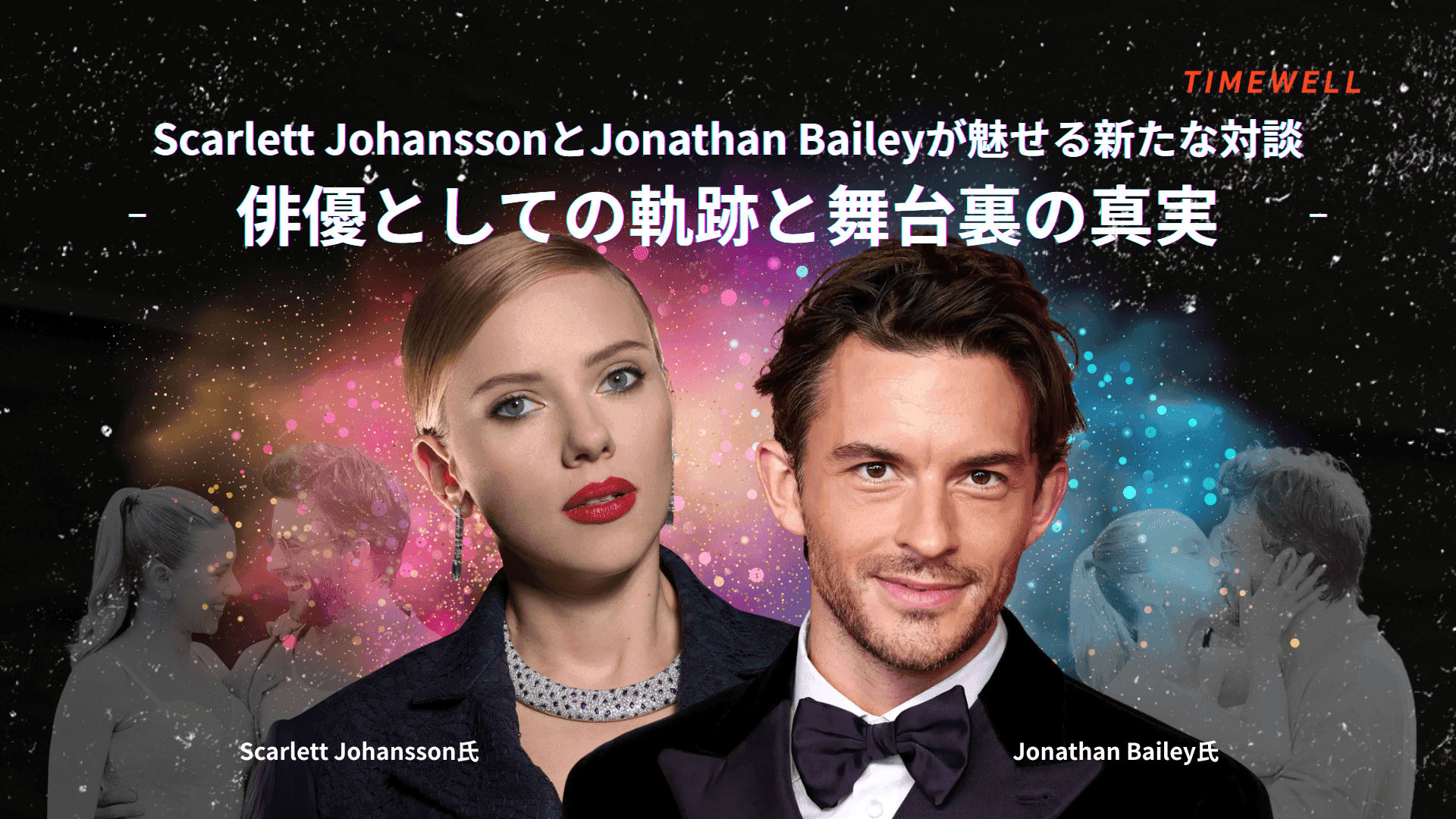
Two actors on what it actually takes to build a career
Scarlett Johansson and Jonathan Bailey are both successful by any public measure. The conversation between them is interesting precisely because they talk about the failures, miscalculations, and random timing involved in getting there — not as humility performance, but as the honest texture of careers that didn't follow a clean plan.
The interview covers breakthrough roles, production war stories, how each of them thinks about social media, and what the directing experience reveals about filmmaking that acting alone doesn't.
Breakthrough roles: the ones that actually mattered to them
Scarlett Johansson identifies The Horse Whisperer (1998, when she was 12) as her real breakthrough — not Home Alone 3, which more people remember. The distinction matters to her: the earlier work showed her range in a way the later commercial role didn't. She is consistent about this throughout the conversation — the project that pushed her is more valuable than the project that got more attention.
Jonathan Bailey points to Broad Church as the work that made viewers take notice. He played a morally complex character in a crime drama — the kind of role where the audience isn't sure whether to root for the person. The complexity of navigating that ambiguity, and the experience of working with that level of creative commitment, stayed with him as a reference point.
On Wicked specifically: the stage experience introduced demands that film doesn't — no second take, no editing correction, performance delivered complete in front of a live audience. Bailey is candid about how that pressure felt and what it required technically.
Set stories: what goes wrong and how you respond
Bailey on the Wicked click track failure: During one live performance, the click track — the metronome signal that keeps performers synchronized with the music — dropped. Performers had to self-synchronize in real time. He describes the specific problem of continuing without the reference point, making micro-adjustments, and somehow completing the performance. The recovery required both technical muscle memory and the ability to not make the problem visible to the audience.
This is the kind of story that doesn't appear in press releases. It illustrates the gap between performing something and having mastered it — and the category of problems that only live performance exposes.
Johansson on directing Eleanor the Great: Moving to the director's chair revealed how differently problems present themselves when you're responsible for the whole film rather than a single performance. She talks about the coordination of cast, crew, and intent — how a decision about a single prop or a small setup detail either supports or undermines what the scene is trying to do. "A piece of paper can construct an entire stage." The detail isn't decorative; it's structural.
She also discusses the creative negotiation that directing requires: your vision is one input, and the practical reality of what's achievable on a given day is another. The best directors hold both simultaneously without pretending one doesn't exist.
The glass-eye shot in Jurassic World Rebirth
Bailey describes working through the specific staging of a scene — a framing with glass between the character and the viewer — that emerged from conversation with the director. The glass creates psychological distance while making the character feel more exposed. The final choice wasn't in the original plan; it came from on-set experimentation.
What's useful here as a general principle: the difference between a competent performance and a memorable scene often comes down to specific decisions made in collaboration — not the execution of what was already planned.
Social media: two different approaches, same underlying logic
Johansson doesn't use social media in any serious way. Her argument: the noise and distraction undermine focus on the actual work. Brand value comes from the work and the craft, not from online presence. She uses her Today Show hosting experience as an example of the value of live, real-time, in-person media over broadcast-through-text relationships.
Bailey is also largely absent from social media by choice — framing it as a strategic decision about protecting creative freedom and privacy. His concern is slightly different: excessive information availability dilutes what actually matters about an actor's work, which is the performance. Both arrive at similar behavior from slightly different reasoning.
Neither is dismissive of digital media as a category. Johansson points to streaming platform promotion and digital video content as essential to modern entertainment. Bailey acknowledges the reach that online platforms provide. The shared position is something like: be strategic about where you spend your presence, and make sure the work is the thing that actually represents you.
What the conversation reveals about craft and career
Several underlying principles emerge from the specifics:
Preparation is foundational, but adaptation is the real skill: Bailey's Wicked click-track story and Johansson's directing experience both point to the same thing — preparation creates a baseline, but the ability to adapt when reality differs from plan is what separates competent from excellent.
The work represents you better than commentary about the work: Both actors are consistent about this. Social posts and interviews don't build reputations; performances do. Strategic restraint in media presence reflects confidence that the work speaks for itself.
Career decisions require ignoring external consensus: Johansson picking The Horse Whisperer over Home Alone 3 as her "real" breakthrough — regardless of which one got more attention — reflects a willingness to evaluate her own work by her own criteria rather than external reception.
Cross-discipline experience improves performance: Johansson's directing work gave her specific insight into production decisions that she couldn't have gained only as an actor. Bailey's stage experience gave him physical and technical demands that screen work doesn't impose. The unusual career moves paid dividends in craft development.
Summary
The Johansson-Bailey conversation works because neither is performing their success. They talk about specific failures (the click track), specific creative debates (the glass shot), and specific decisions about social presence — not in general terms but with the detail that makes each point real.
The larger messages that emerge: careers are built by choosing the right work rather than the most visible work; the ability to recover from unexpected problems distinguishes live performance from recorded performance; and the question of how to manage public presence in a media-saturated environment doesn't have one correct answer, but it requires having a deliberate answer.
Take AI-driven development all the way to production
WARP is a hands-on program for teams who want more than headlines. Former enterprise DX and data strategy leads work alongside you until it runs.
Streamline event operations with AI | TIMEWELL Base
Struggling to manage large-scale events?
TIMEWELL Base is an AI-powered event management platform.
Proven Track Record
- Adventure World: Managed Dream Day with 4,272 participants
- TechGALA 2026: Centrally managed 110 side events
Key Features
| Feature | Impact |
|---|---|
| AI Page Generation | Event page ready in 30 seconds |
| Low-cost payments | 4.8% fee — industry's lowest |
| Community features | 65% of attendees continue networking after events |
Ready to make your events more efficient? Let's talk.