Hello, this is Ryuta Hamamoto from TIMEWELL.
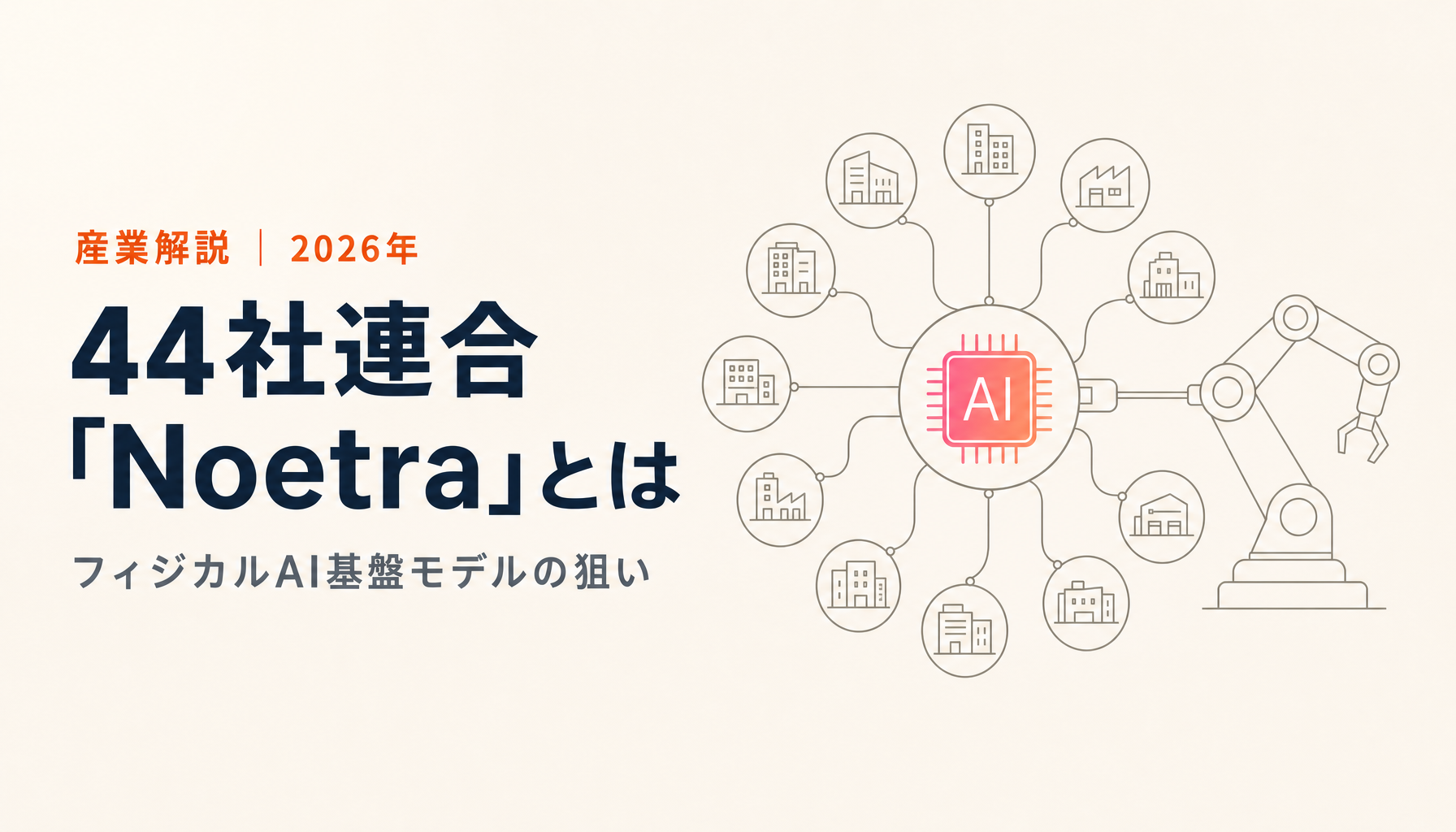
In 2026, a big piece of news moved through Japanese industry. With storied firms such as SoftBank, Sony Group, NEC, and Honda at its core, a total of 44 companies and organizations put up capital to launch a company that builds domestic AI. The company is called Noetra, and at its founding it was reportedly named Japan AI Foundation Model Development. On 16 July 2026, SoftBank officially announced that this company would begin full-scale research and development of a domestic foundation model1.
Read only the headline and you come away with "a giant AI alliance has formed," and that is where the impression stops. But this effort has a distinctive point in its aim: on what ground Japan intends to stage its comeback in AI. So that even a reader with no specialist knowledge of AI can grasp the outline, I will walk through, step by step and in plain words, what Noetra is, why an alliance of this scale was assembled, and how it relates to our own work. If you are wondering what stage your own company's AI use is at, checking your starting point first with our free AI literacy self-check will make the second half of this article far more concrete.
What kind of company Noetra actually is
Let me begin with the true nature of this company, because getting that straight changes how you take in the news.
Noetra is not a company run by a single firm on its own. It is a jointly funded development company, built with a wide range of industries pooling capital, with four companies at its core: Sony Group, SoftBank, NEC, and Honda Motor. According to reporting by the Nikkei, these four core companies each hold more than 10 percent of the shares, placing them in the group of leading shareholders. In the early stage of founding, the investors made public were, in addition to this core, the three megabanks Mizuho Bank, MUFG Bank, and Sumitomo Mitsui Banking Corporation, along with names such as Nippon Steel and Kobe Steel. What stood out was that not only manufacturing but finance too was on the list.
After that, the circle of investors widened further, and SoftBank's official announcement states clearly that participation reaches 44 companies and organizations in total1. Reports say this breaks down into roughly 28 manufacturing firms and about 16 non-manufacturing firms. I will not list every company name here one by one, but in short, the picture is one of representative Japanese makers, financial institutions, telecoms, and services, spanning a wide range of industries, gathering into a single AI company across the walls that usually divide sectors. It is not often, even in the history of Japanese industry, that so many large companies line up side by side and put capital into one technology-development effort together.
On the timing of the company's founding, incidentally, the accounts differ from source to source, "early 2026," "around spring," and so on. Most likely this is because the legal incorporation, the investments by the main companies, the change of company name, and the announcement of the 44-company structure each proceeded at different moments, so the way each outlet describes the timing is slightly out of step. In this article I will not fix a precise date, and will hold to "founded in the first half of 2026 and then expanded to 44 companies." If you need to be exact about dates, I recommend a final check against the registration records or the official announcements.
Why "physical AI" rather than "generative AI"
The single biggest feature of this alliance is the ground it is aiming for. This is the decisive difference from other AI news, so let me explain it carefully.
For the past few years, the AI that has filled the public conversation has been the conversational kind that writes text and answers questions, so-called generative AI. In this field, overseas majors have run out ahead by pouring in capital and talent on an entirely different scale, and it is no easy thing to catch up head-on, later, with a domestic effort. So the ground Noetra has set its sights on is the domain known as physical AI. It is an unfamiliar term, so to break it down: physical AI is AI for recognizing, judging, and controlling machines that actually move in the real world, such as robots, production equipment, self-driving cars, and logistics devices.
Where conversational, generative AI handles text and images and stays complete within the screen, physical AI perceives physical space through cameras and sensors and makes machines that actually move their limbs work intelligently. A factory robot that, even with a part it is seeing for the first time, figures out on its own how to grip it and assembles it. A warehouse transport unit that reads its surroundings and moves safely. Physical AI is the base for that kind of "AI that works in the real world." According to SoftBank's announcement, what Noetra aims for is to develop a "multimodal foundation model" that handles not just text but images, video, and audio in an integrated way, and ultimately to reach a "world foundation model (Real-world Native AI)" that can even understand the properties of physical space1.
Why bet here? The reason falls into place if you think of it as overlapping with Japan's strengths. Japan is a country strong in real-world manufacturing: automobiles, robots, electrical machinery, materials. On the ground of generative AI it has already been left far behind, but physical AI, making machines work intelligently, is the next main battlefield, only now starting up in earnest, and the outcome has not yet been decided. And to produce results in this domain, the diverse data obtained from actual factories and worksites is indispensable. An alliance in which many manufacturers take part has exactly that strength: it can bring that on-the-ground data together. Japan, having fallen behind in generative AI, aims to make its comeback on the next ground where it can put its own strong suits to work. Read Noetra's structure that way and it becomes easy to understand.
Let me add one thing. SoftBank's moves around physical AI are not only this Noetra. In December 2025, SoftBank also announced a collaboration on physical AI with Yaskawa Electric, a major maker of industrial robots. But that is a specific partnership aimed at robot control, and it is a different effort from Noetra, in which 44 companies invest to develop the foundation model itself. Because both are spoken of with the same phrase, "physical AI," they are easy to confuse, but sort them out as separate stories differing in scale and purpose, and you can read the news correctly.
Looking for AI training and consulting?
Learn about WARP training programs and consulting services in our materials.
The huge computing base and the development roadmap
Building a foundation model takes an outrageous amount of computing resources. Let me look at what kind of facilities Noetra plans to use and by what steps it intends to push development forward.
First, the computing base. According to SoftBank's announcement, it will build a large-scale AI computing base using roughly 27,500 of NVIDIA's latest-generation GPUs, "Rubin," with operation scheduled to begin around June 20281. A GPU is the computing device essential to training AI; put simply, think of it as a special computer for training AI's brain. Lining up more than 20,000 of them is like building one of the largest AI factories in the country. The core site envisioned for it is a data center in Sakai City, Osaka Prefecture. This is a building that was originally a liquid-crystal panel factory, which SoftBank acquired and converted into a data center for AI. It has the conditions suited to AI computation: a vast site and the ability to handle large amounts of electric power.
The way development proceeds is drawn not as an attempt to reach the final form all at once, but as a series of steps. According to the roadmap SoftBank has shown, it will first, in fiscal 2027, build a foundation model capable of advanced Japanese-language understanding and reasoning; next, in fiscal 2028, widen this to a model that can handle images, video, and audio in addition to text; and finally, in fiscal 2030, reach a "world foundation model" that can even understand the properties of space1. The project period is put at roughly fiscal 2026 through fiscal 2030. Starting from the stage of understanding text, then seeing with its eyes and hearing with its ears, and at the last grasping physical space: the design builds capability up one step at a time.
As a sense of scale, reports also say the target is a model of about 1 trillion parameters, which would be among the largest in the country. A parameter is something like a yardstick for the scale of an AI's cleverness; the more of them, the more complex the processing it is said to be able to do. But caution is needed here: the "1 trillion parameters" figure is a target value shown in reporting such as the Nikkei's, while SoftBank's own official announcement speaks in stage-by-stage goals and does not state a definitive final parameter count. It is accurate to take this not as a fixed specification but as a reported figure indicating the scale being aimed for. Rather than being pulled along by the size of the number, hold it as something that shows direction.
For a view on how this kind of domestic base building will take effect on the floors of robotics and manufacturing, I have organized my thinking in a separate article explaining Japan's physical-AI strategy, and reading it alongside this piece brings the picture into relief. For anyone who wants to settle in and grasp the country's large moves around AI, this can also be a prompt to review the very way you use AI, and as a first step, designing where AI belongs in your own company with an AI-consulting service like WARP makes it easier to pull news like this into your own concerns.
What the public-private structure with METI and AIST means
Noetra is not an effort of private companies alone. That the government is firmly involved is also an element you cannot leave out in understanding this alliance.
Noetra is proceeding by being adopted into a project publicly solicited by the Ministry of Economy, Trade and Industry (METI) and NEDO (the New Energy and Industrial Technology Development Organization). NEDO is a public body that uses national funds to back the research and development of industrial technology, playing the role of supporting large technology investment at the national level. According to reports, government support for this field reaches a scale of roughly 1 trillion yen over five years. On the breakdown of that amount, some reports put the subsidy for fiscal 2026, the first year, at about 387.3 billion yen, but that single-year figure rests on secondary reporting, and the accurate number is best confirmed against official materials from METI and NEDO on the public solicitation and adoption. The level of roughly 1 trillion yen in total is common across multiple reports, but for the fine allocation it is safer to go to the primary source.
Further, on the research and development side, it is said to be pursued jointly with the National Institute of Advanced Industrial Science and Technology (AIST). AIST is one of the country's leading public research institutions, an entity that can bring in the fundamental, cross-cutting research expertise that companies alone cannot carry. In other words, Noetra is designed as a public-private framework in which private companies and the government and public institutions mesh together, on both the funding side and the research side. As for the management structure, it has been reported that a person who served as the head of the predecessor company will take the top position, but the name and title are at a stage that should be finally confirmed in the official announcement, so in this article I will refrain from asserting proper nouns.
There is a real reason for this public-private form. Developing a foundation model takes many years before results appear, and throughout that time a vast amount of money must keep being poured in. And there is no guarantee it will succeed. That weight and uncertainty are too great for a single company to shoulder. That is exactly why a wide range of companies share the funding and on-the-ground data, the government underpins it with long-term support, and public research institutions contribute their expertise. Sharing the risk and burden across society as a whole, they have built a structure in which the work can be settled into for the long haul: that, one can understand, is the aim of this framework. I also touch on the country's moves to underpin generative AI in a separate article organizing the domestic AI foundation and the involvement of NEDO and TRAFEED, so please see that too if you are interested.
Thinking about what it means that this is a "Japanese-company alliance"
Finally, let me think about what meaning there is in this effort being an "alliance of Japanese companies." This part is less fact than an organizing that mixes in my own view.
So many rival companies lining up side by side to invest in a single AI company. In this picture of firms that usually compete joining hands, I feel there is a message. It is the recognition that the base of foundational AI is no longer a matter of any one company's competitiveness, but something that ought to be held as a common base for Japanese industry as a whole. The experience of being left far behind by overseas majors in the field of generative AI left Japanese industry with a sense of crisis: that if you depend entirely on another country's services for the base, you can find yourself unable to move when it matters. On the next ground of physical AI, let us hold that base in our own hands. Behind the alliance there seems to be this kind of shared awareness of the problem.
That said, an alliance that is large in scale and many in participants has not only good sides but also difficulties. The more companies involved, the more time decisions can take, and the more the various parties' intentions need coordinating. The base coming into being is not itself the goal; whether each company can truly master it on its own floor and connect it to results is what will decide this effort's real worth. So rather than consuming this alliance as a mere spirited tale of "Japan's counterattack," it is the calm way of taking it to view it as the starting point of a long challenge, one of steadily fitting technology and worksites together over many years to come. It is not a story of lifting up or running down any particular country or company. Read it just as material for knowing where Japanese industry is trying to place its bet, and the fit is about right.
On top of that, for manufacturing and robotics companies who could be the parties involved, this move is not someone else's affair. If a domestic base matures, the range of options for using AI suited to the Japanese language, domestic business customs, and one's own floor may widen. Whether you actually receive that benefit will turn not on waiting for the base to be ready, but on whether you have the ability to judge which of your operations to make AI effective in.
How to take this news as a manager
I have followed a big story this far, but let me close by writing how to take it as a story about your own company.
A national-level alliance like Noetra is so large in scale that it may be natural to feel "this has nothing to do with my company." But the message at its root is in fact very close to home. It is that we are entering an era in which the base of AI will rapidly fall into place. Domestic or overseas-made, the environment for using clever AI grows more complete year by year. The question is whether you can translate that environment into the work in front of you at your own company. However fine a base is built, if you do not know where AI takes effect in your own company, the benefit passes you by.
Here is how I see it. What will divide companies over the next several years is less whether you know the latest AI than whether you can judge where in your operations inserting AI takes effect, and actually make it run. A big story like physical AI can, if you are not careful, look like "advanced technology with nothing to do with us." But the idea at its root, "turning AI into force on the floor," runs through every company regardless of size. The more a company can translate a large current into the one step in front of it, the more easily it receives the benefits of this era.
If you are unsure where AI takes effect in your own company, or where to start, talk to the WARP team. Specialists who led DX and data strategy at major companies work alongside you month by month to help embed AI into management. That said, dropping in AI does not solve everything. Let us start from working out where it takes effect and where people should be the ones to do the work, and go from there together.
Summary
This ran long, so let me organize the key points.
- Noetra (formerly Japan AI Foundation Model Development) is a domestic AI development company built with capital from 44 firms and organizations, with Sony Group, SoftBank, NEC, and Honda at its core
- The ground it aims for is not generative AI that writes text, but "physical AI" that makes robots and machines work in the real world. Ultimately it aims for a "world foundation model" that understands physical space
- Development is staged: a reasoning base in fiscal 2027, multimodal in fiscal 2028, and a world foundation model in fiscal 2030. The project period is roughly fiscal 2026 to 2030
- The computing base is about 27,500 NVIDIA Rubin GPUs at the Sakai data center, with operation scheduled to begin around June 2028 (all per the official announcement)
- It is a public-private framework, involving support from METI and NEDO (roughly 1 trillion yen over five years, per reports) and collaboration with AIST
- The picture of many rival companies lining up side by side suggests an awareness that the base of AI should be held as a common base for Japanese industry. But building the base is not the goal; whether each company can master it decides the real worth
News of a large alliance tends to be received as a spirited tale. But what matters, I think, is to get an accurate grip on what is happening, and on that footing to consider what it means for your own company. In this era when the base of AI is falling into place, it is not a bad time to begin preparing to turn it into force of your own. Start by judging where AI takes effect in your own company, and move from there.