In 1982, television was a family appliance. Sony changed that.
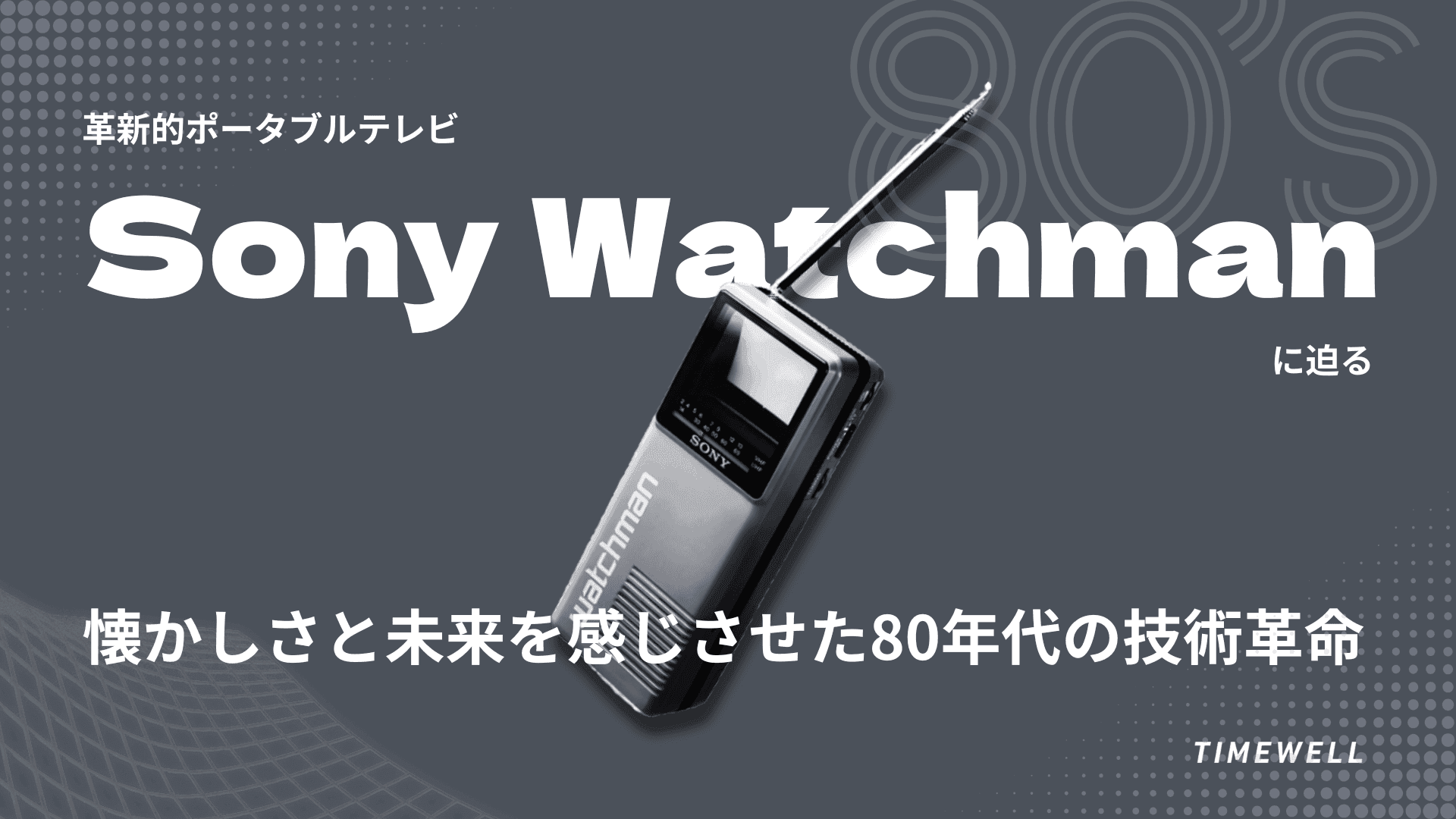
The dominant assumption about television in the early 1980s was simple: it belonged in the living room, and watching it was a shared activity. The Sony Watchman challenged this assumption directly. A 1.5-inch screen in a device small enough to carry to a baseball game, a church service, or a commute — this was not an incremental improvement on existing technology. It was a reframing of what a television was for.
Looking back at the Watchman now, what's striking is not that it failed eventually — it did, once analog broadcasts ended and the device became useless. What's striking is how clearly it articulated a set of ideas about personal media consumption that would define the next 40 years of consumer electronics.
The engineering that made it possible
Flat Display technology
Conventional CRT televisions required an electron gun placed directly behind the screen. The depth this required was the reason televisions were large, heavy, and impossible to miniaturize below a certain threshold.
Sony's solution for the Watchman was to angle the electron gun below the display rather than directly behind it, and to slightly curve the screen surface to compensate for the geometry. The result was designated "FD" — Flat Display — and the first model was the FD-210.
This was not a trivial engineering achievement. The image quality was imperfect — the picture could appear cloudy, and contrast in bright conditions was poor. But the form factor it enabled was genuinely new. A working television, 1.5 inches, light enough to hold in one hand.
AM/FM radio integration
The Watchman also received AM and FM radio. The tuning dial had a physical, tactile quality that users consistently describe with affection — a rotary control that felt like an instrument rather than an interface element. This multi-mode functionality made the device a genuine information access point in a world before smartphones.
Design details
The 17-inch retractable antenna was a visual statement — conspicuous enough to signal "this person has a portable television" in a way that functioned as a social accessory. A kickstand allowed hands-free viewing. A carrying strap was included. These were considered details for a category that had never existed before.
Take AI-driven development all the way to production
WARP is a hands-on program for teams who want more than headlines. Former enterprise DX and data strategy leads work alongside you until it runs.
Market reception and cultural impact
Launch and demand
Sony introduced the Watchman first in Japan, then in the US within six months. Initial demand exceeded supply. Retailers including Bloomingdale's reported consumer queues. Sony's own offices received visitors demanding to purchase or examine the product.
This level of consumer enthusiasm was not primarily about functionality. The picture quality was acknowledged to be limited, and the battery life was genuinely poor. What people were responding to was the idea: personal television, individual viewing, freedom from the shared schedule of the household TV.
Changing how families watched TV
Within households, the Watchman contributed to a fragmentation of television consumption that would eventually become the norm. The father's television, the mother's television, the children's small CRT in their rooms — this distribution of screen access, once unusual, gradually became standard.
The Watchman accelerated this shift by making the concept of personal television both affordable and portable. A child could watch their programming without negotiating for the household television. A commuter could follow a baseball game without being at home.
Advertising and promotional use
The Watchman was used as a promotional item in campaigns that now read as artifacts of 1980s marketing culture. Automobile dealerships included it as a purchase incentive. Food brands ran competitions with Watchman units as prizes. These secondary uses reflect how strongly the product was perceived as aspirational — a small television was still a status object.
The limitations that shaped the legacy
What didn't work
The antenna created reception problems that the device could not solve. In areas with poor signal, the image degraded. Battery consumption was high for the era. The picture remained visibly inferior to a household CRT.
These were not minor complaints. Users talked about them directly — the frustration of carrying a portable television that couldn't maintain a stable picture, or that consumed batteries faster than expected. The Watchman was a product that delivered on concept while compromising on execution.
This gap between concept and execution is part of why it matters historically. It shows that compelling consumer desire can drive market adoption even when the technology is imperfect. People bought the Watchman for the idea of what it represented — personal media on demand — not because the picture was crisp.
The end of the product line
The US transition from analog to digital television broadcasting rendered all analog portable televisions non-functional. The Watchman, designed around analog signal reception, could not be adapted. The product line ended not because Sony abandoned it but because the infrastructure it depended on was switched off.
What the Watchman predicted
Personal media as the default
The core proposition of the Walkman — "your music, wherever you are" — was extended by the Watchman to video. Sony was articulating a philosophy: media consumption should be individual, portable, and on demand. This is now unremarkable. In 1982, it was a specific bet that the shared-screen model of media consumption was not the final form.
Mobile device design principles
The Watchman's engineering challenges — form factor, battery life, signal reception, display quality under variable lighting — are the same engineering challenges that define smartphone design today. The specific technologies are different, but the tension between portability and capability is identical. Every design decision in a modern smartphone reflects accumulated learning from problems that the Watchman first made visible as a product category.
The aesthetics of constraint
The Watchman was not a compromised version of a real television. It was a device designed around a specific constraint — carry it anywhere — and every feature was evaluated against that constraint. This kind of constraint-first design thinking produces more distinctive products than feature-maximizing approaches. The iPhone in 2007, the iPad, the original MacBook Air — each of these reflected a similar discipline of subtracting rather than adding.
Summary
The Sony Watchman launched a product category that didn't survive in its original form. Analog broadcast television ended, and the device with it. But the ideas it embodied — personal media, portable screens, individual rather than shared consumption — became the foundation of how people interact with content today.
The Watchman's battery problems anticipated the most persistent engineering challenge in mobile devices. Its reception issues anticipated the connectivity problems that plagued early mobile internet. Its aspirational cultural status — the object that signaled modernity and independence — anticipated how smartphones became identity objects as much as tools.
Products that fail commercially while succeeding conceptually are worth studying. They identify genuine consumer needs at a point when the technology to meet those needs doesn't yet exist. The Watchman identified the need for personal portable media clearly and precisely. It took another 25 years for the technology to catch up.
Streamline event operations with AI | TIMEWELL Base
Struggling to manage large-scale events?
TIMEWELL Base is an AI-powered event management platform.
Proven Track Record
- Adventure World: Managed Dream Day with 4,272 participants
- TechGALA 2026: Centrally managed 110 side events
Key Features
| Feature | Impact |
|---|---|
| AI Page Generation | Event page ready in 30 seconds |
| Low-cost payments | 4.8% fee — industry's lowest |
| Community features | 65% of attendees continue networking after events |
Ready to make your events more efficient? Let's talk.