This is Ryuta Hamamoto from TIMEWELL.
A phrase I keep hearing from exporters is "EAR99." A U.S. supplier says "this product is EAR99," and it is tempting to conclude, "so no license is needed." Honestly, that is one of the most common misunderstandings I run into.
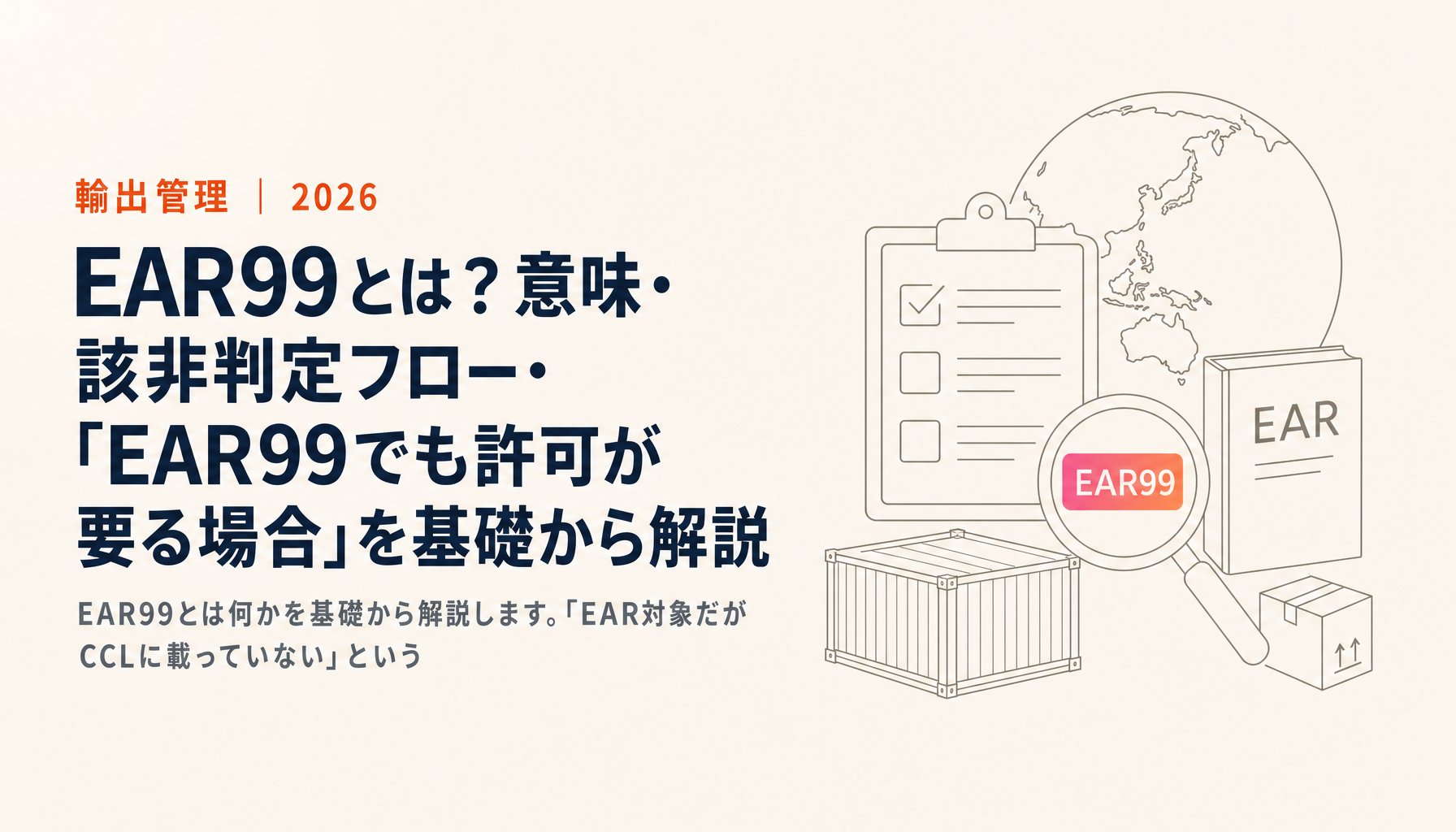
Here is the short version: EAR99 does not mean "unregulated." In most cases no license is required, but depending on the destination, end-use and party, even an EAR99 item can require a U.S. export license, or the transaction can be barred outright. Below I define what EAR99 is, walk through the classification flow, and explain when EAR99 still needs a license, based on primary sources (15 CFR, the U.S. Code of Federal Regulations, and BIS, the U.S. Bureau of Industry and Security).
Key points (30-second summary)
- What EAR99 is: the designation for items that are subject to the EAR (U.S. Export Administration Regulations) but not individually listed on the Commerce Control List (CCL) — 15 CFR 734.3(c).
- Not unregulated: most are No License Required (NLR), but an EAR99 item can still need a license when an embargoed destination, a prohibited end-use, or a restricted party is involved.
- A three-step check: first, is it subject to the EAR; then, is it described by an ECCN on the CCL; if not, it is EAR99.
- It matters for companies exporting from Japan too: the EAR reaches reexports of U.S.-origin items and foreign products with more than a threshold of U.S. content. This is separate from Japan's own classification (gaihi) under FEFTA.
What EAR99 is — "subject to the EAR, but not on the list"
To understand EAR99, start with the structure of the U.S. EAR.
The EAR (Export Administration Regulations, 15 CFR 730–774) is the U.S. export-control framework administered by BIS. It reaches not only items in the United States, but U.S.-origin items wherever located, and foreign-made items that incorporate a certain amount of U.S.-origin content.
Among the items subject to the EAR, those warranting specific control are individually listed on the CCL (Commerce Control List), each carrying an "ECCN" classification number. And —
the designation for an item that is subject to the EAR but matches no ECCN on the CCL is "EAR99," defined in 15 CFR 734.3(c). Think of it as an item that is not in the "catalog" of controlled items (the CCL).
The crucial point: EAR99 is not "outside the net" but "inside the net, in the not-listed bucket." EAR99 items remain subject to the EAR, so the destination, end-use and party controls discussed below (such as the Ten General Prohibitions in Part 736) still apply.
Quick glossary
- CCL: a "catalog" of the items the U.S. wants to control, organized into 10 categories (0–9) and 5 product groups (A–E).
- ECCN: the "shelf number" an item gets within the CCL (e.g., 3A001) — it tells you which category it is in and why it is controlled.
- EAR99: the designation for items subject to the EAR that match no ECCN.
- NLR (No License Required): license-free based on classification and destination alone — but this does not waive the general prohibitions.
For "what an ECCN is, and how to read and look one up," see What Is an ECCN? How to Read and Look One Up.
Replace siloed classification work with AI.
METI's FY2024 data shows 52% of foreign exchange law violations stem from classification errors. Download the TRAFEED product catalog covering features and rollout.
The three steps to decide whether it is EAR99
Whether your item is EAR99 is confirmed in the following order. In the EAR, this maps to the Part 732 steps (Steps 1–6 for scope, Steps 7–11 for CCL classification).
Step 1: Is it subject to the EAR?
15 CFR 734.3(a) makes items like these subject to the EAR:
| Category | Content |
|---|---|
| Items in the U.S. | Items located in the U.S. (including in a Foreign Trade Zone or in-transit) |
| U.S.-origin items | U.S.-origin, wherever located |
| Foreign items with U.S. content | Foreign items that incorporate controlled U.S.-origin content above the de minimis level |
| FDP (direct product) | A foreign item that is a "direct product" of specified U.S. technology/software (15 CFR 734.9) |
Items exclusively controlled by another agency (State's ITAR, Treasury's OFAC, etc.), and "published" information or fundamental research, are excluded under 734.3(b). In particular, military items are judged under the ITAR, not the EAR.
Note that being subject to the EAR does not by itself impose a license requirement (15 CFR 734.2(a)). "Subject to" and "needs a license" are two different questions.
Step 2: Is it described by an ECCN on the CCL?
Once it is subject to the EAR, determine whether it is described by a specific ECCN on the CCL. If no ECCN applies, the item is EAR99.
BIS officially describes three ways to find your item's ECCN:
- Ask the manufacturer/developer: fastest and most reliable — for imported parts and products, the maker often already knows the ECCN.
- Self-classify: understand the item's technical specifications, find candidates using the CCL structure, and read the ECCN entry (its parameters) to confirm. BIS publishes tools such as the Interactive CCL and the CCL Order of Review Decision Tool. When you are narrowing down candidates, an ECCN number list with category quick-reference tables is a faster place to start.
- Request an official classification from BIS (CCATS): if you cannot decide, submit a request via SNAP-R and receive the official ECCN from BIS.
Step 3: If no ECCN matches, it is EAR99
If nothing on the CCL matches, the item is classified EAR99 (15 CFR 734.3(c)). Do not stop at "so no license is needed" — always proceed to the next section.
Most important: when EAR99 still needs a license
This is the part that trips up even experienced teams. An EAR99 item's default is NLR (license-free), set by classification and destination. But NLR does not waive the "Ten General Prohibitions" in Part 736. In the following cases, even EAR99 can require a license, or be barred.
Embargoed / sanctioned destinations (Part 746)
For some countries and regions, a license is required even for EAR99.
| Destination | Treatment of EAR99 | Basis |
|---|---|---|
| Cuba | A license is required to export | 15 CFR 746.2 |
| North Korea | Items subject to the EAR require a license (except certain food and medicine classified EAR99) | 15 CFR 746.4 |
| Syria | The regulation still states a license requirement, but a September 2, 2025 rule created License Exception SPP (Syria Peace and Prosperity): EAR99 items can be exported or reexported without a license application unless a Part 744 control applies | 15 CFR 746.9; SPP at 15 CFR 740.5 (90 FR 42315) |
| Iran | EAR99 is largely governed by Treasury/OFAC's ITSR (31 CFR Part 560); screen OFAC as well as BIS | 15 CFR 746.7 |
| Crimea / covered regions | A license is required for the covered regions | 15 CFR 746.6 |
| Russia / Belarus | Broad, but not literally "every EAR99 item" — tied to controlled items and specific EAR99 software, etc. | 15 CFR 746.8 |
End-use / end-user controls (Part 744)
Where a nuclear, missile, chemical/biological or military end-use is involved, or parties such as the Entity List (15 CFR 744.11), the Military End User (MEU) List, or the Denied Persons List, a license can be required even for EAR99 (the scope depends on each provision and each listing).
The key nuance: "EAR99 = always license-free" is false, but so is "everything needs a license." Each control above is bounded by the scope of its specific provision or listing. And listing on a control list, or designation of a destination, is a regulatory classification — not a finding that the listed company or country did anything wrong. The practical point is to check, calmly and from the party's own standpoint, whether a given transaction falls within scope.
de minimis and FDP — U.S. elements in foreign-made items
Companies exporting from Japan are especially affected when a foreign-made item contains U.S.-origin content. Then whether it is subject to the EAR turns on the value ratio of the controlled U.S. content (15 CFR 734.4).
- 25% rule (734.4(d)): if controlled U.S. content is 25% or less, not subject to the EAR for destinations other than certain embargoed countries (Country Group E:1/E:2).
- 10% rule (734.4(c)): if 10% or less, not subject to the EAR for any country in the world; for embargoed destinations, 10% is effectively the only available level.
EAR99 matters here too: de minimis counts only U.S. content that would require a license to the destination, so EAR99 content — normally license-free — is generally not counted for most destinations. But where EAR99 does require a license (sanctioned/embargoed destinations), it can be counted.
Separately, the FDP (Foreign Direct Product Rule, 15 CFR 734.9) is a jurisdictional basis independent of the U.S.-content ratio. A foreign item that is a "direct product" of specified U.S. technology/software can be subject to the EAR even with little U.S. content — and this has been expanding in advanced computing and semiconductors.
The EAR changes very frequently
When working with EAR99 and ECCNs, always keep the pace of change in mind. BIS publishes export-control rules in the Federal Register at a high frequency (by an official count, 43 rules in 2023 and 52 in 2024).
One example is the so-called "Affiliates Rule (50% rule)," which automatically extends controls to entities owned 50% or more by listed parties. It took effect on September 29, 2025, and was then stayed through November 9, 2026 on the Federal Register. The US and China have announced an extension to January 10, 2027, but BIS had not published the extension as of October 3 (see our BIS 50% rule guide). Effective and suspension status can shift within months — a hallmark of U.S. export control.
So — for this article too — always verify against the current eCFR (15 CFR), the Federal Register and BIS, and let your export-control officer make the final determination.
How it relates to Japan's classification (gaihi) under FEFTA
Finally, from the standpoint of a company in Japan: exports from Japan require a classification (gaihi hantei) under FEFTA (the Foreign Exchange and Foreign Trade Act) — separately from the U.S. EAR. Goods are governed by Art. 48, technology by Art. 25, checked against Appended Table 1 of the Export Trade Control Order. Rows 1–15 are list control; Row 16 is the catch-all (complementary) control.
In other words, an exporter in Japan works in a two-track framework: first run your own classification, then, if U.S.-origin items or U.S. content are involved, separately check the EAR (including EAR99). Clearing one does not clear the other. For Japan's side in detail, see What Is a Non-Applicability Certificate? and List Control vs. Catch-All Control.
Summary
- EAR99 is the designation for items subject to the EAR but not individually listed on the CCL (15 CFR 734.3(c)). It is not "unregulated."
- The check is three steps: first whether it is subject to the EAR, then whether an ECCN describes it, and if not, it is EAR99.
- Even EAR99 can require a license when an embargoed destination, a prohibited end-use, or a restricted party is involved — though each control is bounded by its own scope.
- Through de minimis (25%/10%) and FDP, the EAR can reach foreign-made items whenever U.S. elements are involved.
- The EAR changes fast. Verify the latest primary sources, and let your export-control officer make the final call.
- Companies in Japan check both their FEFTA classification and the EAR.
Deciding whether something is EAR99 — and checking "when EAR99 still needs a license" — is an area where gaps easily creep in. In practice, it helps to put the flow and checkpoints onto a single sheet so the work does not hinge on one person. TIMEWELL's AI export-control agent, TRAFEED, supports classification (gaihi) work, EAR99/ECCN triage, and screening counterparties against major lists. Final classification and licensing decisions rest with your export-control officer and the authorities' latest guidance.
This article is an explanation based on primary sources (15 CFR, BIS, the Federal Register, Japan's METI/e-Gov, etc.) as of July 2026, and is not legal advice. The EAR changes frequently, so always verify the current text in practice.