Hello, this is Ryuta Hamamoto from TIMEWELL.
You go out to check the paddy, see with your own eyes how the water sits, walk the ridges looking for the first signs of pests. You have always done it this way, and you will probably go on doing it this way. Thinking that, you look up at the sky and worry about tomorrow's weather. In the fields there are days built out of that kind of accumulation. And yet, when you look around, the people who worked alongside you leave one by one, and your own age climbs. How many more years can you keep turning this much land? Telling a son or a daughter to take it on is, honestly, hard to say out loud. I suspect there are more than a few of you carrying that quietly.
I am writing this for the people who farm, and for those wondering whether to take over a farm. Let me give the conclusion first: I believe farmers from here on are better off moving to the side that uses AI. But being told that out of the blue, you will feel that machines and computers are not your strong suit, and that there is no room for it anyway. So let me first sort out, together with you, where the pain in the field actually comes from, and then, on that basis, talk about why technology becomes a realistic way to ease that pain, using the government's primary data. I will break down any difficult words as they come up, so please read on without bracing yourself. If the distance between you or your company and AI is on your mind, checking where you stand first with our free AI literacy self-check will make the second half of this piece more concrete.
The pain in the field is not imagined; it shows up in the numbers
First, let me confirm that the felt sense of "people are leaving" is not a delusion but a fact. Look at the numbers and a reality harsher than you had braced for comes into view.
According to the Ministry of Agriculture, Forestry and Fisheries' FY2024 white paper on food, agriculture and rural areas, the number of core agricultural workers, meaning people who mainly farm day to day, fell from 2.4 million in 2000 to 1.114 million in 2024, nearly halving in about twenty years1. The average age is 69.2. Break it down by age and those 65 and over make up 71.7% of the whole, while those 49 and under stay at just 11.2%. In other words, more than seven in ten of the people holding today's agriculture up are already past 65, and young successors are only about one in ten.
This trend is set to accelerate. The ministry expects core agricultural workers to fall from about 1.16 million as of 2023 to about 300,000 over the next twenty years, to roughly a quarter2. This is not a fixed figure but a government projection, yet its basis is statistical survey work, and it is by no means an exaggerated scare. The ministry writes plainly that on the present course, farming premised on conventional production methods cannot protect either the sustainable development of agriculture or the stable supply of food. That walk of the fields, the area one person has to cover alone, will grow quietly but surely. That is what is coming.
The pain felt in the field breaks down, I think, into three parts. The first is the decline and ageing of the people who farm, just described. People are short, and the burden on each person grows heavier. The second is that experience and instinct live only in particular people. When to let the water in, when to move on pest control, which stalks to pinch. The judgment built up over years of observation is lost as it is once that person retires. The third is the endless fight with weather, with pests, and with heavy physical labour. These three look like separate worries, but at the root they are connected.
Why is experience and instinct so hard to pass on
Of the three pains, the one I feel runs deepest is the second, the way experience and instinct sit locked in individuals. Dig into this and you begin to see why technology helps.
Inside a veteran farmer's head there is an enormous amount of information. The faint change in the colour of a leaf, the moisture felt when you grip the soil, the smell on the wind, how the crop was growing at this time last year. Without noticing, they cross-reference all of it and decide the next move. But almost none of that judgment is put into words. Ask the person directly, "why did you decide to let the water in today," and often all they can answer is, "it just felt that way." This is not laziness. Wisdom learned through the body is, by its nature, hard to put into words.
Wisdom that is never put into words does not get recorded. What is not recorded cannot be handed to the next generation. Here lies a structural weakness in agriculture. Factory work can be written into a manual, but in farming, which faces nature, no two years are ever the same. That is exactly why the ability to read the state of a given field in a given year holds value, and yet that ability stays sealed inside the individual and vanishes with retirement. When the people who farm decline, it is not merely a fall in hands; it means this accumulated store of judgment drops out of the region wholesale.
The fight with weather and pests is continuous with this locking-in too. Extreme weather has become the norm, and there are more scenes in which past rules of thumb no longer hold. The more of a veteran you are, the more you sense that "this year is somehow different," while the past patterns you relied on grow unsteady. There is a moment coming in which the more experience is your weapon, the harder that weapon is to wield. This is precisely why a mechanism is needed to supplement experience, keep it as a record, and put it to work in the next decision.
Looking for AI training and consulting?
Learn about WARP training programs and consulting services in our materials.
The government has steered toward "farming that uses AI," by law
Faced with this structural crisis, the government is not sitting on its hands either. Over the past few years, the systems that back the use of AI and smart technology in agriculture have taken fairly concrete shape.
At their centre is the Smart Agriculture Promotion Act, which came into force on 1 October 20243. Its full name is a little long: the "Act on the Promotion of the Use of Smart Agriculture Technology for Improving Agricultural Productivity." Smart agriculture means farming that uses advanced technology such as robots, AI and data to advance labour-saving and precision. The law created two plan-certification schemes: a "production-method innovation plan" for farmers who want to renew how they produce, and a "development and supply plan" for the businesses that provide machinery and services. Those who are certified can receive tax and financial support. It means a mechanism has been prepared not just to wave the flag but to back the people who actually take it on.
And as a set with this law, the government has set out clear numerical targets. As a KPI of the Basic Plan for Food, Agriculture and Rural Areas, meaning a yardstick for whether you are getting closer to the goal, it fixed a target to raise the share of area using smart agriculture technology from about 20% in 2024 to 50% in FY20304. Alongside it, it also sets out raising the share of smart agricultural machinery in shipments from 25% to 50%, and reaching 100% practical application by FY2030 for the technologies listed as priority development goals in the law. Technology now used on only about one field in five is to be spread to half in under ten years. The government is seriously aiming there.
Why set such strong targets? The answer returns to the crisis of the people who farm, seen in the first half. If people fall to a quarter, the only way is to raise the area and the precision each remaining person can cover. Rather than leaving that to individual effort, this whole line of policy is about lifting it with technology. For how AI use in the regions and on the ground is positioned within the country's wider industrial policy, I have also laid it out in a beginner's guide to the Regional Future Strategy; reading the two together brings the background into three dimensions.
The ministry sums up this decline and future projection in a single figure. Words alone make it hard to feel, so please take a look.
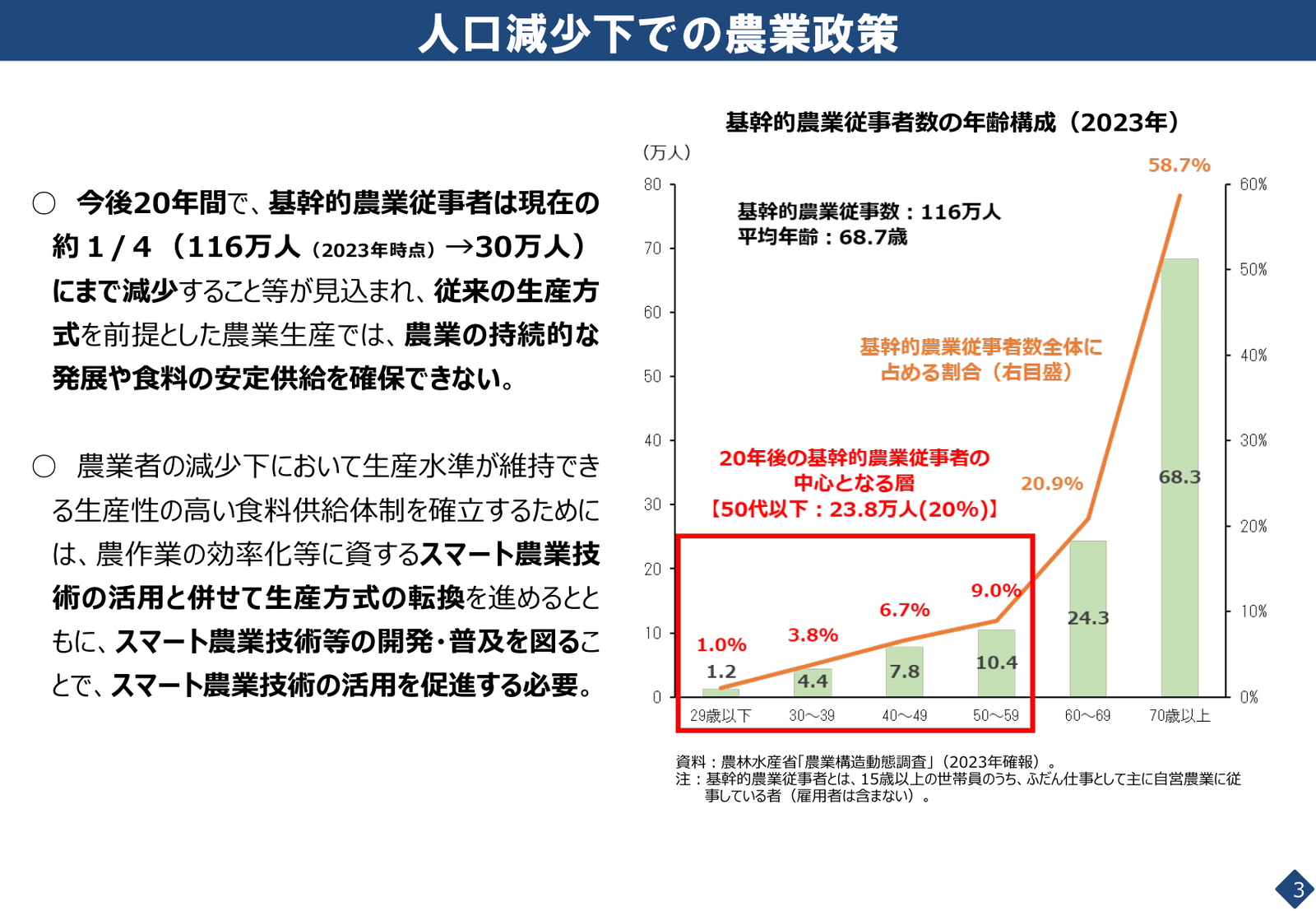
Source: MAFF, "The State of Smart Agriculture" (July 2026 edition), p4
AI does not erase instinct; it turns it into something visible
Here let me line up what AI and smart technology actually do in the field, matched against the pains. What matters is that AI is not something that denies and replaces the farmer's experience. The opposite, in fact: AI's role is to translate the instinct that could not be put into words into a form that can be recorded and handed on.
For example, sensors set in the field record water level, soil temperature and sunlight moment by moment, and water management adjusts automatically on that data. The "how the water sits" you used to confirm on your rounds now stays as numbers. A drone photographs the crop from above, AI analyses the images, and from the changes in colour it picks up unevenness in growth and the first signs of pests early. The "state of the leaves" a veteran followed by eye becomes visible as data across the whole surface. The data stored this way is not only usable for this year's judgment; it becomes an asset that can be carried into next year and the year after. Instinct does not disappear; the substance of the instinct stays in a visible form. This is the essence.
Easing heavy labour is another thing technology is good at. Rice transplanters and tractors that run straight on their own, drones that fly autonomously carrying pesticide, machines that assist harvest and transport. These take over the work that bears hard on the body, like staying bent at the waist or carrying heavy loads under a blazing sun. As hands grow fewer, protecting the bodies of the remaining people who farm is a realistic condition for keeping the business going.
Recently, a use in which you feed such field data and past records into AI and make it a partner for cultivation planning and management decisions has been spreading too. What we usually help with is exactly this area. It is not a story of building a magic tool devoted to a specific crop; it is arranging the records and know-how a business already holds into a form AI can handle, and using it as an aid to judgment. That is a grounded design. The reason we keep running an AI consulting service called WARP, which thinks through with you where and how to put AI so that this business's this task actually gets easier, is that we feel we are getting somewhere on this translation part.
The effect is not "an estimate"; the demonstrations produce numbers
Talk of technology naturally raises the question, "does it really work?" Here let me look not at wishful thinking but at the numbers obtained in the government's demonstrations.
Since FY2019 the ministry has run smart agriculture demonstration projects in 217 districts across the country, measuring how much changes against conventional practice, meaning the way things were done before. In working time per 10 ares, the results reported are an average 61% cut with spraying drones, an average 80% cut with automatic water-management systems, and an average 18% cut with straight-line-assist rice transplanters that run straight5. The 80% cut in water management in particular is large, and it means that the time once spent circling the paddy almost daily opens up considerably. But these are results from using specific technologies under specific conditions. The effect changes with the crop, the region, and the shape and size of the field, so rather than assuming it applies to your own business as is, it matters to estimate under your own conditions before you adopt.
Beyond working time, there is also a sense of progress in yield. According to the government's white paper, in the paddy-crop demonstrations total working hours fell by about 9% on average, yield per unit area, the so-called single-crop yield, rose by about 9% on average, and in roughly three districts in ten working hours were cut by 10% or more6. That labour-saving and higher yield can happen at the same time is reassuring material for keeping a business going. There is also a case where running robot tractors in coordination in a large-block field cut working time by 32% against conventional practice5.
The ministry organises these technology-by-technology effects in a bar chart. The size of the numbers is clear at a glance, so please take a look at this too.
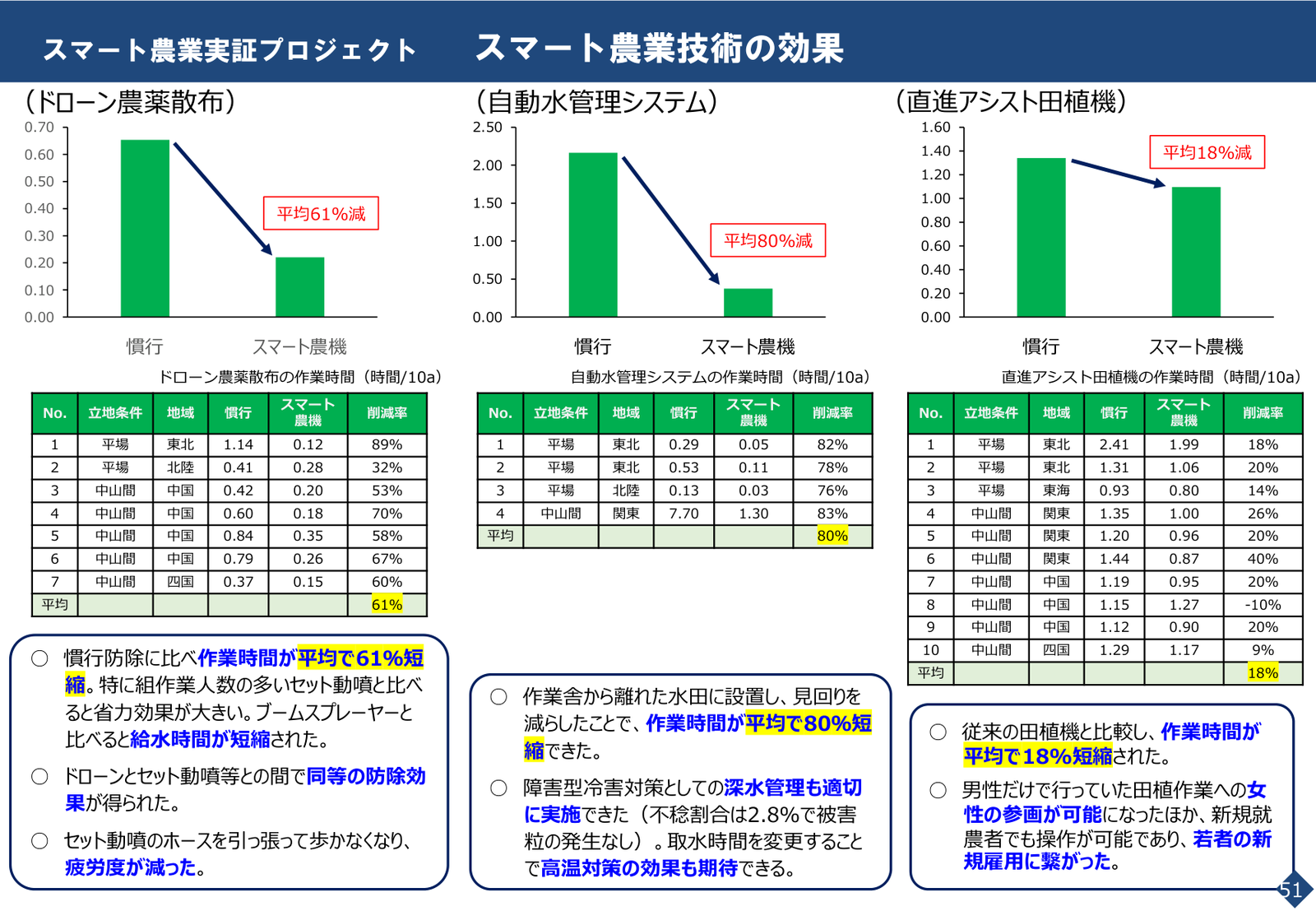
Source: MAFF, "The State of Smart Agriculture" (July 2026 edition), p52 Data use itself, incidentally, is already no longer a rarity. In the government's reference indicators, the share of farmers using data reached 58.5% as of February 20244. More than half of farmers have begun to touch data in some form. Taking your own step is not an outlandish challenge but joining a flow that has already begun.
Do not overtrust it; and yet it is getting easier to begin
I have kept the tone hopeful up to here, but it would not be honest to speak of technology as a cure-all. Let me pass on a few points to keep in mind as you consider adopting it.
The first is that AI helps with judgment but does not take the judgment itself off your hands. What sensors and AI show is only data and candidates; who decides how to move in the end is the person. Data can throw out an abnormal value, and numbers can cut off from a poor communications environment or a faulty device. Rather than swallowing the numbers whole, use them checked against the field-tested eye you have cultivated. AI and experience are not something you choose between; they become a force only when combined. The second is cost and communications. Machinery and systems carry their share of expense, and there are areas, such as mountain regions, where communications are not stable. Start small from the work where the effect shows most easily, and review it if it does not feel right. Not trying to assemble everything at once is the knack for not failing.
And what must not be forgotten is the path where you do not have to buy all the machinery yourself. The number of agricultural support-service providers, which take on drone spraying and data analysis on your behalf, is growing, and the government has set a target to increase them from 5,701 businesses in 2020 to 7,900 in FY20304. Without owning the expensive machinery, you use only the technology you need when you need it. Because this option of "not owning, but using" is backed by the system, the hurdle to entry has certainly come down from before. Try a support service once first, confirm the effect, and then consider adopting your own. That kind of steady order is entirely valid.
The same crisis of the people who work is serious not only in farming but in fishing too. For those interested in how AI is beginning to be used at sea, I would also point you to a piece organising AI-driven fishery. Seen as the whole picture of the primary industries, the meaning of the change now underway comes into sharper focus.
The first step is to choose one task close at hand
Finally, let me talk about what to do from tomorrow. Before any grand capital investment, there is something you can do.
The starting point I recommend is to choose the one task you feel the greatest burden in right now. If you are chased daily by water management, start from automatic water management; if the burden of pest control is heavy, from drones or a support service. In other words, try small from where the pain is largest. When you do, write out once, before you begin, the time and cost the work is taking, and you can then judge whether it worked in your own numbers. The government's demonstration data is only a reference; the answer is in your own field. Alongside that, tidying up how you keep records just a little pays off greatly when you later use data or AI. A handwritten diary is fine. The habit of leaving a record of when, what and how you judged is the first step in turning instinct into a visible form.
Whether you can actually receive the tailwind of the system depends heavily on whether you are ready to move. Subsidies and support work best for the person who has already decided what to tackle first. Conversely, wait and see and the system, though it exists, passes you by. That said, drawing the first design alone is hard. Where does AI help in your business, and from which task can you start without strain. If you are unsure how to organise that starting point, please talk to the WARP team. Specialists who led DX and data strategy at major companies walk alongside you month by month, helping you bring AI down into your management. It is not a story of selling a tool devoted to agriculture; we start from arranging your business's records and know-how into a form you can put to work in judgment.
To sum up
It ran long, so let me organise the key points.
- Core agricultural workers halved in about twenty years, from 2.4 million in 2000 to 1.114 million in 2024, and the average age is 69.2. The government expects a further fall to roughly a quarter over the next twenty years
- The pain in the field comes in three parts: the decline of the people who farm, the locking-in of experience and instinct, and the fight with weather, pests and heavy labour. In particular, instinct that cannot be put into words does not get recorded and is hard to pass on, which is a structural weakness
- With the Smart Agriculture Promotion Act in force from October 2024 and a KPI to raise the share of area using it to 50% in FY2030, the government has steered clearly toward farming that uses AI
- AI is a tool that translates instinct into a form that can be recorded and handed on, rather than erasing it. Demonstrations show up to an 80% cut in working time, and both working hours and yield improving by about 9% in paddy crops
- Do not overtrust it; the person decides in the end. Given cost and communications, starting small from the "not owning, but using" path, such as using a support service, is the steady way
- The first step is to choose one high-burden task and write out the time and cost before you begin. The habit of tidying your records turns instinct into a visible form
The experience the fields have built up will remain the greatest asset from here on. AI is not something that takes that asset away; it can be a tool for protecting it and handing it on amid the people who farm growing fewer. Now, with the government pointing a direction, is not a bad time to start moving. Begin from working out where technology helps in your own fields.
References and primary sources
Footnotes
-
MAFF, "FY2024 White Paper on Food, Agriculture and Rural Areas," Part 1, Chapter 2, Section 3 (Figure 2-3-2, number and average age of core agricultural workers) https://www.maff.go.jp/j/wpaper/w_maff/r6/pdf/1-2-03.pdf ↩
-
MAFF, "The State of Smart Agriculture" (July 2026 edition), p4 (future projection of core agricultural workers; baseline is the 2023 final figures of the Survey on the Dynamics of Agricultural Structure) https://www.maff.go.jp/j/kanbo/smart/smart_meguji.pdf ↩
-
MAFF, "About the Smart Agriculture Promotion Act" (Act on the Promotion of the Use of Smart Agriculture Technology for Improving Agricultural Productivity; enacted and promulgated June 2024, in force 1 October 2024) https://www.maff.go.jp/j/kanbo/smart/houritsu.html ↩
-
MAFF, "The State of Smart Agriculture" (July 2026 edition), p10 (the smart agriculture technology KPI of the Basic Plan for Food, Agriculture and Rural Areas, the share of farmers using data, and the target for the number of agricultural support-service providers) https://www.maff.go.jp/j/kanbo/smart/smart_meguji.pdf ↩ ↩2 ↩3
-
MAFF, "The State of Smart Agriculture" (July 2026 edition), p52 and p28 (the effect of smart agriculture technologies; coordinated work by robot tractors) https://www.maff.go.jp/j/kanbo/smart/smart_meguji.pdf ↩ ↩2
-
MAFF, "FY2024 White Paper on Food, Agriculture and Rural Areas," Feature 3 (results of the smart agriculture demonstration projects) https://www.maff.go.jp/j/wpaper/w_maff/r6/r6_h/trend/part1/chap0/c0_1_03.html ↩