Hello, this is Ryuta Hamamoto from TIMEWELL.
You head out to the harbour while it is still dark, check the colour of the sky and the sea, trace your memory of the same season last year, and decide "where do I head today." The more seasoned the fisher, the more confidence and pride there is in that judgment. And yet, behind that pride, hasn't a certain anxiety been growing heavier year by year? There are more days when you go to the ground where the fish should be and come back empty. Fuel keeps getting more expensive, and one wasted trip weighs on the household budget. And there is no one to take over.
I wrote this article to treat that anxiety head-on, rather than brushing it off as "just your imagination." I put every technical term back into everyday language as it comes up. By the time you finish, I hope you will feel that fishing with AI and data is not something for a special few, but a matter tied directly to how easily each person out on the water today can keep going. If you are curious about your own distance from AI, checking where you stand first with our free AI literacy self-check will make the later part of this piece read more concretely.
The real shape of that anxiety before you put out to sea
First, let me put the anxieties felt on the water into words. Once the outline is clear, the countermeasures become easier to think about.
The first is the unreadability of the catch. Even going to the same place in the same season, the gap between the days you catch and the days you do not is large. The water temperature and the flow of the tides swing from year to year, and I suspect there are many who feel that years of instinct no longer carry. The second is the weight of fuel costs. The more you run around offshore hunting for fish, the more fuel you burn, so a wasted trip becomes a straight loss. Betting on a run far out without knowing whether the fish are there is hard on the mind as well.
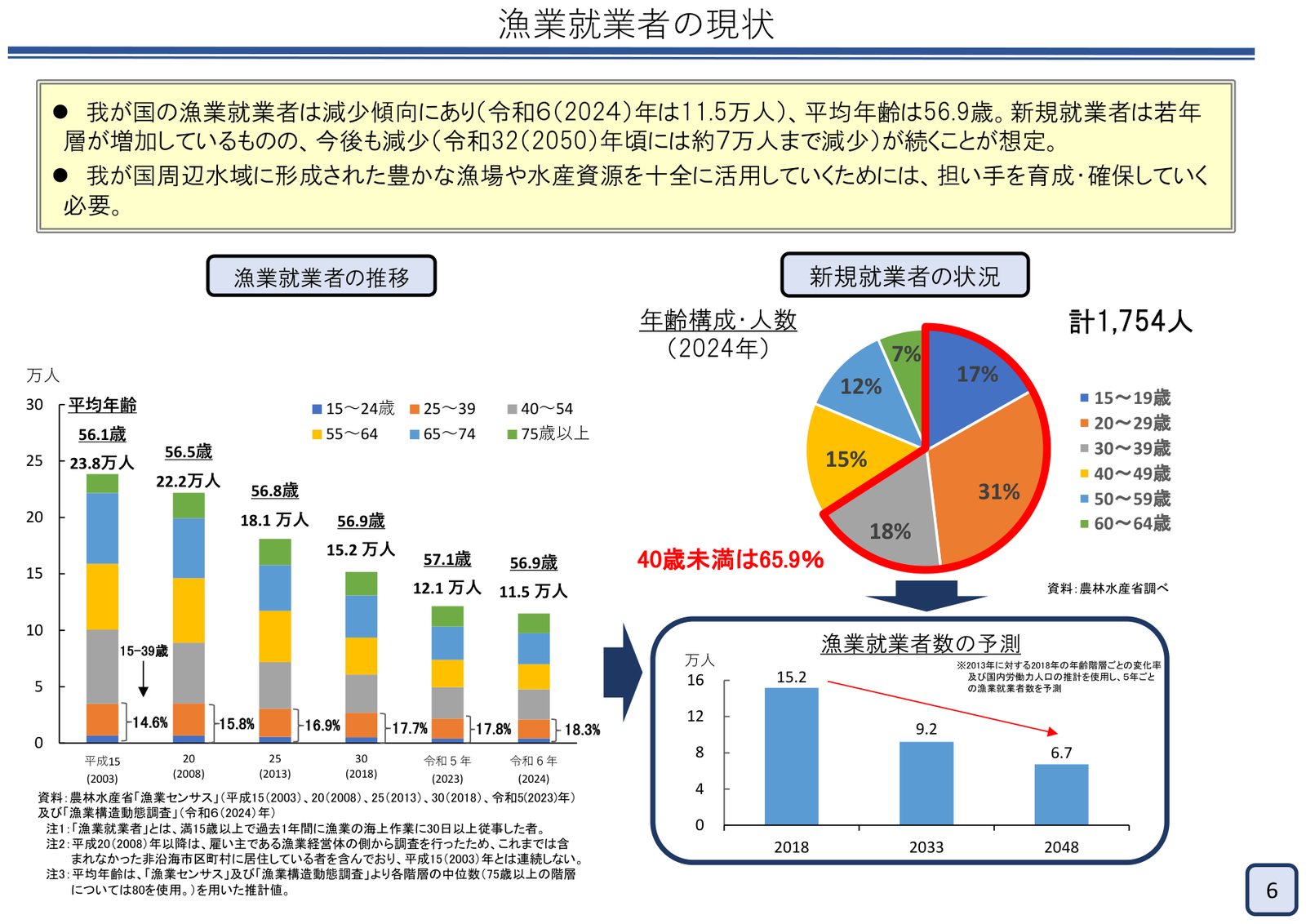
The third is the shrinking of the workforce. Here it is not just a feeling; the numbers tell the story plainly. According to the Fisheries Agency's FY2024 Fisheries White Paper, the number of fishery workers was 121,389 in 2023, down 1.4 percent from the previous year1. Materials for the Basic Plan on Fisheries give roughly 115,000 for 2024, with an average age of about 57, and assume a fall to around 70,000 by about 20502. That figure of 70,000 is only an assumption, not a fixed future, but set against the reality of an average age around 57, it does not feel like an exaggeration.
The fourth is anxiety about the resource itself. Take too much and the fish decline; when they decline, you tighten the noose around your own neck next year. Everyone understands this, and yet you still have to protect the landing right in front of you. This bind is something like the fate of the work of fishing. No catch, high fuel, fewer people, thinning stocks. These four look like separate worries, but deep down they are connected.
Why instinct alone stopped being enough
Next, let me organise the structure of how these pains arise. Once the causes come into view, so does where AI and data actually work.
Behind it lies a long-term shrinking of production. Japan's combined output from capture fisheries and aquaculture was 3.83 million tonnes in 2023, down 2 percent from the year before. Compared with the peak of 12.82 million tonnes in 1984, it has fallen to roughly 30 percent of that level3. The sheer volume of fish that can be taken has thinned over several decades.
What matters here is that even as the catchable volume falls, the people who support it are falling faster still. When the workforce shrinks, the load each person carries grows. Hunting for the fish, catching them, sorting and shipping all have to be done by fewer hands. When a veteran retires, the wisdom in their head about "where, when and how to catch" leaves the harbour with them. This tacit wisdom, the instinct learned by the body over long years, has never been left on paper or in numbers. That is why it is hard to pass on.
There is a hopeful side too. According to the same white paper, production per fishery worker in 2023 was 32 tonnes, and fishing income was 6.34 million yen4. The industry as a whole is shifting toward a form in which fewer people earn solidly. Turned around, from here on the contest is over "how to catch cleverly, without strain, with fewer people." A war of numbers can no longer be sustained. Precisely because of that, we need to translate the asset of experience and instinct into data and change it into a system that even a small number of people can run. This is where AI comes in.
Source: Fisheries Agency, "The State of Affairs Surrounding Fisheries" (2025)
Looking for AI training and consulting?
Learn about WARP training programs and consulting services in our materials.
Smart fisheries, a nationwide push
In response to this flow, the state has not been standing idle either. The Fisheries Agency is advancing an effort called "smart fisheries." The name alone sounds difficult, but the substance is simple.
Smart fisheries means an effort to change fishing, which has relied on experience and instinct, into fishing based on data, using digital technologies such as ICT, AI and satellite information. The purpose is a fishery that protects the fish as a finite resource while remaining sustainable with fewer hands. There are three main pillars: more sophisticated stock assessment that properly makes the resource visible, fishing-ground forecasting that predicts where fish can be taken, and more efficient aquaculture that raises and grows fish.
What is worth noting is that this has not ended as a mere order from above. The Fisheries Agency has built a foundation called the "Fisheries Data Collaboration Platform" that connects data from across the country, and by FY2024 it had chosen five "digital fisheries strategy hubs" nationwide to advance digitalisation region-wide, including Yaizu and Kagoshima5. Beyond that, a "human-resource bank" scheme is running, sending specialists to fisheries high schools and elsewhere to teach the technology. In FY2022, 13 visiting classes were held5. In short, it is designed not to hand over the technology and stop there, but to see it through to raising people who can actually use it.
This kind of nationwide movement is proceeding in the same direction in agriculture and in regional industries too. It is a flow that takes the labour shortage as a given and reorganises the very way work is done, using AI. If you are interested, reading it together with an article that organises the use of AI in agriculture and an explainer on what Japan's Regional Future Strategy means for local industry makes clear that fishing is not special. Every primary industry is trying to face the same challenge, a shrinking workforce, with the same tool, AI.
How far AI can make the grounds and the stocks visible
So, what on the water can AI change, and how far? This is probably what you most want to know. Let me look at concrete numbers from Fisheries Agency materials.
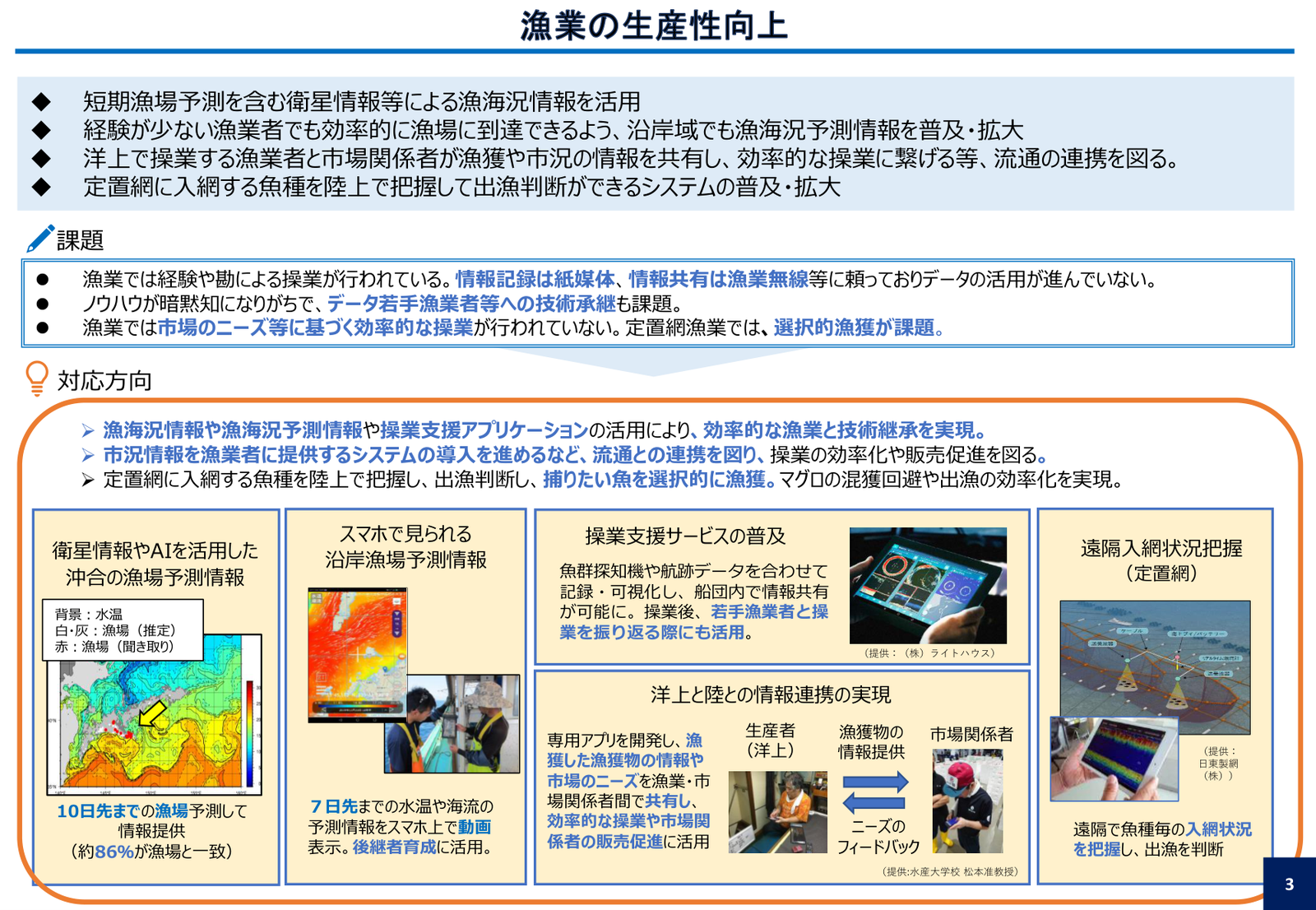
The most straightforward is fishing-ground forecasting. According to Fisheries Agency materials, offshore fishing-ground forecasting that uses satellite information and AI can provide forecasts up to ten days ahead, and about 86 percent of them were reported to match the actual grounds. Along the coast, efforts are under way to show forecasts of water temperature and currents up to seven days ahead as video on a smartphone6. The read on "where the fish are likely to be," which we used to call instinct, is now backed by data. If you can form an expectation that the fish are in the target waters more than eight times out of ten, the number of times you run around offshore on guesswork will surely fall. You save fuel, time and physical strength.
Source: Fisheries Agency, "On the Development of Smart Fisheries" Next, stock management. To keep taking fish sustainably, you need to know accurately how many of which fish there are right now. The number of species covered by this stock assessment widened from 50 in FY2018 to 192 in FY20217. The number grew because it became possible to gather and analyse data more precisely. In FY2024, when 50 stocks across 36 species were assessed in three categories, "high," "middle" and "low," the low category accounted for 52 percent8. It is a harsh reality that more than half the stocks are thinning. That is exactly why you need to judge "how much may be taken this year" with data rather than instinct. Preventing overfishing is also protecting your own landing next year.
Aquaculture is changing greatly too. Overfeed and both costs and water pollution rise; underfeed and the fish do not grow. AI helps with judging that line. The Fisheries Agency is advancing AI-driven optimal automatic feeding and robots that clean nets automatically, and as production targets for aquaculture it pictures raising amberjack species to 240,000 tonnes by 2030, about 1.7 times the 2018 level, and red seabream to 110,000 tonnes, about 1.8 times6. These targets were originally set out in the "Comprehensive Strategy for Making Aquaculture a Growth Industry" and are re-shown in the smart fisheries materials. Farming fish sits better with data than with instinct, and it is a field with large room to grow.
What the numbers say about doing more with fewer people
Let me confirm the story so far from the side of the numbers. These are not estimates but actual figures published by the Fisheries Agency.
Looking first from the workforce side, the number of new fishery workers was 1,733 in FY2023, up 2.5 percent from 1,691 the previous year. Of them, about 70 percent were 39 or under, an entry of a younger generation9. What I want to draw attention to is that many of those newly entering fishing come from other industries with zero experience. The people who have no time to learn a veteran's instinct with their body are the ones for whom data and forecasting bring the greatest benefit. If a fishing-ground forecasting app tells them "these waters look promising today," even the inexperienced can avoid a big miss. AI can play the role of a bridge, carrying the wisdom that was on the verge of being lost with the veterans' retirement across to new hands.
The direction is clear on the productivity side as well. Output itself has shrunk to about 30 percent of the peak, but the production value in 2023 was 1.6853 trillion yen, up 85.2 billion yen from the year before and the highest level since 200310. A large part is that the unit price of fish rose, but it can also be read as an industry shifting toward earning solidly even with a smaller volume. Fewer people, no waste, and aiming for high-value fish. As a tool for realising this form, fishing-ground forecasting and stock-assessment data start to matter.
The future the Fisheries Agency pictures looks further still. Assess about 200 fishery stocks based on data; for species managed under a total allowable catch, decide the amount in principle along the idea of the largest volume that keeps the resource from declining even under continued fishing. And connect data from across the country on a single platform, tying together everything from stock assessment through operation to processing and distribution11. Come this far, and fishing changes in its very character, from "a job left to luck" into "a job that sets an outlook with data."
This flow of data and doing more with fewer people, and how to bring it into your own company or fishery cooperative, is exactly what we think through together in WARP, our AI consulting service. You do not need to bring in the most advanced technology all at once. First, in your own fishing, which judgment do you want data to support? Do you want to cut misses, rethink how you feed, or make it easier to hand over to younger hands? A workable first step begins from settling one such point.
What you may leave to AI, and what you must not
I have kept the tone forward-looking so far, but let me be honest about the cool-headed cautions too. AI is not all-powerful. Overtrust it, and you get burned instead.
First, a forecast is a probability, not a guarantee. Hearing that fishing-ground forecasting is about 86 percent right is reassuring, but turned around, it is wrong more than once in ten. The sea is a living thing, and you cannot fully read sudden changes in water temperature or disturbances in the tide. What AI shows is at most a "promising expectation," and the one who decides whether to put out the boat in the end is the person standing there. Data is a tool that adds to the material for judgment; it does not take the judgment itself off your hands. This line, I hope, is one you never forget.
Second, do not leave the entrance of the data to someone else. AI's forecasts are settled by the quality of the data you gather. Only when records of water temperature, catch and feeding pile up accurately does a forecast that is actually useful come out. Conversely, feed in sloppy data and you get back an answer that looks plausible but is dubious inside. It is not a matter of installing and being done; the steady, humble work of keeping careful daily records is the foundation.
Third, the handling of information and the sizing of costs. Data on your grounds and records of your operations are precious assets to that person and that region. Where you store them, and with whom you share them, needs to be decided carefully. And equipment and systems naturally cost money. It is important to make good use of national subsidies and regional hubs and to start within a scale that fits you. Rather than trying to assemble everything at once, try small where it works. Keep this order and AI becomes a reliable partner. Discern where it works and where it does not. That judgment is itself the first and largest fork in the road.
The first step, and wisdom that gets passed on
Finally, let me write about how to take this as your own concern.
Honestly, when you hear "smart fisheries" or "AI," you may feel "that is a story for big companies and advanced regions, far from us." But look closely at the Fisheries Agency's efforts and you find that arrangements letting an individual fisher receive forecasts of water temperature and currents on a smartphone, as in Miyazaki Prefecture, are already running on the water. In 2019, Miyazaki Prefecture became the first in the country to install ocean radar that can observe out to roughly 100 kilometres offshore, and developed a smartphone app to support operations5. Without a large capital investment, we have entered an age where you can start from a device in the palm of your hand.
What I most want to convey is that AI-driven fishing does not rob veterans of their pride. Quite the reverse. The wisdom learned by the body over long years, "this season it is here," "with this tide it moves like this," has until now been tucked away in one head and vanished with retirement. Leave it as data and it can be passed on to young hands, and to the inexperienced who come from other industries. AI is a vessel for handing the instinct that was on the verge of being lost across to the future. In a future where the workforce may fall to 70,000, we can build a fishery that even a small number of people can keep going. That realistic means is now right in front of us.
If you are unsure where and how to bring AI and data into your own company or cooperative, or what works and what does not, please talk to the WARP team. Specialists who led DX and data strategy at major companies walk alongside you month by month, helping in a form that lands on the water. With the state's push here now, this is not a bad time to start moving.
To sum up
It ran long, so let me organise the key points.
- The anxieties felt on the water are four: the unreadability of the catch, the weight of fuel costs, the shrinking workforce and the depletion of stocks. Deep down these are connected
- Fishery workers numbered 121,389 in 2023 and roughly 115,000 in 2024, with an average age of about 57, and are assumed to fall to around 70,000 by about 2050
- The Fisheries Agency's smart fisheries aims, around the pillars of more sophisticated stock assessment, fishing-ground forecasting and more efficient aquaculture, at a fishery that even fewer hands can keep going
- AI offshore fishing-ground forecasting can be provided up to ten days ahead, and about 86 percent was reported to match the actual grounds. It is a concrete tool for cutting misses
- The stock-assessment coverage widened to 192 species, and aquaculture carries a target of raising amberjack species to about 1.7 times by 2030
- But AI is a tool that shows probability, not a guarantee. The one who decides in the end is a person. Starting small where it works is the realistic path
The pride of reading the colour of the sea and sensing the movement of the tide will remain at the centre of fishing. AI is no more than a help for handing that pride to the future in the form of data. Begin from settling one judgment in your own fishing that you would like to lighten.
References and primary sources
Footnotes
-
Fisheries Agency, "FY2024 Fisheries White Paper," Chapter 2 (3) Trends surrounding fishery workers, Figure 2-19 (number of fishery workers, 121,389 in 2023). https://www.jfa.maff.go.jp/j/kikaku/wpaper/r06_h/trend/1/t1_2_3.html ↩
-
Fisheries Agency, "The State of Affairs Surrounding Fisheries" (2025, basic material for the Basic Plan on Fisheries; roughly 115,000 in 2024, average age about 57, assumed to fall to around 70,000 by about 2050). https://www.jfa.maff.go.jp/j/policy/kihon_keikaku/attach/pdf/index-36.pdf ↩
-
Fisheries Agency, "FY2024 Fisheries White Paper," Chapter 2, Figure 2-1 (trends in output from capture fisheries and aquaculture, 3.83 million tonnes in 2023, peak of 12.82 million tonnes in 1984). https://www.jfa.maff.go.jp/j/kikaku/wpaper/R6/attach/pdf/250606_1-6.pdf ↩
-
Fisheries Agency, "FY2024 Fisheries White Paper," Chapter 2, Figure 2-3 (productivity per fishery worker, 2023: 32 tonnes output and 6.34 million yen in fishing income). https://www.jfa.maff.go.jp/j/kikaku/wpaper/R6/attach/pdf/250606_1-6.pdf ↩
-
Fisheries Agency, "FY2024 Fisheries White Paper," Chapter 2 (5) Advancing smart fisheries and related efforts (five digital fisheries strategy hubs, the human-resource bank, Miyazaki Prefecture's ocean radar and operation-support app). https://www.jfa.maff.go.jp/j/kikaku/wpaper/r06_h/trend/1/t1_2_5.html ↩ ↩2 ↩3
-
Fisheries Agency, "On the Development of Smart Fisheries" (offshore forecasts up to ten days ahead about 86% matching, forecasts of water temperature and currents up to seven days ahead, amberjack species about 1.7 times and red seabream about 1.8 times by 2030). https://www.jfa.maff.go.jp/j/kenkyu/smart/attach/pdf/index-19.pdf ↩ ↩2
-
Fisheries Agency, "FY2024 Fisheries White Paper," Chapter 3 (species covered by stock assessment widened from 50 in FY2018 to 192 in FY2021). https://www.jfa.maff.go.jp/j/kikaku/wpaper/R6/attach/pdf/250606_1-7.pdf ↩
-
Fisheries Agency, "FY2024 Fisheries White Paper," Chapter 3, Figure 3-3 (three-category assessment of high, middle and low; FY2024, 50 stocks across 36 species, low at 52%). https://www.jfa.maff.go.jp/j/kikaku/wpaper/R6/attach/pdf/250606_1-7.pdf ↩
-
Fisheries Agency, "FY2024 Fisheries White Paper," Chapter 2, Figure 2-20 (trends in the number of new fishery workers, 1,733 in FY2023, about 70% aged 39 or under). https://www.jfa.maff.go.jp/j/kikaku/wpaper/r06_h/trend/1/t1_2_3.html ↩
-
Fisheries Agency, "FY2024 Fisheries White Paper," Chapter 2, Figure 2-2 (trends in production value from capture fisheries and aquaculture, 1.6853 trillion yen in 2023, the highest level since 2003). https://www.jfa.maff.go.jp/j/kikaku/wpaper/R6/attach/pdf/250606_1-6.pdf ↩
-
Fisheries Agency, "FY2024 Fisheries White Paper," Chapter 2, Figure 2-28 (the future vision smart fisheries aims at, data-based stock assessment of about 200 species and the data collaboration platform). https://www.jfa.maff.go.jp/j/kikaku/wpaper/r06_h/trend/1/t1_2_5.html ↩