Hello, this is Ryuta Hamamoto from TIMEWELL.
"Hire one outstanding person and they will do the work of a hundred." Around any conversation about AI, you hear this kind of line more and more. It sounds like good news, and yet I suspect many people listen to it with a faint unease, whether they are on the side that hires or the side about to enter the working world.
In this article, I want to open up that phrase, "the work of 100," as precisely as I can. I will keep a clean line between the parts you can back up with national statistics and wage data, and the parts that rest only on overseas reporting and venture-capital analysis. And I have written it for two readers at once: the HR leader who carries the burden of hiring, and the student weighing up a future career. Let me give you the temperature of my conclusion first. Figures like "the work of 100" or "a hundred-million-yen salary" are symbolic expressions, not averages and not promises. But the tectonic shift that produces such symbols is genuinely under way.
The HR reality: you keep hiring, and you still cannot keep up
Let me start from the scene on the hiring side. Every year you take on dozens of new graduates. You spend a budget on training, place them on the front line, and after two or three years they finally become capable. Then, around the time they have become a real asset, some of them leave, and you start the whole hiring cycle again. Job-ad costs and agency fees climb year after year, and even when you post an opening, applications do not grow the way you hoped. In particular, almost no one you could entrust with AI or data comes through the door, while the routine clerical slots fill up easily. There must be many HR leaders who feel a daily frustration at this asymmetry.
On the other side, the students about to enter the world carry a mirror-image anxiety. "Won't AI take my job?" "I hear clerical work is no longer safe, so what should I choose?" "Am I at a disadvantage coming from the humanities?" They head into job hunting without any real conviction about what to study to raise their own market value. These two pains look like separate worries, but they are in fact the front and back of one and the same change. The side that cannot hire and the side that fears not being chosen are struggling at the same time.
That is exactly why I recommend starting by knowing where you, or your company, stand right now. To let you check your current position on how well you can wield AI in a few minutes, we have prepared a free AI literacy self-check, so before you read on, do give it a try once. The numbers in the second half should then rise up as something that concerns you personally.
Why this happened: clerical work is in surplus, and people who can handle AI are short
To understand the true nature of the pain, the quickest route is to look at the future the government is drawing. According to a 2040 workforce-structure projection compiled by METI's Industrial Human Resources Division, the number of working people shrinks from about 67.06 million in 2022 to about 63.03 million in 20401. With the population falling, that is only natural. The problem is the breakdown. In the same projection, by 2040 clerical workers become a surplus of roughly 4.37 million, while people who handle the use of AI, robots and the like fall short by about 3.39 million, and frontline workers including production processes also run well short. By education, STEM university and graduate-school graduates fall short by roughly 1.24 million, while humanities graduates are in surplus by about 760,000, a contrast that sits side by side1.
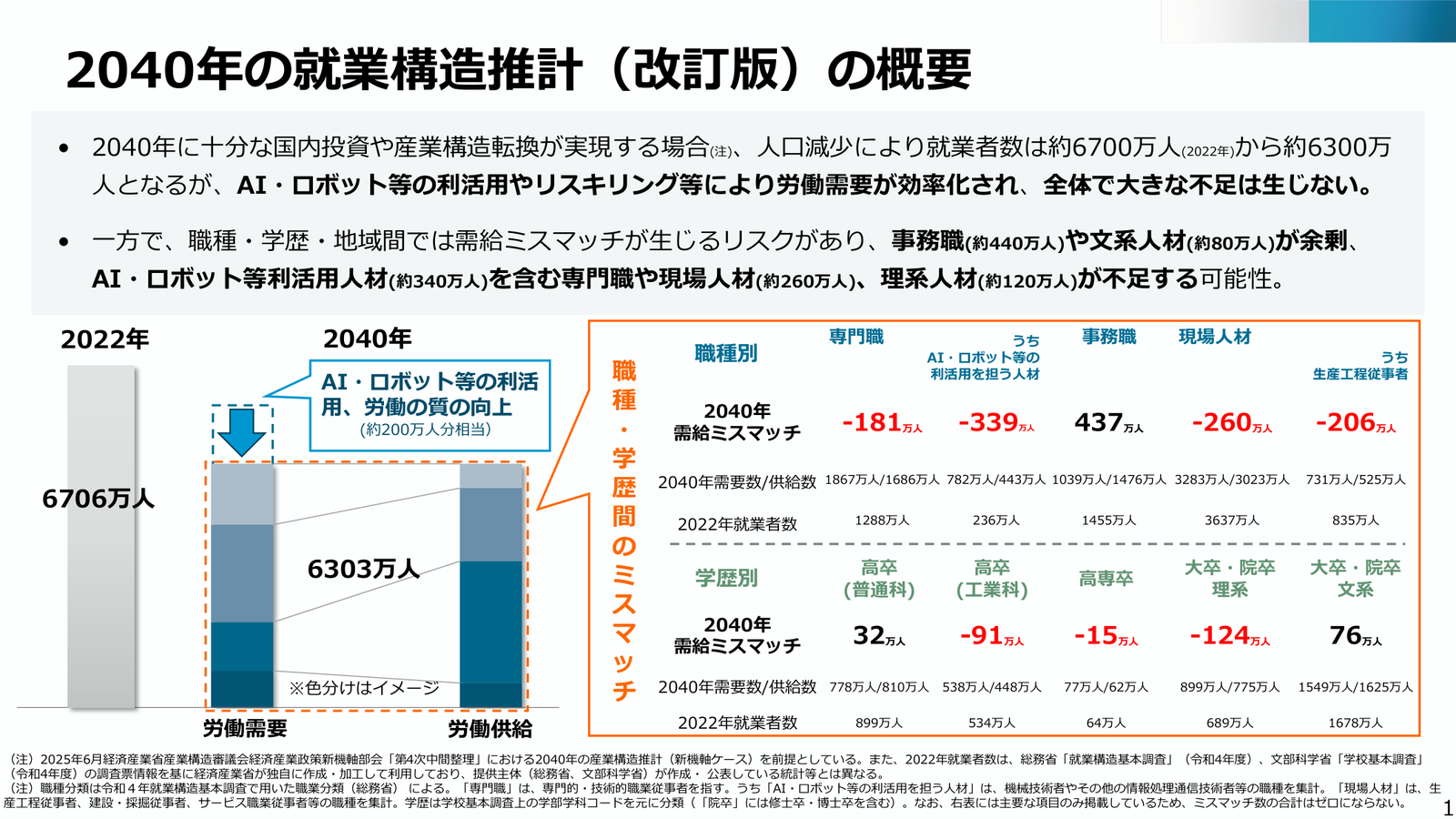
Source: METI, Industrial Human Resources Division, "On Efforts toward Developing Industrial Human Resources," 25 February 2026, p1 In short, the places where people are in surplus and the places where they are short are dividing cleanly. The frontline sense that applications flow to the clerical slots while you cannot hire anyone who can handle AI is not a trick of the imagination; it was the structure itself.
What makes this structure even harder is the weakness of hiring and training in Japan. In a survey by the Information-technology Promotion Agency (IPA), 85.1% of Japanese firms answered that they lacked the "quantity" of people to advance DX, far above the 23.8% in the United States and 44.6% in Germany. And it has barely improved from a few years ago2. Narrow it to AI and it is more serious still: the share answering that they lacked people who could plan products and services using AI was 61.0% in Japan, and the shortage of people who could build AI was 53.7%, both leaving the US and Germany behind2.
If they are short, you would think they could just train people, but that too is precarious. In the same survey, 36.6% of Japanese firms answered that they provided "no particular support" for developing DX talent. Set against 1.0% in the US and 1.9% in Germany, the gap is stark. The rate at which employees pursue self-development also placed Japan last among the major countries surveyed2. In international assessments as well, in IMD's 2024 digital competitiveness ranking, Japan's "talent" item came last among the G7 and sank to 51st among 67 countries and regions2. They do not train, so they fall short; they fall short, so they have no choice but to hire ready-made people expensively from outside. This vicious circle sits at the root of the pain of hiring difficulty.
Looking for AI training and consulting?
Learn about WARP training programs and consulting services in our materials.
What is an "AI-driven person," and what can they actually do?
Here let me break down, as plainly as I can, the term at the centre of this article: the "AI-driven" person. Being AI-driven means placing AI at the core of your work as a capable partner and lifting your own productivity by several notches. Concretely, it is a way of working in which you push tasks forward on your own, fast and in parallel, while leaving research, document preparation, drafts of text and email, first-cut programs, and the aggregation and analysis of data to AI. A process that once took several people, divided up over many days, gets shaped by one person in half a day. This is genuinely happening.
What matters is that this is different from simply "being able to ask ChatGPT questions." The core of the AI-driven person lies in three things: being able to design the instructions to AI, that is, the prompts, to fit the goal; being able to verify the answers that come back rather than swallowing them whole; and being able to build that into their own work process so it can be repeated. There is a wide gap between being able to touch a tool and being able to keep producing results with it. Whether HR can spot that difference in the hiring moment is where the craft of recruiting will show itself from here. On how to make that judgment, I go into more concrete detail in an HR-focused piece on hiring and developing AI-driven talent and, stepping into the engineering side, in a guide to AI-driven developers.
The reason we keep running an AI consulting service called WARP is precisely that we feel we are getting somewhere on that bridge from "being able to touch" to "being able to produce results." Where, in which task, do you put AI so that this company's this job actually gets easier and can run on a small team? It is work you design one piece at a time together with management and the front line. Handing out AI does not raise productivity. Only when the people who can wield it and the structure that lets it be wielded come together do the numbers finally move.
How big is the gap? Reading it through government and private figures
So how large is the gap between someone who can wield AI and someone who cannot? Here I will keep a clear line between government data I can state with confidence and overseas data that rests only on reporting.
First, the domestic projection I can state firmly. According to the same METI material, labour demand for people engaged in clerical work is projected at 15.3 million on the premise that generative AI is not introduced, but is estimated to fall to 6.8 million if the advance of generative AI is assumed. That is a substitution rate of roughly 32%, with a further 23% of margin said to remain. Demand for transport work also falls sharply, while the substitution rate for interpersonal services such as healthcare stays at just 1% to 2%1. In other words, the more routine the clerical work, the more it runs on smaller teams through AI, while jobs that face people and jobs that demand high skill remain. That is the colour-coding.
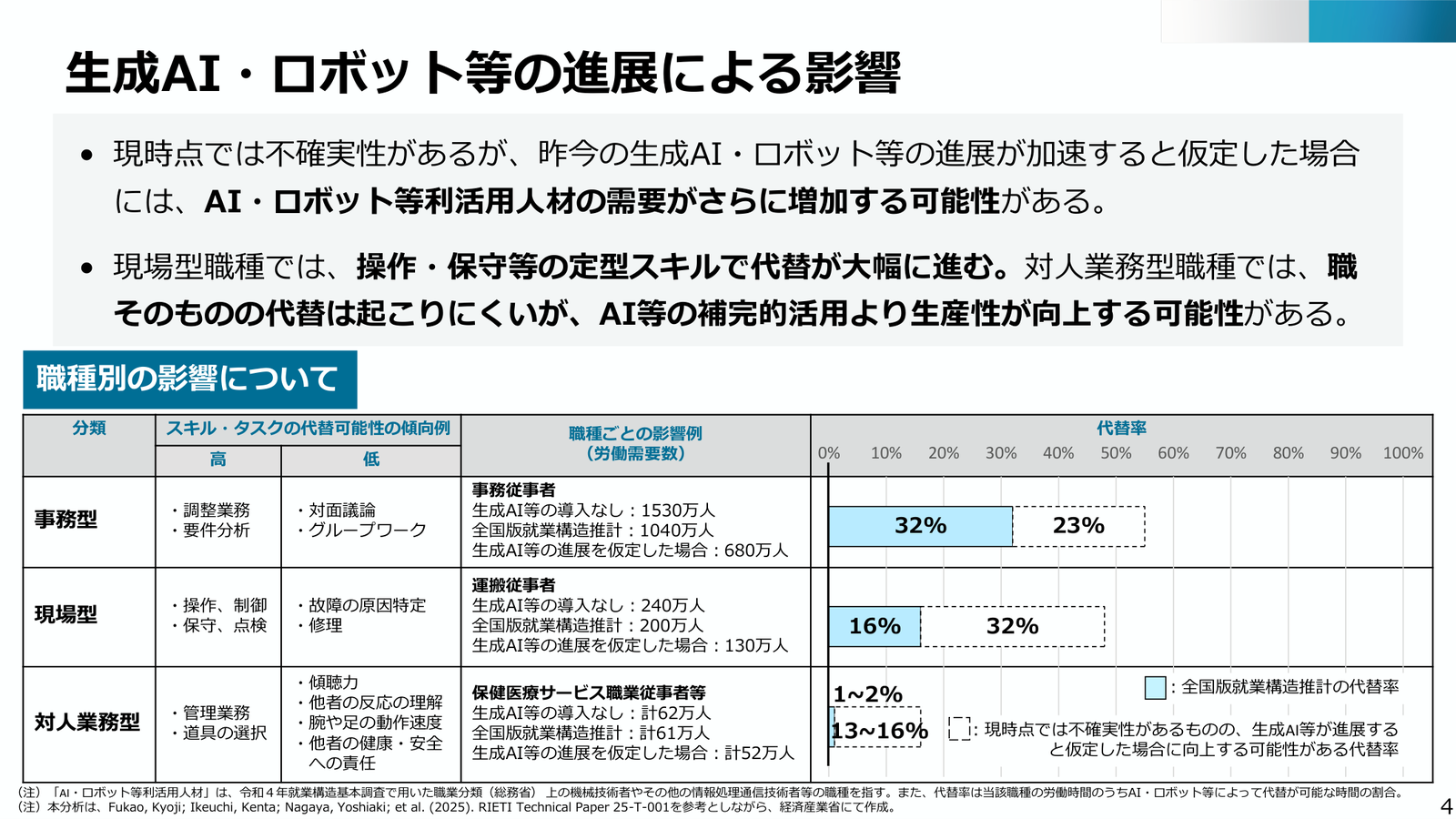
Source: METI, Industrial Human Resources Division, "On Efforts toward Developing Industrial Human Resources," 25 February 2026, p4 The price of talent itself can also be confirmed in public statistics. In a comparison in the same material, based on the Ministry of Health, Labour and Welfare's Basic Survey on Wage Structure, the scheduled monthly cash earnings for 2024 were highest for those in professional and technical occupations at roughly 377,000 yen, followed by clerical workers at about 337,000 yen and production-process workers at about 293,000 yen1. Given that the wage level was already set higher for professional and technical work, and now AI adds both smaller teams and higher value-added on top, it is a natural flow for the scarcity value of people who can handle it to rise.
From here on, the figures rest on overseas reporting and venture-capital analysis, so please note that their nature changes. According to an article in the US business magazine Forbes, revenue per employee at "AI-native firms" that place AI at the core of the business reaches 2 to 4 million dollars, far above the roughly 300,000 dollars of an average listed SaaS company. One image-generation service is cited at around 18 million dollars per person, but that is an estimated figure for a private company3. This gap, "roughly 7 to 13 times a listed SaaS company," is the backdrop against which the phrase "the work of 100" is born. It is not a literal 100 times, but the degree to which a small team can run the whole thing has certainly risen by an order of magnitude.
The surge in pay has been reported too. One major tech company is said, in reporting, to have offered a total compensation package on the scale of 300 million dollars over up to four years, exceeding 100 million dollars in the first year, to poach a leading AI figure. But it is not accurate to state this flatly as a "100-million-dollar signing bonus." The company itself has explained that this was total compensation rather than a lump-sum signing bonus, and it is a reporting-based figure throughout4. In recent years there has also been a conspicuous move to hire only the founding team or the core researchers at high cost, rather than buying an entire AI-native firm. Reporting says several major tech companies have poured a combined total exceeding 20 billion dollars over a few years into this "hire the people, not the company" approach4. The symbol of "one person even if it costs a hundred million" traces back to these overseas cases.
How to take "the work of 100" and "a hundred-million-yen salary"
Let me be honest about the points to keep in mind so as not to swallow these figures whole.
First, both "the work of 100" and "a hundred-million-yen salary" are symbolic expressions. The revenue at AI-native firms and the extraordinary pay I introduced as backing are estimated figures for private companies and overseas reporting; they are neither the average for an ordinary Japanese company nor something promised to anyone. The quantities you should use are the ones that come paired with clearly sourced backing, such as "roughly 10 times a listed SaaS company" or "generative AI cuts clerical demand from 15.3 million to 6.8 million." I believe that is the honest way. Pulling out only the outstanding success stories to stir people up is unkind to the reader.
Second, the government's view is in fact the opposite of a "mass-layoff" story. METI's projection is written in a tone that says the efficiency gains from using AI and robots and from reskilling mean no large overall labour shortage arises. What it stresses is "labour movement" from jobs in surplus toward jobs in shortage, not a story of casting people aside1. For students and for HR alike, I hope you can take this point calmly.
Third, it is not the case that bringing in AI solves everything. Generative AI has the weakness of putting out content at odds with the facts, and confidently so, and the handling of confidential information carries the risk of information leakage. That is precisely why the person who can verify answers and the person who can build them safely into the work become the linchpin. Not overtrusting AI, and judging where it works and where it does not, is, I feel, the very core that will be asked of talent from here. If one person looks like the work of a hundred, it is not because AI erased people, but because a person who can rein AI in correctly has become able to carry that much larger a job.
A first step for students, a first step for HR
Finally, let me write a first step for each of the two positions.
To students. The government is calling on you to grow the strengths and individuality that AI cannot replace. In the Ministry of Education's vision for high-school education reform, growing abilities hard for AI to replace is set out as a perspective for living independently through uncertain times1. And as the earlier figures show, STEM talent and people who can plan and build with AI fall well short. There is a market vacancy here. There is no need to decide you are at a disadvantage because you are from the humanities. What matters, more than memorising how to operate a particular tool, is building up the experience of actually solving everyday problems with AI. A report, running a club, improving a part-time job; anything will do. The experience itself of having wielded AI to move something forward becomes your passport in the coming seller's market. If, in future, you have an interest in the path of launching a business with a small team, the thinking behind developing entrepreneurs from scratch in an AI-driven way should be a useful reference.
To HR leaders. Try, once, to untie the premise of hiring many people and taking time to train them. From here, two wheels turn together: building a structure that runs on a small team thanks to AI, and reskilling the staff you already have into AI-driven people. The fact that 36.6% of firms provide "no particular support" for development means, put the other way around, that just that much margin remains to grow people internally2. Before betting the whole budget on the competition to hire expensively from outside, there is more than enough value in turning your eyes to the potential of existing staff to transform.
If you are unsure where and how to bring AI into your own company, or where to act on productivity so that things run on a small team, and you are struggling to organise that starting point, please talk to the WARP team. Specialists who have led DX and data strategy at major companies walk alongside you month by month, helping you bring AI down into the design of your hiring and development.
To sum up
- "The work of one hundred" and "a hundred-million-yen salary" are symbolic expressions, not averages and not guarantees. Much of the backing (revenue at AI-native firms, extraordinary pay) rests only on overseas reporting and venture-capital analysis.
- At the same time, the tectonic shift is real. In the government's projection, clerical jobs are a surplus of +4.37 million and people who use AI a shortage of -3.39 million, the fortunes splitting cleanly by occupation.
- There is an estimate that generative AI cuts clerical labour demand from 15.3 million to 6.8 million, while the substitution rate for interpersonal work is a low 1 to 2%, and the value of people and skill remains.
- In Japan, 85.1% of firms lack DX talent, and a high 36.6% leave development untouched. That is exactly why the scarcity value of AI-driven talent is high and the margin to grow people is large.
- Students can reach a seller's market through the experience of wielding AI. HR should take a step of shifting its footing from mass hiring toward building structures that run on AI and reskilling internally.
Discern the nature of the numbers, and translate them into the one step in front of you. Not being swung around by flashy headlines, and starting from there, is, I think, the surest road of all.
References and primary sources
Footnotes
-
METI, Economic and Industrial Policy Bureau, Industrial Human Resources Division, "On Efforts toward Developing Industrial Human Resources" (material for the Regional Economy and Industry Subcommittee of the Industrial Structure Council, 25 February 2026). https://www.meti.go.jp/shingikai/sankoshin/chiiki_keizai/maintaining_local_life/pdf/004_01_00.pdf ↩ ↩2 ↩3 ↩4 ↩5 ↩6
-
Information-technology Promotion Agency (IPA), "DX Trends 2025: Developing Digital Talent in the Age of AI" (research and analysis discussion paper, June 2025). https://www.ipa.go.jp/digital/chousa/discussion-paper/j5u9nn000000abx5-att/dx2025_digital_talent_ai_era.pdf ↩ ↩2 ↩3 ↩4 ↩5
-
Paul Baier, "AI-Native Firms Lead In Revenue Per Employee," Forbes (31 March 2026, citing market analysis from Redpoint Ventures, CB Insights and Gartner). https://www.forbes.com/sites/paulbaier/2026/03/31/ai-native-firms-lead-in-revenue-per-employee/ ↩
-
Reporting by various outlets on high-cost AI hiring and the acqui-hire of founding teams by major tech companies (TechCrunch, Fortune, Reuters, CNBC and others, 2025). All amounts and terms are estimates based on reporting. ↩ ↩2