Hello, this is Ryuta Hamamoto from TIMEWELL.
Anyone volunteering to organise a class reunion pictures the seating plan and the speeches. What actually wears you down is the money.
Transfers arriving with no name you recognise. Married names that do not match the list. Reminder messages you have to send three times. And the venue deposit, paid out of your own account because nobody has handed you anything yet. On the night there is float to prepare, a queue at the door, and the people who did not show up whose share somebody has to absorb.
This article is about removing three things with one change of sequence: the transfer fee, the reconciliation and chasing, and the organiser's out-of-pocket exposure.
The short version:
- A bank transfer on a 3,000 yen fee costs 5.1% — above the 3.6% of a card payment
- In cash at an ATM it is 880 yen, or 29% of the fee
- Taking payment up front removes reconciliation, chasing and fronting the money at once
- The real asset of a reunion is not the evening. It is the list — and it is never handed on
Transfers are not the cheap option
The most common misconception first.
"Let's ask people to transfer so we don't pay fees." Standard reasoning in any community treasury, and wrong below a certain amount.
MUFG Bank's personal transfer fees, tax included1:
| Channel | Same bank | Other bank, under ¥30,000 | Other bank, ¥30,000+ |
|---|---|---|---|
| Online banking | free | ¥154 | ¥220 |
| ATM (card) | ¥110 | ¥275 | ¥275 |
| ATM (cash) | ¥550 | ¥880 | ¥880 |
| Branch counter | ¥880 | ¥990 | ¥990 |
A 3,000 yen fee transferred online to another bank costs 154 yen: 5.1% of the fee, above a card payment's 3.6%. In cash at an ATM, 880 yen, or 29%. At the counter, 990 yen, or 33%.
At 6,000 yen the 154 yen is 2.6%, roughly comparable. Transfers only win clearly once the fee is above 10,000 yen.
And that fee is paid by the attendee. The organiser's costs are separate, and larger.
The manual work weighs more than the fee
Collect by transfer and this lands on the organiser's desk.
Reconciliation. Checking statements against the list to see who has paid. Married names do not match. At a reunion, where many people changed their surname, this happens every single time. Company accounts and family accounts appear too.
Chasing. Messaging everyone past the deadline. Once is never enough. The people who do not reply need an individual message, starting again from whether they are coming at all.
Fixing the headcount. The venue needs a number. Until the transfers are in, you do not have one, so you negotiate without it.
All of that is the organiser's time. At five minutes a head across fifty people, it is more than four hours. That is worth considerably more than the total fees.
Take card payment up front and all three vanish. The system records who paid, so nothing needs reconciling. Who has not paid is a list, so chasing is one message. The headcount is fixed at the deadline.
Looking to optimize community management?
We have prepared materials on BASE best practices and success stories.
Nobody should be fronting the venue
One more burden that rarely gets discussed: the deposit.
Many venues want part or all of the money before the event. If fees are collected on the night, there is nothing in hand, so somebody fronts it, and that somebody is the organiser.
Then people do not show up. Reunions are unusually prone to it — these are gatherings people have not attended in five or ten years, and plans change late. Their share of the venue cost comes out of the organiser's pocket.
Advance payment removes the structure entirely. The money is in before the event, so nothing is fronted. No-shows have already paid. Cancellation terms go in the invitation, and the organiser's own bank account never enters the picture.
People say talking about money feels awkward. It feels awkward because you are collecting cash on the night. Settle it at sign-up and the subject never comes up in the room.
You can explain where the fee goes
Advance payment means a processing fee. Worth being straight about that.
Card fees run 3–5% not because the platform is taking it, but because roughly 70% of a merchant discount rate goes to the company that issued the attendee's card. That figure is from Japan's growth strategy implementation plan, approved by Cabinet in June 2021 and quoted in the Fair Trade Commission's survey report2. JCB separately publishes its split as roughly 3 to 1 between issuer and acquirer, which lines up3.
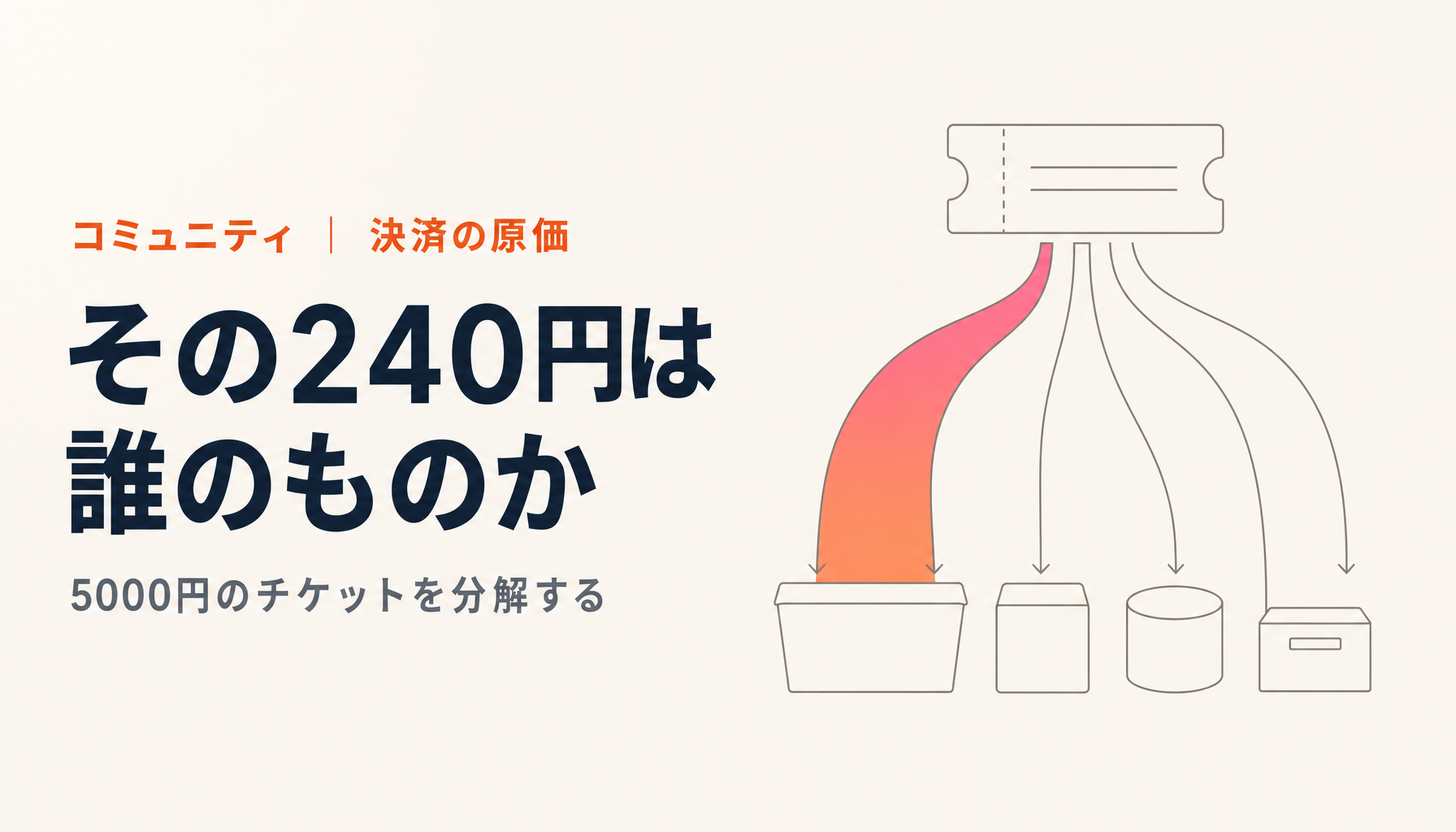
On a 5,000 yen ticket, of the 240 yen deducted, something like 60 yen stays with the platform. The full breakdown is in where event fees actually go.
Which means that when an attendee asks why there is a fee, you have an answer — including the fact that it is often cheaper than everyone paying their own transfer fee.
One thing to watch when comparing: the fixed amount per ticket. Some services charge a rate plus, say, 99 yen. On a 3,000 yen fee that 99 yen is another 3.3%. Comparing headline rates alone will mislead you.
The real asset is the list, not the evening
This is the part I care most about.
Reunions happen every five or ten years. Contact details change in between. People move, change jobs, marry, switch numbers. Half of the previous list is dead by the time anyone uses it again.
So the next organiser starts by rebuilding it. Finding whoever still has the old version, working through mutual friends, searching social media. This is the most time-consuming part of organising a reunion, and it is redone from scratch every cycle.
The cause is that the list lives in someone's spreadsheet or group chat. Change the organiser and it does not transfer. Transfer it and it is out of date. And who is responsible for that personal data stays comfortably vague.
If attendees become members of a community at the moment they sign up, that changes. The list belongs to the group rather than to a person. People update their own details. The next invitation goes out without rebuilding anything.
Collection is a job that ends this year. The list pays off for the next decade. It is not a hard call which one to systematise.
The sequence, step by step
- Decide the date and make the page. Date, venue, fee, deadline. That is enough to take sign-ups. Nothing elaborate is needed.
- Send the invitation. To the old list if there is one, otherwise through year representatives and mutual friends. One URL.
- Take the RSVP and the payment together. Collecting attendance and money separately is what creates reconciliation. Do both at once and the task ceases to exist.
- Fix the headcount at the deadline and tell the venue. The money is already in, so a deposit is no problem.
- Say nothing about money on the night. The door is a name check. No float, no queue, no awkwardness.
- Leave the list with the group. Along with the photos and the record, so the next invitation writes itself.
It is in use
TIMEWELL BASE is built to make exactly that sequence possible. A page takes 60 seconds, RSVP and payment complete in one flow, and everyone who signs up becomes a member of the community. The fee is 4.8% on paid events, with no fixed amount per ticket and no monthly charge.
Reunion organisers are using it. The reasons they gave us were the rate, and that the community features are there from the start and usable without configuration — no separate service needed just to hold the list.
It is also in use in the public sector. SHIN Minatomirai, Kanagawa Prefecture's startup support hub, has adopted it for running its community. Reunions and municipal communities look unrelated, but they share one problem: keeping a gathering running when the person in charge keeps changing.
Summary
- On a 3,000 yen fee, a 5.1% transfer costs more than a 3.6% card payment. Smaller amounts favour cards
- Advance payment removes reconciliation, chasing and fronting the venue simultaneously
- Money never comes up on the night, so neither does the awkwardness
- Roughly 70% of the card fee goes to the issuer. You can explain it if asked
- The real asset is the list. Keep it with the group and you halve the next organiser's work
If you want to talk through running a reunion or a local community, see TIMEWELL BASE or get in touch.
References
Footnotes
-
Transfer fee schedule (MUFG Bank). Personal accounts, tax included ↩
-
Report on the survey of credit card transactions (Japan Fair Trade Commission, April 2022). The "approximately 70%" figure is the report's quotation of the growth strategy implementation plan approved by Cabinet on June 18, 2021 ↩
-
Publication of the allocation ratio of credit card merchant fees (Japan Fair Trade Commission, June 1, 2023) and JCB's published materials ↩