Hello, this is Ryuta Hamamoto from TIMEWELL.
Watching communities run by local government and support facilities, I keep seeing the same shape of failure.
Launch has energy. People come to the kickoff, cards get exchanged, a chat group appears. It moves for about six months. Then the officer running it rotates out, and by the time their successor arrives, the list, the record of who came, and any sense of what worked have not been handed over.
The cause is not enthusiasm. It is structure. This piece is about designing a community that survives the handover, and about what to watch when money changes hands.
The short version:
- The reason it stops is that the list and event history are tied to a person
- Rebuilding a sign-up form every time means the relationship ends when the event does
- Public sector events are mostly free, so the value sits in continuity, not fees
- If you charge, decide who the host is first. Public revenue is a separate conversation
The failure is in the handover
The sequence is almost always the same.
Year one. The officer runs events with energy. The attendee list is in their own spreadsheet; invitations go to addresses pasted into the To field. Each sign-up gets a fresh free form.
Year two. Gaps open between events. Inviting last time's attendees starts with hunting for which file the list was in. Form responses are scattered across separate sheets.
Year three. Rotation. The successor finds an old list in the shared drive but cannot tell when it was accurate. Half the emails bounce. So they start again from the first event.
Nowhere in that sequence is anyone slacking. The entire cause is that the list and the event history are tied to an individual rather than the facility.
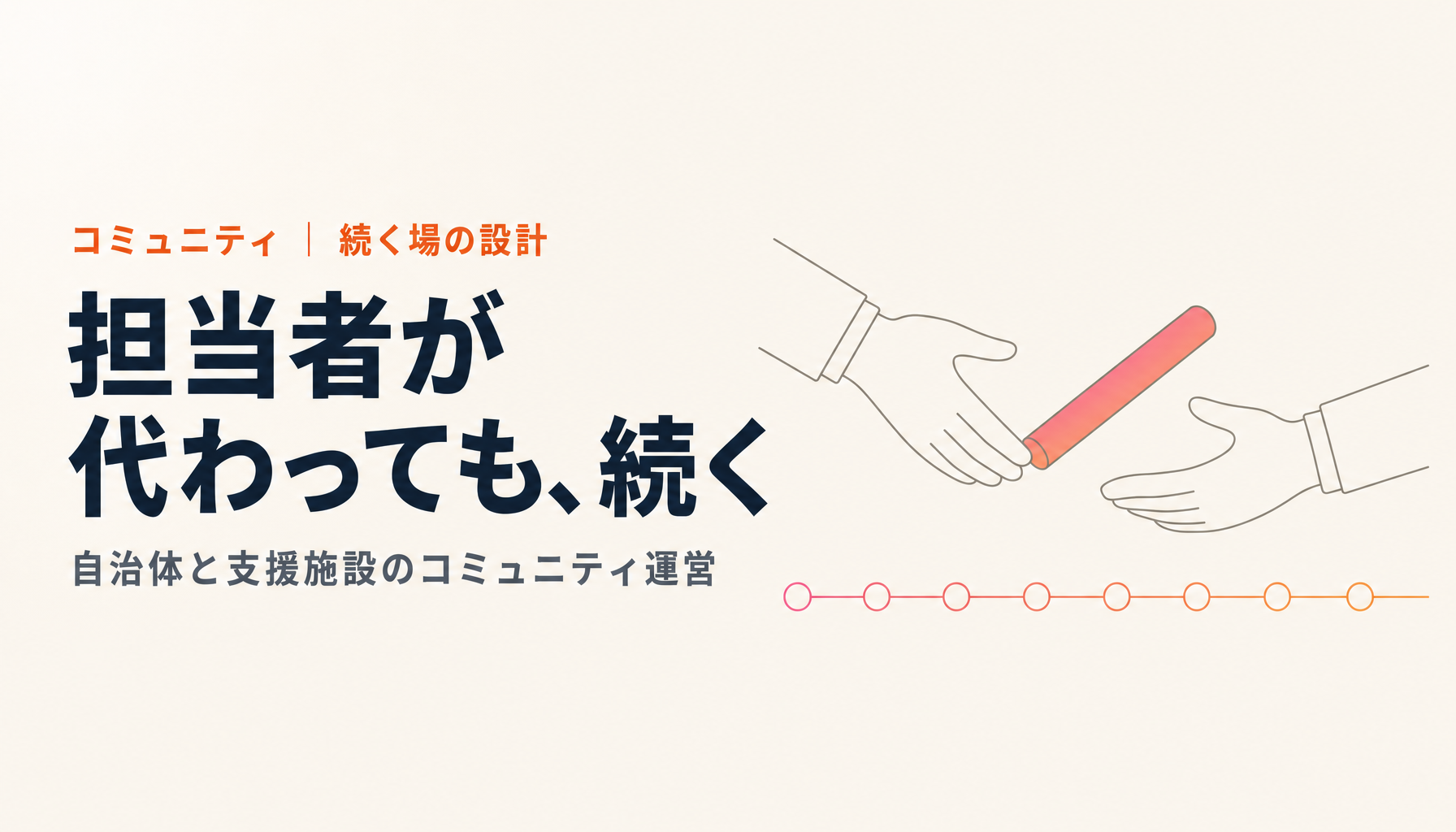
Fixing it is not hard. If signing up registers someone as a member of the facility's community, the list stays with the facility. The event history accumulates in the same place. What gets handed over at rotation is an account permission.
It is also the safer arrangement for personal data. Attendee contact details in an officer's spreadsheet or personal account get orphaned at every departure. Hold it in the facility's name and swap the people.
A one-off form is a tool for ending relationships
Here is the overlooked part. Rebuilding a sign-up form for every event resets the relationship every time.
A form exists to take sign-ups. When the event is over, it has done its job. The contact details in it sleep inside that response sheet unless someone moves them by hand.
From the attendee's side it looks like this. They sign up for the first event and attend. The second invitation may or may not come. If it does, they type their name and email in again. Someone attending for the third time is treated exactly like a first-timer.
If you want this to grow into a community, that has to change. You want sign-up to mean belonging, not attending. The first event makes them a member; from the second, invitations arrive and they do not retype anything; the count of how often they have come is on the record.
It looks like a small difference. Over three years, it is not.
Looking to optimize community management?
We have prepared materials on BASE best practices and success stories.
If you charge, settle who the host is
Where public bodies are involved, charging needs care.
Start from the fact that government-run courses and events are mostly free. Where they are paid, it is usually at the level of materials or venue cost recovery. That is worth holding as the baseline.
With that said — if you do charge, the treatment turns entirely on who the host is.
Where an organising committee or operating body hosts. The attendance fee is that body's income. It runs like a private event: collect on the platform, settle to the body's account. Most support facility community events take this shape.
Where the public body itself hosts and the fee is public revenue. Different conversation. Collection of public money has a statutory framework, and a third party receiving it on the body's behalf requires a procedure specific to that authority. "Open an account and start collecting today" is not how this goes. Check with the responsible department and finance first.
In practice, starting from cost recovery is the realistic route. Materials for a hands-on workshop, food and drink at a social, the cost of printed material. Small amounts, easy for attendees to accept, and easy for the host to account for. Taking payment in advance also removes cash handling and change on the day.
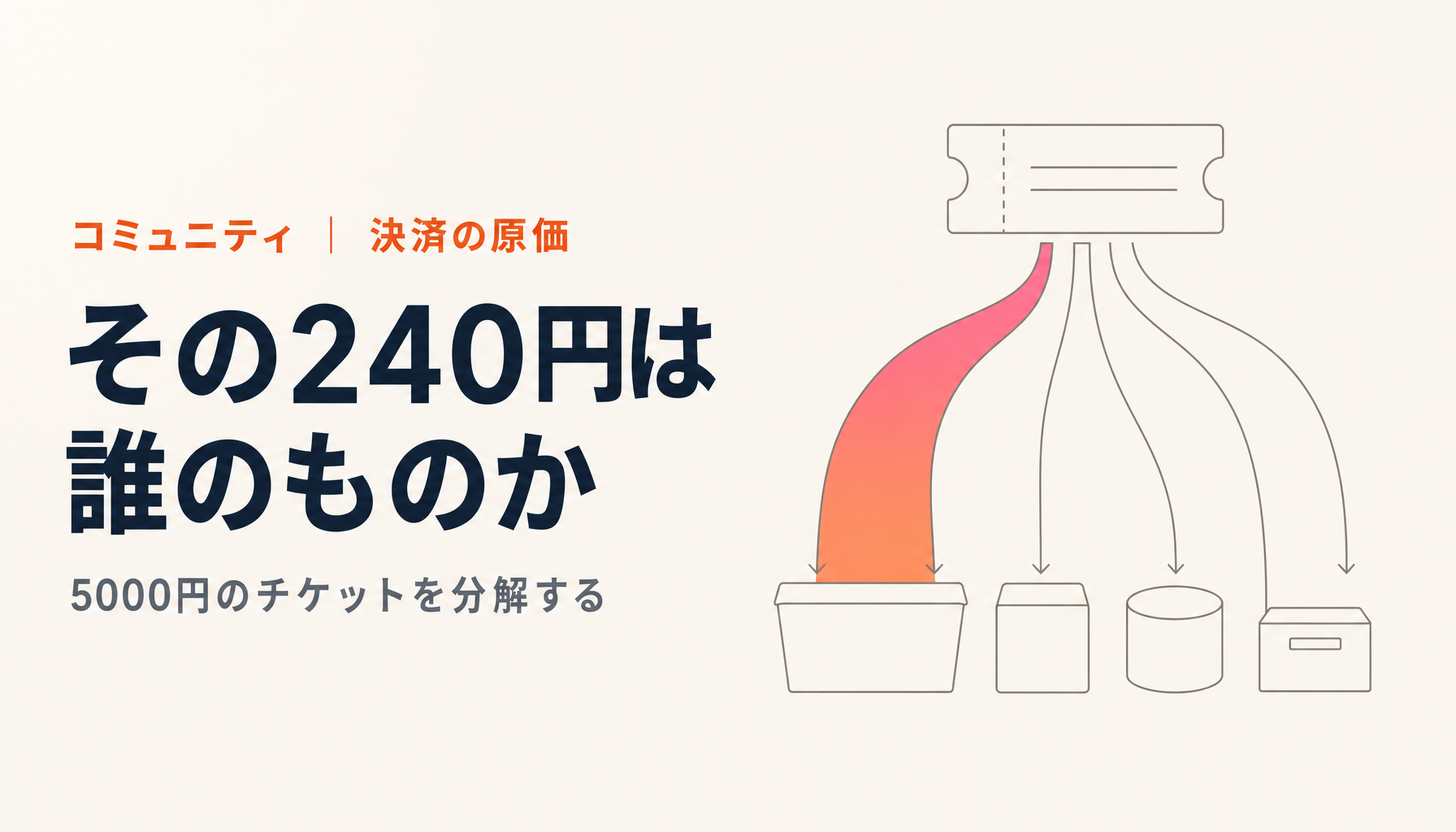
Note that bank transfer works against you at small amounts. A 3,000 yen membership fee transferred to another bank costs 154 yen, which is 5.1% of the fee — above the 3.6% a card payment costs1. There is a full breakdown in where event fees actually go.
Free events still benefit
"All our events are free, so we don't need a payment service." I hear this often.
Fees only apply to paid events, so free use costs nothing. And there is a part that specifically helps free events.
Free events have a low barrier to entry, which also means the relationship breaks easily. Sign up, attend, done. Nothing guarantees a next time. If attendees remain members of the facility's community, the ability to send the next invitation persists. That has nothing to do with whether money changed hands.
For support facilities there is a second thing, which is the link between residents and alumni. Companies that have moved out, and companies currently in the building. A facility where those two groups are connected and one where they are not are different places entirely. Alumni who can take information at their own pace, and come back when they need to. Whether that door exists comes down to where the list lives.
How it runs at SHIN-MINATOMIRAI
A concrete example. SHIN-MINATOMIRAI, Kanagawa Prefecture's startup support hub, uses TIMEWELL BASE as the platform for its community.
(For disclosure: we are a resident company there. I am writing as a daily user as well as the vendor.)
Support facility communities have conditions that ordinary event operations do not.
Residents, alumni, and outside participants are mixed together. Sending everyone the same invitation is not always right; you sometimes want to split the audience.
The range of events is wide. Pitch events, study sessions, networking, expert clinics. Different scales, different formats.
Staff rotate. I will keep saying this. Where government or an affiliated body is involved, you have to design on the assumption that people change every two or three years.
Against those three, what is needed is not clever features. It is being fast to stand an event up, and having the list stay with the facility. If an event page takes sixty seconds, the officer spends their time on the content. If attendees become members automatically, the next officer inherits a list rather than a clean slate.
The order to start in
If you are building or rebuilding one:
1. Create the account in the facility's name. Not an individual's. Get this wrong and everything ties back to a person.
2. Stand up the first event. Do not wait for a perfect design. Publish one event and start receiving people.
3. Make sign-up and membership the same action. Do not hold attendance and the member list separately. Split them and manual transcription is guaranteed.
4. Send the second invitation without collecting addresses again. The moment that works, the mechanism is running.
5. At handover, pass permissions, not files. That is what removes the break.
6. Decide about charging later. Start free, and add a paid session when something with real costs comes up. It does not need deciding at the outset.
In summary
- Communities do not stop for lack of enthusiasm. They stop because the list and the history are tied to a person
- One-off sign-up forms end the relationship at the end of every event
- If you charge, settle who the host is. Public revenue means the statutory collection route, so check with the department and finance
- Even for free events, retaining the ability to send the next invitation is the value
- What you hand over is account permissions, not files
If you want to talk through community operations for a public body or a support facility, see TIMEWELL BASE or get in touch. We can share what other facilities with the same problem have done, within what we are able to discuss.
References
Footnotes
-
Transfer fee schedule (MUFG Bank, Japanese). Personal customers, tax included. Online banking transfers to another bank: 154 yen under 30,000 yen, 220 yen at or above. The 3.6% card figure is from Stripe's Japan pricing ↩