Hello, this is Ryuta Hamamoto from TIMEWELL.
If you have ever organised a paid event, you have looked at the settlement statement and thought: what exactly is this fee paying for?
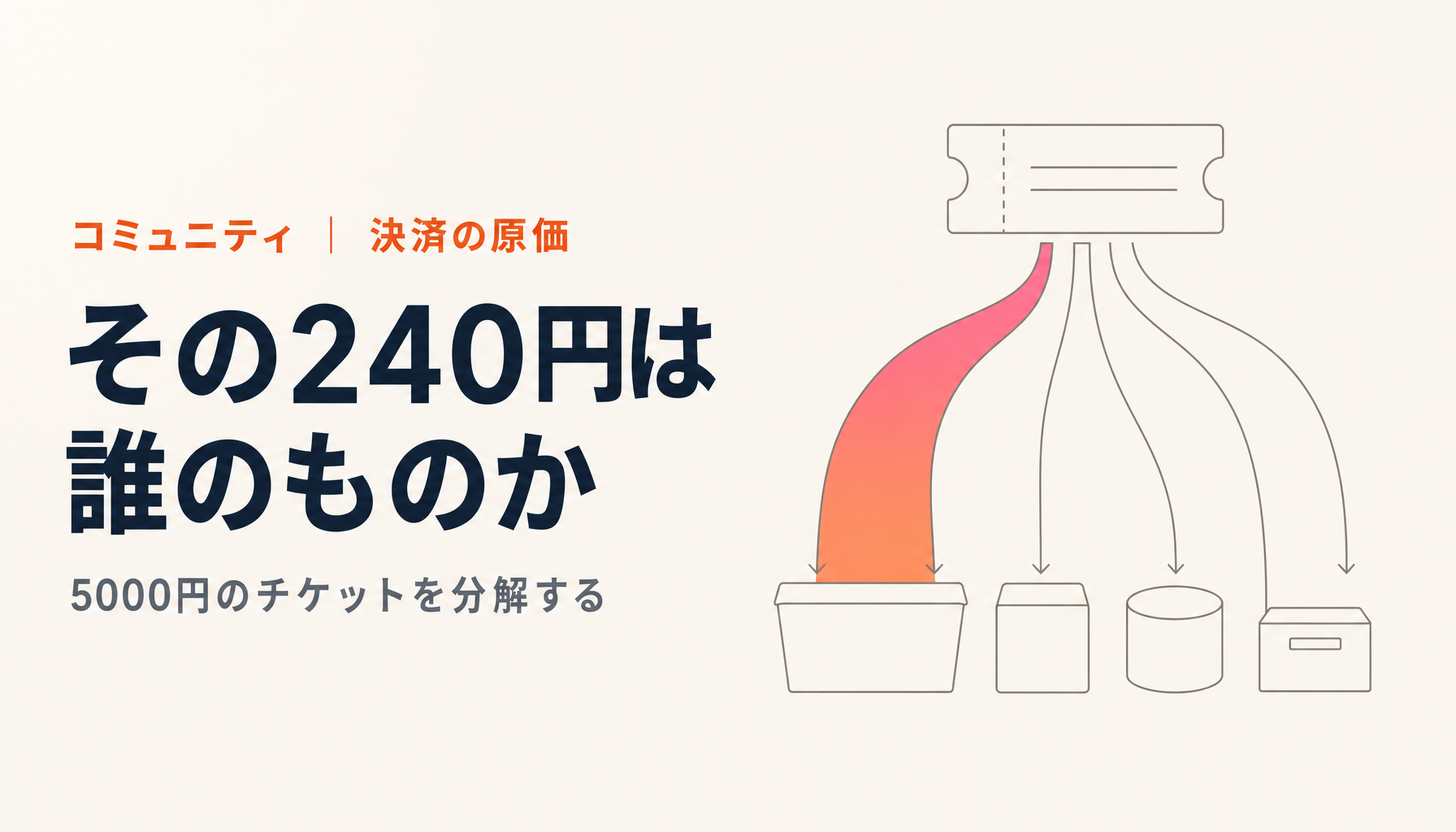
A 5,000 yen ticket sells, 4,760 yen lands in your account, and the missing 240 yen looks like the platform's cut. It mostly is not. Most of that 240 yen passes straight through and goes somewhere else.
This article takes event payment economics apart, using only figures from Japan's Fair Trade Commission, Cabinet-approved policy documents, card network disclosures and payment processor pricing. By the end you should be able to explain what actually determines the rate.
The short version:
- Roughly 70% of a Japanese merchant discount rate goes to the card issuer (growth strategy implementation plan)
- The same card payment ranges from 0.60% to 2.88% depending on industry and card tier — nearly a five-fold spread
- The JFTC survey found a simple average of 2.70% and a weighted average of 1.66%. Smaller merchants pay more
- The cheapest option in this market shut down on June 30, 2026
- Collecting a 3,000 yen fee by bank transfer costs 5.1% — more than a card payment
The cheapest option no longer exists
A fact to establish first. PassMarket, which charged the lowest rate among Japanese event platforms, closed on June 30, 2026.
Operator LINE Yahoo announced it on December 17, 2025. Organisers could run events until 23:59 on June 30, 2026, the ticket management tool stayed available until August 31, and buyers lost access to their purchase history from September 11. The notice named no successor and gave no reason.
The basic plan charged 3.564% including tax, with no setup fee, no system fee and no transfer fee1. In hindsight the retreat was gradual: new signups for the professional plan had already closed in October 2022, more than two years before the shutdown.
This matters because the benchmark has moved. 3.564% is no longer an option anyone can choose. Comparisons have to be redone among what remains.
Who keeps the 240 yen
The moment a card is used, the money passes through three parties.
First, the company that issued the buyer's card (the issuer) fronts the money, deducting the interchange fee as it does. Then the company contracted with the merchant (the acquirer) receives it, adds its own costs for terminals and underwriting, and pays the merchant. Both of them separately pay the card network — Visa, JCB and so on2.
Interchange is the big one. How big: roughly 70% of the merchant discount rate. That figure comes from Japan's growth strategy implementation plan, approved by Cabinet in June 2021 and quoted in the Fair Trade Commission's own survey report2.
One of the obstacles to expanding cashless payment in Japan is the high cost of credit card merchant fees. According to interviews, interchange fees account for approximately 70% of merchant fees.
A second disclosure lines up with it. Following requests from the JFTC and METI, JCB published its split in June 2023: roughly 3 to 1 between issuer and acquirer3. Three to one is 75%.
So of the 180 yen of processing cost inside a 5,000 yen sale, somewhere around 126 to 135 yen flows to whoever issued the buyer's card. That money funds credit risk, reward points and fraud cover. Premium cards pay generous points because merchants pay higher interchange on them.
Looking to optimize community management?
We have prepared materials on BASE best practices and success stories.
A five-fold spread by industry and card tier
Interchange is not one number. In November 2022, at the request of the JFTC and METI, Mastercard, UnionPay and Visa each published their standard rates for Japan4.
Visa's published Japanese credit rates, by industry category5:
| Category | Classic | Gold | Platinum etc. | Infinite |
|---|---|---|---|---|
| Government / public service | 0.60% | 0.70% | 0.90% | 0.90% |
| Entertainment / leisure | 0.90% | 1.00% | 1.20% | 1.50% |
| Various services | 0.95% | 1.05% | 1.25% | 1.55% |
| Large retail and hotels | 1.85% | 1.95% | 2.15% | 2.45% |
| General / other (standard) | 2.28% | 2.38% | 2.58% | 2.88% |
Two things stand out.
Industry matters enormously — 0.60% to 2.88% is close to a five-fold spread. Utilities sit low, general retail high. Events and leisure fall into one of the cheaper bands.
Card tier matters too. Within the same category, Classic at 0.90% becomes Infinite at 1.50%. From the organiser's side, which card the attendee happens to use changes the underlying cost. As we will see, a processor absorbs that variance so it never reaches you.
Mastercard also publishes Japanese rates, though we could not retrieve the figures programmatically, so none are quoted here. JCB does not set interchange as such and instead publishes the split described above3.
Smaller organisers pay more
One more thing worth making explicit. The rate depends on your size.
A JFTC written survey of 336 companies found an average merchant discount rate of 2.70% on a simple average and 1.66% weighted2. The gap is the finding: a weighted average more than a point lower means the merchants with the largest volumes are on much lower rates.
The card companies' own answers, as collected by the JFTC, are blunter2.
The 3.25% figure each company publishes appears to be a standard merchant fee for small and medium merchants; an average including large merchants would be considerably lower.
Because merchant fees are set according to whether terminal costs are borne and the scale of sales, fees for small and medium merchants are sometimes set above the standard interchange rate.
Merchant fees for the large retailers that account for a large share of our acquiring volume are set considerably lower.
This is why an individual organiser or a small community contracting card payments alone ends up on a poor rate. The volunteer organising a school reunion a few times a decade is not going to negotiate against a national retail chain. One real function of a platform is aggregating many organisers' volume to reach a rate none of them could reach alone.
Taking the ticket apart, all the way down
With those figures, here is the full breakdown for TIMEWELL BASE.
| Who | Amount | For what |
|---|---|---|
| Attendee pays | ¥5,000 | The ticket |
| BASE's fee | ¥240 | 4.8% of sales |
| of which, to Stripe | ¥180 | 3.6% processing |
| BASE keeps | ¥60 | 1.2% of sales |
| Organiser receives | ¥4,760 |
And the 180 yen, estimated with the figures above:
- roughly 70%, about ¥126, is interchange going to the attendee's card issuer
- the remainder is the acquirer's, out of which network fees are also paid
- the processor is left with something on the order of ¥50 of the ¥180
So of the 240 yen that looks like a platform taking a cut, we keep 60 yen, the processor keeps around 50, and roughly 130 goes to card issuers and networks. The majority of the fee goes to the people running the payment rails.
A note on Stripe's rate. Japanese card payments are a flat 3.6% with no setup or monthly fee6. Given that interchange itself swings between 0.60% and 3.28%, a flat rate means the processor is absorbing that variance. An attendee paying with a premium card costs the organiser exactly the same. Unglamorous, but genuinely useful.
Bank transfers are not the cheap option
"We'll ask people to transfer the money so we don't pay fees." Common in community treasuries, and wrong below a certain amount.
MUFG Bank's personal transfer fees, tax included7:
| Channel | Same bank | Other bank, under ¥30,000 | Other bank, ¥30,000+ |
|---|---|---|---|
| Online banking | free | ¥154 | ¥220 |
| ATM (card) | ¥110 | ¥275 | ¥275 |
| ATM (cash) | ¥550 | ¥880 | ¥880 |
| Branch counter | ¥880 | ¥990 | ¥990 |
A 3,000 yen fee transferred online to another bank costs 154 yen — 5.1% of the fee, above the 3.6% of a card payment. At an ATM in cash it is 880 yen, or 29%.
And the transfer fee is only the visible cost. Matching payments to names, chasing the ones that do not match, chasing the people who have not paid at all — that all stays as manual work for the organiser. Count the time and the gap widens.
Comparing what is left
Organiser's cost on one 5,000 yen ticket, from each company's published pricing as of September 2026.
| Service | Organiser pays | Keeps | Notes |
|---|---|---|---|
| TIMEWELL BASE | ¥240 | ¥4,760 | 4.8%, no fixed or monthly fee |
| Kokuchi-Pro | ¥339 | ¥4,661 | 4.8% + ¥99, plus ¥210 per payout |
| Doorkeeper | ¥404 | ¥4,596 | 2.5% + ¥99 plus Stripe, plus ¥1,650+ monthly |
| EventRegist | ¥400 | ¥4,600 | 8%, plus ¥160–250 per payout |
| Street Academy (their traffic, online) | ¥1,500 + tax | ¥3,500 | 30%; audience is the consideration |
| (gone) PassMarket | ¥178 | ¥4,822 | 3.564%. Closed June 30, 2026 |
Major ticketing agencies do not publish organiser-side rates. Their public pages list what buyers pay in system and issuance fees; the organiser's commission is set per contract. We cannot put a number in the table, so we note the absence instead.
Marketplace models charging 20–30% are not expensive so much as selling you an audience. If you can fill the room yourself, that is a cost you do not have to carry; if you cannot, it may be a fair trade. Compare like with like before you compare rates.
So can it come down?
Honestly: not by much. When 70% of the cost leaves for someone else, a platform can only work on the remaining 30%.
Our own 4.8% is 3.6% to the processor and 1.2% to us. That 1.2% funds the event pages, attendee management, the community features, settlement and support. Getting to the low 2% range is not possible under this structure. If a provider claims otherwise, look for a monthly fee, a fixed per-ticket amount, or an audience charge somewhere else in the bill.
Three things an organiser can actually do.
Compare the total, not the rate. A ¥99 fixed amount is 2% of a ¥5,000 ticket and 10% of a ¥1,000 one. The lower your ticket price, the worse fixed amounts get.
Run the bank-transfer maths. For small fees, cards win outright, before you even count the chasing.
Own your audience. Most of a 20–30% fee is the cost of reach. If people already come to you, that part is yours to keep.
What we are building with BASE is aimed at that third point. An event page takes 60 seconds, and attendees become members of the community, so the next event does not need its reach bought again. 4.8%, no fixed amount, no monthly fee. We run on 1.2%, which is thin enough that we would rather you used it heavily.
If you want to talk through how to structure collection and community operations, get in touch.
References
Footnotes
-
PassMarket Blog, "Regarding the closure of the PassMarket service" (posted December 17, 2025). Service end date of June 30, 2026, organiser events until 23:59 that day, the ticket management tool until August 31, 2026, and buyer history access ending September 1, 2026 are from that notice, which names no successor service and gives no reason. The 3.564% (tax included) rate and "no setup fee, system fee or transfer fee" wording are from the company's basic plan page and its Specified Commercial Transactions Act disclosure. The October 2022 close of new professional-plan signups is from its organiser page. Operated by LINE Yahoo Corporation. These pages are now offline; content was read from an Internet Archive capture dated June 30, 2026 ↩ ↩2
-
Report on the survey of credit card transactions (Japan Fair Trade Commission, April 2022). The "approximately 70%" figure is the report's quotation of the growth strategy implementation plan approved by Cabinet on June 18, 2021. The 2.70% simple and 1.66% weighted averages, the category figures, the card companies' quoted responses, and the description of the transaction flow are all from that report ↩ ↩2 ↩3 ↩4
-
Publication of the allocation ratio of credit card merchant fees (Japan Fair Trade Commission, June 1, 2023), and JCB's published materials. The roughly 3-to-1 issuer-to-acquirer split, not fixed as a standard rate, is JCB's own wording ↩ ↩2
-
Publication of standard interchange fee rates for credit cards (Japan Fair Trade Commission, November 30, 2022). Mastercard, UnionPay and Visa each published Japanese standard rates on that date ↩
-
Visa, "Japan Interchange Fees" (Visa official site). The industry and card-tier rates are from that page; the table above is an excerpt of the main categories ↩
-
Pricing and fees (Stripe Japan). 3.6% for card payments, +2% where currency conversion is required, no setup or monthly fee, and no separate charge for standard payouts ↩
-
Transfer fee schedule (MUFG Bank). Personal accounts, tax included ↩