The Legacy Problem Nobody Solved
Enterprise technology has a problem that has been building for decades: an enormous installed base of COBOL systems running on IBM mainframes that nobody knows quite what to do with.
The numbers are striking. Estimates suggest there are around 250 billion lines of COBOL in active use worldwide. Banks process somewhere between 80 and 95 percent of daily ATM transactions on COBOL-based systems. Most of the world's major insurance companies, airlines, and government agencies run on mainframe infrastructure that would be considered ancient by the standards of modern software engineering.
This is not because COBOL is good. It is because it works, it has worked for decades, and replacing it is genuinely difficult.
Why Modernization Has Stalled
Anyone who has tried to understand why legacy migration projects fail — and they fail at extraordinarily high rates — runs into the same set of problems.
The knowledge has left. The engineers who built these systems are retired or dead. The documentation is incomplete. The institutional memory of why particular decisions were made has been lost. Understanding what a complex COBOL system actually does requires reverse engineering it from the code.
The code is entangled. Decades of patches, workarounds, and accumulated business logic make large COBOL codebases nearly impossible to fully understand. Variables have non-descriptive names. Control flow is complex. Business rules are embedded in ways that are not obvious from the code structure.
The risk is asymmetric. When a COBOL system processes billions of dollars in transactions daily, the cost of a migration error is catastrophic. The incentive to avoid risk overwhelms the incentive to modernize.
The economics are unfavorable. A full legacy migration requires expensive specialist contractors, long timelines, and high uncertainty — with the payoff being a modern system that does the same thing the old one did. It is hard to build a business case.
Struggling with AI adoption?
We have prepared materials covering ZEROCK case studies and implementation methods.
What Anthropic's COBOL Work Signals
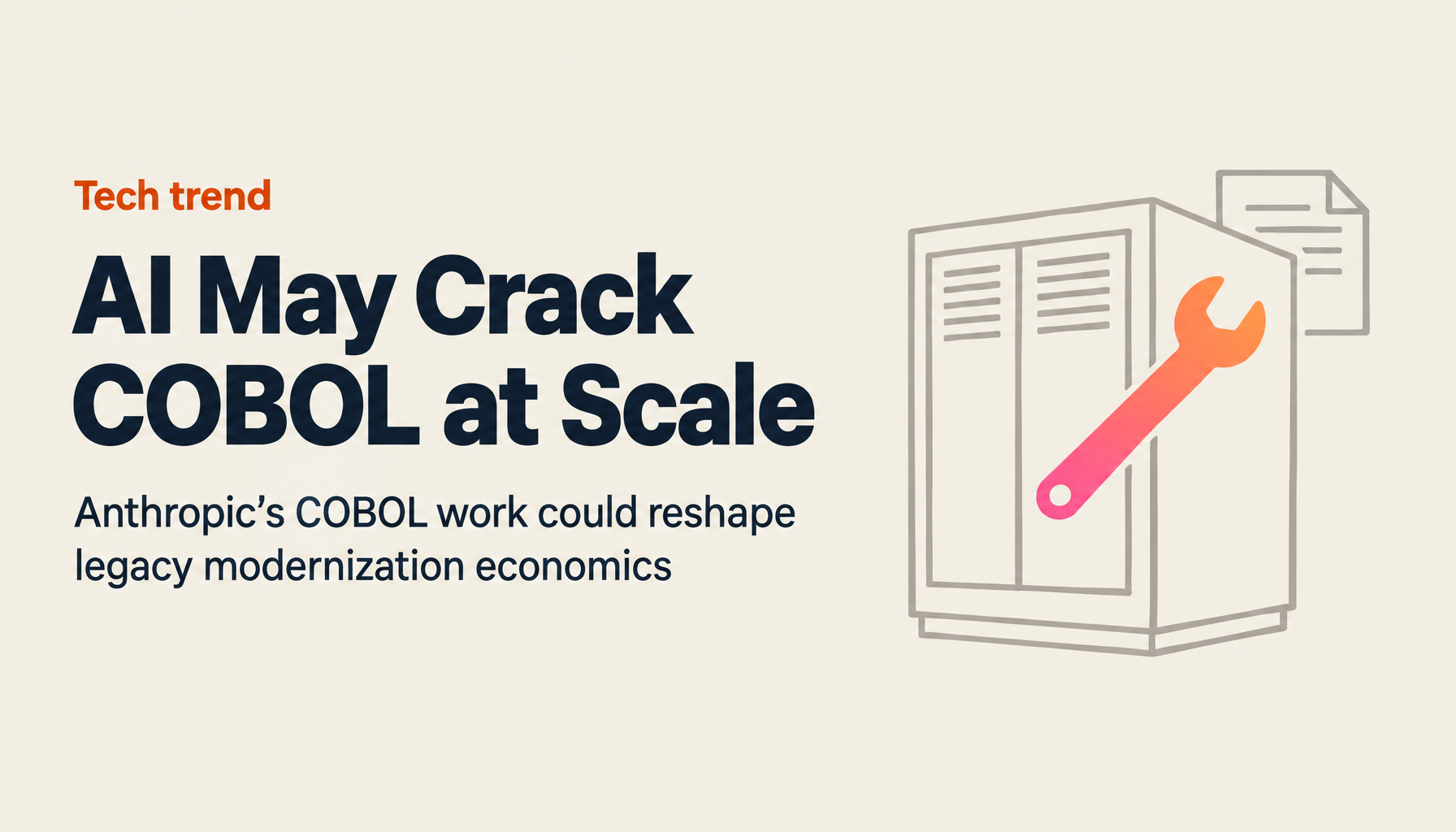
Anthropic's work on COBOL analysis — helping large language models understand, document, and translate COBOL code — represents a meaningful shift in what is technically possible.
The core capability that matters here is not translation per se. It is comprehension. A model that can read COBOL code and accurately explain what it does — in plain language, at the function level, with identification of where business logic is encoded — addresses the knowledge problem that has blocked modernization for years.
With accurate comprehension comes several other capabilities:
- Automated documentation. COBOL systems that lack adequate documentation can have that documentation generated, making the systems more maintainable by modern engineers.
- Risk assessment. Before migration, understanding which parts of a codebase are most complex and most tightly coupled allows organizations to prioritize and sequence migration work appropriately.
- Translation assistance. While full automated translation of complex COBOL remains imperfect, AI-assisted translation of well-understood, modular components is increasingly feasible.
The economic implication is significant. If AI can compress the time and cost required for the comprehension phase of legacy modernization — which is often the largest component of total project cost — the economics of migration projects improve materially.
What This Means for IBM
IBM's mainframe business has been remarkably durable. Despite decades of predictions that the mainframe was dying, IBM continues to generate substantial revenue from mainframe hardware, software, and services — largely because the migration alternative has been too difficult and too risky to execute at scale.
AI-assisted modernization does not immediately threaten this position. IBM is itself investing heavily in AI, including for mainframe-related use cases. And organizations with complex mainframe environments will not migrate quickly regardless of what tools become available.
But the structural logic shifts. If the cost and risk of migration decline meaningfully, the calculus for large organizations changes. The "better the devil you know" logic that has sustained mainframe lock-in begins to erode when the alternative becomes more accessible.
This is a slow-moving shift, measured in years rather than months. But the direction is clear.
The Broader Pattern
The COBOL story is a specific instance of a more general pattern: AI is reducing the cost of tasks that require deep expertise and careful analysis.
Legacy code comprehension has been expensive because it requires experienced engineers who can read arcane code and reason about complex systems. AI does not fully replicate this expertise, but it augments it substantially — meaning that less experienced engineers can do more, and experienced engineers can cover more ground.
The same dynamic applies to other high-expertise domains: legal document review, financial analysis, scientific literature synthesis. In each case, AI reduces the friction of accessing accumulated knowledge and accelerates the pace of analysis.
For incumbents who have built business models around the scarcity of expertise — including IBM's mainframe services business — this is genuinely disruptive. For organizations that have been locked into legacy systems by cost and complexity, it is an opportunity.
The Honest Assessment
AI will not solve the COBOL problem overnight. The most complex legacy systems have accumulated so much customization, so many interdependencies, and so much undocumented business logic that automated tools will struggle with them for years.
But the direction of progress is clear. The tools are improving rapidly. Organizations that have deferred modernization indefinitely because the cost was too high should revisit that assumption. The calculation is changing.
For IBM, the mainframe era is not ending immediately. But the window in which mainframe lock-in can be treated as a permanent feature of the enterprise technology landscape is probably shorter than it once appeared.
TIMEWELL's WARP Consulting
TIMEWELL supports enterprise technology strategy — including AI adoption and legacy modernization planning.


![Claude Code Superpowers Complete Guide: v6's Multi-Harness Development Methodology [2026]](/images/columns/superpowers-claude-code-plugin/cover.png)