Hello, this is Ryuta Hamamoto from TIMEWELL.
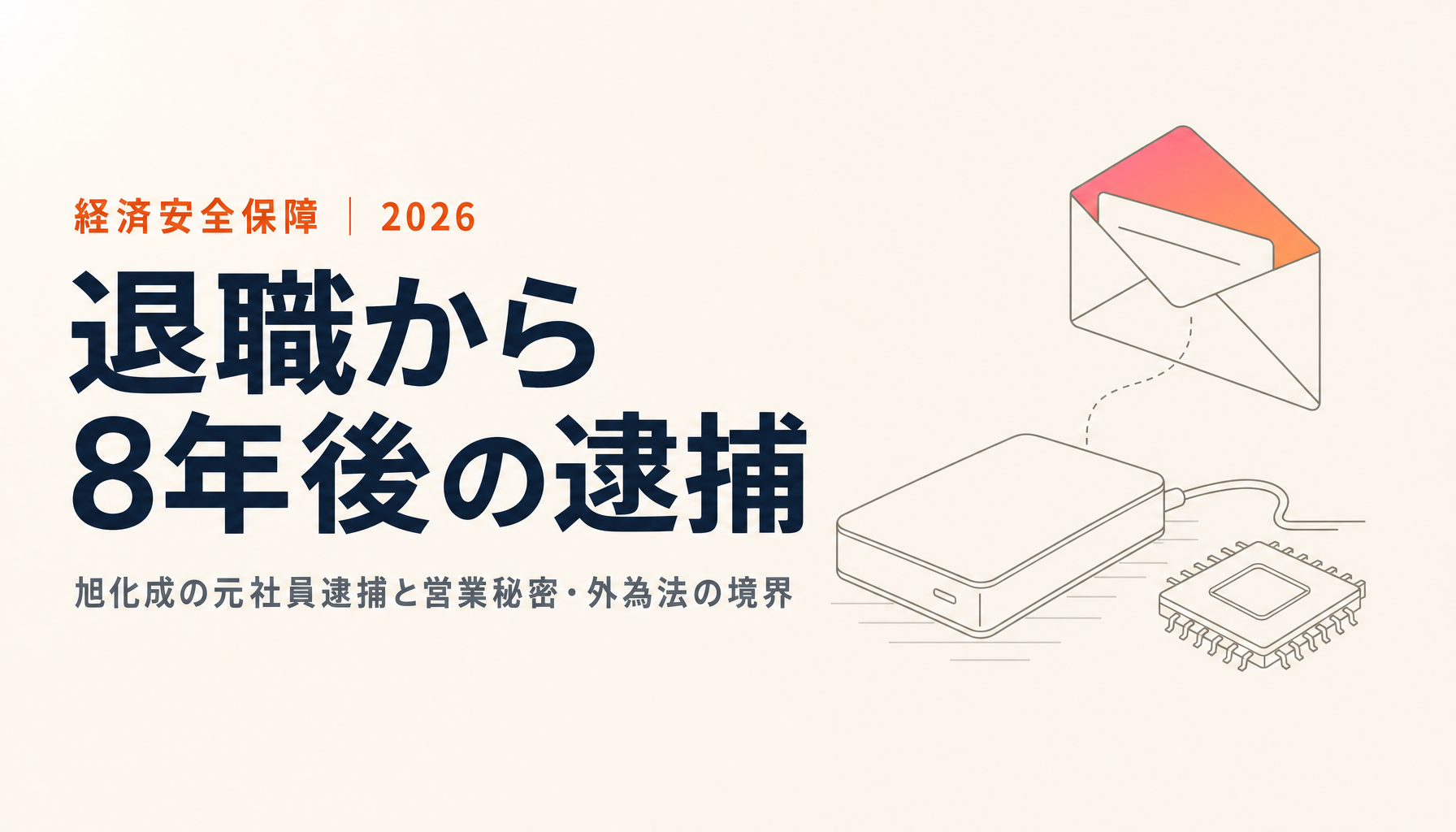
On September 17, 2026, Aichi Prefectural Police arrested a former employee of Asahi Kasei, one of Japan's largest chemical companies, on suspicion of disclosing trade secrets on a latent curing agent used in adhesives for semiconductor manufacturing to a Chinese company12. The same day, Asahi Kasei announced that its own investigation had confirmed the former employee took confidential information obtained during his employment and, after leaving, passed it to Shandong Shengquan New Materials Co., Ltd. in China, and that it intends to sue both the former employee and the company3. He left the company at the end of November 2018. The arrest came eight years later. That gap is, in itself, the story.
If you work in export controls or economic security, the first question is which law was broken. Trade secrets? The technology provision rules under the Foreign Exchange and Foreign Trade Act (FEFTA)? The Economic Security Promotion Act? The only charge reported is the Unfair Competition Prevention Act. FEFTA does not appear. Going back to the statutes to see why tells you which of your own technologies are protected by which law, and which are protected by none. An arrest is an allegation, not a finding. I will keep to "suspected of" and "according to reports" throughout, and I will separate the facts from my own reading.
What happened, as far as Asahi Kasei's statement and the press tell us
Start with the party that was harmed. Asahi Kasei's release of September 17 says a former employee was arrested by Aichi police on suspicion of violating the Unfair Competition Prevention Act for "improperly taking confidential information relating to our latent curing agent obtained during employment and leaking it to a third-party Chinese company." It states that the leaked information did not include technical documents entrusted by customers or personal data, that the company's investigation identified Shandong Shengquan New Materials as the recipient, that it plans civil litigation against the former employee and that company to stop use of the information and have it destroyed, and that it will keep checking whether the information is being misused. The recurrence prevention measures listed are a stronger group-wide technology leakage prevention structure, clearer identification and classification of confidential information, stricter management through new IT tools, a review of access rights, tighter rules for departing employees including written undertakings and control of company-issued PCs, and training for all officers and employees3.
The press fills in the rest. The arrested man is 66, lives in Fuji City in Shizuoka Prefecture, served as head of a manufacturing technology department among other posts, and left the company at the end of November 201812. The Yomiuri Shimbun describes him as having led development of semiconductor and other electronic materials4. The reported allegation is that around November 30, 2018 he failed to return a storage device containing trade secret data on the manufacture of the latent curing agent Novacure, and that around September 13, 2024 he emailed the data to a person at another company24. Police have not disclosed whether he admits the allegations25.
How the case surfaced is the most interesting part. According to the Chunichi Shimbun and the Yomiuri, a Nagoya company where he worked after leaving Asahi Kasei consulted the police in August 2024 about a separate suspected information leak involving him. In that investigation, police searched his home, and analysis of a seized computer showed that he had taken Asahi Kasei's confidential information24. Tokai TV reports that police are also looking into other possible offenses6. In other words, the Asahi Kasei information was found not through Asahi Kasei's own report, but as a chain reaction from another company's consultation.
On the technology, Asahi Kasei's release says only "latent curing agent." The product name Novacure comes from the press. According to the company's product page, Novacure is a microcapsule-type latent curing agent for epoxy resins, a curing agent and accelerator for one-part adhesives that delivers storage stability and curing performance at the same time. It is used in camera modules, advanced semiconductor packaging, and automotive electronic materials7. This is not chip design or fab equipment. It is a material used in the packaging step.
Two notes on how I am writing this. First, the former employee. The arrest is at the suspicion stage and his response has not been made public, so I do not name him and I keep to "suspected of." Second, the company named as the recipient. Shandong Shengquan is the name Asahi Kasei published as the result of its own investigation. It is not a judicial finding, and I have not been able to confirm any comment from that company at the time of writing. As for Asahi Kasei, it is the Japanese company on the receiving end of the harm, and I report its statement as it stands. If you want to know first where your own technical information sits under FEFTA, the export compliance self-check is a quick way in, and the rest of this article will read as your own problem rather than someone else's.
Replace siloed classification work with AI.
METI's FY2024 data shows 52% of foreign exchange law violations stem from classification errors. Download the TRAFEED product catalog covering features and rollout.
Why an arrest? Where Article 21 of the Unfair Competition Prevention Act comes in
The Unfair Competition Prevention Act defines a trade secret in Article 2(6) as "technical or business information useful for business activities, such as manufacturing or marketing methods, that is kept secret and is not publicly known"8. In practice these are the three requirements: secrecy management, usefulness, and non-public status. Of the three, the one fought over in court is almost always secrecy management. Did the company manage the information in a way that made it clear to employees that it was secret? Put the other way, however advanced the technology, if anyone in the company could see it, it is not a trade secret. I covered this in Japan's Unfair Competition Prevention Act and trade secret protection in practice.
Criminal penalties are in Article 21. The relevant part for this case is paragraph 2. A person who was shown a trade secret by its holder, meaning someone who legitimately had access as an employee, and who, for the purpose of wrongful gain or of causing damage to the holder, breaches the duty to manage that secret by "misappropriating" it (item 1), or uses or discloses a misappropriated secret (item 2), faces imprisonment of up to ten years, a fine of up to 20 million yen, or both. The statute lists three ways of misappropriating: embezzling the storage medium, making a copy, or failing to delete a record that should have been deleted while pretending it was deleted8.
Now map the reported allegation onto that text. Failing to return a storage device containing trade secret data around November 30, 2018 is conduct that could fall under misappropriation by "embezzling the trade secret storage medium." Emailing the data to a person at another company around September 13, 2024 is conduct that could fall under "disclosure" of a misappropriated secret. The reason every outlet reports the charge as "disclosure of trade secrets" is, as I read it, that the allegation is built on the item 2 disclosure12.
What I keep looking at is the dates. The alleged misappropriation was November 2018 and the arrest was September 2026, seven years and ten months apart. Because the offense under Article 21(2) carries a maximum of ten years, the limitation period under the Code of Criminal Procedure is seven years. Taken on its own, the misappropriation would already be time-barred at the time of the arrest. The alleged disclosure, on the other hand, was September 2024, with plenty of time left. How the police actually built the case has not been published, so this is only my reading. But the structure is exactly what the statute says: no matter how many years have passed since something was taken at departure, a new offense is committed the moment it is handed to someone. Time is not a pardon, for the person who took it or for the person who receives it.
Leaks abroad carry a heavier bracket. Article 21(5) sets imprisonment of up to ten years or a fine of up to 30 million yen for, among other things, disclosing a trade secret while knowing that the recipient intends to use it outside Japan. Where a corporation is involved, Article 22 sets fines of up to 500 million yen for domestic cases and up to 1 billion yen for overseas cases8. Whether the paragraph 5 overseas aggravation will be applied here is not clear from the reports. Given that Asahi Kasei has publicly identified the recipient as a Chinese company, I would expect it to be examined as a matter of course.
One point on the civil side. The 2023 amendment (Act No. 51 of 2023, in force April 1, 2024) made explicit that when a Japanese company's trade secret is infringed outside Japan, the company can sue in a Japanese court and Japanese law applies9. Asahi Kasei plans to sue the former employee and Shandong Shengquan, but it has not said in which court or under which law. What matters for readers is simply that a route exists, at least on paper, to seek an injunction and destruction in Japan against a company overseas.
Why neither FEFTA nor the Economic Security Promotion Act appears
Anyone in export controls will ask: if technical information went to a Chinese company, why is this not a FEFTA case? This is the most misunderstood point in the whole affair, so let me go through the statutes.
FEFTA Article 25(1) requires a license from the Minister of Economy, Trade and Industry for transactions that provide, in a foreign country or to a non-resident, technology relating to the design, manufacture, or use of goods designated by cabinet order as liable to impede the maintenance of international peace and security, the "specified technology"10. These are the list-controlled technologies. Providing them without a license carries, under Article 69-7, imprisonment of up to seven years or a fine of up to 20 million yen, rising to ten years or 30 million yen for technology related to nuclear and similar weapons, with corporate fines of up to 1 billion yen10. On the numbers alone, this is the same tier as the Unfair Competition Prevention Act.
The difference is what each law protects. FEFTA protects international peace and security, and whether something is controlled depends on the type of technology. Secrecy is irrelevant; even the content of a published paper needs a license if it is listed technology. The Unfair Competition Prevention Act protects a company's secrets, and whether something is covered depends on how it is managed. The type of technology is irrelevant; even technology on no list at all carries criminal penalties if it is kept as a secret. So technical information falls into four boxes: covered by both laws, covered by only one, or covered by neither.
That is why no FEFTA violation has been reported in this case. Whether the latent curing agent technology falls under list controls has not been disclosed. If it does not, FEFTA has no role. If it does, an unlicensed technology transaction could be investigated separately. We do not know which, but the practical point is elsewhere. A technology that is not on the control list can still lead to an arrest if it is managed as a secret. "We classified it as not controlled, so it was fine to send it abroad" is a correct statement about FEFTA and says nothing whatsoever about the Unfair Competition Prevention Act.
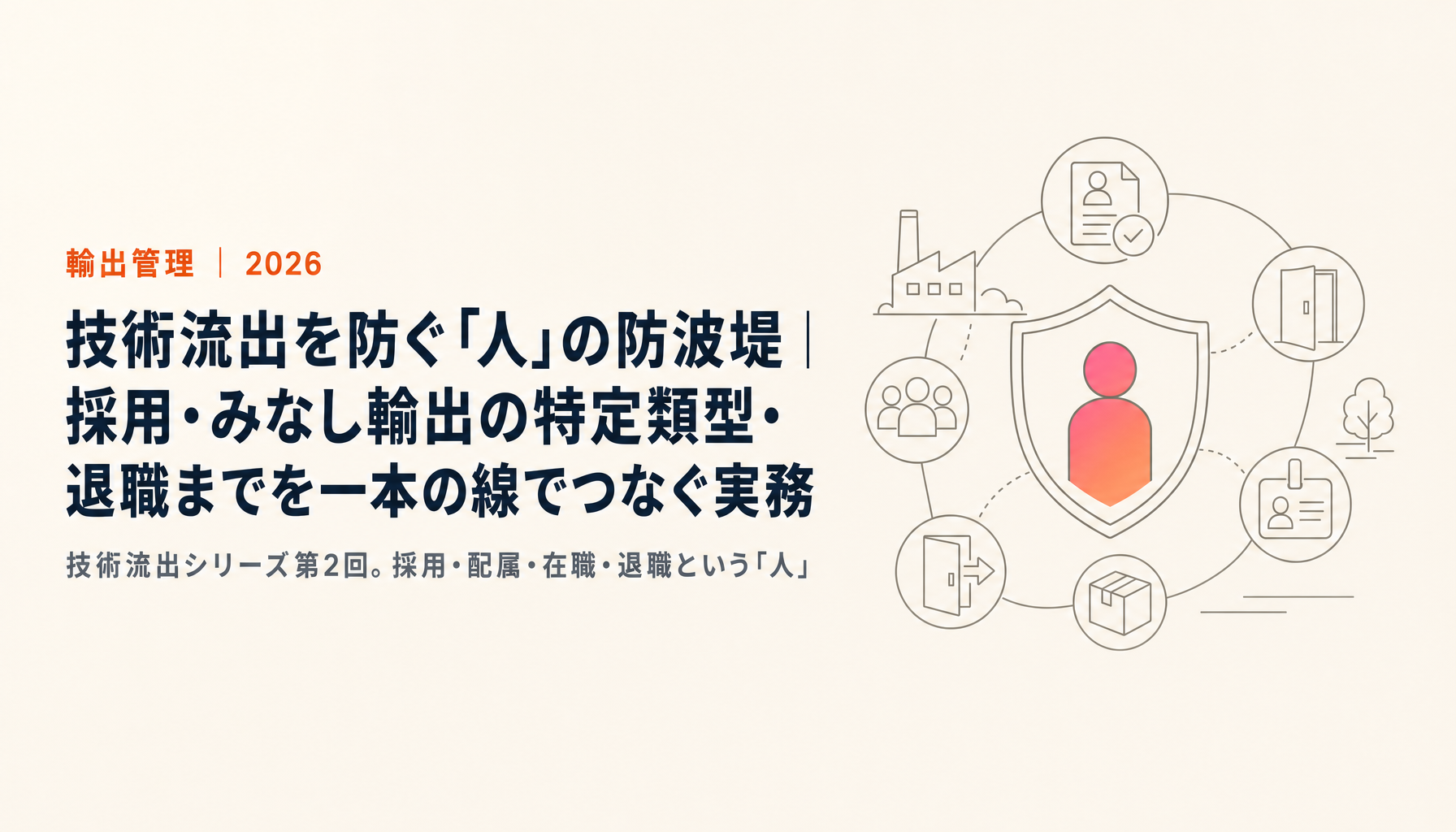
A word on the "deemed export" specified categories clarified in May 2022. These treat the provision of technology to certain residents of Japan who are under the strong influence of a foreign government or foreign entity as an export, and they apply to current employees and joint researchers11. When a person who has already left sends technology by email to a company abroad, as alleged here, that is not a deemed export. If the technology were specified technology, it would be an ordinary provision to a non-resident under Article 25(1). Checking specified categories is an entry-side matter; departure-side leakage is an exit-side matter. I wrote about connecting the two into a single line in The human breakwater against technology leakage.
What about the Economic Security Promotion Act? It has four pillars: supply chain resilience, security of critical infrastructure, support for advanced critical technologies, and non-disclosure of certain patent applications, and an amending act passed in June 202612. None of them is a framework for protecting an individual company's trade secrets through criminal law. The Act on the Protection and Utilization of Critical Economic Security Information, the security clearance system in force since May 2025, governs the vetting of people who handle information designated by the government. Technology a company developed on its own is outside its scope13.
Line them up and the picture is clear. Even now, with "economic security" on every agenda, the main tool for protecting private-sector technical information through criminal law is still the Unfair Competition Prevention Act. The Economic Security Promotion Act protects national supply chains and critical infrastructure. FEFTA protects international peace and security. The law that protects your own technology works only if you manage that technology as a secret. Get this wrong and you will get your priorities wrong.
Where this case sits: the crossroads of leakage through people
The National Police Agency classifies technology leakage into three patterns: through cyberattacks, through espionage, and through legitimate economic and academic activities such as joint ventures and joint research14. This case is the oldest route of all: a person carries out a storage device, and a person sends an email.
The numbers show this route is growing. Statistics the NPA published in March 2026 put trade secret infringement cases cleared in 2025 at 38, up 16 from 22 the previous year, a 72.7 percent increase. Over ten years, the level has stepped up from 18 cases in each of 2016 through 2018, to 29 in 2022, to 38 in 2025. Consultations received stayed high at 74. The NPA writes that "many cases involve taking trade secret information at the time of changing jobs or going independent"15. One of the cleared cases in the same report involves former employees of a precision mold maker who, in March 2023, sent mold drawing data from a company-issued PC to their own email addresses to make copies and then emailed it to a corporation located in China; three people were arrested in October 202515. The shape is close to this one.
Past judgments give a sense of the sentencing range. In March 2015, the Tokyo District Court sentenced a former engineer at a partner company to five years in prison and a fine of 3 million yen for copying NAND flash memory research data onto storage media at Toshiba's Yokkaichi plant and providing it to the Korean company he moved to16. Toshiba sued the Korean company in parallel and settled in December 2014 for a payment of 278 million dollars1718. In August 2021, the Osaka District Court sentenced a former Sekisui Chemical employee to two years in prison suspended for four years and a fine of 1 million yen for emailing information on conductive microparticles used in smartphone touch panels to a person at a Chinese telecommunications parts maker; the contact reportedly began through LinkedIn19. In February 2025, the Tokyo District Court sentenced a former senior researcher of Chinese nationality at the National Institute of Advanced Industrial Science and Technology to two years and six months suspended for four years and a fine of 2 million yen for emailing research data on fluorine compound synthesis to a Chinese company20.
What the three have in common is the simplicity of the means, a storage device or an email, and the fact that the person had legitimate access while employed. Investment in stopping cyberattacks and investment in closing this route are two different things. I have written elsewhere about whether these sentences are too light, in Is six or seven years enough for stealing a process recipe?, so I will not repeat it here.
Government is starting to aim at this route too. METI revised its Trade Secret Management Guidelines in March 202521 and published the second edition of its Technology Leakage Countermeasures Guidance in April 202622. The NPA refreshed its technology leakage prevention pamphlet and video in January 2026 and continues its outreach program, in which prefectural police visit companies and universities to explain methods and countermeasures14. This case also shows one more thing: the victim does not always find out on its own. Asahi Kasei's information came to light because another company went to the police. Consultation numbers stay high partly because there is now a track record that going to the police gets an investigation moving.
What to check in your own company today
Now the practical part. Working backward from this case, the checks come down to five.
First, does your secrecy management hold up? Whether you can fight over a trade secret in criminal or civil court depends on whether the information was managed inside the company in a way that made its secret status clear. Classification and labeling, limits on who can access it, and records of that access. METI's Trade Secret Management Guidelines set out the minimum needed to receive protection21, and the handbook on protecting confidential information gives examples of countermeasures and sample contract clauses23. Asahi Kasei put "clearer identification and classification of confidential information and its management" at the top of its recurrence prevention list because that is where everything starts3.
Second, access management for departing employees, secondees, and foreign-national employees. Can you confirm from records that company devices and storage media were collected at departure? Is there a procedure that narrows access rights as soon as notice is given? For people under the influence of a foreign government or foreign entity, is there a routine that checks the deemed-export specified categories before technology is provided? I laid out the specified categories in Deemed exports and the specified categories in five minutes.
Third, detection of removal. Can you trace attachments to outside email, forwarding to personal addresses, and writes to external media in your logs? The NPA's example began with a former employee sending drawings to his own email address15. Detection sounds like an after-the-fact measure, but the knowledge that a detection mechanism exists is itself a deterrent.
Fourth, FEFTA classification and technology transactions. Does your technology fall under list controls? Could it be caught by catch-all controls? What is the regulatory status of the party you are providing it to? This check is a separate axis from trade secret management, and the same technology needs both. To be honest, trade secret management itself is not what TRAFEED does. What TRAFEED does is determine where your technology and goods sit under FEFTA and check the counterparty. Its AI classification accuracy is 95 percent or higher, verified jointly with Okayama University on roughly 30,000 past screening records (our own measurement), and it reflects regulatory updates in each country on the same day. The final classification decision still rests with your export control officer; TRAFEED prepares the decision material and the audit trail. Details are on the TRAFEED product page.
Fifth, decide in advance where to report and consult. Each prefectural police force has a designated trade secret protection officer, and the NPA publishes a consultation address for technology leakage (keizaianpo110@npa.go.jp)1415. When there is a suspicious approach, or when a departing employee is suspected of taking something, who consults whom should already be decided. Remember that this case moved because another company consulted the police. Consulting protects not only your own company but the industry as a whole.
| Check | What to look at | Basis |
|---|---|---|
| Secrecy management | Classification, labeling, access limits, records | UCPA Article 2(6); Trade Secret Management Guidelines |
| People in and out | Device collection at departure, narrowing of rights, specified-category checks | UCPA Article 21; FEFTA Article 25 (deemed exports) |
| Detection of removal | Logs for outside email, personal addresses, external media | Handbook on protecting confidential information |
| Position of the technology | Classification, catch-all, counterparty checks | FEFTA Articles 25 and 48 |
| Where to consult | Prefectural police trade secret protection officer; NPA desk | NPA, "Preventing technology leakage" |
My reading
That is the factual part. Here are three things I take from it.
First, executives should know that something taken at departure can be prosecuted years later as a "disclosure." The reported allegation here is an email sent roughly six years after the device was taken. If your exit control amounts to "get the PC back on the last day," then whatever was not returned that day can start moving years afterward. Record the confirmation of return, and when something has not come back, act on it then. It is unglamorous, and it is what works.
Second, the fact that the case surfaced through another company's consultation is a message for the whole industry. People who take technology do not always stop at one company. When you catch a suspicious sign inside your own organization, lower the internal bar for going to the police. That ends up protecting your customers' and your peers' technology too. My honest impression is that this culture of consulting is still weak in Japanese manufacturing.
Third, the technologies that fall between the Unfair Competition Prevention Act and the control lists are probably the largest group of all. Technology that comes out as not controlled under FEFTA classification vastly outnumbers controlled technology. Most of it is a trade secret if it is managed as a secret, and protected by no law at all if it is not. Sort your technologies by "which law protects this," and the companies that have only ever looked at FEFTA will be surprised at how wide the unprotected area is.
To sum up: the arrest of the former Asahi Kasei employee is being investigated as trade secret infringement under Article 21 of the Unfair Competition Prevention Act, and neither FEFTA nor the Economic Security Promotion Act has been reported as playing a role, at least so far. Trade secrets are decided by how you manage them; FEFTA is decided by what the technology is. Lay your technologies out along both axes, and look at the departure side for people and the entry side for technology provision in the same ledger. That is what you can take back to your desk from this case. If you want to talk through where your technology sits under FEFTA and how to run counterparty checks, book a TRAFEED consultation.
Footnotes
-
Ex-Asahi Kasei employee arrested over suspected leak of semiconductor-related information to a Chinese company (Kyodo News via Tokyo Shimbun, September 17, 2026, in Japanese). Press report ↩ ↩2 ↩3
-
Former employee arrested on suspicion of taking Asahi Kasei semiconductor-related technology; leak to Chinese company confirmed (Chunichi Shimbun, September 17, 2026, in Japanese). Dates in the allegation, the former employee's career, how the case surfaced, and the non-disclosure of his response are from this report. Press report ↩ ↩2 ↩3 ↩4 ↩5 ↩6
-
Regarding the arrest of a former employee (Asahi Kasei Corporation, September 17, 2026, in Japanese). The recipient company's name, the planned civil suit, the absence of customer information, and the recurrence prevention measures are from this release ↩ ↩2 ↩3
-
Asahi Kasei semiconductor-related technology leaked to a Chinese company; former development head arrested (Yomiuri Shimbun Online via Yahoo! News, September 17, 2026, in Japanese). The product name, the type of storage device, and how the case surfaced are from this report. Press report ↩ ↩2 ↩3
-
Trade secrets suspected of being leaked to a Chinese company; former Asahi Kasei employee arrested, police do not disclose his response (Nagoya TV via Yahoo! News, September 17, 2026, in Japanese). Press report ↩
-
Former Asahi Kasei employee arrested; consultation came from the company he later worked for, police also investigating other offenses (Tokai TV via Yahoo! News, September 17, 2026, in Japanese). Press report ↩
-
Novacure (Asahi Kasei semiconductor and high-speed communication materials portal, in Japanese) ↩
-
Unfair Competition Prevention Act (Act No. 47 of 1993, e-Gov, text in force as of September 18, 2026, in Japanese). Articles 2(6), 21(2), 21(5), 21(6), and 22 ↩ ↩2 ↩3
-
Most recent amendment of the Unfair Competition Prevention Act (2023) (METI, in Japanese). Act No. 51 of 2023, in force April 1, 2024 ↩
-
Foreign Exchange and Foreign Trade Act (Act No. 228 of 1949, e-Gov, text in force as of September 18, 2026, in Japanese). Articles 25(1), 48(1), 69-7, and 72 ↩ ↩2
-
Q&A on the clarification of "deemed export" controls (METI, revised August 8, 2023, in Japanese). Overview of the specified categories at Deemed export controls (METI, in Japanese) ↩
-
Economic Security Promotion Act (Cabinet Office, in Japanese) ↩
-
Act on the Protection and Utilization of Critical Economic Security Information (Cabinet Office, in Japanese) ↩
-
Preventing technology leakage (National Police Agency, in Japanese). The three risk patterns, outreach activities, the January 2026 pamphlet, and the consultation email address are from this page ↩ ↩2 ↩3
-
Clearance of economic crimes in 2025 (National Police Agency, Community Safety Bureau, March 2026, in Japanese). Cleared trade secret cases, consultations received, the precision mold maker case, and the trade secret protection officers are from this document ↩ ↩2 ↩3 ↩4
-
Toshiba data leak: former engineer sentenced to five years, Tokyo District Court (Nikkei, March 9, 2015, in Japanese). Press report ↩
-
Filing of a lawsuit against SK Hynix of Korea (Toshiba, March 13, 2014, in Japanese) ↩
-
Toshiba settles with SK Hynix over NAND flash confidential information leak (PC Watch, December 19, 2014, in Japanese). The settlement amount is from this report. Press report ↩
-
Former Sekisui Chemical employee found guilty of leaking information to a Chinese company (Nikkei, August 18, 2021, in Japanese). Press report ↩
-
AIST data leak: former researcher of Chinese nationality found guilty, Tokyo District Court (Nikkei, February 25, 2025, in Japanese). Press report ↩
-
Trade Secret Management Guidelines (METI, revised March 2025, in Japanese). The three requirements are explained at Trade secrets: protecting and using them (METI, in Japanese) ↩ ↩2
-
Technology Leakage Countermeasures Guidance, second edition (METI, April 27, 2026, in Japanese) ↩
-
Handbook on protecting confidential information (METI, revised February 2024, in Japanese) ↩