Hello, this is Hamamoto from TIMEWELL.
At the 13th meeting of the Trade and Commerce Subcommittee of the Industrial Structure Council, held on June 5, 2026, a plan for a new organization called the "Economic Security Center" (provisional name) appeared in the publicly released materials1. The idea is to establish, within fiscal 2026, an independent administrative agency responsible for research and analysis on economic security. At first glance this might look like bureaucratic reshuffling. But I see it as news that is directly relevant to the people working on the front lines of export control.
When the state thickens its analytical capabilities, the flip side is that the level of accountability demanded of companies also rises. And in the second half of the year, several regulatory deadlines are converging that could pull the rug out from under you if you leave them unattended. In this article, I will use the Economic Security Center plan as an entry point and, drawing on primary sources, organize what will be required of corporate export control governance, that is, the internal compliance program (CP), classification (gaihi hantei), and counterparty screening, in the second half of 2026.
What the Economic Security Center Plan Signals
First, let me lay out the facts. Among the materials distributed for the 13th meeting of the Trade and Commerce Subcommittee, released by the Ministry of Economy, Trade and Industry (METI) on June 5, the "Economic Security Center" (provisional name) is referenced in Material 41. The form of establishment is an independent administrative agency, with establishment scheduled for fiscal 2026, and the function envisaged is research and analysis on economic security, in other words, a think-tank function.
Why would the state go out of its way to create a new organization? Behind it lies today's trade environment, in which technology and national security are inseparably intertwined. In fields such as semiconductors, rare earths, and AI, you need a specialized body that continuously analyzes which technologies carry security significance. Hence the move to prepare a new vessel.
What I want to pause and consider here is the implication this plan throws at companies. When the state strengthens its analytical function for economic security, that also means the resolution of policy increases. Which items, which technologies, which counterparties pose risk: that line-drawing will be updated in finer detail and at greater speed than today. If the corporate side cannot keep up with those updates, you may find yourself standing on the wrong side of a regulatory violation without realizing it. When the state strengthens its framework, companies are pressed to upgrade their CP. I take this plan as the starting gun for exactly that.
Why a Stronger National Framework Rebounds on Corporate CP
In the world of export control, there is a concept called "catch-all controls." Even if an item is not on the list (a method of regulating specific items by designating them on a list), if there is a concern that it could be used to develop weapons of mass destruction or conventional weapons, a license is required for export. In other words, memorizing the list is not the end of the story. There is a broad domain in which companies themselves must make judgments, including the end use and the end user. This sits at the heart of what makes export control difficult.
When the national analytical function is strengthened, the difficulty of this "companies must judge for themselves" portion rises. Lists of countries and end users of concern are updated more frequently, and the line-drawing in the gray zone shifts. The Economic Security Center plan I just described is precisely a device for accelerating those updates. Faster updates are something to be grateful for, but for the company on the receiving end, it also means that the information you have to monitor increases and the freshness of your judgments comes under scrutiny.
A symbolic example is the partial amendment to the "Three Principles on the Transfer of Defense Equipment and Technology," decided at the National Security Council and by the Cabinet on April 21, 20262. Previously, the transfer of finished products was limited to five categories: rescue, transportation, warning, surveillance, and minesweeping. This amendment removed the categorical restriction and, on the condition of rigorous review and management, made all finished products transferable, including fighter aircraft, escort vessels, and submarines23. Hearing the word "relaxation," it may sound as if management is loosening, but the reality is the opposite. Because the premise is the condition "by conducting rigorous review and management," the quality of management demanded of individual companies actually rises. When the domain the state moves expands, so does the management responsibility of the companies downstream of it. The past year's developments keep showing this same structure.
To be honest, you cannot keep up with these regulatory updates merely by chasing breaking news. That is exactly why the design of operations itself comes into question: is your CP a system that can reflect the latest regulations? Rather than being satisfied with having written a program, the real issue is whether the program is built as a living system that stays current. That is the main keep of the castle.
I have seen this play out in many organizations. A company drafts a thorough compliance program, gets it approved, files it, and then treats it as finished. Two years later, the list of countries of concern has changed, the U.S. has revised the EAR several times, and the person who originally owned the document has moved to another department. The program is technically still in force, but no one is feeding it. The gap between what the document says and what the regulations now require widens quietly, and it usually surfaces only when something goes wrong, an audit, an inquiry from a counterparty, or a transaction that should have been flagged but was not. The lesson is simple: a program that is not maintained is, in practice, no program at all.
Replace siloed classification work with AI.
METI's FY2024 data shows 52% of foreign exchange law violations stem from classification errors. Download the TRAFEED product catalog covering features and rollout.
The Time-Bound Risk of Regulatory Deadlines Converging in H2 2026
Now to the second half of the year. This is the part I most want to convey in this article. In November 2026, two major regulations reach their deadlines at the same time. Leave them alone, and one day the premise of your transactions will suddenly change. That kind of time-bound risk is built into the calendar.
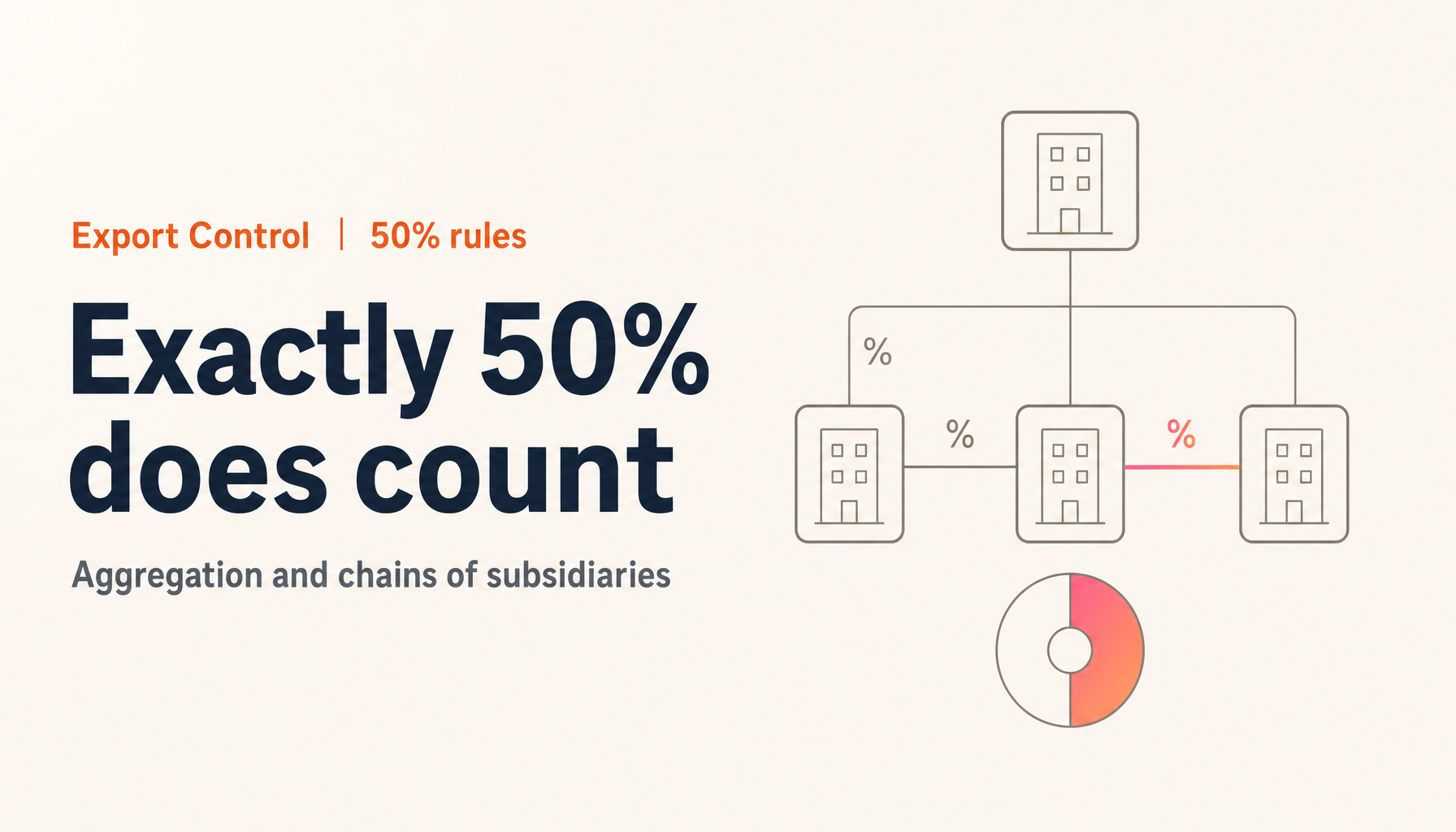
The first is the U.S. Affiliates Rule, the so-called 50% rule. This is a rule under which an affiliate that is owned, directly or indirectly, 50% or more by a company on the Entity List (the U.S. list of parties whose transactions are restricted) automatically becomes subject to the same restrictions. Although it was introduced as an interim final rule on September 30, 2025, in response to the U.S.-China trade agreement it was suspended for one year, from November 10, 2025, to November 9, 20264. What matters is what comes next: the suspension is structured in two stages, and absent a further extension, the suspended content returns to the EAR from November 10, 2026, reviving the license requirements4. The US and China have announced an extension to January 10, 2027, but BIS had not published the extension as of October 3 (see our BIS 50% rule guide). In other words, even if you can currently transact without worrying about the 50% rule, the situation may change completely once the stay ends, so it is worth preparing for either date. CISTEC's Q&A collection on EAR reexport controls, in its Rev.8 revision of February 2026, also reflects that this 50% rule is suspended until November 9, 20265.
The second is China's rare earth export controls. In the autumn 2025 agreement, the United States and China settled on suspending each other's export control measures for one year, and that suspension period extends into November 20266. At the same time, China strengthened export controls on dual-use items destined for Japan in January 2026, and in February added 20 Japanese companies and organizations to its export prohibition list, and another 20 companies and organizations to its watch list7. The reality is that for rare earths, including dysprosium and terbium, which are indispensable for permanent magnets, Japan depends on China for nearly the entire supply, and there have been reports of an 80% drop in rare earth exports to Japan8. Behind the word "suspension," individual regulation aimed at Japan is advancing in another form. These two cross in the same month: November.
Will your counterparties be affected by the reintroduction of the 50% rule? Where is there room to substitute in your rare earth procurement? Before you head into the second half, I strongly recommend taking inventory of your classification and CP self-check at least once. TRAFEED accepts individual consultations on classification and counterparty screening. If you have items or counterparties you are unsure about, sorting them out early will help you avoid the November turmoil.
The U.S.-China agreement is a product of diplomacy, so whether it will be extended or reintroduced as scheduled carries the uncertainty of depending on the negotiations of the moment. That is precisely why I think it is realistic for companies to prepare on the premise that the rule will be reintroduced. If the suspension continues, lucky you; if it does not, you are prepared as planned. Either way, the side that comes out ahead is the side that prepared.
A CP Inventory Checklist and a Regulatory Deadline Calendar
I do not want to end on abstractions, so let me present concrete inspection items. First, an inventory checklist for your internal compliance program (CP). Before you head into the second half, check whether your operations can answer the following questions.
- Do you record the basis for classification (specification documents, regulatory provisions, date of determination) in a form that a third party can trace afterward?
- Do you record "when, by whom, and against which list" counterparty screening was performed, and is it operated so that screening is re-run periodically?
- Does your program describe a procedure for tracing counterparties back to their parent companies and shareholder structures, that is, to their ownership ratios?
- Do you have a process to identify in advance the counterparties that will be affected, ahead of the reintroduction of the 50% rule (the stay runs through November 9, 2026 on the Federal Register; a US–China extension to January 10, 2027 has been announced)?
- Is it documented who reflects updates to regulatory lists and the official gazette into the CP, and at what frequency?
- Have you clarified who holds final responsibility for classification and transaction review, and is the escalation path determined?
The crux of this list is the first three items. If no records remain, you cannot later explain "why you made that determination." In export control, whether you pass an audit hinges less on the judgment itself than on whether you can preserve the basis for the judgment. From what I have seen on the front lines, what trips people up is not difficult technical judgments but the places where the operation of this recordkeeping has become a mere formality.
Next, let me lay out the regulatory deadlines to keep in mind for the second half.
| Timing | Event | Action required of companies |
|---|---|---|
| February 19, 2026 | CISTEC EAR Reexport Controls Q&A Rev.8 published5 | Reflect the premise of the 50% rule suspension in internal materials |
| April 21, 2026 | Partial amendment to the Three Principles on the Transfer of Defense Equipment and Technology2 | Inspect the review and management framework for finished-product transfers |
| Within fiscal 2026 | Economic Security Center (provisional name) scheduled for establishment1 | Build CP operations anticipating faster policy updates |
| November 9, 2026 | Deadline of the U.S. Affiliates Rule suspension on the Federal Register (a US–China extension to January 10, 2027 has been announced; check whether BIS publishes it)4 | Identify in advance the counterparties subject to reintroduction |
| November 10, 2026 | Affiliates Rule applies again unless extended / arrival of the China rare earth suspension deadline46 | Re-determine transaction eligibility, confirm procurement alternatives |
Looking at this table, it is clear that November is a peak. Conversely, if you advance your preparations over the summer, you can avoid panic. Risks with visible deadlines are easier to deal with precisely because they are visible. The hardest risks are the ones that arrive without warning; here, you have the date in advance, which is a genuine advantage if you use it.
How to Run Classification and Counterparty Screening
Finally, let me talk about how to actually run the practice. Many of you reading this far have probably felt that "there is too much to do." Indeed, regulations keep increasing, updates keep accelerating, and the counterparties you must verify only keep growing. Chasing all of it by hand alone is becoming unrealistic.
If you break down the task of classification, at its core is a structured process of matching technical specifications against regulatory lists. Does a product's performance value exceed the regulatory threshold? Does it fall under a specific technical category? In the sense of matching, this is an area well suited to AI agents. Counterparty screening is the same: comparing counterparty names against lists and tracing ownership relationships is faster, and reduces omissions, when a machine does the preliminary research and a human verifies, rather than a person investigating one case at a time. Of course, the final judgment should be carried by a human. But the hours spent investigating themselves can be greatly compressed.
Let me say a little here about our own service. TRAFEED (see TRAFEED product catalog (PDF)), provided by TIMEWELL, is an AI agent specialized in export control. It supports classification in a form compliant with the standards of the Ministry of Economy, Trade and Industry (METI), and performs counterparty screening in multiple languages. As with the reintroduction of the 50% rule I touched on earlier, when regulations move frequently, the work of re-investigating while reflecting the latest premises arises again and again. Re-checking every single case by hand each time is exhausting. Leave the preliminary investigation and recordkeeping to the agent, and have people concentrate on judgment and accountability. I believe this is the realistic division of labor for the second half of 2026 and beyond.
If you feel uneasy about the very approach to classification, the shortcut is to start by getting the basics down. I have organized the steps of determination and how to handle non-applicability certificates in How to Write a Non-Applicability Certificate (Parameter Sheet) Guide. I have compiled concrete preparations for the reintroduction of the 50% rule in Was the BIS 50% Rule Delayed? What Can Happen Between November 9 and January 10. Read them together and you should be able to grasp the overall picture of preparing for the second half.
What to Do Now, Heading into the Second Half
On its own, the Economic Security Center plan looks like a story about a government organization. But lay it alongside the trend of the state thickening its analytical framework, the regulatory amendment to defense equipment transfers, and the Affiliates Rule and China rare earth deadlines converging in November, and a single line emerges. Export control is no longer a job tucked away in the corner of a specialized department. It has become a theme to confront across the entire company, as a matter of management and as a matter of accountability.
The few months of summer are a precious preparation period for the turmoil of the second half. If you translate today's discussion into action starting tomorrow, the priorities, I think, are as follows. First, identify the counterparties likely to be affected by the reintroduction of the 50% rule. Next, inspect whether your classification records can be traced afterward. And decide who reflects regulatory updates into the CP, and at what frequency. There is no need to aim for perfection. Get yourself into a state where you can explain things before November. That alone will considerably reduce the unease underfoot.
Regulations will keep moving. On the premise that they keep moving, how do you build a framework that is resilient to re-investigation? To that question, please consider, at least once, the answer of a division of labor between humans and AI.
Footnotes
Footnotes
-
13th Industrial Structure Council, Trade and Commerce Subcommittee, Distributed Materials — Ministry of Economy, Trade and Industry — June 5, 2026 — https://www.meti.go.jp/shingikai/sankoshin/tsusho_boeki/013.html ↩ ↩2 ↩3
-
On the Partial Amendment to the "Three Principles on the Transfer of Defense Equipment and Technology" — Ministry of Economy, Trade and Industry — April 21, 2026 — https://www.meti.go.jp/press/2026/04/20260421003/20260421003.html ↩ ↩2 ↩3
-
On the Partial Amendment to the "Three Principles on the Transfer of Defense Equipment and Technology" — Ministry of Defense / Japan Self-Defense Forces — April 21, 2026 — https://www.mod.go.jp/j/press/news/2026/04/21a.html ↩
-
One Year Suspension of Expansion of End-User Controls for Affiliates of Certain Listed Entities — Federal Register (U.S. BIS) — November 12, 2025 — https://www.federalregister.gov/documents/2025/11/12/2025-19846/one-year-suspension-of-expansion-of-end-user-controls-for-affiliates-of-certain-listed-entities ↩ ↩2 ↩3 ↩4
-
Q&A Collection on EAR Reexport Controls Rev.8 — Center for Information on Security Trade Control (CISTEC) — February 19, 2026 — https://www.cistec.or.jp/service/uschina/12-ear_qa.pdf ↩ ↩2
-
BIS Suspends Affiliates Rule for One Year as Part of the US-China Trade Deal — Skadden, Arps, Slate, Meagher & Flom LLP — November 2025 — https://www.skadden.com/insights/publications/2025/11/bis-suspends-affiliates-rule-for-one-year-as-part-of-the-us-china-trade-deal ↩ ↩2
-
China Names Japanese Companies in Export Ban: The Full Picture of Rare Earth Controls — Research by nicoxz — February 25, 2026 — https://research.nicoxz.com/articles/china-dual-use-export-ban-rare-earth-japan ↩
-
China's Rare Earth Exports to Japan Drop 80%; Japanese Firms Rush to Substitute via Australia, India, and Recycling — Nikkei — June 2026 — https://www.nikkei.com/article/DGXZQOGM023CA0S6A600C2000000/ ↩